
Ask an AI model for a competitor’s strengths, weaknesses, opportunities and threats, and four tidy boxes appear in seconds. Hand those boxes to your sales team, and nobody quotes them in a deal. A rep can’t tell a buyer “they are weak on security” without knowing who saw it, where and when.
So the boxes are the easy part. What makes a SWOT useful is a source behind every point, and for most points the best source is the competitor’s own sales call: what its rep showed, quoted and dodged when a buyer asked.
Mystery Demo gets you that source. It books your competitors’ sales demos as a genuine buyer, asks the questions your SWOT needs answered, records every call and email, and hands back a board where each finding carries the minute it was said.
Here is what a finished competitor SWOT looks like when every point has a source. The competitor on it is invented, and so is every line and every minute.
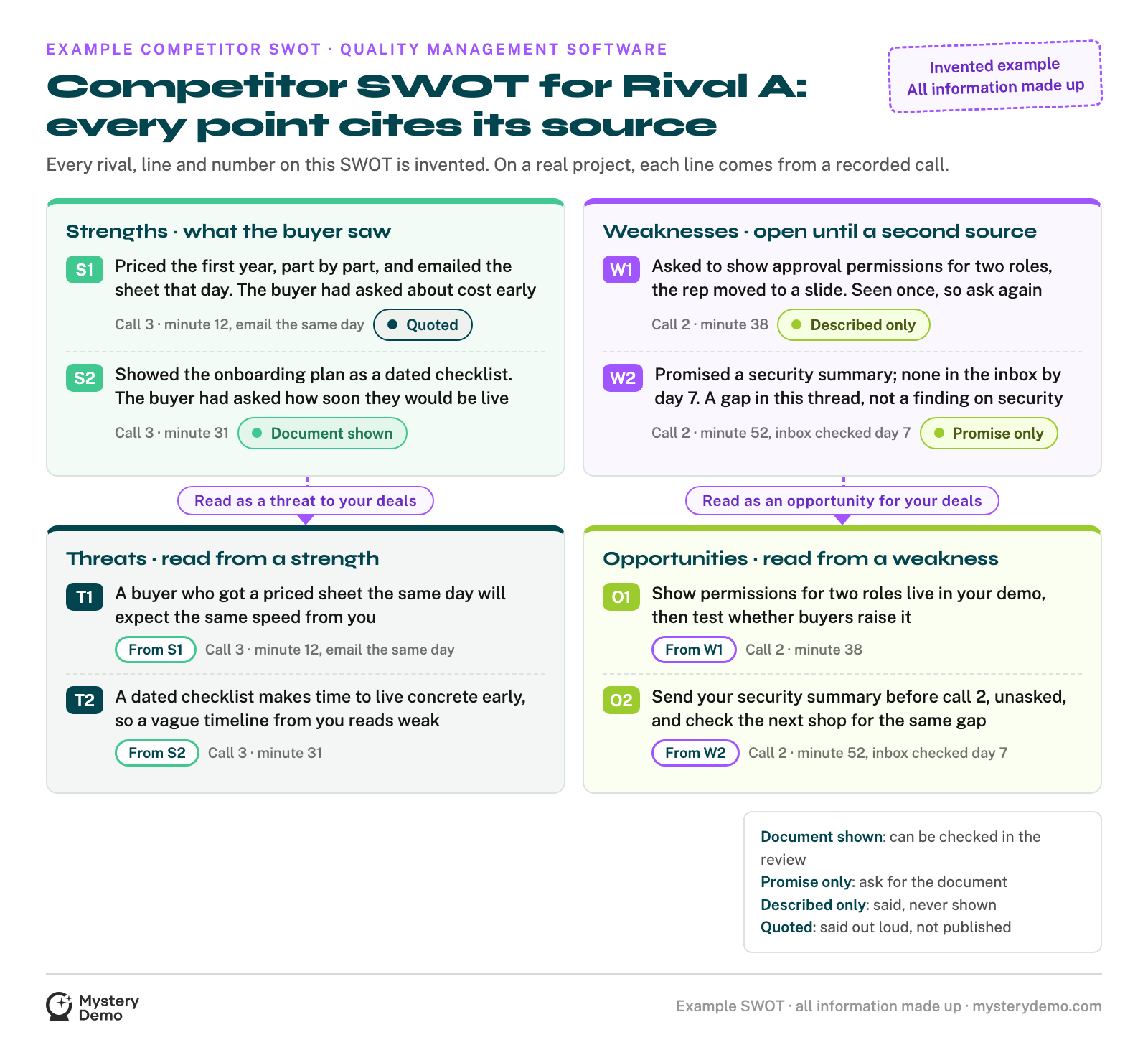
The top two boxes hold what a buyer saw on the competitor’s calls. The bottom two say what that means for your deals, and each one names the point above it that it came from.
You can build one in six steps. Five you can run yourself, and the fourth is the one we do for you:
Why Sales Teams Ignore Most Competitor SWOTs
Most SWOT templates fill the boxes from public pages. Product Marketing Alliance’s template is a typical one: its first step is to gather customer feedback, industry reports, competitor websites and market research, and its second is to list what your company does better than its competitors.
That fills four boxes. It doesn’t ask who saw each point, or whether a point is something the competitor did or something you guessed from it.
A seller who reads “weak onboarding” in a box has three questions before they can use it in a deal:
A point that can’t answer those is a guess, however neat its box. The fix starts before anything goes in a box.
Step 1: Write the SWOT From Your Sales Team’s Point of View
The textbook SWOT is a company looking at itself: its own strengths and weaknesses inside, and opportunities and threats out in the market. A competitor SWOT borrows the four boxes, and most templates never say what changes when the subject is somebody else.
Say at the top whose view it is. For a sales team, the SWOT is written from your side, about one competitor, for one kind of buyer you name.
The competitor’s strengths and weaknesses are what a buyer met in its sales process: the product as its rep showed it, the price as it was quoted, the follow-up as it arrived. The opportunities and threats are what those mean for your deals, and each one names the strength or weakness it came from.
| Box | In the textbook SWOT | In a SWOT for your sales team |
|---|---|---|
| Strengths | What your company does well | What the competitor showed, quoted or did that met what the buyer asked for |
| Weaknesses | Where your company falls short | Where the competitor’s answer fell short, open until a second source agrees |
| Threats | Dangers out in the market | What one of the competitor’s strengths means for your deals |
| Opportunities | Openings out in the market | What your team can do in its deals because of a weakness |
Whether something is a strength depends on what the buyer asked for. A rep who sends a dated onboarding plan is strong with a buyer who asked how soon they would be live, and the same plan does little for a buyer who only asked about price.
The competitor’s funding, headcount and market share still matter. They come from published reports, and they get labeled with the report they came from.
Step 2: Note Where Every Point Came From
Before a point goes in a box, write down the same seven things about it. It is the same habit as giving every battlecard line a source, with room added for what the point means:
Take W1 from the example at the top. Asked to show how approval permissions work for two roles, the competitor’s rep moved to a slide instead of the product (call 2, minute 38).
That one line already fills four of the seven: what happened, the source (call 2, minute 38), the scope (one buyer, one call) and the confidence (seen once). The harder question is where a line like that comes from at all.
Step 3: Start With What You Can Find Online
A good share of your SWOT can be filled from public sources, and it should be, before anyone books a call. Each one gives you something real, and each one stops somewhere:
| Public source | What it gives your SWOT | How to label it | Where it stops |
|---|---|---|---|
| Three-star reviews | What customers quietly complain about, in their own words | Customer review, with its date | It is a customer’s view, not what a rep does for a new buyer |
| The pricing page | The plans, the seat limits, and which plans say to talk to sales | Published, with the date you read it | The price a rep quotes, and what moves it |
| The features page and help docs | What the competitor says the product does | Published claim | Whether a rep shows it working when a buyer asks |
| Job posts | Where the competitor is hiring, and for which roles | Hint, with the post’s date | What the new team says to buyers |
| Filings and analyst reports | Funding, headcount, and the market as an analyst sees it | Reported, with the report named | Anything the report does not cover |
Mark the competitor’s roadmap, finances and churn as unknown, unless a named report covers them. Then label them Reported, with the report beside them.
Be careful with website traffic tools. A competitor that wins its deals through sales relationships can barely show up in them, so a SWOT built on traffic can rank it wrong.
Now go back to W1. The competitor’s features page lists role-based permissions, and its help docs describe them.
Neither one tells you what its rep does when a buyer asks to see permissions working for two roles, because that only happens on a call. If the rep moves to a slide, you have a reason for a follow-up question, or for showing your own version live. You don’t have proof the feature is missing.
So the point a seller would use in a deal is the one no web page shows. Someone has to be the buyer on that call.
Step 4: See How the Competitor Sells to a Buyer
Mystery Demo does this step for you. Many of our partners bring us in for exactly this kind of work, to understand their competitors far better than online research allows. We request each competitor’s demo the way a serious prospect would, answer its qualifying questions, ask our own, and record every call and email.
The evaluation is real, because we are evaluating software on your behalf. The only thing the competitor never learns is who asked us to look.
Your own team could request the demo too. The competitor’s rep would look up your email domain before the first call, and you would get the tour a competitor gets.
Choose the competitors your deals meet. Buyers decide early who they will compare: in 6sense’s 2025 Buyer Experience Study, about four of the five vendors a buyer evaluated were on the shortlist from day one. So start with the two or three names your reps already hear in deals.
Use one buyer for all of them. Before any call is booked, we write the buying scenario: who the buyer is, why they need software, what they are solving and by when. The details fit each competitor’s usual customer, while the buyer’s needs stay the same everywhere, so one rep’s answer can be set beside another’s.
Below is the Fábula page from our public example board, where the client and every company are invented. A real project’s board is built from that client’s own calls.
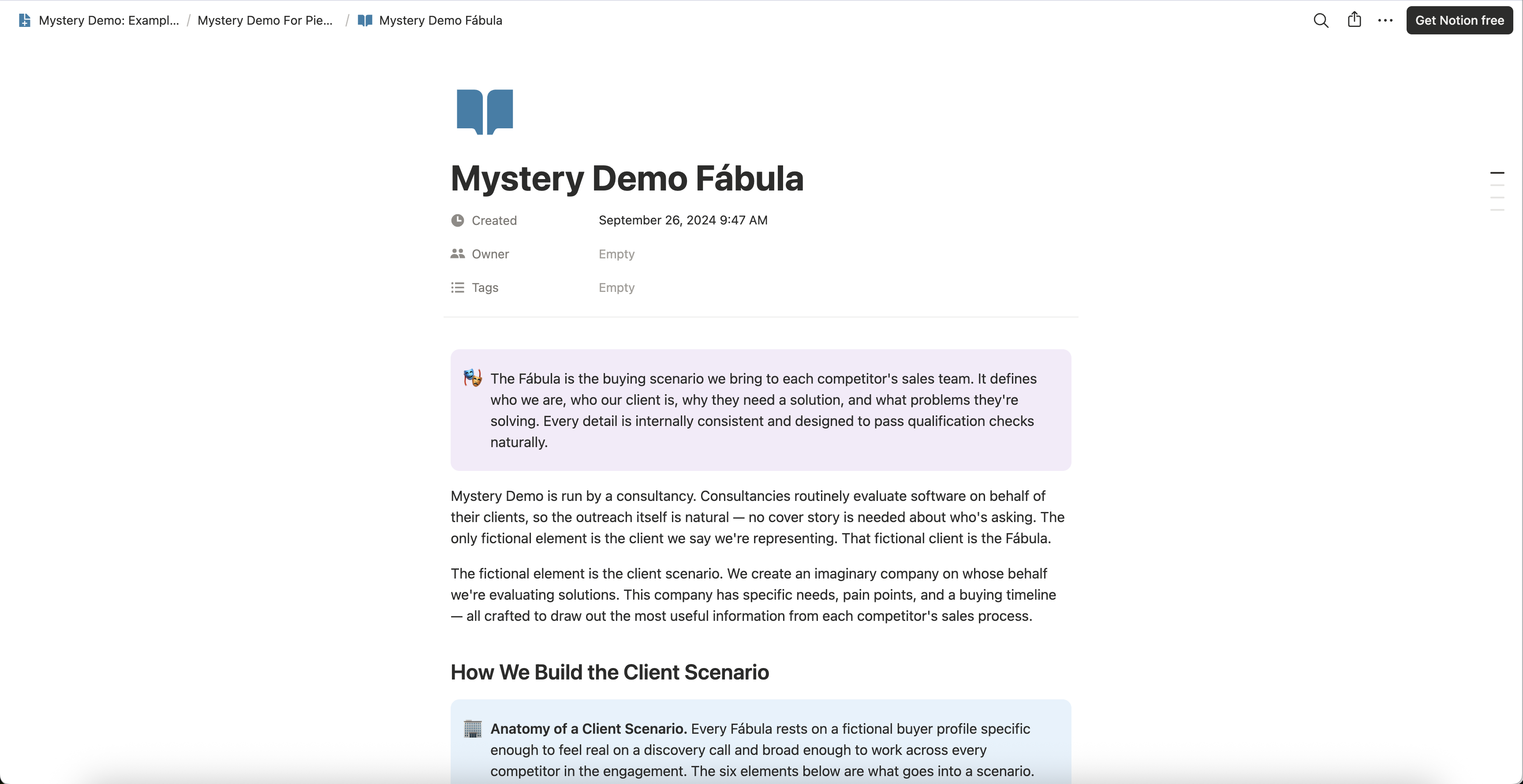
This page holds the scenario each competitor’s sales team meets. Because every competitor meets the same buyer, a dodge on one call means something next to the others.
Ask every competitor the same questions. The permissions question goes to each one in the same words, at the same point in the demo. The calls run as they would for any serious buyer: discovery, the demo, a technical deep dive, the pricing conversation and every follow-up email.
The people asking have sold B2B software themselves, so they know which question pulls a rep off the script. When a rep reaches for a slide, they ask to see the screen.
One call tells you what one rep said and showed, to one buyer, on one date. It becomes a pattern worth acting on only when the same thing happens on other calls, with other reps.
Read what comes back. Each competitor gets its own page on the board, with its recordings, transcripts, emails and collateral, and the analysis written from them.
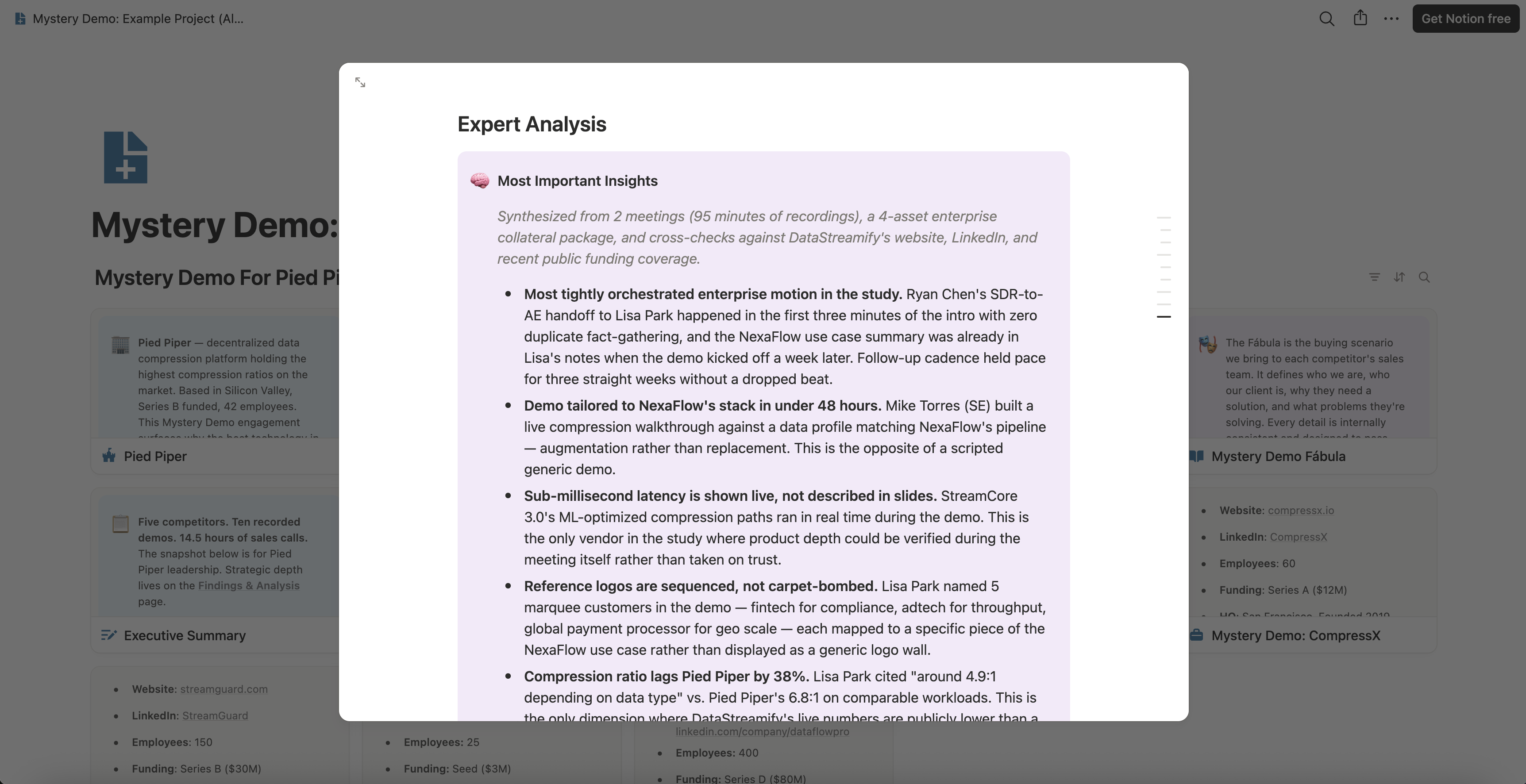
The line at the top names what the insights rest on: the meetings, the minutes of recording, the collateral. Because each insight is tied to its calls, you can split it into what happened and what it means when it goes into your SWOT.
One competitor costs a flat €499, everything included, from the buyer scenario to the board, and takes one to two weeks. If one competitor’s permissions story, its price or its security answer is the point your SWOT keeps guessing at, tell us which competitor it is, and we will bring back the minute it answered.
Step 5: Fill In the Four Boxes
With a source for every point, each one goes in its box. Go back to the example at the top and read it box by box.
S1 and S2 are things the rep did on the calls, each judged against what the buyer had asked for. W1 and W2 were each seen once, so they stay open until a second call or source agrees. A slide instead of a live demo is a result about one call, and a missing security summary is a gap in one email thread.
The bottom two boxes say what those mean for you, and each one names its source. T1 comes from S1: a buyer who got a price sheet from the competitor the same day will expect the same speed from you.
O1 comes from W1: show the permissions flow for two roles live in your own demo, then see whether buyers bring it up. W1 was seen once, so try O1 in a few demos before you build your pitch around it.
The example also leaves three things out on purpose. It says nothing about the competitor’s roadmap, finances or churn, because no named report supports a point about them.
Most of these points come from the call because of what a call holds. A website, a review site and an analyst note hold what was published or remembered. A call holds the sentence the rep said and the screen they showed, at a minute anyone on your team can play back.
Only the buyer who was promised a follow-up can tell whether it arrived. W2 exists because someone watched the inbox for seven days after the call.
.png)

Step 6: Keep Your SWOT Up to Date
A SWOT built from this month’s calls describes this month. Reps change their pitch when a release lands or a quarter goes badly, so every point gets a date and a reason to look again:
W1 goes on that list first. The next call asks to see permissions for two roles again, and the SWOT changes with the answer.
Most deals put you against more than one competitor, so the next SWOT is usually for the second name your reps hear. When every serious player in a market gets the same calls, the board’s Executive Summary sets them side by side.
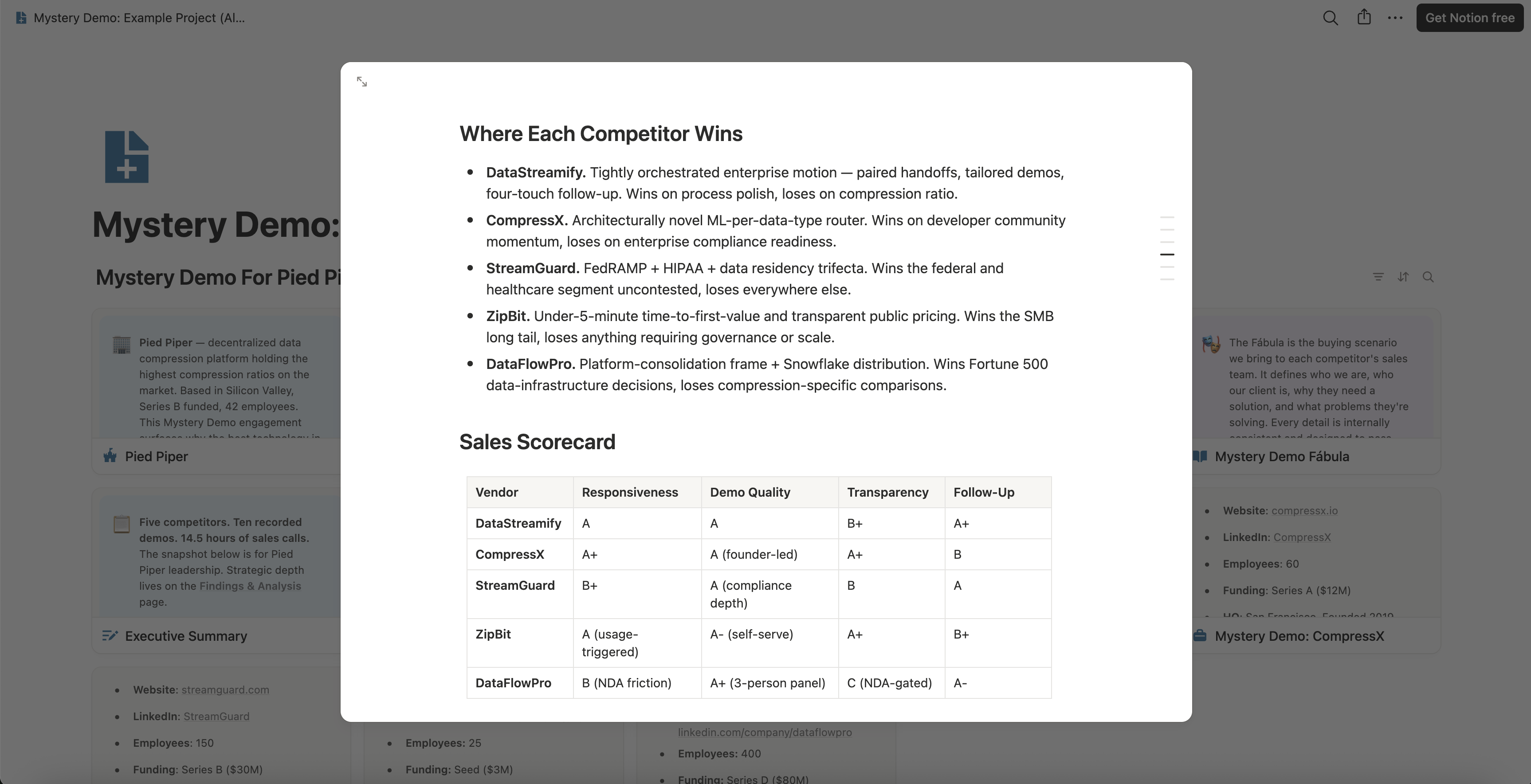
Each line says where one competitor wins and where it loses, and the scorecard beneath grades how each one sells, step by step. It is not a SWOT, but it tells you which competitor’s SWOT matters for which deal. Across a whole market, that work is our SaaS market entry research, and a full landscape takes four to eight weeks.
You can do every step in this guide yourself, except the call. Your own team can’t take that one without being recognized, and it holds the points your sellers would say to a buyer. Name the competitor whose SWOT is mostly guesses, and we will be its buyer and bring back the recording behind every point a call can settle.
.png)


