
A renewal is the date your customer decides again whether to keep you, and a competitor that wants the account has every reason to call before that date. The competitor makes its offer to switch on its own sales calls, and nobody from your side is in the room.
Mystery Demo books competitors’ real sales demos as a credible buyer, asks the questions that bring out the real offer, and records every call. Your team gets the recordings and the analysis in one shared workspace, including what each rival offers a buyer who wants to leave their current vendor.
An account owner with a renewal coming up, and the enablement team behind them, can prepare in four steps:
Know Why This Renewal Is Open
A renewal opens when something gives your customer a reason to look. A price increase was the most common trigger of a renewal review, at 26%, in The Reality Department’s August 2026 survey of 250 UK B2B buyers at companies with $50m or more in revenue. A new competitor pitch set off 18%, and the departure of the person inside who had backed the vendor set off 14%.
A new leader on the customer’s side reopens the decision too, because they did not make it. One customer success manager on Reddit described an account where the day-to-day team loved the product. Then a new VP arrived and “almost cut us just to free up budget for his own initiatives.”
The contract holds two of the dates that matter, and your customer holds the third. A customer success leader wrote on LinkedIn that buyers now start competitive evaluations 90 to 120 days before the contract expires. So keep three dates apart:
The first date comes earliest and is the only one not written in the contract, so it is the one to watch for. The signs in the next step are how you spot it.
Watch for Signs Your Customer Is Looking
The early signs show up on the account, not in your product data. A customer success manager on Reddit listed the ones they watch. The replies under the post added more, with what to do about most of them:
| Sign | What it may mean | What to do that week |
|---|---|---|
| The person who chose you leaves | Nobody inside is defending the renewal | Find who replaced them and earn their support |
| A new leader arrives with a vendor they prefer | Someone who did not make the decision is reopening it | Meet them and show what you deliver against their own goals |
| Layoffs or a drop in headcount | Seats and budget will be questioned | Check seat use, budget, and the renewal date together |
| A rival’s product appears in their job posts, or in a review by someone at the company | Someone there already uses it or is testing it | Ask your contact plainly what they are evaluating |
| A support issue closed but never solved | The unsolved problem can return at renewal as price or a competitor | Read the last few tickets and reopen the issue |
| They go quiet before the renewal | They may be comparing quotes | Ask who owns the renewal and what they need from you |
| You are raising their price at this renewal | The most common trigger of a review in the survey above | Explain the increase early, in writing, with what it pays for |
The price row is ours, built on the survey. Its authors put it plainly: “Treat every price rise as a renewal review, because for a quarter of customers it is one.” The silence row comes from a thread about a service contract, where one reply said, “Silence six weeks out is what a customer sounds like while comparing.”
One sign alone proves little. A reply under the customer success manager’s post said none of these is reliable alone, and the value comes from “combining two or three so one noisy alert doesn’t trigger a task by itself.” Another set the right tone for a rival’s name turning up: flag the account for review, “not automatic panic.”
When two signs line up and one of them is a rival’s name, treat the renewal as one that rival may be working on. The next thing you need is what it offers customers who switch.
Find Out What the Rival Offers Customers Who Switch
You cannot prepare an answer to an offer you have never seen. A rival trying to move your customer has a short list of things it can offer, and each one is built to remove one reason to stay.
The first reason is effort. A sales leader on LinkedIn explained why buyers hold back even from a platform they like: “The benefits of change are still a promise; the work of changing feels immediate.” The second is money: one customer success manager on Reddit wrote about “sales teams able to give massive discounts to new accounts.”
| What the rival offers | What it removes | Your counter |
|---|---|---|
| Migration help: data moved, setup and training done for them | The work of moving | Show what staying saves this account: no data to move, no retraining, no new login. You need its real setup: users, integrations, and data held. |
| A discount or a lower first-year price | The price gap at renewal | Compare the total over the full term, including the rival’s price at its own first renewal. You need the rival’s terms and the best price you can offer. |
| Free months or an overlap period | Paying for two products during the switch | Set out the costs free months leave, such as the team’s time on the move. If they need time to decide, offer a short extension, agreed in writing. |
| Matched or better contract terms | The lock-in of a long contract | Match, in writing, the terms this customer cares about, where you can. You learn which ones in the conversations from step 2. |
Part of an offer is visible from your desk: the rival’s pricing page shows its list price, and its website may promise help with migration. The offer itself is made on a sales call, to a buyer who says they want to leave their vendor. No rival makes that offer to your own account manager.
Mystery Demo takes that call for you, starting from the questions you need answered. Every project delivers its findings on a board, a shared Notion workspace, and the questions sit on its Research Objectives page. Here is that page on our public example board, where the client and every competitor are invented.
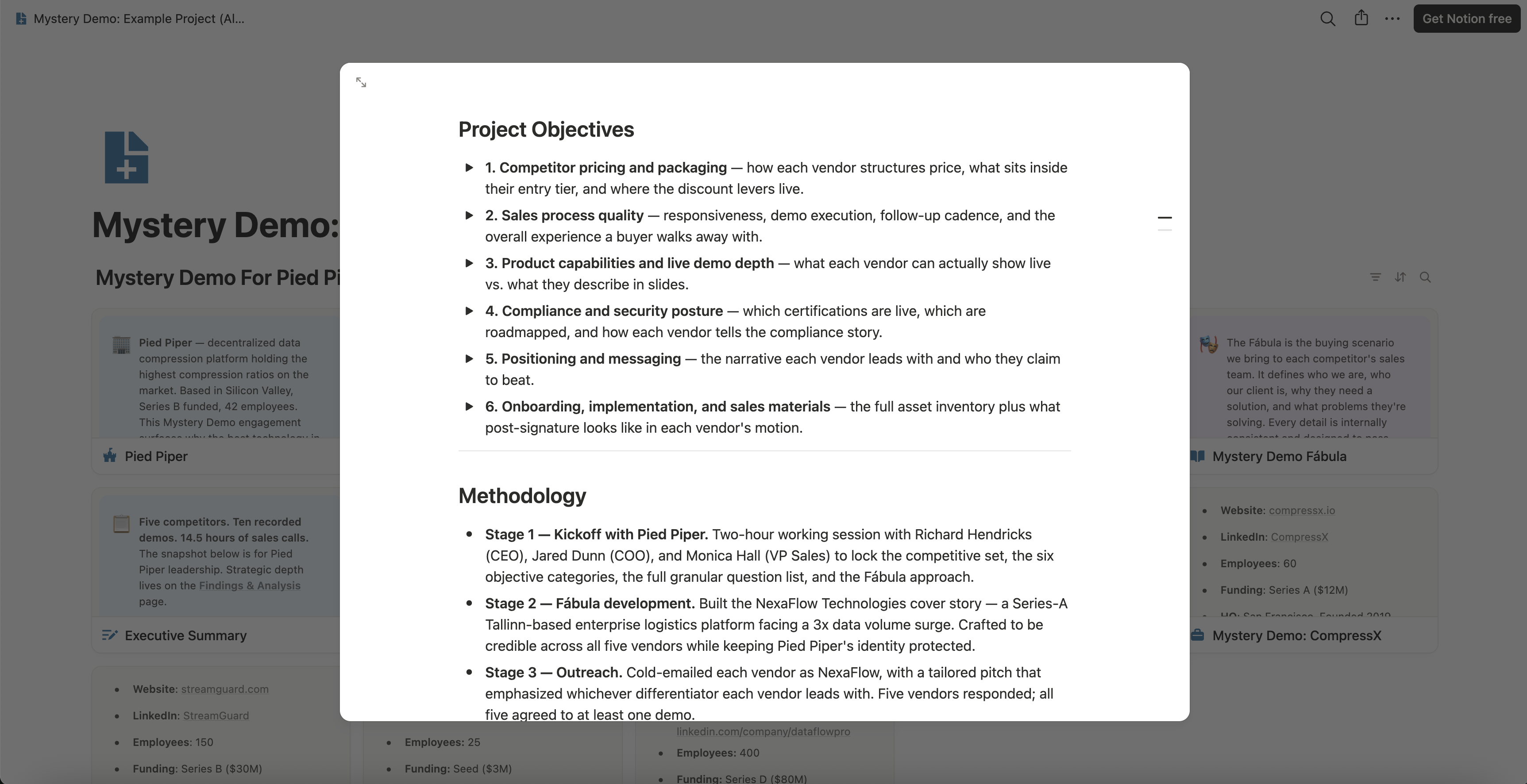
A real project’s board is built from the calls taken for that client. The first objective asks how each vendor prices and where its discount levers are, and the second asks how good each sales process is. A renewal project adds your question beside them: what does this rival offer a buyer like your customer who wants to switch, and on what conditions?
On the pricing call, we do not stop at the offer. We ask what it depends on, because your counter is built from the answers:
| What we ask on the call | What it tells your account owner |
|---|---|
| How long the buyer has to sign for | Whether the first-year price needs a longer contract than yours |
| When the offer ends | Whether the offer carries a deadline meant to hurry the decision |
| What the price becomes at the rival’s own first renewal | The real total over the term, to set beside your own |
| Who does the migration work once the contract is signed | Whether the migration help covers the hard part |


All of it lands on the board. Each rival gets a page with its recordings, transcripts, emails, and our analysis, and the offer sits there with its conditions and the minute each was said. A renewal team starts on the Executive Summary, the board’s verdict page, shown here on the invented example board.
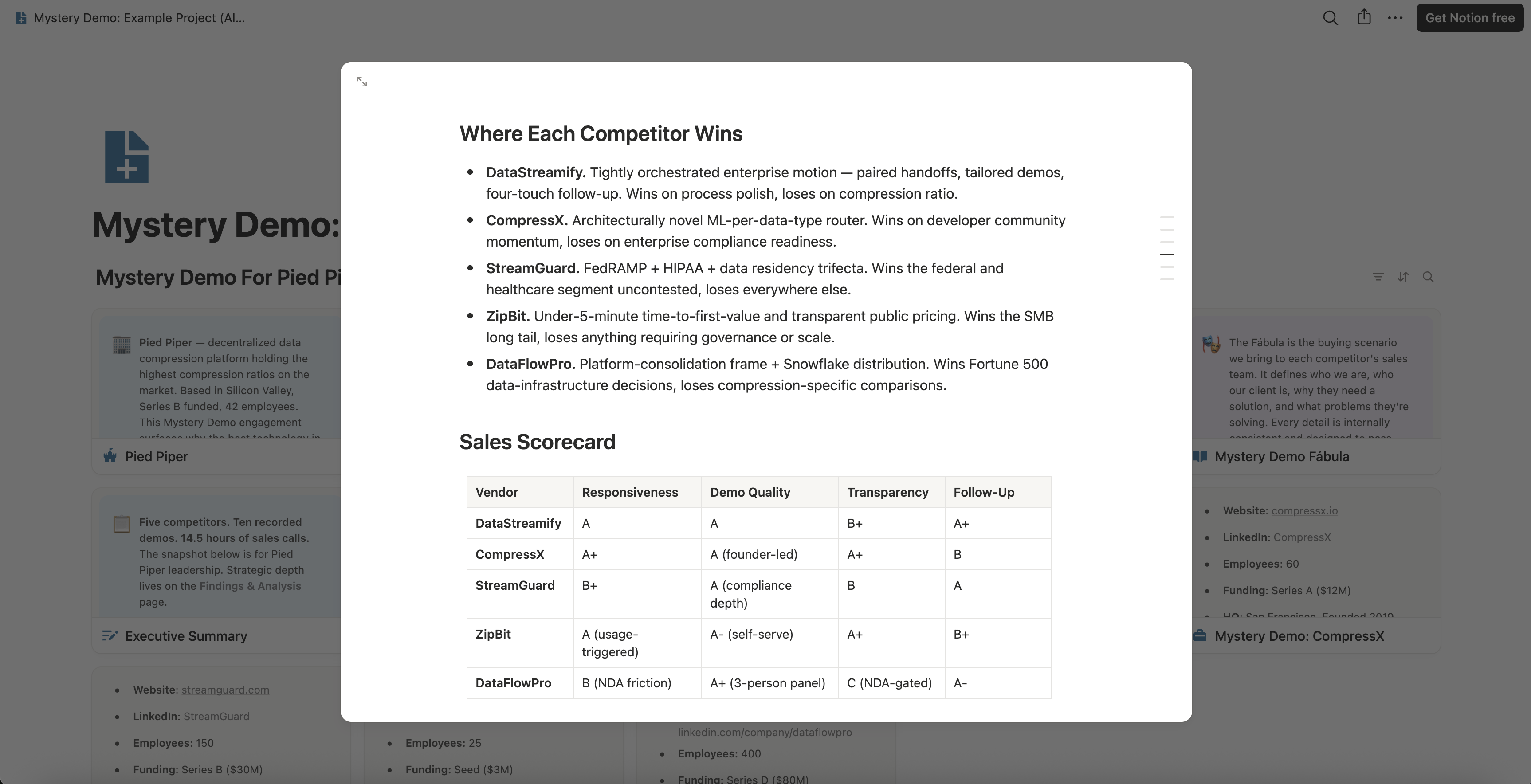
The top half gives one line per rival on where it wins and where it loses, which tells your counter where to point. Below it, the sales scorecard grades each rival’s sales motion on responsiveness, demo quality, transparency, and follow-up. For a renewal, start with Transparency: if a rival’s reps were vague about price, read the conditions of its offer twice.

That grading, and the recorded offer behind it, come from our competitor sales tactics research, which follows a rival’s sales motion from the first reply to the last follow-up email. It works because the buyer is believable, and because operators who have sold B2B software choose the questions that take a rep off the script. Every finding is a recording, a transcript line, or an email, with a timestamp.
The price is a flat €499 per competitor, everything included, and one rival takes one to two weeks. If one rival keeps turning up in your renewals, tell us which one on a short intro call. We will go through its sales process as a buyer ready to switch, and bring back its offer with every condition attached.
With the offer on the board, the last step belongs to your account team: turning it into what they say before the renewal call.
Build Your Counter Before the Renewal Call
A counter answers two things: the rival’s offer, and the reason your customer started looking. The Reality Department asked 203 of its buyers, the ones whose last renewal was not close to automatic, what would have tipped them into switching. A stronger competitor offer came to 15%.
Faster fixes for issues they had flagged, more flexible pricing, and more proactive account management came to 48% between them. All three are decisions you make, so answer the offer briefly and specifically, then spend the conversation on why staying is the better choice:
Here is that preparation on one page, for an invented rival in parking management software. It shows where Rival A’s offer wins and where it loses, the traps its rep sets for the current vendor, and the proof to bring, with your counter at the bottom. Every line and minute on it is invented.
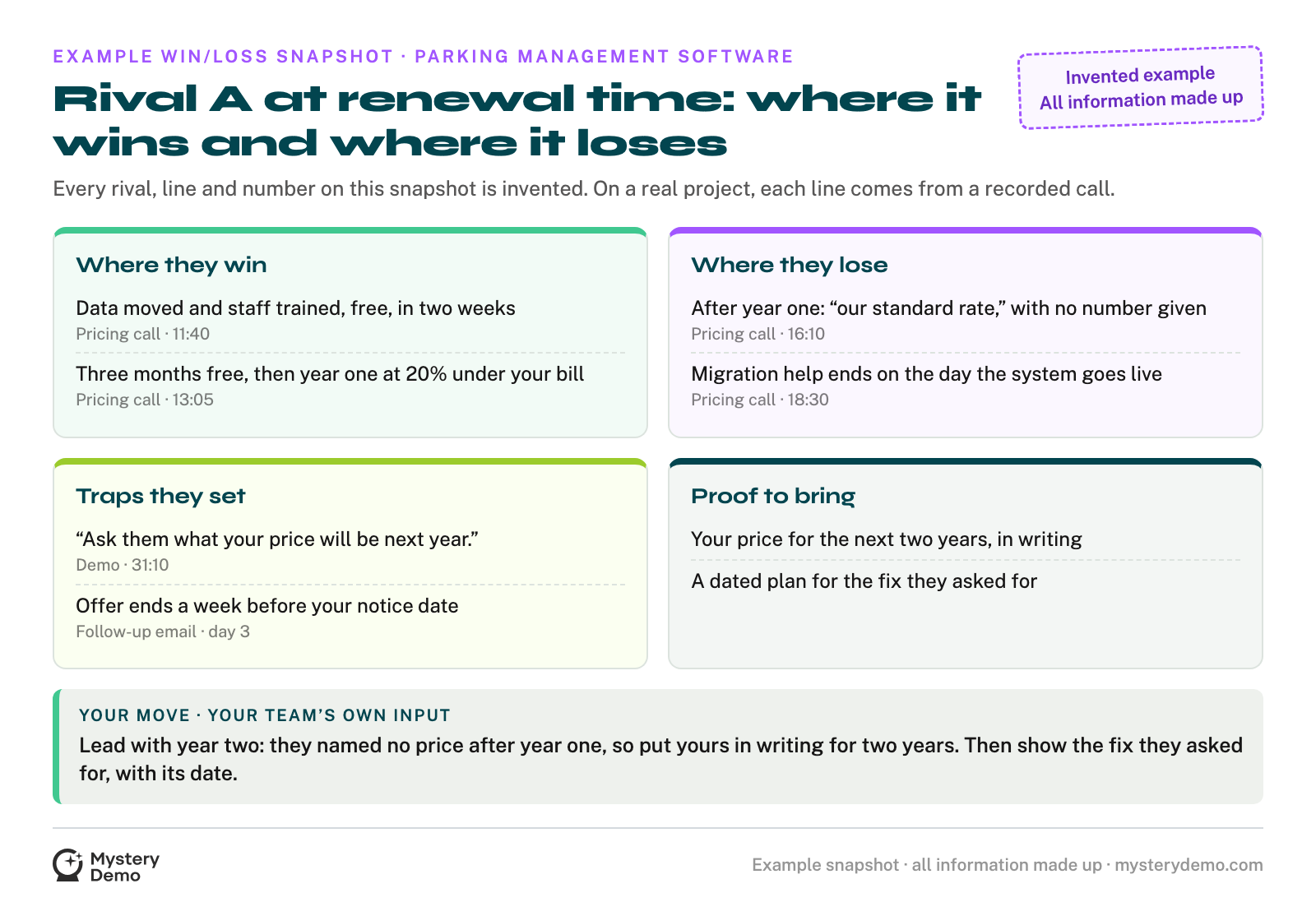
Compare the first trap with the first loss. The rival tells buyers to ask their current vendor about next year’s price, while naming no price of its own after year one, and that gap hands your account owner the opening line.
Mark Your Next Renewals Against the Signs
A renewal is saved before the renewal call, by the team that saw the signs early and knew the rival’s offer before the customer brought it up. Start at the first sign, not at the notice date. One renewal lost anyway is not the end of the account, because a win-back plan built on the rival’s promises starts from the same recordings.
This week, list every renewal due in the next 120 days, the window in which one customer success leader says buyers now start looking. Then, for each one:
Start with the rival that turns up against the most accounts. Bring that rival to an intro conversation with us, and we will hear its switch offer on its own sales calls and return each condition with the minute it was said.


