
A competitor’s clickable product tour is the easiest look at its product you will get: free, open today, and no sales call. Its marketing team picked every screen, the order they come in and the words on them. Nothing in the tour has to answer a question you bring.

So the two give different kinds of evidence, and neither is a better version of the other. For a product marketer who studies rivals’ tours, here is what each one shows, how current it is, what it costs to get, and what each is good for.
Mystery Demo takes that second look for you. Its team goes to each rival’s live demo as a credible buyer, asks what the tour never had to answer, and brings back the recordings. Everything lands on a shared board your team keeps, with an analysis of what each rival said, showed and quoted.
What a Competitor’s Product Tour Shows You
For learning a rival’s product quickly, a tour is a sensible first stop. In the time it takes to get a sales call on the calendar, you can click through it and come away knowing:
A tour is also a selection. One founder on Reddit, planning a tour for their own product, described the choice plainly: “I’d like to put those workflows into an interactive demo and let people go through them before getting on a call.” The workflows that make the cut are the ones its makers want a buyer to see first.
Check how old it is, too. Where the tour shows when it was captured, compare that date with the rival’s release notes, because anything released since may look different in the product today. Where it shows no date, treat every screen as undated.
A tour cannot answer you, though. It never learns who you are, and nothing in it changes when your question does.
The Questions Only a Live Demo Answers
The questions a tour cannot answer are the ones buyers take to a seller. In Gartner’s survey of 632 B2B buyers, run in August and September 2024, 61% said that, overall, they prefer to buy without a sales rep. Yet for working out whether a product fits their company’s needs, the same buyers prefer to ask a seller, and keep self-service for general information.
A buyer on Reddit said the demo “mostly confirms whether the tool matches the problem, pricing, workflow, and whether I trust the team enough to deal with the messy parts after buying.” The website and the seller do not always agree, either. 69% of the buyers Gartner surveyed reported inconsistencies between the two.
For a product marketer studying a rival, the same split holds. Set side by side, the tour and the live demo answer different questions:
| What you want to learn | From the product tour | From the live sales demo |
|---|---|---|
| The product path | The path its makers chose, in their order | The path a rep picks for a buyer like you, and where it bends when you ask |
| Discovery | A set path, with no questions about your situation | The rep’s questions, which show who the rival sells to and how it decides a buyer is worth its time |
| Pricing | Published pricing, where the tour or the site shows it | The price quoted to that buyer, and what moves it |
| Unscripted questions | No answers beyond the path | The rep’s answers, and whether each one is shown working or only described |
| The pitch | The tour’s captions | What the rep leads with, and how the rep talks about the alternatives |
| How current it is | The capture date, where the tour shows one | The date of the call; whether a feature shown is generally available is a separate question |
| What it costs to get | Free, in minutes | A buyer’s time across several calls, and a rep who believes the buyer |
The demo column is still one rep answering one buyer’s situation on one day. It is first-hand evidence of that call, not the whole truth about the product.


Everything in a tour, and on a website, is what the rival chose to publish. On a sales call it has to answer a buyer. That is where it names a price, shows what the buyer asks to see, and says what it thinks of the other options.
Mystery Demo takes that call as the buyer. Before anything is booked, we write a buying scenario fitted to what the rival sells: a believable company, a real reason to look at software, and a timeline to decide on. Then we ask for the demo through the rival’s normal front door, the way any serious prospect would.
From there the evaluation runs like any other, and at each step we ask what the tour never had to face:
Every call is recorded and every email kept. It all lands on a shared Notion board, the workspace your team keeps after the project, with one page for each rival.
Below is one rival’s page from our public example board. The company, its people and every detail on it are invented, and a real project’s board is built from that client’s own calls.
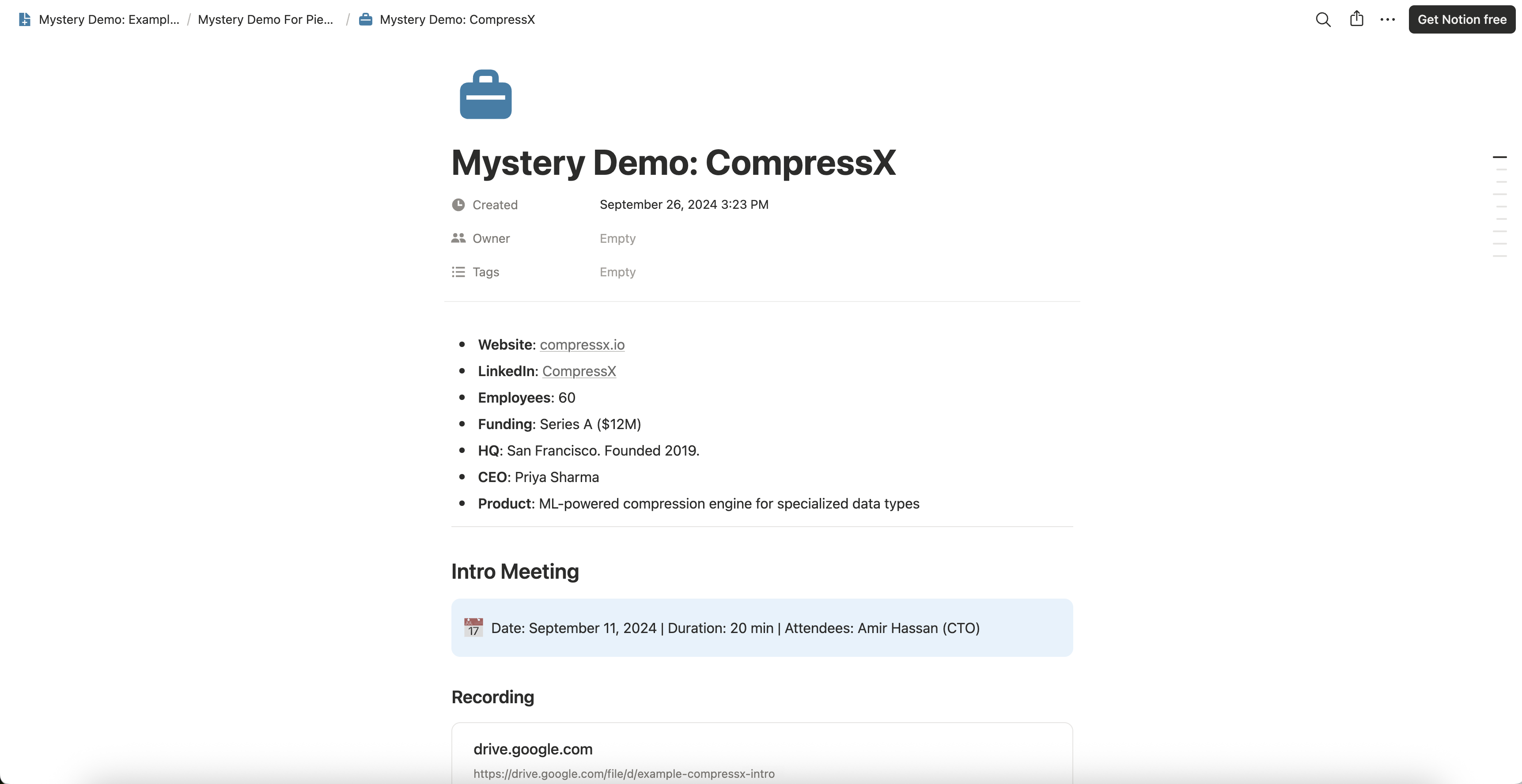
The page starts with the rival’s basic facts, then each meeting and its recording, so every finding on the board has a call behind it. The recordings still need sorting, because a rep saying a feature works and a rep showing it working are not the same proof.
Sorting What the Rival Showed From What It Said
That sorting is the main work of a competitor product comparison. Each capability a rival claims gets one of three ratings in the feature matrix, the page of the board that lines every rival up capability by capability:
Each rating is our reading of the evidence: what the rep showed, what the rep only said, and what the rival’s own site claims. After the calls, every claim a rep made is checked against the live website, LinkedIn and public news before a rating is set.
The step before the rating is easiest to see on one rival. Here is an example claims map for an invented rival that sells tutoring center software, with every line made up. Each mark records what happened on the calls, and the note under it says whether the claim was in the rival’s tour at all.
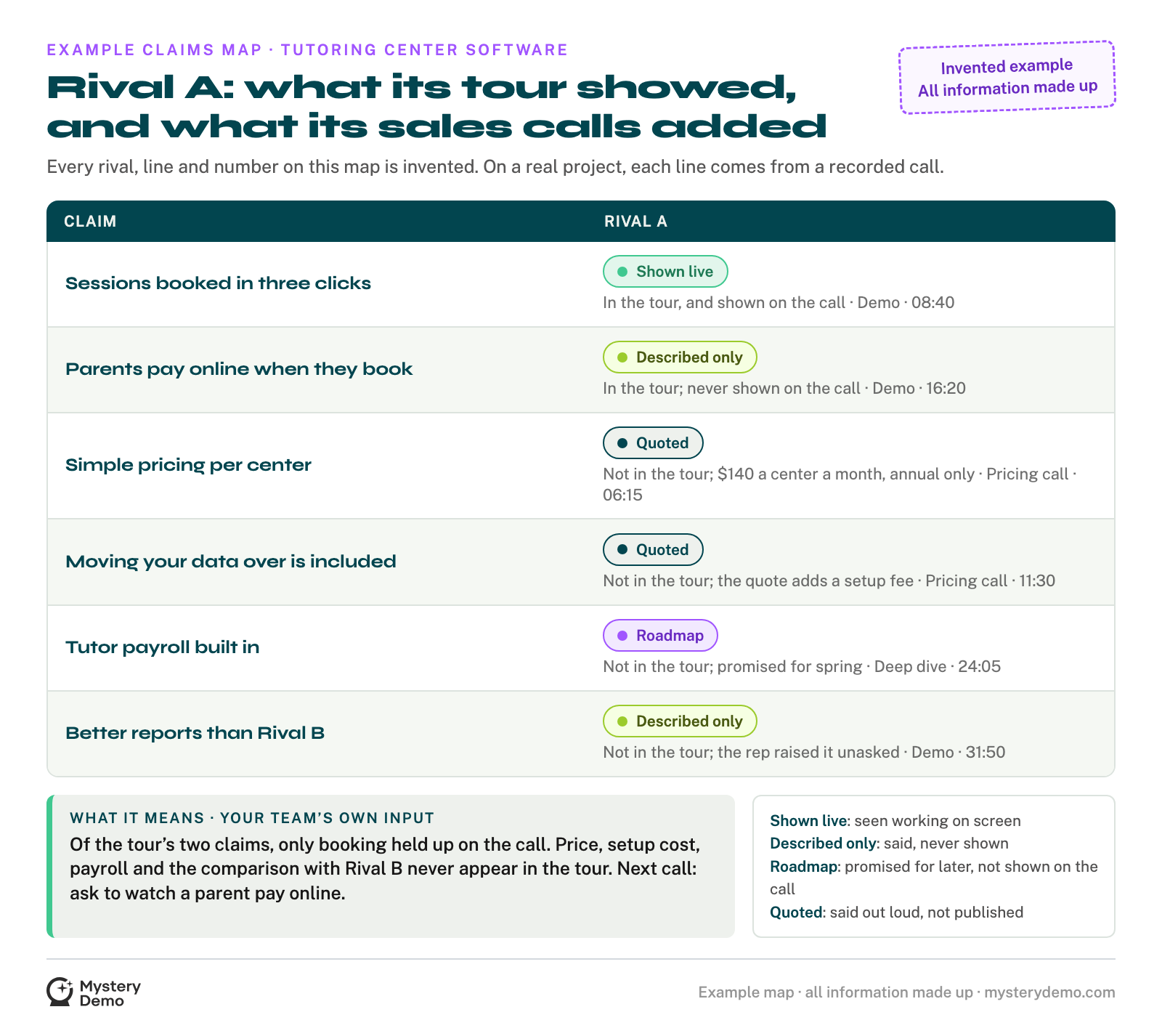
In this example the tour covered booking and payments, and only booking was shown working on a call. The per-center price, the setup fee, the payroll promise and the comparison with Rival B came up on the calls alone. A product marketer needs exactly that split before telling reps what a rival can and cannot do.
On a real board, the ratings and the reasoning behind them sit in Findings & Analysis, the page that compares every rival side by side. In the capture below, the same invented rival’s table holds its facts and its own headline claim. The section under it, How They Sell, records how the rival ran its sales process and what its demo was like.
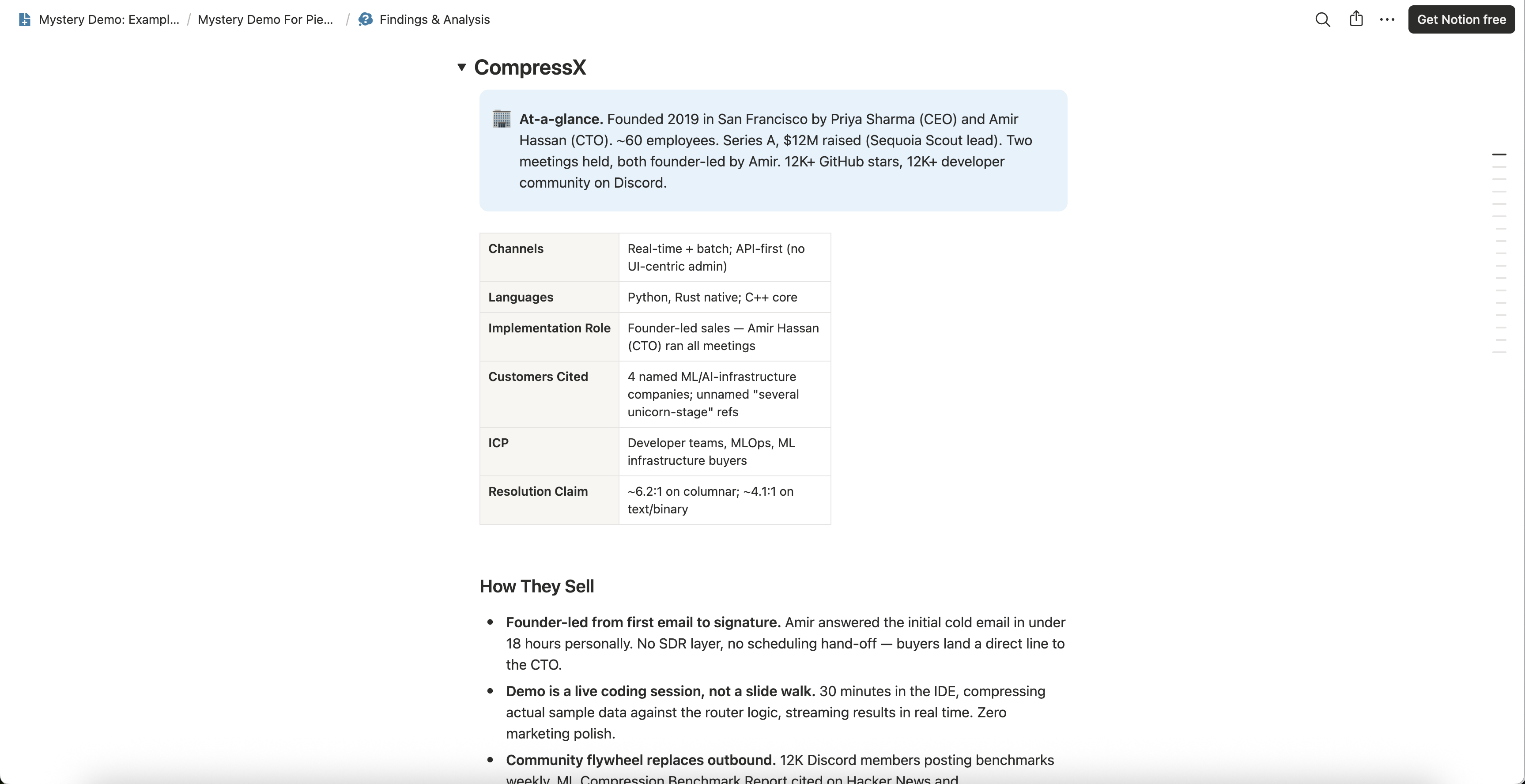
No tour could fill in that second part. Someone has to take the demo, and that someone is either your own team or us.
Who Should Take the Rival’s Demo
Your own team can take it. That costs hours across several calls, and a buyer identity the rep may look up before the first one. If the rep spots a rival’s email domain, the risk is that you get the polished general tour, which you already had.
Mystery Demo is built for that gap. A believable buyer, fitted to each rival, gets the whole sales process, from the first discovery question to the price conversation.
The calls are run by operators who have sold B2B software, so they know which question pulls a rep off script. Every finding comes back as a recording with a timestamp. Here is how the three ways of seeing a rival’s product compare:
| Approach | What it verifies | What it cannot see |
|---|---|---|
| The rival’s product tour | The path its makers chose, and published pricing where shown | Discovery, a quote, and answers to your own questions |
| Your team taking the live demo | What the rep says and shows to your team’s buyer identity | What the rep would say to a buyer it does not suspect, if your team is recognized |
| Mystery Demo taking the live demo | What the rep says, shows and quotes to a credible buyer, recorded | Anything not raised on those calls, and what the rival keeps for signed customers |
Each live-demo row is one rep and one buyer scenario. Here is what each approach costs, and how long it takes:
Pick the rival whose tour your team has clicked through most. Let’s talk about that rival, and we will take its live demo as the buyer, then set what the calls showed beside what the tour shows.
When to Use Each One
Use the tour to learn a rival’s interface and main workflow, quickly and for free, and look again whenever it changes. Use the live demo, taken by a buyer the rep believes, when your question is about fit, price or anything the rival did not script. The tour tells you what to ask, and the demo is where it gets answered.
So the first step costs nothing. Open your closest rival’s tour and write down three questions it leaves open, the kind a buyer would ask:
Then hand the list to us. Start with a short conversation about it. We will ask every question in the rival’s live demo as the buyer, and each answer comes back with the minute of the call it came from.


