
If a rival can rebuild the features that win your deals in a few weeks, those features stop setting you apart. The way you sell then becomes one of the few advantages left, and it is the one part of a rival you cannot read off its website.
If you are a founder or sales leader deciding what to defend, the sections below compare the usual defenses, take on the strongest case against selling better, and show how to watch a rival sell from the buyer’s side.
Mystery Demo works from that side. Its team goes through your competitors’ sales processes as a buyer, from the first call to the last follow-up email, and hands back every call recorded, with each step of the rival’s selling graded. A buyer lives through four of those steps with any vendor:
Buyers already weigh those steps. In Wynter’s June 2026 survey of 100 B2B SaaS marketing leaders who had recently evaluated competing vendors, 64% found the vendors hard to tell apart from their websites and messaging. Asked in their own words what made the vendor they chose different, 31% described the sales experience.
The argument holds wherever a deal goes through a sales conversation. For a product bought entirely self-serve, there is no conversation to win, and the case for distribution gets stronger.
How Hard Each Defense Is to Copy
The usual defenses against a fast copy are distribution, brand, data, speed and knowing the customer well. The table sets them beside the way you sell, with how hard each is for a rival to copy and how much of a rival’s own version you can see. The middle column is our own judgment, and nobody has measured it.
| Defense | How hard to copy (our judgment) | What you can see of a rival’s version |
|---|---|---|
| The product’s features | Quick, once the features that matter in your deals can be rebuilt | Most of it: the website, the docs, a free trial |
| Speed of shipping | An edge only while the gap lasts; focus and hiring can close it | Release notes and changelogs |
| Distribution | Hard: it rests on months of learning what works | The channels, but not why they work |
| Brand and trust | Hard: it builds over years of customers | Reviews, case studies, who recommends it |
| Data only you hold | Hard, where the data is really yours | Rarely more than the claim |
| Knowing the customer’s day | Hard: it shows only in how well the product fits | Little, beyond the product it shaped |
| How it sells | Hard: it lives in people and habits | Secondhand from buyers; first-hand only as its buyer |
The best case for distribution is about learning. One founder put it plainly: a rival “can’t copy the months of figuring out” who cares, “what messaging lands, and which channels are mostly noise.” Selling rests on the same kind of learning, built one call at a time.
Read the last column and the rows split three ways. A rival’s product, releases and channels are on show. Its data and its feel for the customer mostly stay hidden, and looking harder will not show them to you.
Its selling is the exception: hidden from its website, open to anyone who goes through its sales process as a buyer. Of the three hidden defenses, it is the only one you can study first-hand. Selling still has to beat the strongest objection, which says your next dollar belongs elsewhere.
The Case for Spending on Distribution Instead
Ask a founder where that dollar should go once the product can be copied, and the answer is often distribution and brand.

Much of that is true. In the same survey, 87% of buyers got vendors onto their shortlist through peer recommendations, a conversation no vendor is part of. For a product bought without any sales call, distribution may be the whole game.
The shortlist is not the decision, though. When the vendors left on it felt interchangeable, the most common response was to push for a deeper trial or demo, at 41%, and only 15% went with the best-known brand. A tie between similar products gets settled by making the vendors prove themselves, often in a demo.
So the claim that survives is narrower, and it is about time as much as money. In deals that reach a competitive sales conversation, the buyer weighs how each vendor runs it, and you can change yours this quarter, long before a brand compounds. We are not claiming that selling beats distribution overall.


Improving against a particular rival raises a question your desk cannot answer: what does that rival do differently in the same conversation? Each source you can reach from outside gets you part of the way:
| Where you look | What it tells you about how a rival sells | What it misses |
|---|---|---|
| Its website | The product it wants buyers to see | How its rep questions a buyer, and when a price comes out |
| Review sites | How customers felt after the sale | What the rep said before it |
| A win-loss interview | The buyer’s memory of the rival’s call | What the buyer forgot or kept back, colored by how the deal ended |
| Its sales process, taken as a buyer | The questions, the demo, the price conversation and the follow-up, recorded | What it saves for signed customers |
Mystery Demo gets that conversation first-hand. Its team writes a buying scenario fitted to what each rival sells, asks for the demo through the rival’s normal front door, and carries the evaluation through the price conversation and the follow-up emails. Every call is recorded and every email kept, and each rival gets its own page on a shared Notion board, the client’s workspace for the project.
Below is one rival’s page from our public example board, where every company is invented. On a real project, the page is built from the calls taken for that client. The line at the top names the recorded meetings behind the analysis, and each insight under it is about how that rival sold.
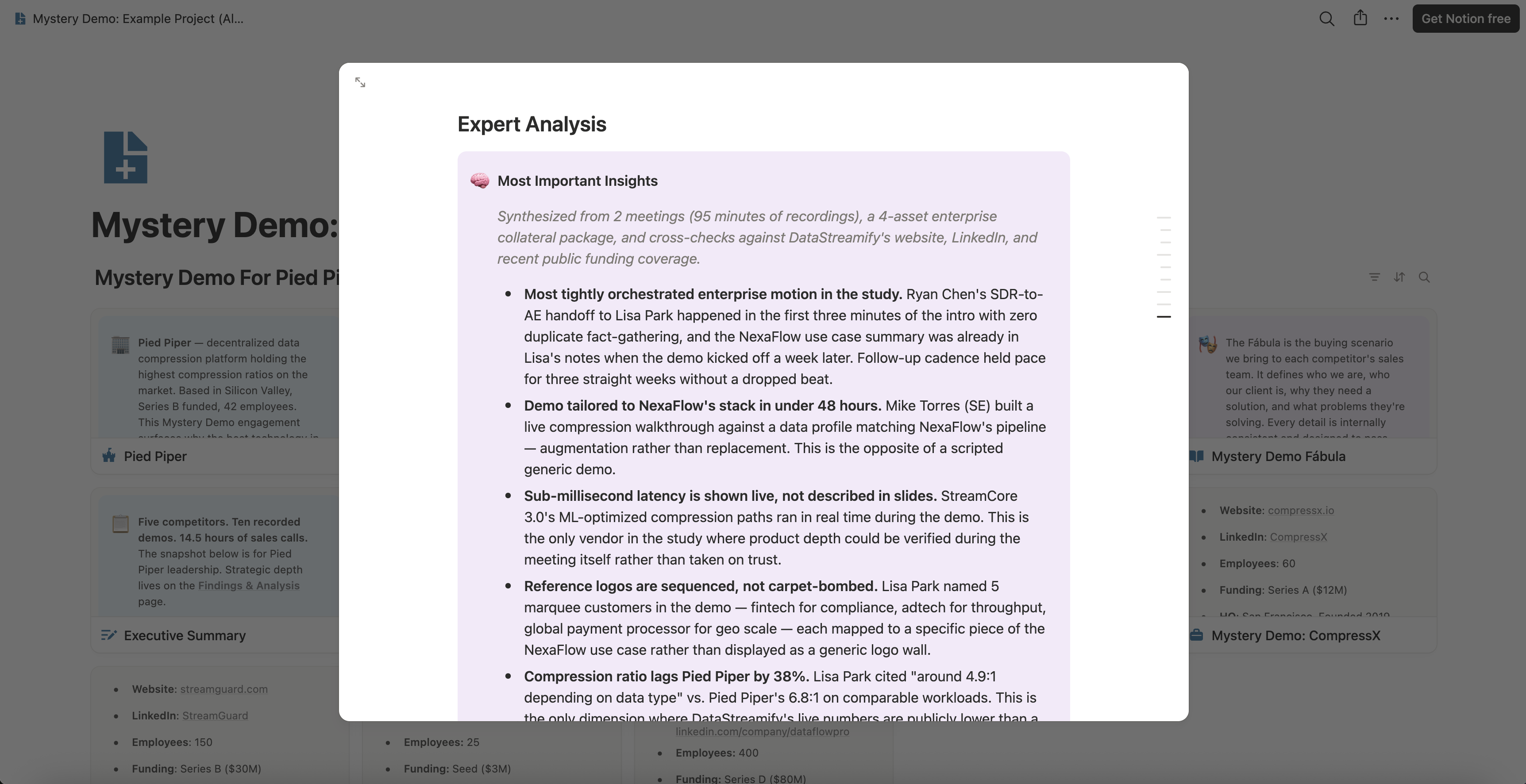
A page like that shows how one rival sells. It earns its keep when you set it beside how your own team sells in the same moments.
What to Change After Watching a Rival Sell
That comparison lives in the sales scorecard, the page at the center of the service we call competitor sales tactics research. Each rival is graded on how fast it responded, how good the demo was, how open it was about price, and how it followed up. Every grade traces back to the recordings on that rival’s page.
This is the scorecard on the same invented example board. Read the columns rather than the grades, because the columns are where a rival with your features can still outsell you.
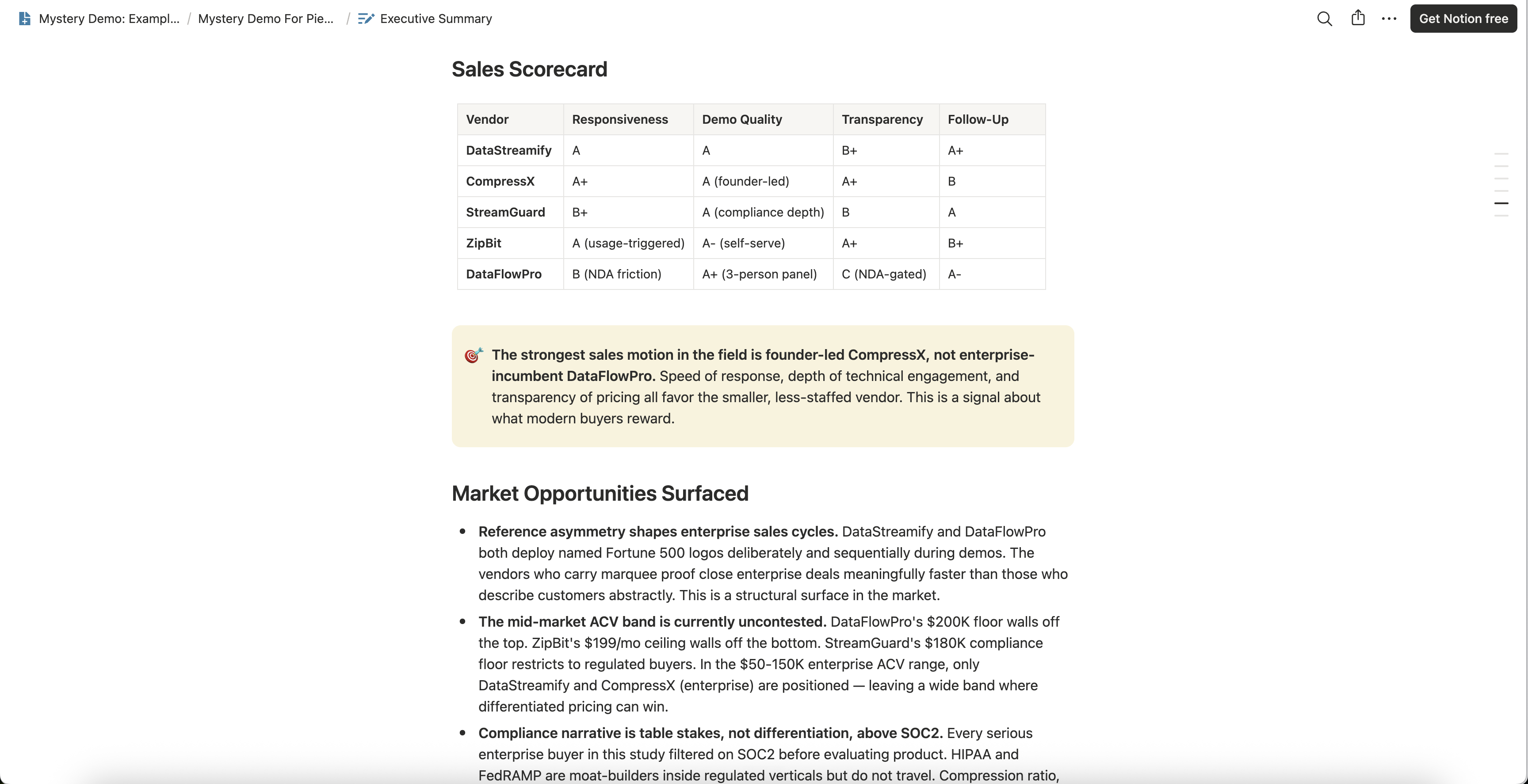
One call shows what one rep did with one buyer, so the gaps worth acting on are the ones that repeat across a rival’s calls. Each is a change to test on your own calls, not proof of why the rival wins, and none of them touches the product. In two invented examples, the change to test is plain:
The comparison is sharpest when both sides meet the same buyer, so Mystery Demo can also mystery-shop your own sales team with the same scenario, unannounced, and grade both against that buyer. The point is a better sales process, never discipline. Here is an example of what comes back, with every line on it invented.
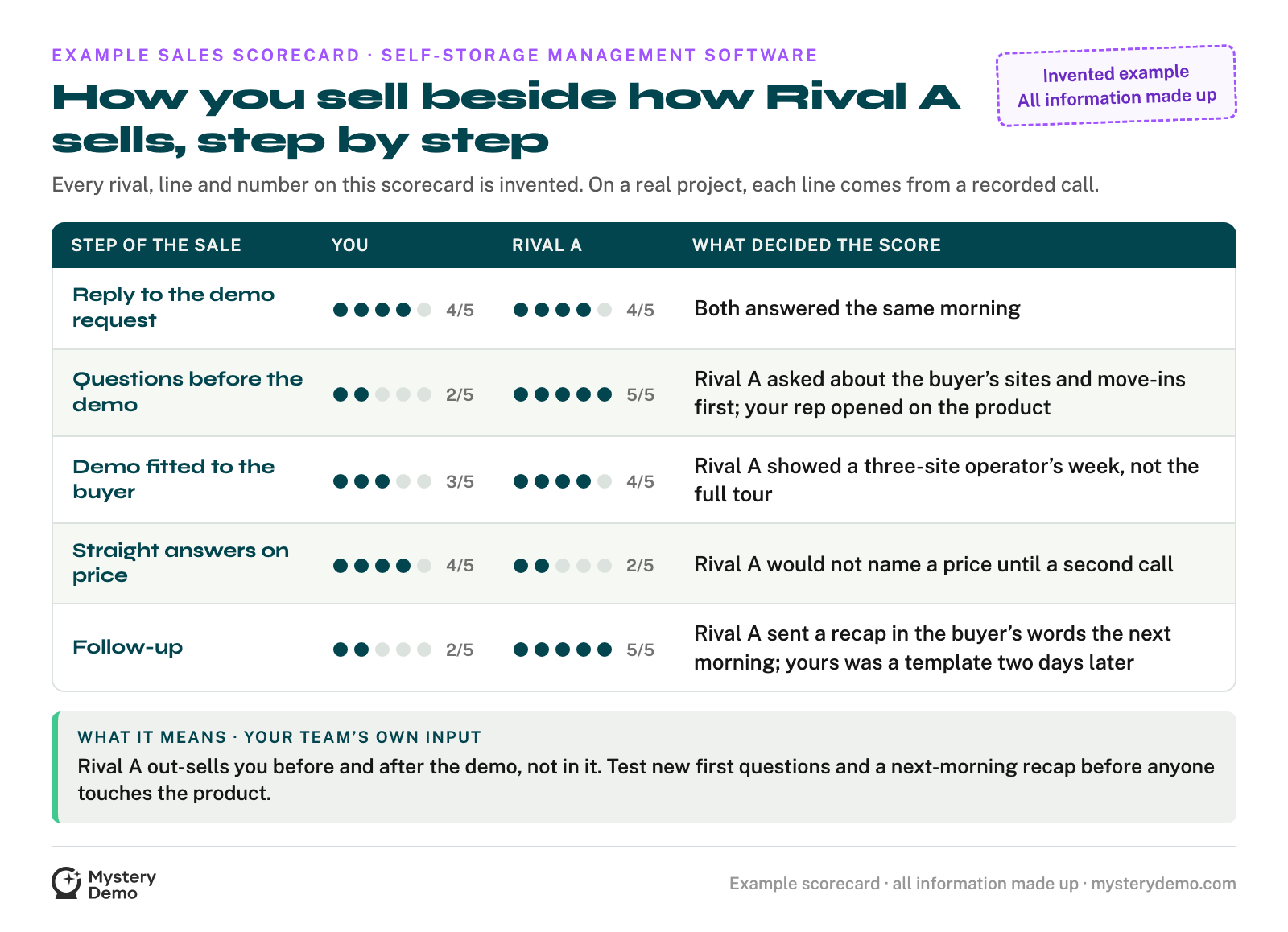
You could ask your own reps to take a rival’s demo instead. Their email domain gives them away, and a rep who spots a competitor gives the generic tour, so you would be grading a show put on for a rival.
Mystery Demo brings a believable buyer, adapted to each rival, and its calls are run by operators who have sold B2B software and know which question pulls a rep off script. Here is what one rival costs and what comes back:
Pick the rival whose product is closest to yours, the one where deals feel like a coin toss. Talk that rival through with us, and we will go through its sales process as the buyer and grade every step. Before you talk to us, check what you already know about that rival.
Win the Deals That Reach a Sales Call
Once a rival can copy your product, your lead in a tied deal lives in the sales conversation, and the team that has watched its rival sell knows where to build it.
A rival could watch you the same way, and a good one will. It can see how you sell within a couple of weeks. Copying what it sees means changing how its own reps work, which is slow, so the team that starts first keeps its lead.
The first act costs nothing. For the two rivals closest to you, write down what you know about each of the four steps, from the first questions to the follow-up. Beside every line, write how you know it:
Count the guesses. If they outnumber the recordings, send us the two names. We will be the buyer in both sales processes and bring back every step recorded and graded, ready to set beside your own.


