
When a buyer has already taken a rival’s demo and your rep knows that rival only from its website and reviews, yes. The buyer heard the price the rival quoted for this deal, what its rep said about you, and how its product looked running. Your rep’s battlecard holds none of that, because none of it is published.
A fresher battlecard built from the same public pages will not close that gap, because what the buyer heard on the rival’s call was never on a page. Mystery Demo works from the buyer’s side of those calls. For each rival you name, its team takes the rival’s sales calls as a buyer and records every one, so your team gets what the rival said, quoted and showed, with the minute it happened.
The buyer’s research starts before your rep is in the deal, while they build the shortlist they bring to your rep. In 6sense’s 2025 study of more than 4,000 buyers across North America, EMEA and APAC, 94% of buying groups had ranked their preferred vendors before first contact with a seller. One buyer described the result on Reddit in September, after reading reviews and doing competitor analysis: “by the time I’m in the demo I know what your competitors offer.”
What the Buyer Knows That Your Rep Does Not
Take a rival the buyer has already met on a demo, and compare what each side knows about it. Your rep has the usual kit: a battlecard, a slide deck and whatever the rival publishes.
| About the rival | The buyer, after taking its demo | Your rep, working from public pages |
|---|---|---|
| Which rivals are in the deal | Their own shortlist, built from AI answers, reviews and peers | Whatever the buyer chooses to tell them |
| What it says it does | Its website and reviews, then its demo | The same website and reviews, summarized on a card |
| Its price | The number its rep quoted for this deal | The pricing page, if the rival publishes one |
| What it says about you | What its rep said on the call | Its comparison pages, if it has any |
| How its product works on screen | What its demo showed live | Its screenshots and marketing videos |
Your rep can read whatever the rival publishes, just as the buyer can. Your rep learns which rivals are in the deal only if the buyer says. The last three rows come only from the rival’s calls, so the buyer has them and your rep does not.
A founder testing an idea with sales leaders on Reddit in October described where that ends: the rep “ends up saying something about the competitor that the buyer corrects on the spot.” A product marketer in another thread named the cause: “Reps get beaten by whatever the competitor says about us in the room and none of that was ever a public information.”
Why a Fresher Battlecard Does Not Close the Gap
Enablement teams have a fair answer to that table.
Part of that is right. In Gartner’s survey of 645 B2B buyers, run in August and September 2025, 51% said they were more likely to meet misleading information from GenAI, and 49% said the same of a sales rep. A current card also beats one that, as a practitioner put it on Reddit, “hasn’t been opened in over nine months.”
But a better card built from the same sources still holds only what the rival chose to publish. Even the public half of a battlecard, which an AI tool can now draft, is the buyer’s own reading list rearranged. It has no line for the price the rival’s rep quoted, or for what that rep said about you.
Some cards also carry what buyers told your reps, or what a win-loss interview about the rival’s pitch turned up. Those are worth having. They are still the rival’s words as a buyer remembered them, after the deal was decided.
The Evidence Lives on the Rival’s Sales Calls
Buyers already use reps to check AI answers: in the same Gartner survey, 69% said they prefer to validate AI-generated insights with sales reps. Our reading is that a rival’s pitch gets checked the same way. And a quoted price, or a remark about you, can only be checked against the call where it was said.
A rival’s website says what it wants buyers to believe, and its reviews say what some customers chose to write. Its sales calls are where it says the rest:
Those calls are primary evidence about the rival, and everything else on a card is a step removed from what it tells buyers. Mystery Demo gets that evidence the way your buyer did, by taking the rival’s calls as a buyer.
Its team books each rival’s demo through the normal front door and evaluates the software on your behalf, with a buying scenario fitted to what that rival sells. The rival’s rep runs the call it runs for any serious prospect, and every step is recorded: discovery, the demo, the technical deep dive, the pricing conversation and the follow-up.
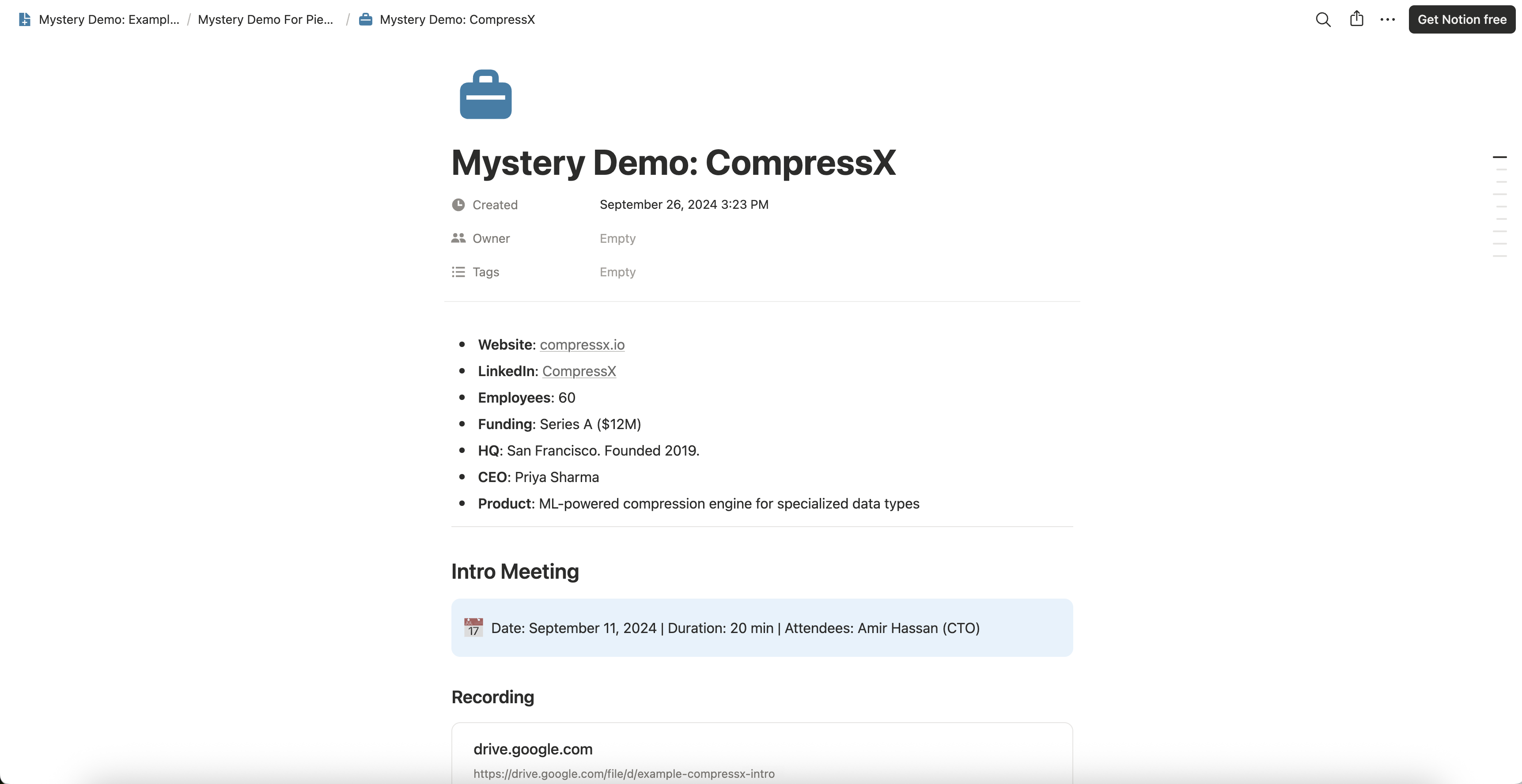
The recordings land on a shared Notion board, with a page for each rival holding its calls, transcripts and the team’s analysis. Below is the top of one rival’s page on Mystery Demo’s example board, which is invented (a real board is built from that client’s own calls). It shows the rival’s facts, the first meeting and its recording, which is what every line on a card points back to.
What Your Reps Hold Before the Next Call
For your reps, the recordings become battlecards where every line links to the recorded moment. Each line is short and carries three things:
Short matters as much as sourced. A LinkedIn article about one enablement leader’s team put the limit plainly: “A rep sitting twenty minutes out from a technical call won’t open three documents in SharePoint and read them properly.” One line with a timestamp asks far less of that rep.
With a board like that behind each rival, the last three rows of the table fill in on your rep’s side, each with the minute it was said or shown. One call shows what one rep told one buyer, in one scenario, on one day. When the same remark comes up again on comparable calls, it starts to say something about the rival, and the card marks which lines rest on a single call.


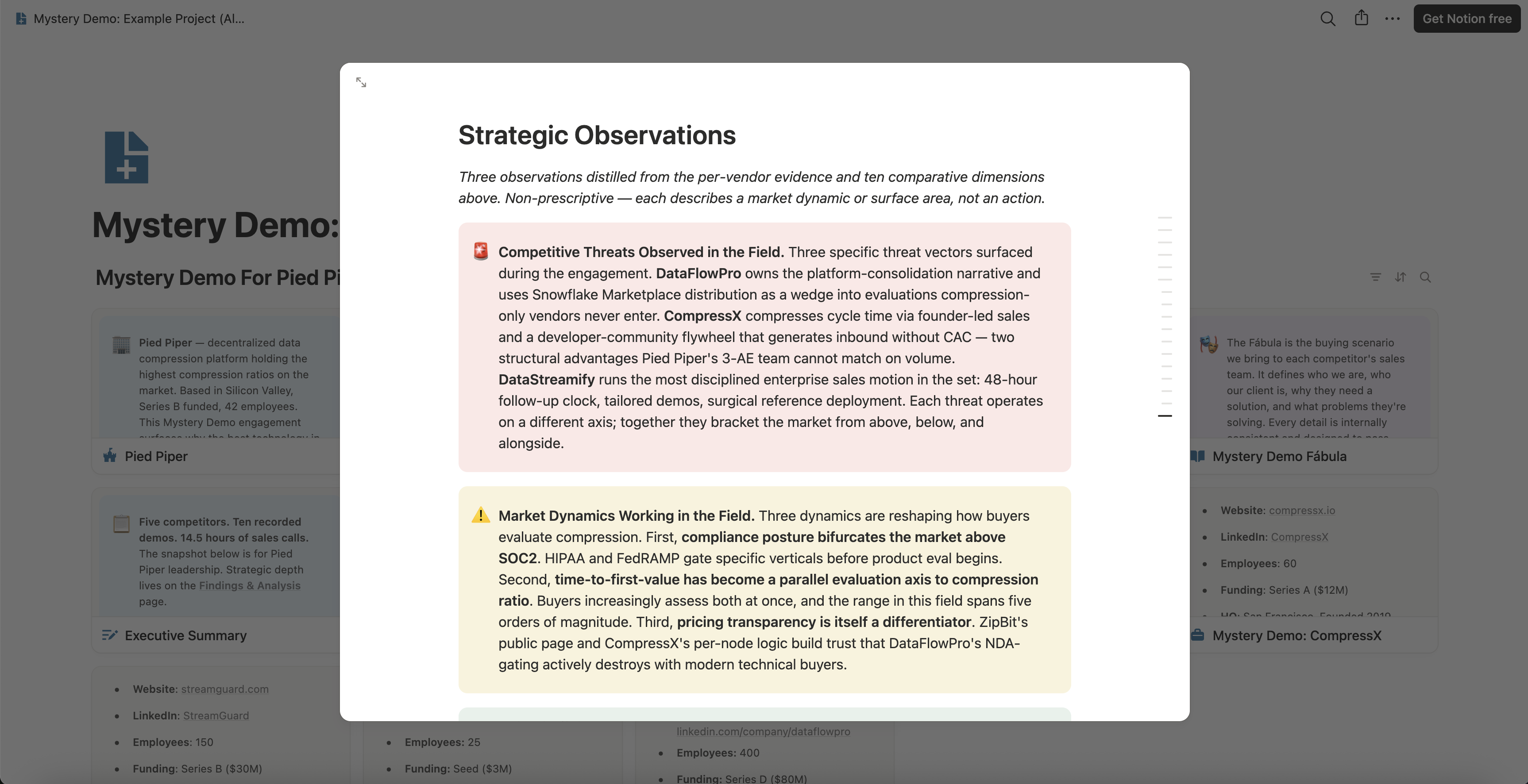
Behind the cards sits the analysis. Below is the Strategic Observations page from the same invented board, where the team sets out how each rival competes against the client, using what it said on its calls. A rep’s answer to each rival starts there.
Why not send your own reps to take the rival’s demo? A team that shops its own rivals gets recognized, or gets the generic tour instead of the call a real buyer gets. Mystery Demo’s operators have sold B2B software themselves, so they know the question that gets a rep off the script.
Every finding comes back as a recording with a timestamp, at a flat €499 per competitor with everything included, and one rival takes one to two weeks. If your buyers keep quoting one rival back to your reps, start there: an intro call with the Mystery Demo team is where we agree on that rival and the buying scenario to bring to its calls.
Ask Your Reps How They Know What a Rival Quoted
Where a buyer has taken a rival’s demo and your rep has only public pages, the buyer holds the facts that decide the comparison. No number of slides will hand those facts to your rep. Hearing the rival’s calls will.
You can test it in your own team this week. Ask three reps these questions about your biggest rival:
If the answers rest on a pricing page, a guess or a buyer’s memory of the call, the gap is in your deals too. Hand that rival to us on a short intro call, and we will take its calls as a buyer like yours, answer the first two questions for your reps, and make the recording the answer to the third.


