
Yes, you can mystery shop a competitor’s enterprise sales team, up to the point a credible buyer reaches before a real procurement begins. That usually takes in discovery, the demo, the technical deep dive, the security answers a rep gives on the call, and often an indicative price.
Procurement, the contract and anything a vendor shares only under an NDA stay out of reach. No stage is guaranteed either, because each vendor decides how far it takes a buyer. For a sales team that keeps losing enterprise deals to the same competitors, the useful question is how far a project gets at each stage.
Mystery Demo does this work for software companies, at a flat €499 per competitor. Its team books competitors’ real sales demos as a credible buyer, asks the questions a serious evaluation would ask, and hands back every call recorded, with an analysis of what each competitor said.
How Far a Buyer Gets at Each Stage
Enterprise vendors sell in recognizable stages, though not always in the same order. At each stage, the vendor either offers something in conversation or asks for a commitment before it says more.
A credible buyer can reach what a vendor offers in conversation: answers, demonstrations and a price for its situation. A commitment means an NDA, a procurement process or a contract, and a mystery demo stops there.
| Stage | What a credible buyer can usually reach | What usually stays out of reach |
|---|---|---|
| First call and qualification | A meeting, when the buyer fits the customers the competitor sells to, and the rep’s qualifying questions | A meeting the vendor declines, delays or hands to a team that sells to smaller companies |
| Discovery | The questions the rep asks, and the ones the rep keeps coming back to | Anything the rep decides not to raise |
| Demo | The product as the rep shows it to this buyer, live or only described | Features the rep declines to show |
| Technical deep dive | Answers on architecture, integration and deployment, often from a sales engineer | Test environments or documents released only under an NDA |
| Security questions | The rep’s answers on certifications, where data is stored and who can access it | Security reports shared only under an NDA, and a completed security questionnaire |
| An indicative price | Usually a price or a range for the buyer’s situation, with the terms the rep names, though not in every case | The final negotiated price |
| Procurement and legal | Nothing: a project stops before this stage | Redlines, the signed contract and the procurement process itself |
The NDA line holds at every stage, not only near the end. Mystery Demo never signs an NDA, so whatever a vendor releases only under one stays with the vendor, whether it comes up on the first call or in the deep dive. A project also stops before the point where a real buyer would choose a vendor, sign or pay, because Mystery Demo never buys the product it evaluates.
On many enterprise deals, the formal security review comes after that choice. In G2’s survey of 1,038 B2B decision-makers in June 2026, 50% of enterprise buyers, at companies of 1,000 to 5,000 employees, named IT security review as their biggest delay after choosing a vendor. The security answers a project can reach are the ones a rep gives on calls, before any vendor is chosen.
A vendor offers those answers, demonstrations and prices only to a buyer it believes is worth its time.
Getting Past an Enterprise Rep’s Qualifying Questions
Enterprise vendors save their sales engineers and their pricing conversations for deals they expect to close. A buyer who looks too small for them gets turned away on the first call, or handed to a team that sells to smaller companies.
A sales team that tries to shop a competitor under its own name has a different problem. The rep recognizes who is asking, and the evaluation ends there or turns into the generic tour.
A study of an enterprise competitor has to arrive the way a real enterprise buyer would. That is how Mystery Demo runs every project, in five stages:
When the evaluation calls for it, the team also asks to meet a competitor’s product team, its engineers or an executive, and the fixed fee covers those meetings.

Everything the project collects lands on a Notion board, a shared workspace with one page for each part of the work. Below is the Research Objectives page of our public example board, where the company and every competitor are invented. A real project’s board is built from that client’s own calls.
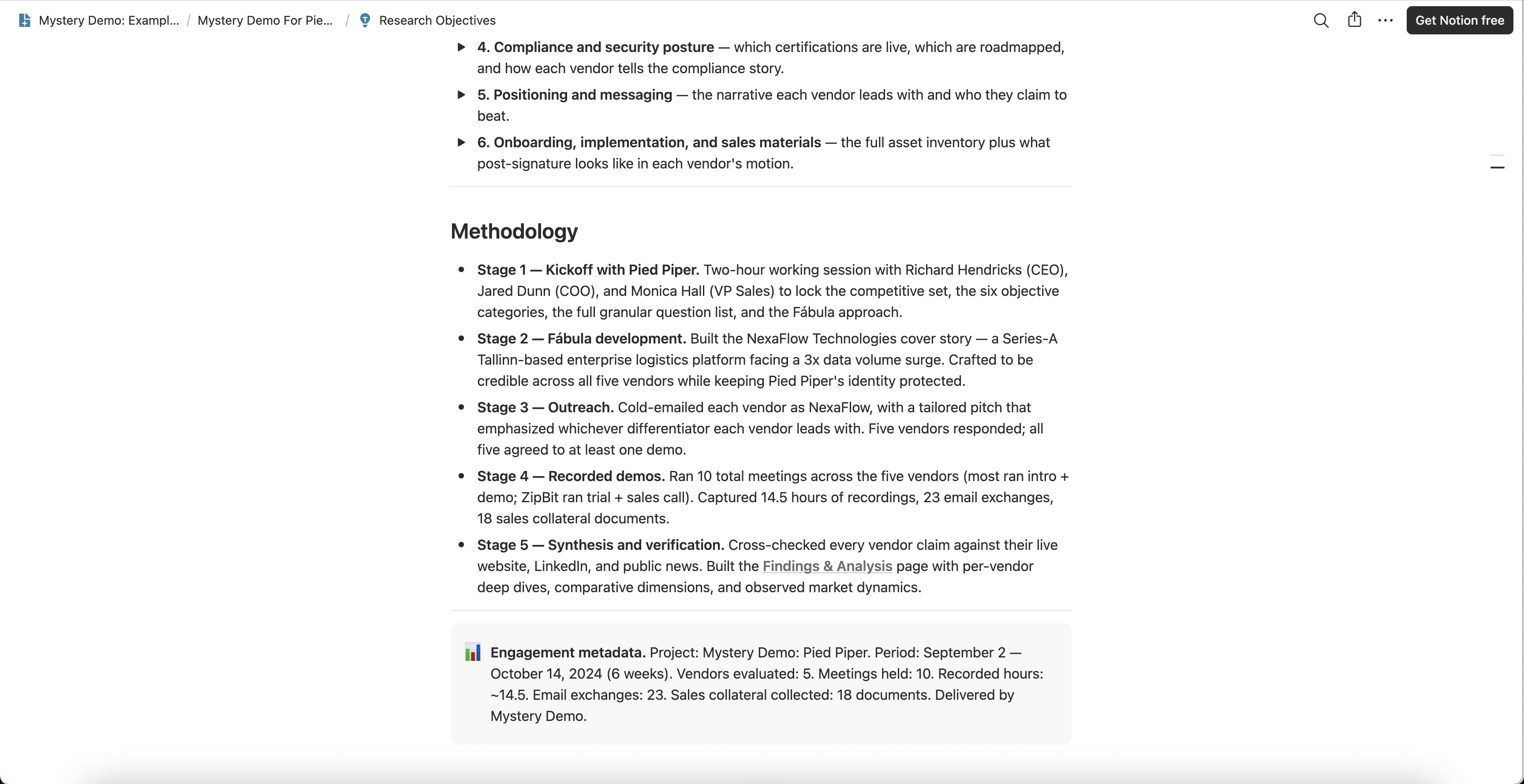
Kickoff writes the objectives at the top of this page, and the five stages under them are how a project answers each one. Compliance and security posture is among them: which certifications a competitor holds, which are only planned, and how its rep tells that story to a buyer.
The last stage checks every claim a rep made against what the competitor publishes. A competitor’s website and its analyst briefings say what it wants the whole market to believe, while its deep dive and its pricing call are where it answers one buyer’s hard questions. Those are the answers your buyers bring to your reps.
What Comes Back From an Enterprise Project
For a sales team, the first thing to open is the sales scorecard, a table on the board’s Executive Summary page. It grades each competitor’s sales motion: how fast it replied, how well it ran discovery and the demo, how straight its answers were, and how well it followed up.
Here is that scorecard on the same invented board. Beside some grades, a short note says what decided them, and on an enterprise project those notes are where a competitor’s request for an NDA gets recorded.
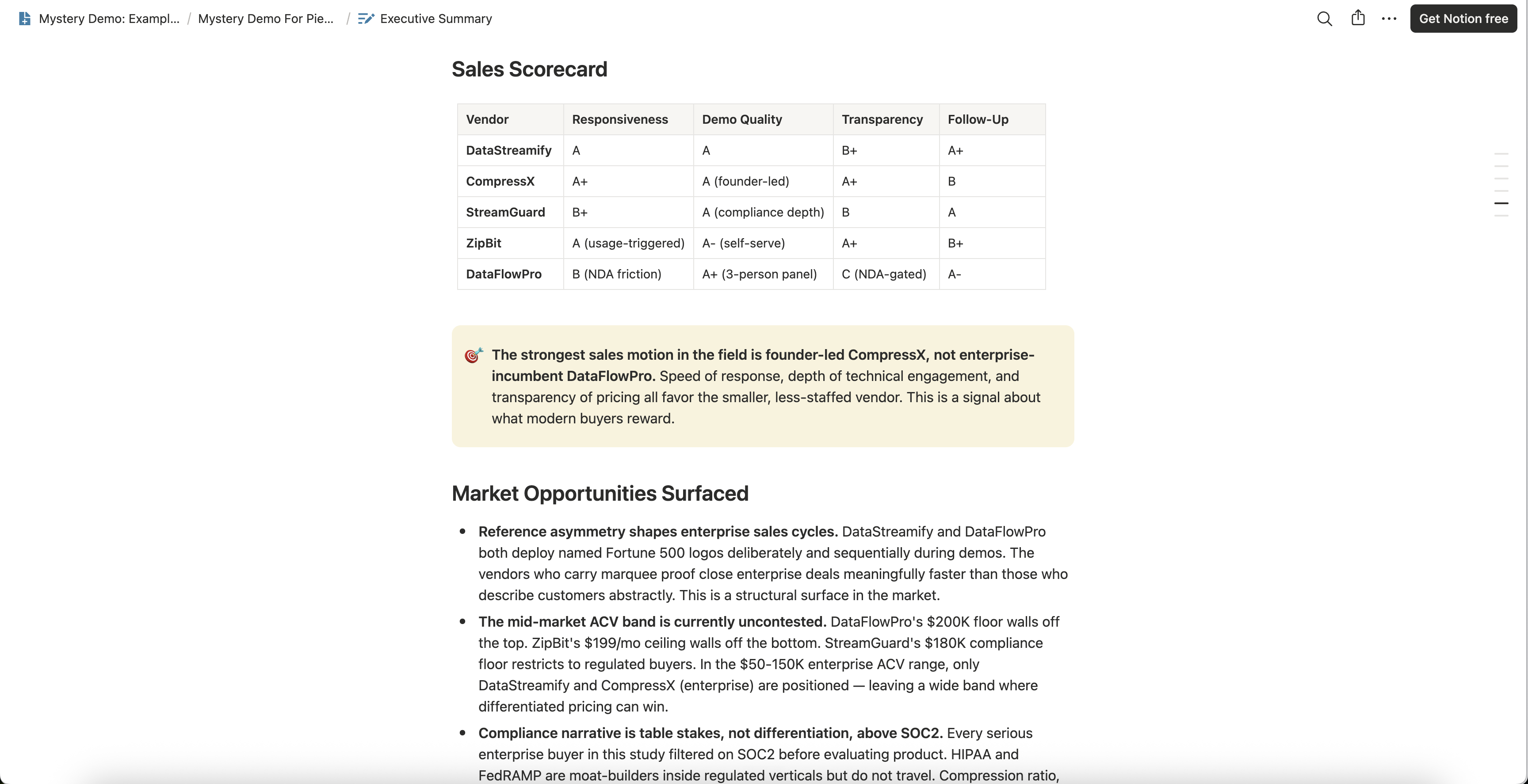
The grades show your reps where a competitor will be strong in front of an enterprise buyer, and where its process leaves an opening, such as a security answer it gives only under an NDA. Behind each grade, the board keeps the evidence a rep can check:
An enterprise project’s calls can also be graded stage by stage, the way the table at the top divides the sale. We drew the example below for three invented rivals in laboratory software. It is an illustration rather than a page of the board, and every rival, grade and minute on it is made up.
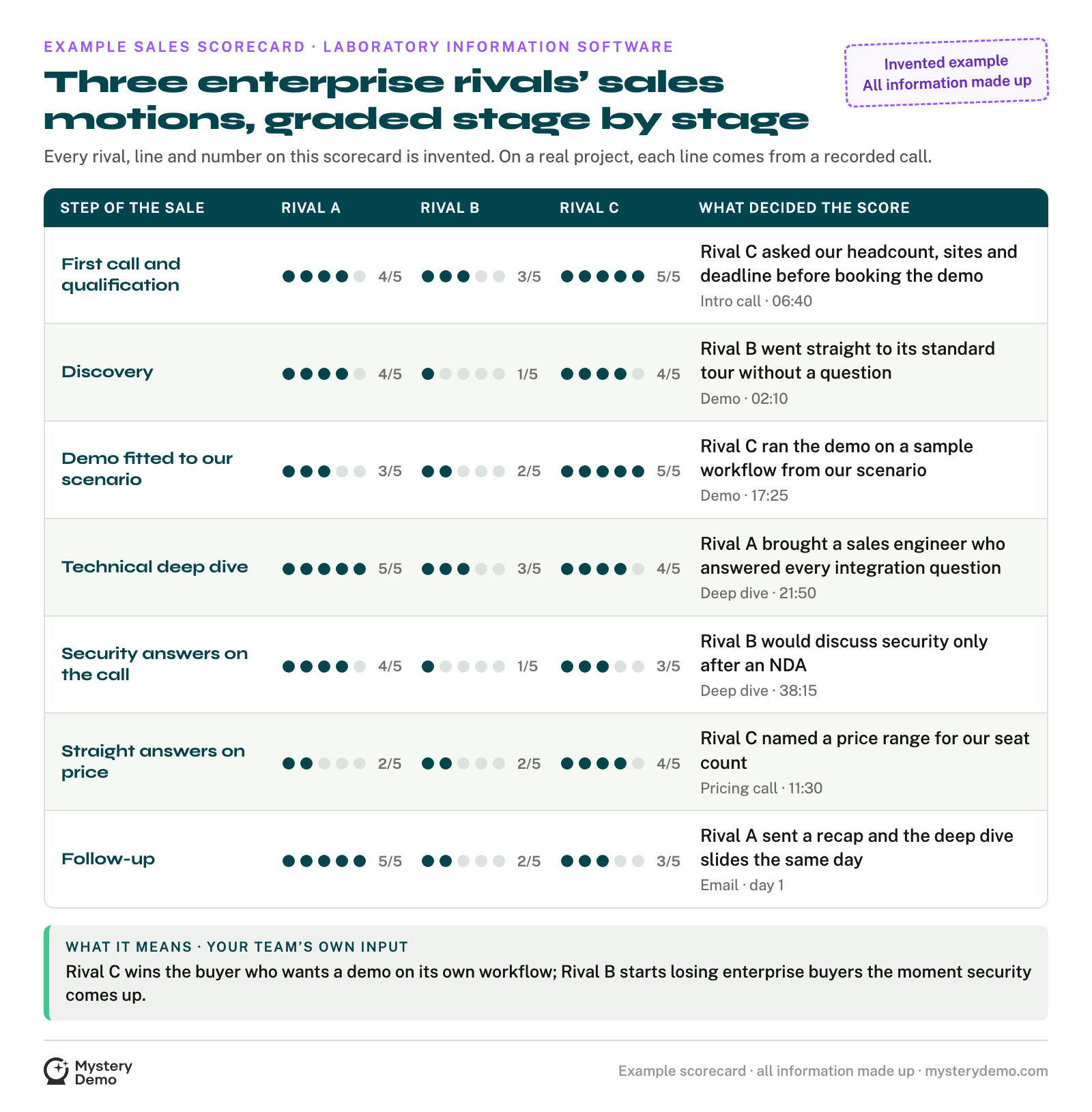
On a real project, each reason carries the call and the minute it came from. With that minute, a rep can play back the moment instead of trusting someone’s summary of it.
Grades like these are only as good as the questions behind them. Operators who have sold B2B software themselves run these calls, so they know the question that pulls an enterprise rep off the script, and they can hear when an answer has been rehearsed.
Grading that whole motion, from the first reply to the last follow-up email, is the work of competitor sales tactics research. The flat fee covers all of it, from the buying scenario to the board, with no second invoice.
One competitor takes one to two weeks. A landscape of six to fifteen competitors takes four to eight weeks, because the calls run in parallel.
Name the enterprise competitor your reps meet most on an intro call with the Mystery Demo team. We will take its sales process as far as it lets a credible buyer go, and tell you plainly where the project stopped and why.
Start With the Stage Where Your Deals Slip
Your reps compete against what an enterprise competitor says before anything is signed: its answers, its demonstrations and its prices. A project reaches that stretch, as far as the competitor takes a credible buyer.
The place to start is the stage where your own deals slip most:
Bring that stage and that competitor to a first conversation with us. We will say plainly whether a project is likely to reach what you need, before you spend anything.


