
Most battlecards are built for the buyer’s end user, the person who will use the product every day. They say how a competitor’s features compare with yours and what its demo leaves out. Then the deal reaches finance, security, IT and the executive who signs off, and each of them asks your rep a question about that competitor the card cannot answer.
One sales leader put it plainly on LinkedIn: “Your battlecard was written for a room that does not exist.” The real room is bigger than the card assumes. Forrester’s 2026 research on business buying puts the typical purchase at 13 internal stakeholders, plus nine influencers from outside the company.
An enablement team can close that gap with one short battlecard for each role on the buying committee, meaning everyone at the buyer with a say in the deal. Mystery Demo fills in the competitor’s side of each card. It books your competitors’ real sales demos as a credible buyer and records what each one says, all the way through the technical deep dive and the pricing conversation.
Each Role Asks Its Own Question About a Competitor
A card written for the end user answers one question: does this competitor’s product do my job better than yours? Everyone else on the committee tests the same competitor on different terms. As another seller wrote on LinkedIn, “Security is not persuaded by the same argument that won over the end user.”
Finance is in more of these decisions than it used to be. In G2’s survey of 1,038 B2B decision-makers, run in June 2026, finance’s involvement in buying committees rose from 31% to 46% in a single year. For finance, as one marketer wrote, value “may mean payback”: what the competitor costs in the first year, and when it earns that back.
Security review is where a chosen vendor waits. In the same survey, IT security review was the biggest single source of delay after a vendor had been picked, named by 39% of buyers and by half of enterprise buyers at companies of 1,000 to 5,000 employees. A card written for the end user has nothing for either conversation, and a competitor’s public pages leave the same gap:
| Role | What anyone can read | What only comes out in the sales cycle |
|---|---|---|
| Finance | Plans and list prices on the pricing page | The price, terms and discount offered to this buyer |
| IT | A wall of logos on the integrations page | How the connection to this buyer’s own systems works, and who builds it |
| The executive who signs off | Case studies and customer logos | What the rep says when asked what happens if the rollout goes wrong |
| Security | Certifications and policies on the security page | Which documents the rep sends, when, and what it says about the gaps |
Those pages answer every buyer at once. The questions each role brings to your rep are narrower, and the competitor answers them in its sales cycle, one buyer at a time.
Say the buyer’s finance lead asks your rep: “They offered us the first-year price for two years. Can you match that?” Your rep hears the offer as the buyer chose to tell it, without its conditions, and the competitor’s own words were said on a call nobody from your team joined.
How Mystery Demo Collects Each Role’s Answers
A first demo is built around the person who will use the product. In a normal sales cycle, security and integration questions get their full answers in the technical deep dive, and cost and terms in the pricing conversation, both after the demo. A buyer who stops after the first demo never reaches either.
Mystery Demo goes through that whole cycle as the buyer, on your behalf. The team asks every role’s questions itself, as one buyer, wherever in the cycle they fit. A project runs in five stages:
When your own team books a competitor’s demo, the competitor’s rep recognizes your email domain or gives the generic tour, and the deep dive and the pricing conversation rarely follow. A believable buyer, fitted to each competitor, gets the whole cycle. The calls are run by operators who have sold B2B software, and they know the follow-up that makes a rep send the document or admit it is not ready.
All of it lands on a board, a shared Notion workspace with a page for each competitor and pages that compare them. One of its first pages is the question list from kickoff, shown here on our public example board, where the client and every competitor are invented. On a real project, the board is built from the calls made for that client.
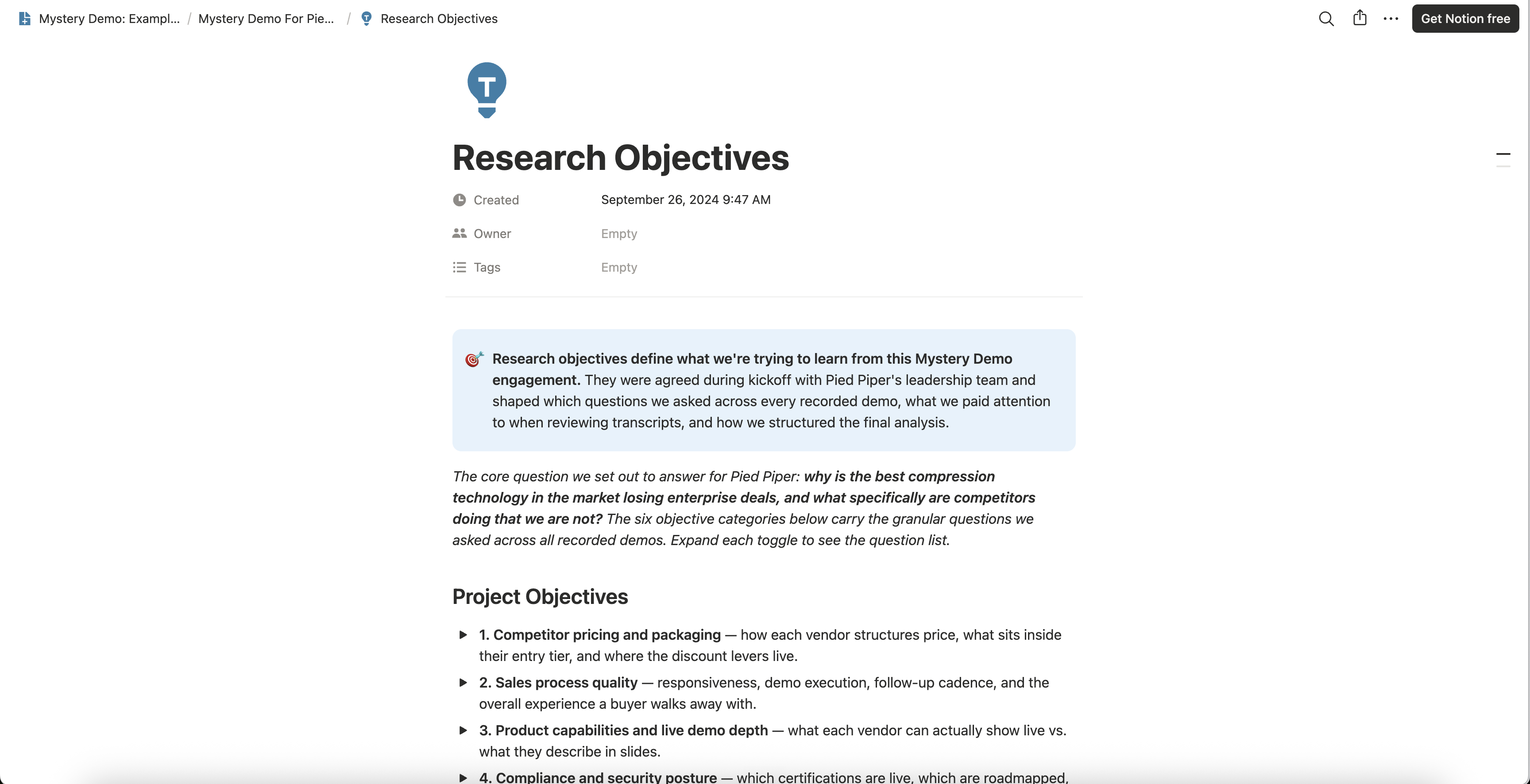
Each objective on that page is a group of questions asked of every competitor. Three of them line up with roles on a committee: pricing and packaging for finance, what the product shows live for the end user, and compliance and security posture for the security reviewer.


The answers are then set side by side on Findings & Analysis, the board page that compares the competitors one topic at a time. On the invented example board, the security topic is a table with a row for each competitor and a column for each certification and for where customer data is stored.
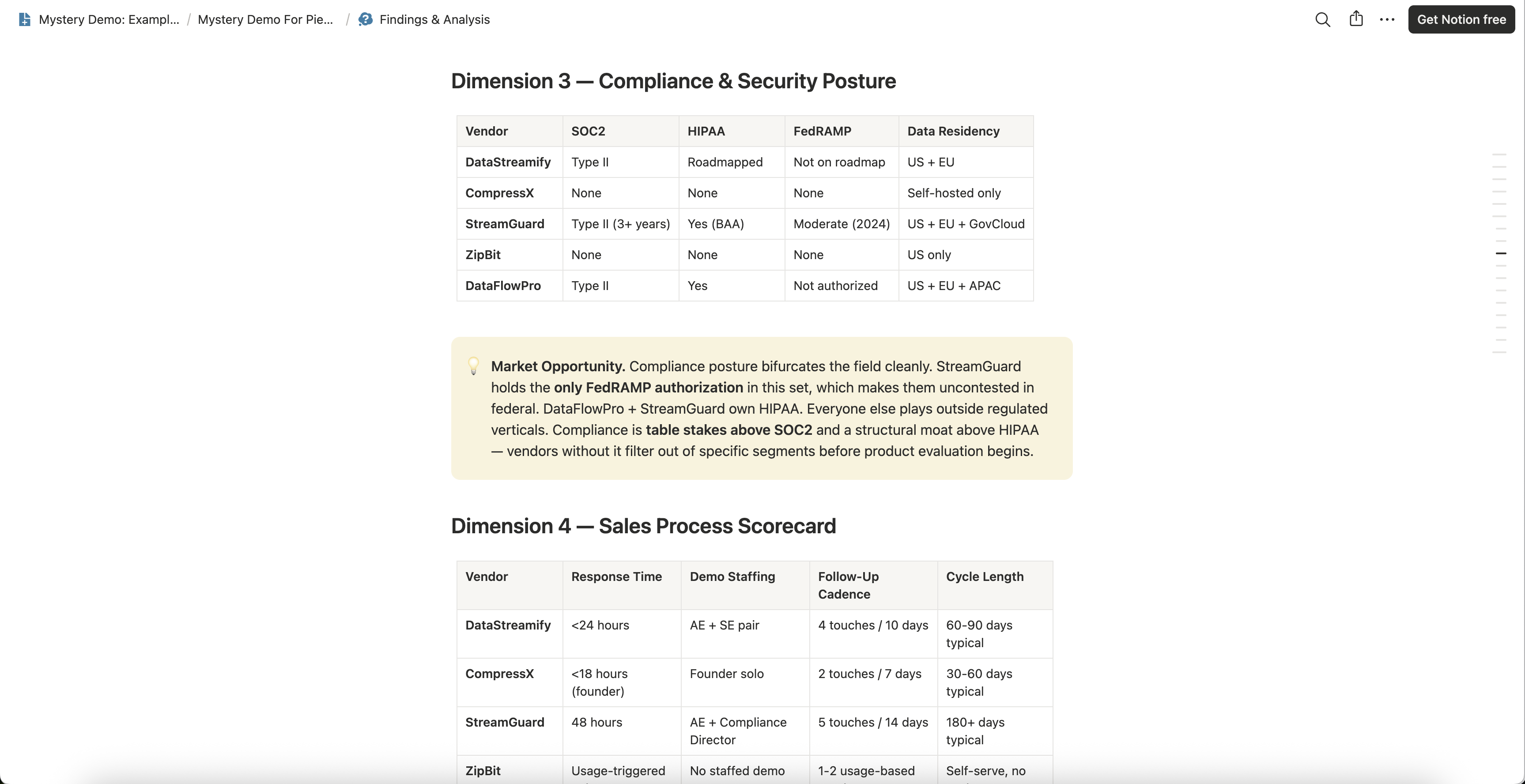
Each row is where a security card for that competitor starts. Certifications are partly public, so the board checks what each rep claimed against the competitor’s own site. What a rep promised to send, and whether it arrived, is kept on that competitor’s page with the call and the minute.
Mystery Demo charges a flat €499 per competitor, with nothing added, and one competitor’s board is ready in one to two weeks. If one competitor keeps turning up in your enterprise deals, tell us which one on a first call, and we will go through its whole sales cycle as the buyer. With those answers on the board, each role’s card can be written.
One Short Card for Each Role
Here is the whole set as one table, one row per role. The table is yours to copy, and the competitor column is the part that needs the calls.
| Role | What they ask about a competitor | What the competitor said, and where it is kept | The proof your rep brings |
|---|---|---|---|
| End user | Does it do my job better than what we have? | What it ran live in the demo and what it only described (board: the competitor’s page and its recordings) | The same job, run live on your product |
| Finance | What will it cost in year one, and when does it pay back? | The price, terms and discount offered, usually in the pricing conversation (board: the pricing comparison) | Your price for the same scope, and a payback case |
| The executive who signs off | Why this vendor, and what is the risk? | How it framed its value and answered questions about risk (board: the Executive Summary’s line on where each competitor wins) | Results and references from customers like this buyer |
| IT | How does it connect to what we run, and who maintains it? | How it integrates, rolls out and is supported, usually from the deep dive (board: the implementation and onboarding comparison) | Your integration details, and a customer with a similar setup |
| Security | How does it handle our data, and what can it prove? | Certifications, where data is stored, who has access, and which documents were sent, usually from the deep dive (board: the compliance and security comparison) | Your security documents, ready to send |
The third column holds what the competitor said that answers that role’s question, wherever in the cycle it came out, and not necessarily to someone in that role. The last column is your team’s own work, and the card keeps the two apart.
Each competitor line keeps the call and minute it came from, which is how every line on a competitor battlecard should be sourced. One call is what one rep told one buyer scenario, fitted to buyers like yours. When the same answer comes up on a second call, it is a claim about the competitor, and the card can say so.
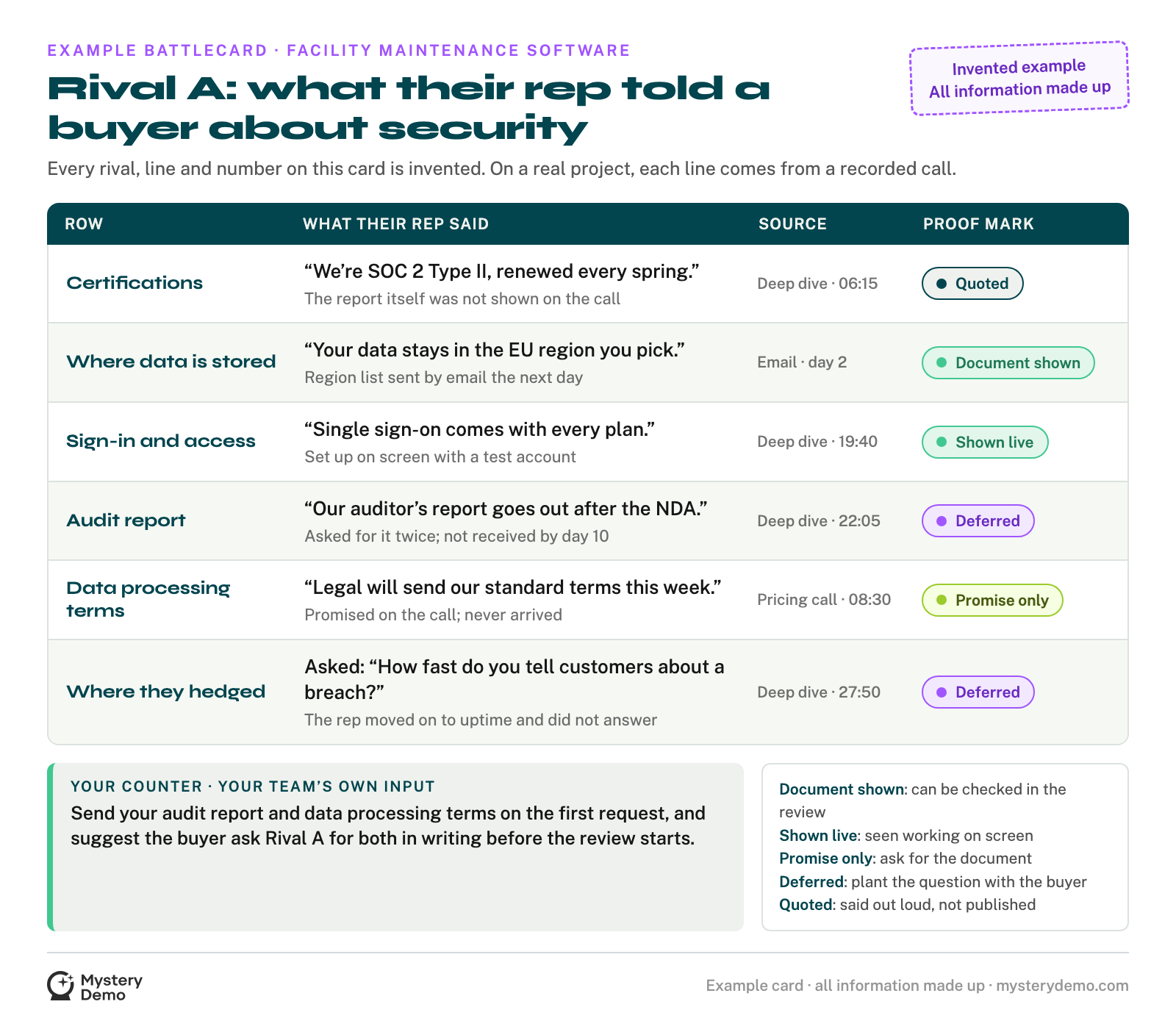
Here is what each card looks like for one invented competitor, Rival A, in facility maintenance software. Every quote, call and minute in these examples is made up.
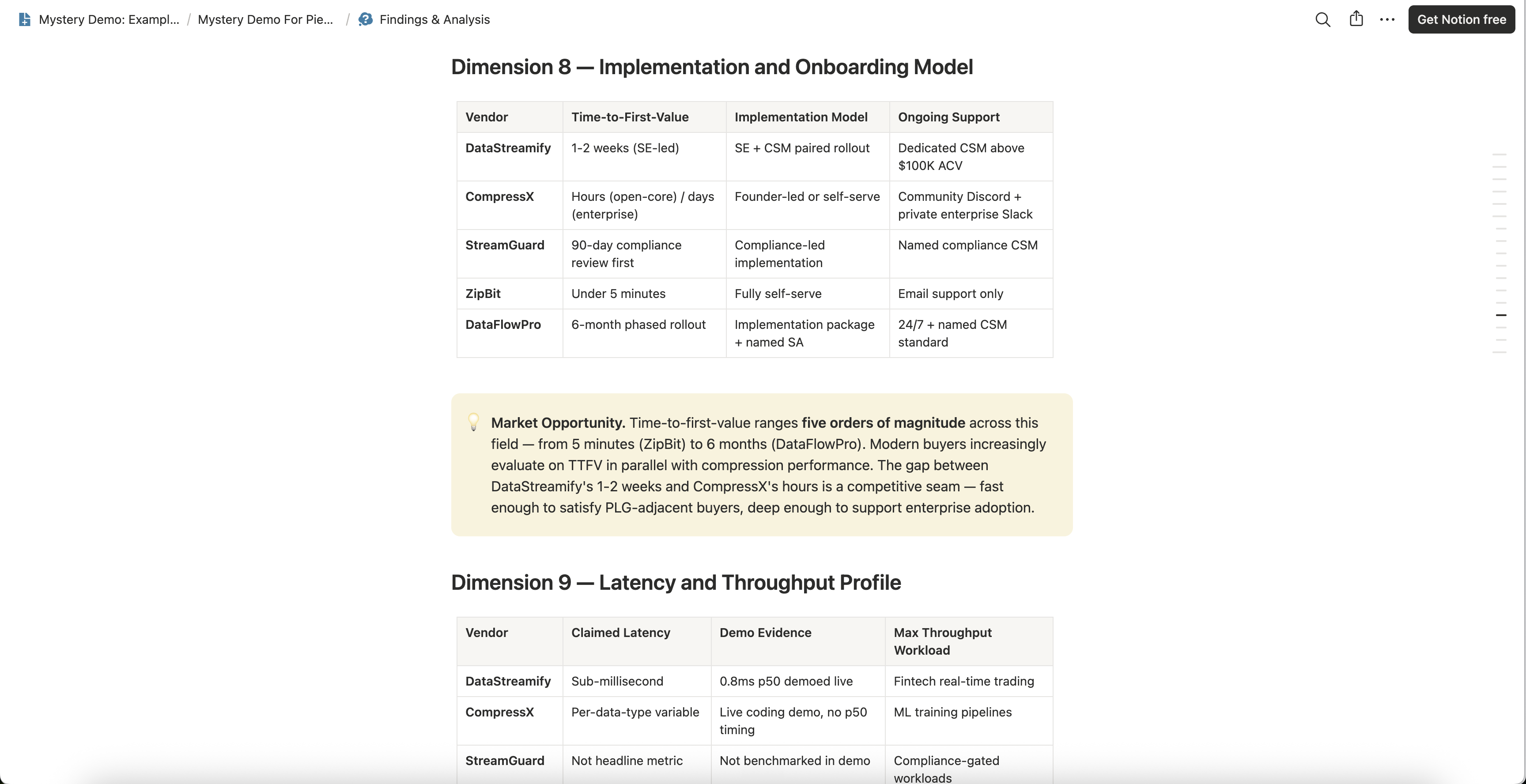
The IT card draws on the implementation and onboarding topic of Findings & Analysis, shown here on the invented example board. It sets out how long each competitor takes to get a customer running, how it rolls out, and what support comes after.
Here is Rival A’s security card in full. Every line on it is invented, and each carries the call and minute it came from and a mark for whether proof followed. On a real project, our competitor battlecard research fills a card like this for each competitor you name, every line linked to the recorded moment.
When a Competitor Changes Its Answers
Every line on these cards is only as current as the call behind it. Competitors change their answers: a certification lands, a discount policy tightens, a connector ships or slips.
You cannot re-check every card at once, and you do not need to. Your own win/loss notes and deal notes say which role stalls your deals against which competitor, so start with that card. Signs it needs new calls:
Any one of those signs is reason to run that competitor again, which takes one to two weeks. Clients also re-run a whole project one to three years later to see how each competitor moved. A battlecard written only for the end user leaves your rep improvising in front of everyone else on the committee, and any one of them can stop the deal.
Which card would your reps most like filled from real calls? Tell us the role and the competitor, and we will go through that competitor’s sales cycle as the buyer and bring back what it tells a buyer who asks that role’s questions.


