
Next year’s plan sets your prices, picks the segments you sell into, decides who you hire, chooses the product bets, and fixes the sales targets. Every one of those decisions assumes something about your competitors: what they charge, who they go after, what they ship, and how hard they fight for a deal. If nobody checks those assumptions before the plan is signed, last year’s picture of the market sets this year’s targets.
Pricing shows how fast that picture moves. Nalpeiron, which sells monetization software, surveyed 255 product and engineering leaders at B2B software companies in 2026, and 82% of them had changed their pricing or packaging in the previous 12 months.
The one-page check below puts each planning decision beside the question about competitors it depends on and the evidence that answers it, for the CEO and the revenue team building the plan. Some of that evidence never appears on a website. Mystery Demo books your competitors’ real sales demos as a buyer and hands back the recordings, with an analysis of what each one quotes, shows and promises.
The Price, the Pitch and the Offer Are Not Published
You can check a lot of the plan’s assumptions about competitors from a desk, in an afternoon. A pricing page gives the list price, release notes show what shipped, job posts show where a competitor is hiring, and case studies show the customers it is proud of.
The assumptions that move fastest are different. They turn on what a competitor tells a buyer: the price it quotes for a deal like yours, how its rep pitches against you, and what it offers to close before the quarter ends. In August 2026, Dupple, which reviews business software, counted pricing across the 377 tools it covers, and 126 of them, a third, keep at least one pricing tier behind a sales call.
For 18% of all 377, no usable price is published anywhere. Here is what a desk can tell a planning team, and what only a sales call can:
| What the plan needs to know | What a desk shows | What only a sales call shows |
|---|---|---|
| What a competitor charges | The list price, where one is published | The price quoted for a deal your size, the discount, and when it was offered |
| How it sells against you | Its homepage, its ads and its comparison pages | What its rep says about you when a buyer names you |
| What its product does | Release notes and product pages | What the demo shows working, and what the rep only describes |
The list price is the number a competitor is happy for you to plan against. Websites, review sites and analyst notes describe what a competitor wants buyers to believe. The quote, the pitch and the offer come out on the call, with a buyer on the other end.
Your buyers and your win-loss interviews pass some of those answers on later, secondhand and from memory. The first-hand version is said only inside a competitor’s sales process. Before the plan is signed, someone has to go through that process as a buyer.
How Mystery Demo Checks What Competitors Tell Buyers
Mystery Demo goes through each competitor’s sales process the way a serious buyer would. At kickoff, your plan’s open questions about competitors become the project’s question list. You also show the team your own product, so its questions sound like a real evaluation.
Then the team writes a buying scenario for each competitor: a believable company with a real reason to buy, matched to the kind of customer that competitor sells to. It books the demo through the competitor’s normal front door, like any other prospect, and records every step that follows:
Every email and quote is kept, and each claim a rep made is checked afterwards against the competitor’s website and public news. Everything lands on a board in Notion, a shared workspace your team can search, with a page for each competitor.
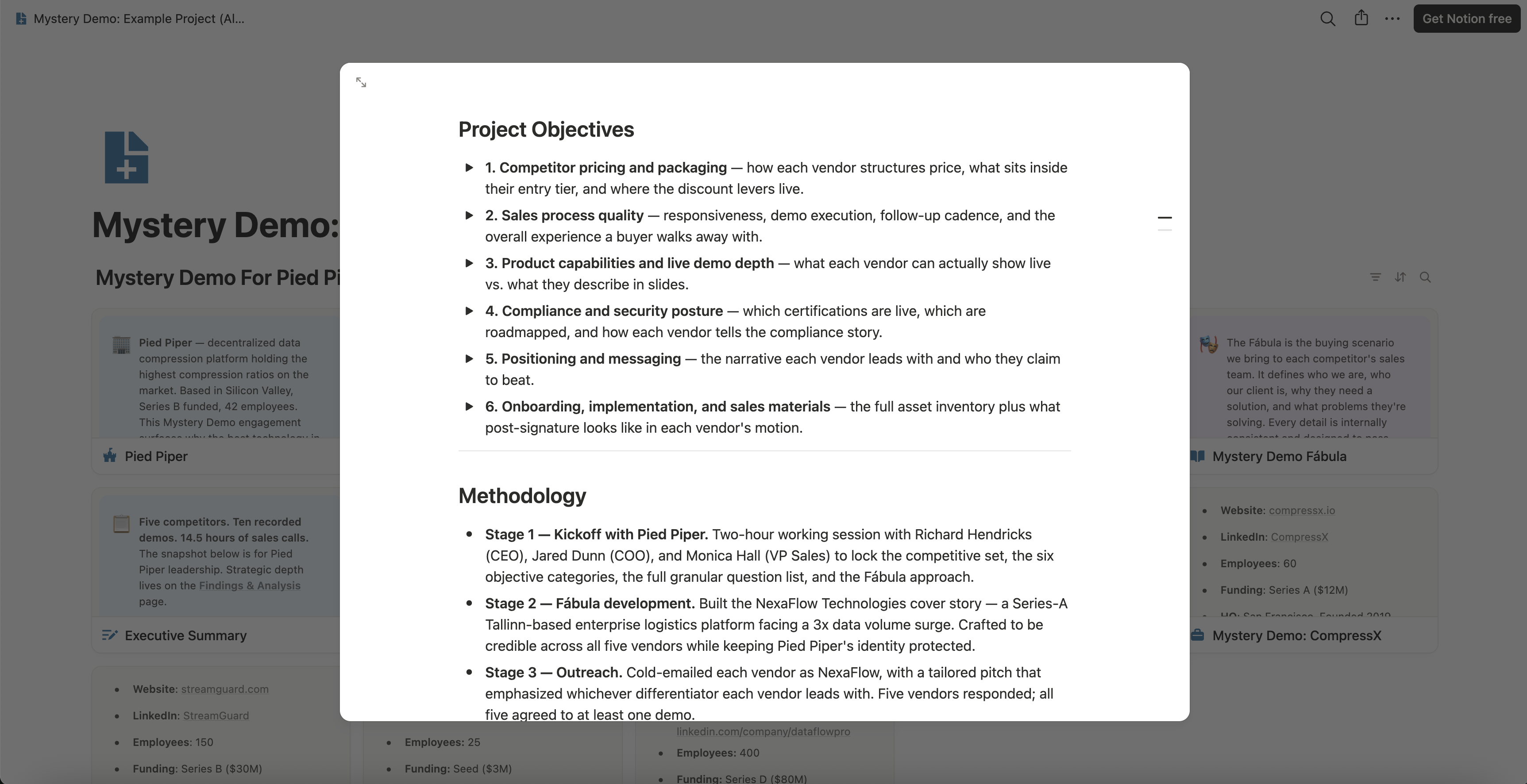
Below is the Research Objectives page of our example board, where the client and every competitor are invented. A real board is built from your own competitors’ calls. Its six objectives run from pricing and discount levers to what each competitor shows live, and on a planning project that list starts as your plan’s open questions.
Across the competitor pages, the board compares the competitors side by side. Four of those comparisons answer the questions a plan asks:
On top sits the Executive Summary, the page written for leadership and the one a planning meeting reads first. Here is part of it on the same invented board.
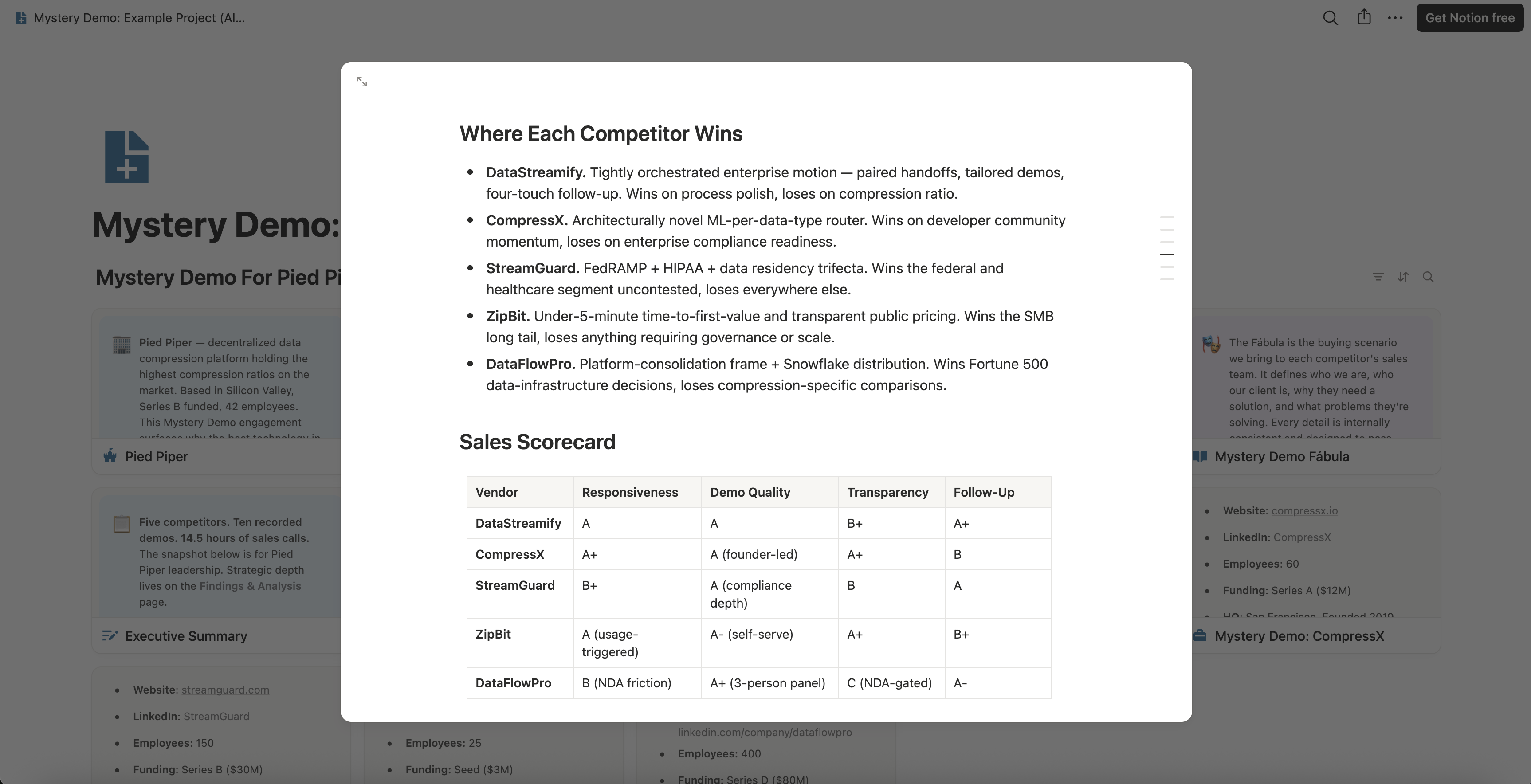
The lines on where each competitor wins speak to your target segments, and the scorecard below them speaks to how hard a deal against each one will be. On a real project, every line traces back to a recorded call.
Your own team could request these demos instead. The rep would spot your email domain, or give you the tour kept for people who will never buy.
One competitor takes one to two weeks, and a landscape of about six to fifteen takes four to eight weeks, because the demos run in parallel. A plan that rests on a whole market, not two or three rivals, needs every serious player in it seen from the buyer’s chair, and our SaaS market entry research covers exactly that. Count back from your sign-off date to see when a project has to start.
One call is what one rep told one buyer on one day. A finding becomes a planning assumption when it holds across the calls with that competitor and fits buyers like yours. Anything heard once stays marked as one call.
If your plan gets signed in December or January, tell us on a short call which competitors it is built around, and when it gets signed. We will tell you what we can bring back before that date. Your team then fills the page below from the board.
What to Check Under Each Planning Decision
The page has one row for each planning decision: the question about competitors it depends on, the evidence that answers it, and where that evidence comes from. Beside each row, the plan records the date it was checked and the source, and a row nobody checked says so.
| Planning decision | The question about competitors | The evidence that answers it | Where it comes from |
|---|---|---|---|
| Pricing | What do competitors quote a buyer like us, and how far do they move? | The price quoted for a deal your size, the discount and what triggered it, beside the list price | The pricing matrix |
| Target segments | How do competitors pitch to a buyer in the segment we want? | Their qualifying questions, their pitch, and the customers they offer as references | The messaging matrix and each competitor’s page; case studies from your own desk research |
| Hiring | Where are competitors putting people? | Their job posts, and what their reps say is coming | Job posts from your own desk research; rep promises on each competitor’s page |
| Product bets | What do competitors ship today, and what do they only describe? | What the demo showed working against what the rep only described | The feature matrix; release notes from your own desk research |
| Sales targets | How hard do competitors fight on price and terms in deals like ours? | When the discount appeared, the terms offered, and how fast and how well they sold | The sales scorecard and the pricing matrix |
Pricing. This row informs your list price and how much discount your reps may give. Write each competitor’s quote as a dated fact, and set it beside your own win-loss and margin data.
The quote shows what you are up against, and your own numbers show what you can afford. On the board, every competitor’s pricing sits in one table, shown here on the invented example board: each competitor’s pricing model, its lowest price, how openly it shared its price, and what the price grows with.
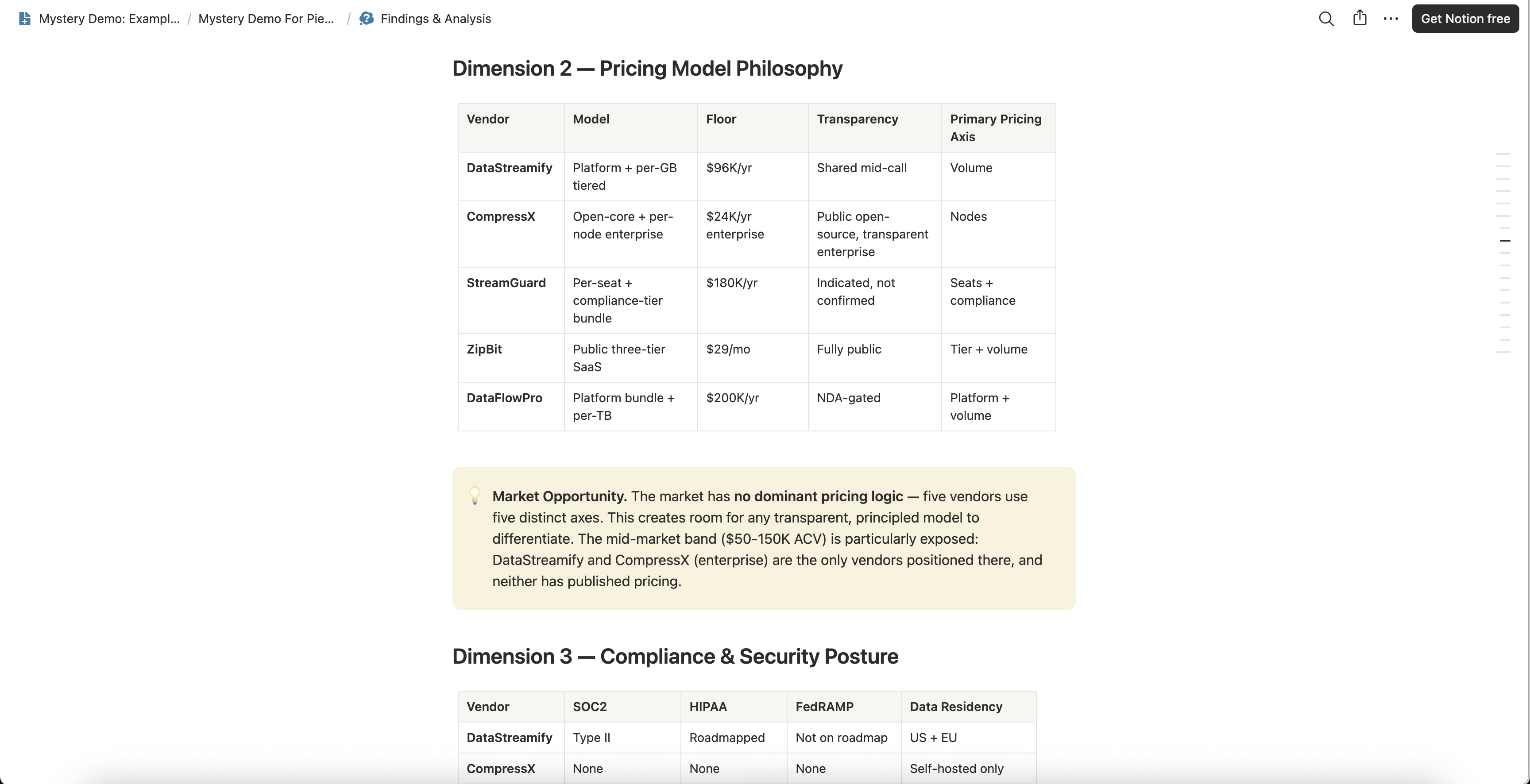
Here is the pricing row filled in for three competitors, with every competitor and every number invented:
| Competitor | What it quoted | Checked | Still open |
|---|---|---|---|
| Rival A | $38 a seat for 60 seats, with 12% off for signing before year end | 4 November, from the pricing call | What it quotes a buyer twice your size |
| Rival B | No price on the first call; $41 a seat in the follow-up email | 6 November, from the email | Whether the quote holds past December |
| Rival C | Only the list price on its website | Not checked | Everything beyond the list price |
Target segments. A competitor’s qualifying questions show which buyers it wants, and the references its rep offers show where it claims to be strong. Neither proves which segments it wins, so read them beside your own win-loss records, segment by segment, before you choose where to go first.
Hiring. Job posts and a rep’s promises show where a competitor intends to compete, and the board keeps each promise as a promise, with the minute it was said. Treat that as context for your own hiring plan, never the reason for it: your headcount rests on your pipeline plan, and the competitor may never follow through.
Product bets. This row informs which bets you make and which gaps you point to in your own pitch. Write each feature the way the feature matrix marks it:
A feature nobody showed is a question for the next call, not proof the competitor cannot do it. A roadmap promise stays a promise until it ships.
Sales targets. This row informs the win rate and the average discount your targets assume. Compare each competitor’s discount timing, terms and follow-up speed with your own deal history, and leave open what it does in deals you never see.


That page is true on the day the plan is signed. The competitors keep selling after that.
Keep the Page Current After Sign-Off
The plan locks once a year, and competitors change their price and their pitch whenever they like. A public tracker kept by Gravity logged 45 list-price increases that nine software vendors tied to AI between September 2024 and October 2026, 15 of them in 2026.
Re-check the pricing and sales-target rows first, whenever a competitor changes its pricing page, buyers start repeating a new line from its reps, or deals you used to win start going its way. A new pricing page gives you the new list price, and only new calls give you the new quote and the new pitch. One competitor takes one to two weeks, so you can re-check just the one that moved, and a full project is usually re-run one to three years later.
A plan built on last year’s picture of competitors sets this year’s targets against deals that have already changed. Before yours is signed, name the competitors it depends on. We will go through each one’s sales process as a buyer and bring back what it quotes, shows and promises today, ready for every row on the page.


