
When a competitor gives the first demo, your buyer judges yours against one you never saw. By the time you join the call, they know four things about it that you do not:
The steps below are for the account executive giving the second demo, and the enablement lead who coaches them: what to ask the buyer, what to check, and what to show. One step depends on how that rival runs its demo for a buyer, and no seller can see that from their own desk.
Mystery Demo finds that out for you. It books competitors’ real sales demos as a credible buyer, records every call, and hands back what each rep showed, skipped and promised. Step 2 explains how, and Step 1 starts with the buyer you already have.
Step 1: Ask the Buyer What the Other Demo Showed
Before you share a screen, spend your discovery questions on the demo the buyer already had. Skip the background they already gave the rival. One sales intelligence vendor’s guide to discovery warns reps against “gathering basic context the prospect has already shared with three other vendors.”
Ask about the other demo instead, and read each answer for what it tells you and what you do next:
| Ask the buyer | What the answer may tell you | Your move |
|---|---|---|
| “What did you see that mattered to you, and why?” | The capability they care about, and the reason behind it | Show how you handle that need in their own workflow, then ask what proof would settle it. |
| “What did they say it would cost, and what was included?” | The price and scope you will be compared against, as the buyer remembers them | Ask whether they have it in writing. Never guess the number back at them. |
| “Was there anything you asked to see that they didn’t show?” | A request the demo left open, which is not proof the product cannot do it | Write it down as a question to come back to, and show it yourself if you can. |
| “Who else was in that demo, and what did each of them ask about?” | Who already holds a view, and about what | Plan one point for each person, and ask who should join your demo. |
| “Did they say anything about other options, including us?” | A claim you may have to answer, or nothing about you at all | Answer each specific claim with evidence, never with a counterattack. |
| “What would you need to see from us to feel confident?” | The open question your demo has to settle | Build the demo around it, and say back what you heard. |
Treat every answer as the buyer’s account, not a recording. It holds what impressed them and what they chose to share, and memory has already filtered it. Set the rival’s demo beside what the buyer passes on to you, and the gap is plain:

The rival decided everything on the left, from the story it told to what ran live and what stayed on a slide. The buyer can tell you what stuck. Everything else the rival chose to show, skip or say in passing, you either guess or find out.
Step 2: Find Out How That Rival Runs Its Demo
You can guess what the buyer saw, or you can know how that rival runs its demo for a buyer like yours, because someone took it as a buyer and recorded it. If your team already has a recording of that rival’s demo, or win/loss notes from deals against it, open them before the call. If not, tomorrow’s demo rests on the buyer’s answers, and the recording is for the next deal against this rival.
If the rival trains its reps on one demo, a recording shows you roughly what your buyer saw. If it tailors each demo, the recording still shows what it leads with for a buyer like yours. Either way it tells you what to check, never what this buyer heard.
A recording of a rival’s demo shows five things you can then check with this buyer:
Mystery Demo makes that recording. It asks for the rival’s demo the way a serious prospect would, through the normal front door, with a buying scenario fitted to what that rival sells. Operators who have sold B2B software take every call, from discovery to the pricing conversation, and ask the questions that pull a rep off script.
Every call is recorded, and every claim a rep makes is checked against the rival’s website and public news. The analysis lands on a board, a shared workspace with a page for each rival, like this one from our public example board. The client and every competitor on that board are invented, and a real project’s board is built from that client’s own calls.
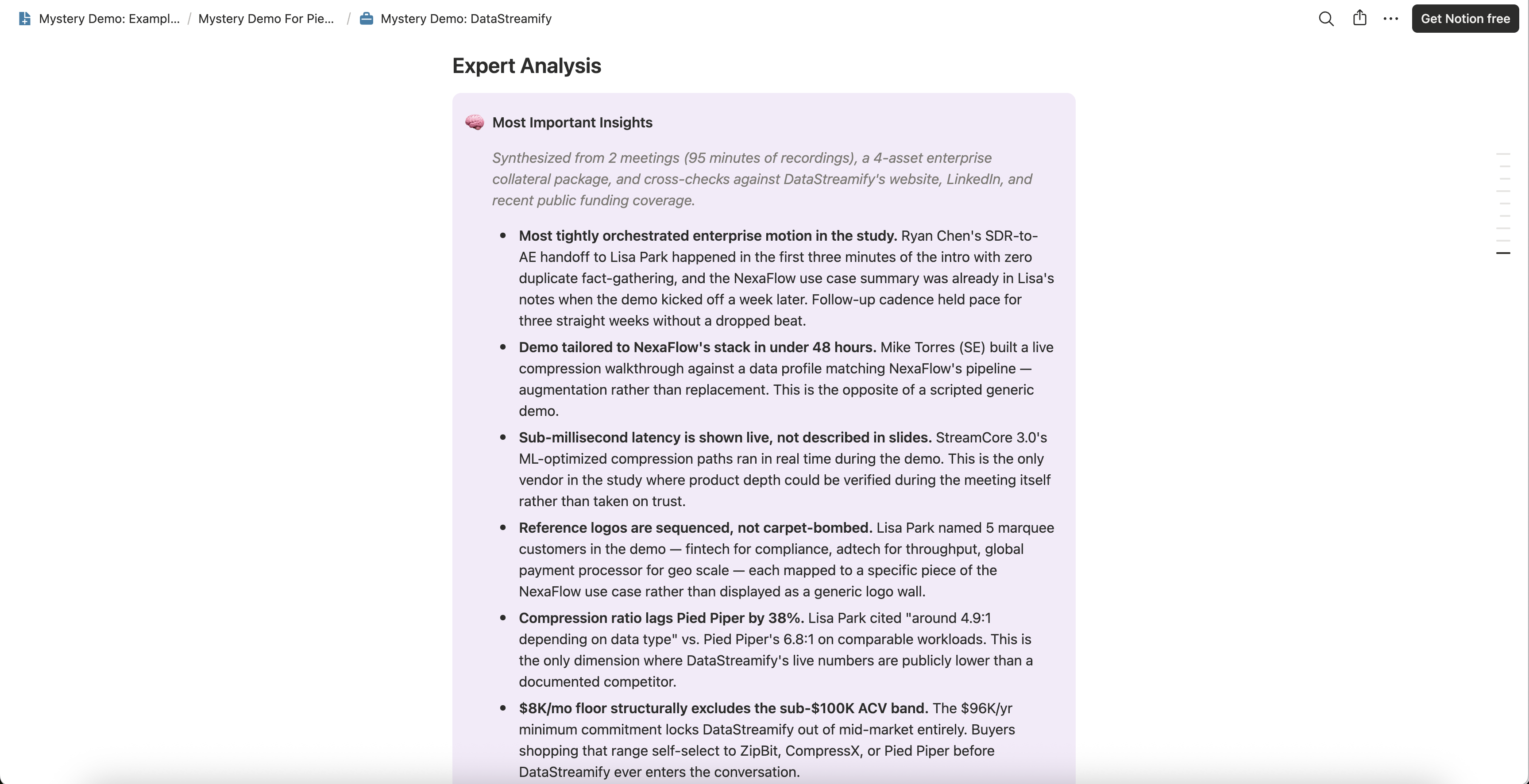
The line under the heading names what the analysis rests on: the meetings, the recordings, the collateral and the checks against public pages. Each insight below it then says what the rival ran live and what it only described, which your buyer may not be able to tell you.


Across rivals, the board’s Executive Summary, the page written for leadership, carries the sales scorecard. It grades each rival’s sales motion step by step, from how fast it replied to how it followed up, and a rep uses the grades to choose which rival’s calls to open first. The recordings and transcripts sit on that rival’s page, each finding with the minute it was said.
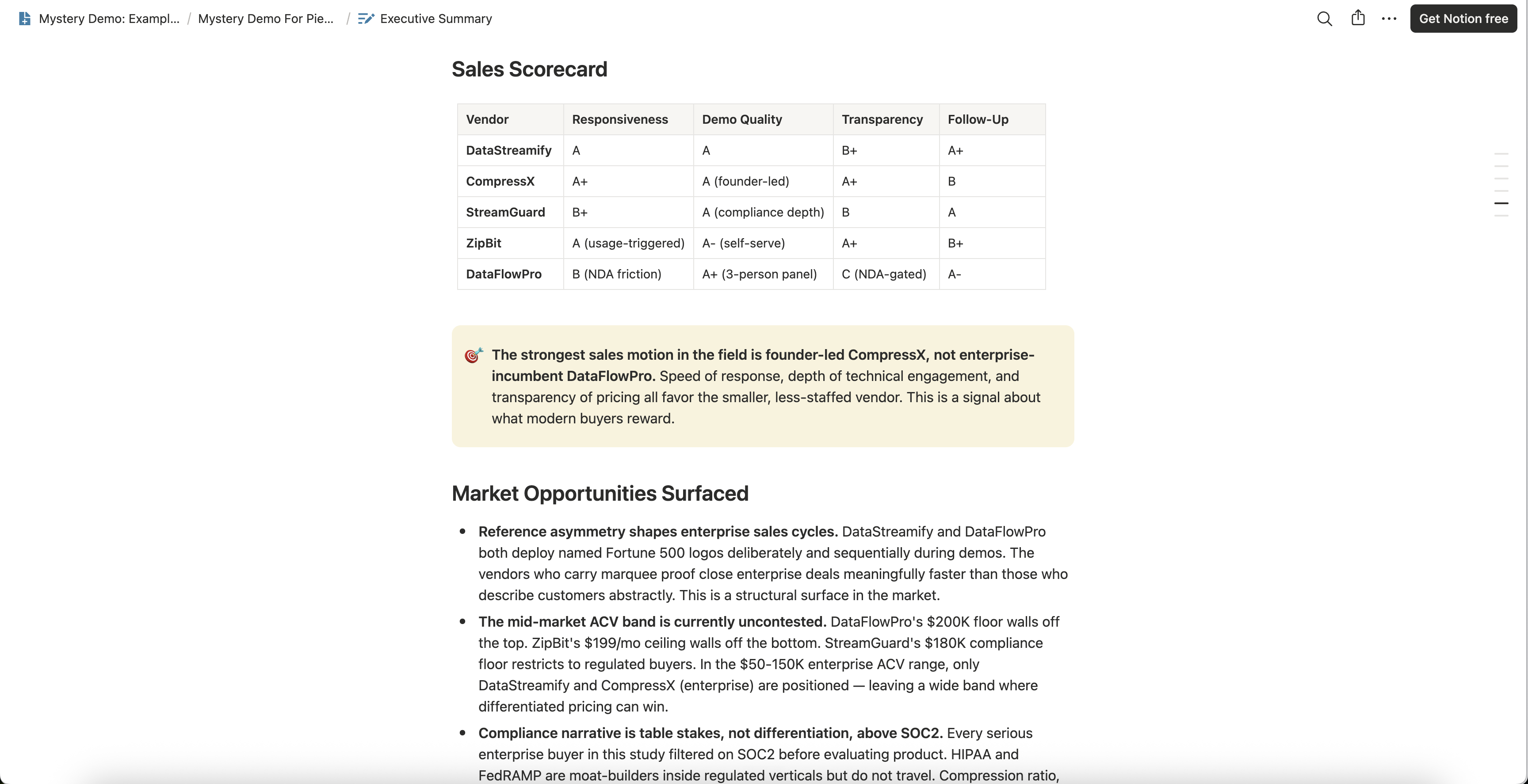
For a second demo, the demo quality and transparency columns matter most, because they cover what the rival showed and how straight it was about price. A rival’s website and product tour are worth reading too, and they show what it wants every buyer to see. Set the three sources side by side, and each one stops somewhere:
| Source | What it tells you | Where it stops |
|---|---|---|
| The rival’s website and product tour | What the rival wants every buyer to believe about it | What its rep says when a buyer pushes back |
| Your buyer’s account of the demo | What stuck with them, and what they chose to share | What the rival skipped, or said in passing |
| A recording of the rival’s demo | What its rep led with, ran live, only described and promised, each with its minute | What this buyer heard on their own call |
Your own team is the wrong buyer for that demo, because a rival’s rep recognizes a competitor or gives it the generic tour. A believable buyer, fitted to each rival, gets the real demo, with the discovery questions, the deep dive and the price conversation that come with it.
Mystery Demo charges a flat €499 per competitor, with nothing added, and a single rival’s board is ready in one to two weeks. That is too late for tomorrow’s call and in good time for the next deal against the same rival. The rival’s whole sales motion, from the first reply to the last follow-up, is what our competitor sales tactics research covers.
Which rival keeps getting the first demo in your deals? Tell us on a short intro call, and we will take its demo as the buyer, so your team has the recording before you meet that rival again.
Step 3: Turn the Recording Into Questions for This Buyer
Without a recording, build the questions from the buyer’s answers in Step 1. With one, add a question for each thing the rival led with or only described, and for each claim the buyer repeated to you. Word each one so it asks, never so it tells the buyer what they saw:
Put them on one card the rep can hold in the call, built around what the buyer will say. Here is one filled in for Rival A, an invented rival in fitness studio software, where every line is made up. Each row reads across, from what the buyer repeats to what Rival A’s rep told them on the recording, and the answer your rep gives.
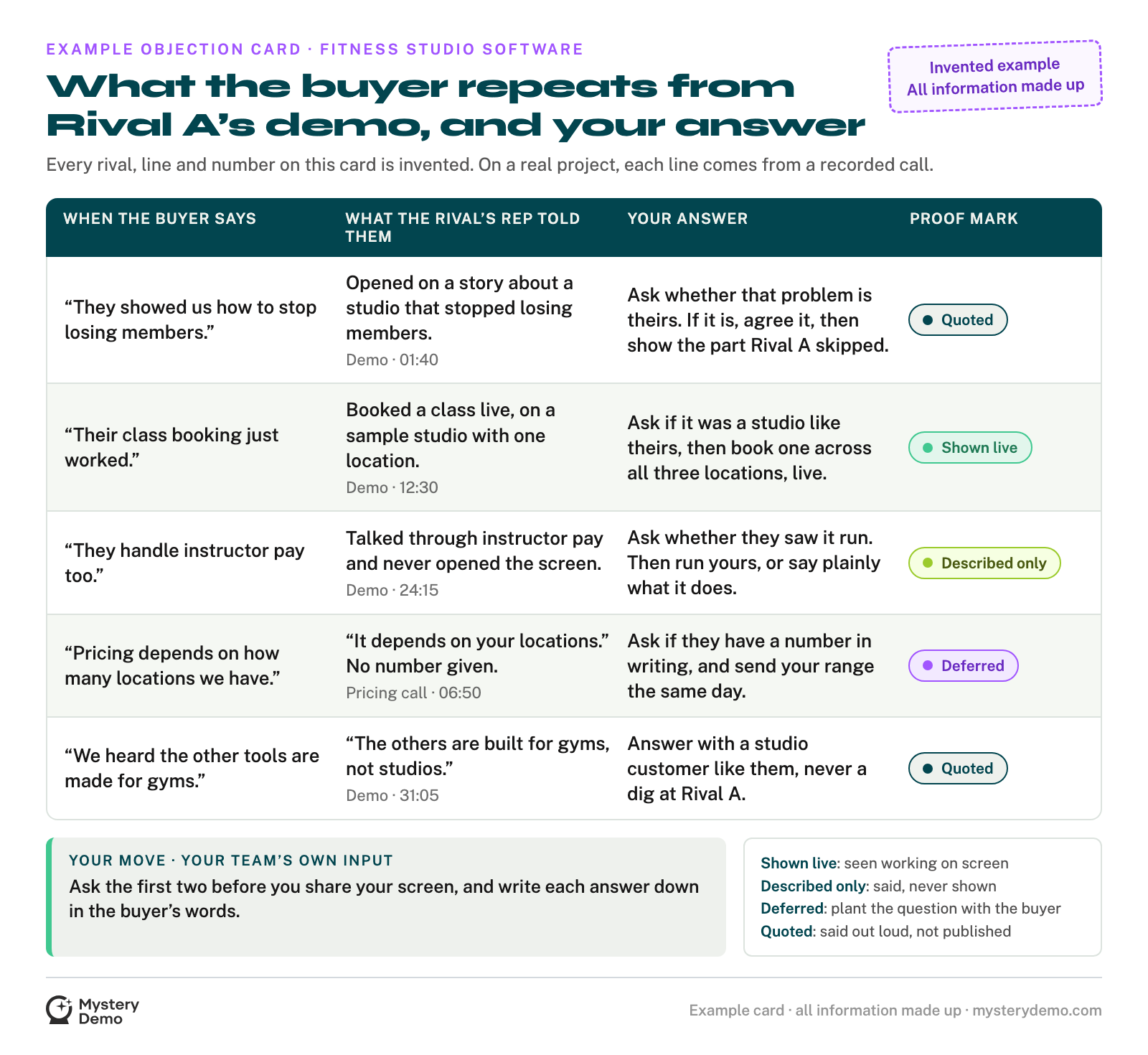
The buyer’s answers to those questions are what the decision should rest on, so write them down in the buyer’s own words.
Step 4: Agree What the Decision Rests On
Read the buyer’s answers back to them. Agree the two or three things the choice should rest on for both vendors, and which one matters most. Start from what the buyer named, because a criterion only you care about is a feature list with a new title.
One product marketer’s advice on beating a rival with a slicker demo was to make “clear how someone should evaluate the category.” Here you do the same for one buyer, out loud, before you show anything.
For the invented studio on the card, the agreed criteria might read:
Each line is a test both vendors now face, including the one that went first. The criteria also decide what you show, and in what order.
Step 5: Build Your Demo Around Those Criteria
Open on the criterion that matters most to the buyer, and leave the tour out. A seller of ERP software put the risk plainly in a sales forum: “if we start with an ‘overview demo’ that opp is going to be really hard to win.” The same seller said that showing the features that solve a buyer’s three or four biggest problems first gives them “a good to great chance.”
In the demo itself:
For the enablement lead, the same recording is also a clip to coach your reps against, one step of the demo at a time. The next rep who goes second then already knows how that rival opens.
Before That Rival Goes First Again
The buyer’s account tells you what stuck. A recording of the rival’s demo tells you what it was built to show, skip and promise. Together they replace the guess with questions you can check, and the checks decide the demo.
You will meet this rival again, and it may go first again. Tell us which rival it is, and we will be the buyer in its next demo, so your rep walks into the next deal against it knowing:
Start with a short call about that rival, and from there the demo, the recording and its page on your board are ours to deliver.


