
When a buyer goes quiet after a good demo, the easy reading is that they lost interest, and the easy response is another follow-up email. Stalls are common in B2B buying: Forrester’s 2024 research on business buying found that 86% of B2B purchases stall at some point in the process. The better question is what the buyer is doing instead of replying.
One sales practitioner, writing on LinkedIn in September, argued that deals go quiet after the demo “because that is the exact moment the decision leaves the person you have been selling to.” That is one possible cause among several, and each one can be told apart by a clue in your own notes and a question you can ask.
Your own deal rarely shows one thing: how your competitors follow up after their demos. A buyer comparing vendors sets your follow-up beside theirs, and you only ever see yours. Mystery Demo gets that evidence by taking your competitors’ sales demos as a believable buyer and keeping everything that follows, dated, on a board your team shares.
After the Demo, More People Review the Purchase
More buyers now say evaluation takes longer than any other stage. In G2’s 2026 survey of 1,038 B2B decision-makers, 40% called it the longest stage of their buying journey, up from 36% a year earlier. And the person who watched your demo is not the only one judging it.
The Reality Department, a B2B marketing firm, asked 250 UK buyers at companies with more than $50m in revenue about a recent purchase, in August 2026:
The people who join do not always agree. In a 2024 Gartner survey of 632 B2B buyers, 74% of buying teams showed unhealthy conflict during the decision.
So your contact may be waiting on people you have never met, or losing an argument you never heard about. Any clue from the deal deserves a question before you act on it. What could the silence mean in one of your own deals, and what would you ask?
How to Tell What the Silence Means
Six possible causes run through the buyer research above and through what sales practitioners write about deals that stall after a demo. Each can leave a clue in your demo notes or your CRM, and each has a question that tests it.
| Possible cause | A clue worth checking | A question to ask, and a move to try |
|---|---|---|
| No next step was agreed | The demo ended on “we’ll be in touch,” with no date or task in the buyer’s own words | “What would you need to see before you take this to your team?” Then end the next demo on a step the buyer names, with a date. |
| More people are reviewing it | Questions arrive from people you have not met, such as the buyer’s security team | “Who else is looking at this, and what do they need from us?” Then send each of them what they asked for. |
| The buying group disagrees | Your contact passes on objections from colleagues, then stops replying | “What concerns came up when you shared it?” Then give your contact answers to those objections. |
| Approval is under way | You were already chosen, and the questions now are about terms, timing, or payment | “Where is this in your approval process?” Then answer finance’s questions directly and quickly. |
| The demo missed a priority | The buyer’s top priority from discovery never came up on screen | “Did you see what you needed on that priority?” Then offer a short session on that one thing. |
| The buyer is comparing vendors | Questions about features or terms you never raised, or a request to match something | “Who else are you looking at, and what stood out?” Then find out what the buyer saw elsewhere. |
The rows are possibilities, and several can be true at once. A question your contact never answers leaves the cause open, and an answer narrows the list without proving why the deal stalled. The move after each question is our suggestion, not a finding from the research.
Two of the rows have numbers behind them:
One seller in a Reddit thread about deals going quiet after a good demo put the last row bluntly: “Easy answer is the other option felt better to them and they don’t want to tell us.”
Your notes, your CRM, and a direct question can test every row from your side of the deal. None of them shows what the other vendors did after their demos, which is the other half of the last row.
Your Deal Rarely Shows What the Other Vendors Sent
If your buyer is comparing vendors, the others did not stop selling when your contact went quiet. Each ran its own demo and is running its own follow-up, which can mean a recap, a proposal, a case study, a call from a manager, or an offer with a deadline. Your buyer sees all of them side by side, and your team sees one.
| What happened | Your team sees it | Your buyer sees it |
|---|---|---|
| Your demo | Yes | Yes |
| Your follow-up | Yes | Yes |
| Each rival’s demo | No | Yes |
| Each rival’s follow-up | Only what the buyer passes on | Yes |
A buyer may forward a rival’s email or mention its offer, and that helps. It is still one piece, passed on second-hand, by someone with a reason to use it in a negotiation.
Nothing public fills the rest. A rival’s website shows the sales process it wants buyers to expect, and review sites, competitive intelligence tools, and analyst notes only see what has been published or remembered. The follow-up itself goes only to the buyer, one email at a time.
To know how your follow-up compared with one rival’s, you would need that rival’s follow-up observed directly, with every touch dated. Unless a buyer passed pieces of it on, that record is not in your deal. A past buyer’s inbox stays out of reach, but anyone who becomes a buyer in a rival’s process now can see its follow-up whole.
How to See a Rival’s Follow-Up From the Buyer’s Side
Mystery Demo goes through a rival’s sales process now, as a buyer like yours, and records what that rival sends. It cannot say why a past deal went quiet, but it gives your team a real follow-up to set its own against.
For each rival you name, the work runs the same way:
All of it lands on a board in Notion that your team shares, with one page per rival and pages that set the rivals side by side. Below is one rival’s page from our public example board. The client and every competitor on it are invented, and a real project’s board is built from that client’s own calls.
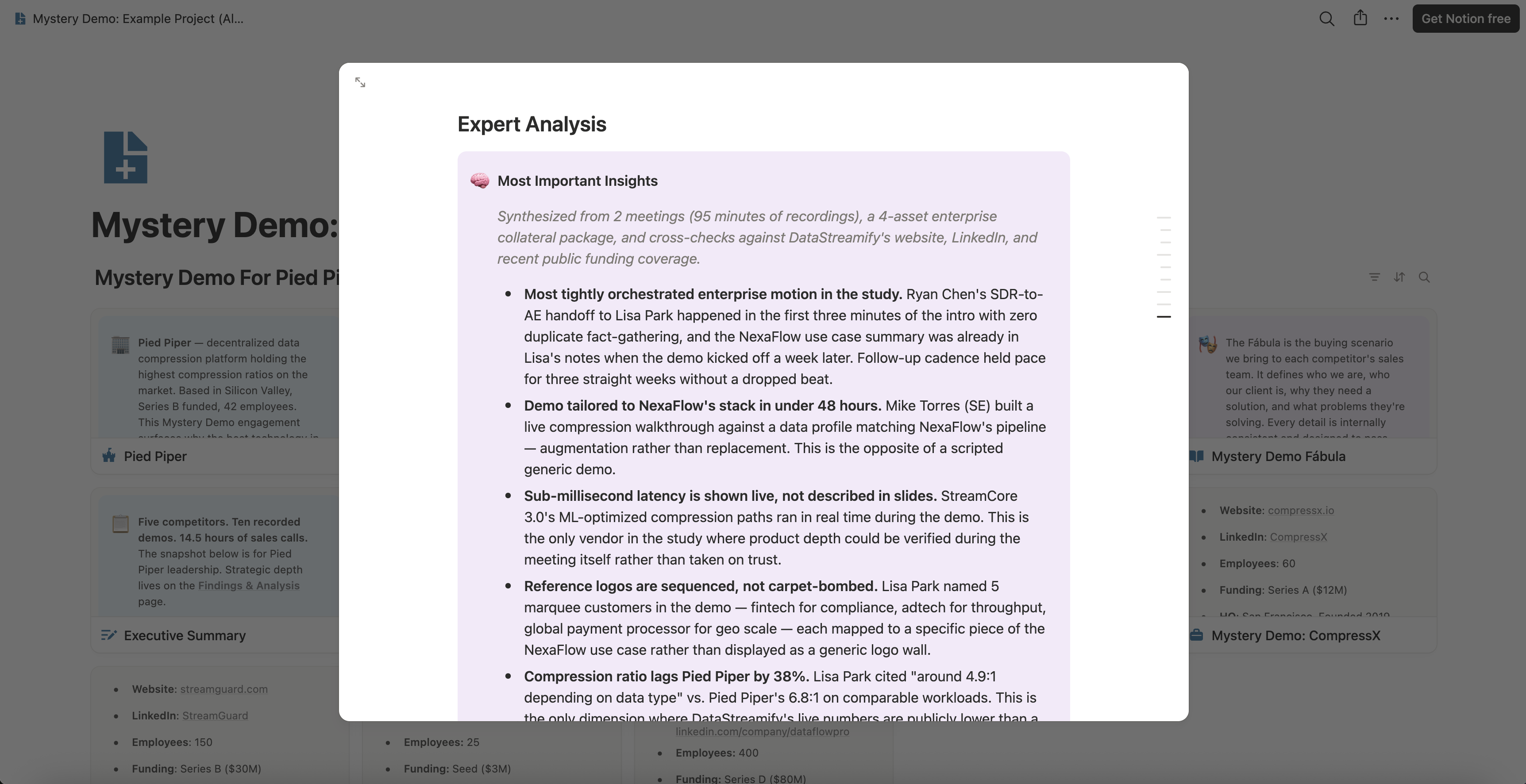
Start with the line at the top. It lists what this rival’s analysis was built from: the meetings, the recordings, the sales documents the company sent, and the public pages it was checked against. A rival’s follow-up emails land on the same page, each with its date, so an insight about the follow-up can point at the message behind it.
One page shows what one rival sent. A follow-up looks strong or weak only next to the others, so it gets graded against them.
Every Rival’s Follow-Up, Graded on One Scorecard
The sales scorecard grades each rival’s sales process column by column, and follow-up is one of the columns. It sits on the Executive Summary, the page of the board that leadership reads first. On the same invented board, it looks like this.
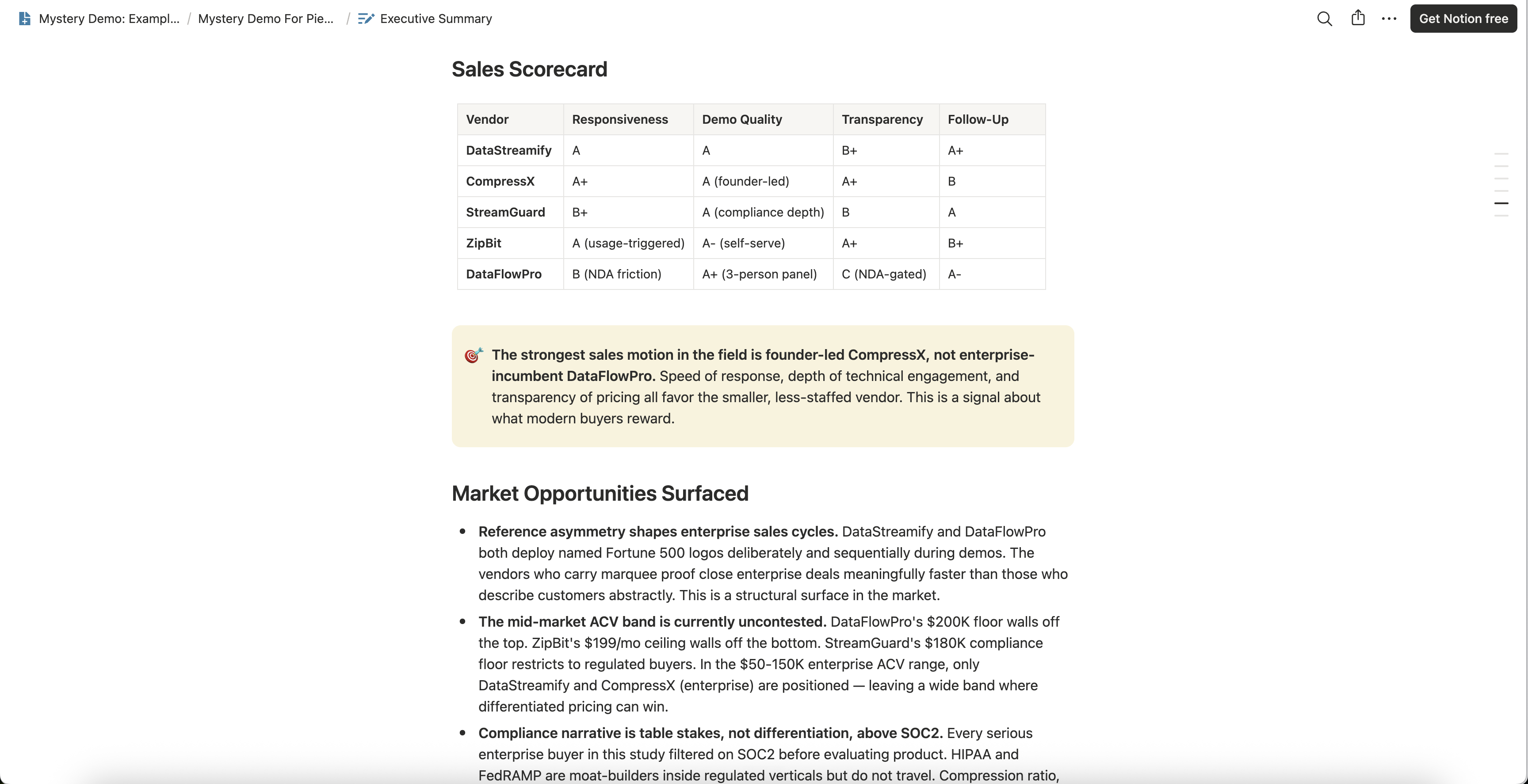
The grades are invented, like everything else on that board, and a grade can carry a short note on what earned it. A grade says how a rival did, and the record behind it says what the rival sent, and when. The example that follows is invented too: every touch Rival A sent after a demo of pest control software, day by day.
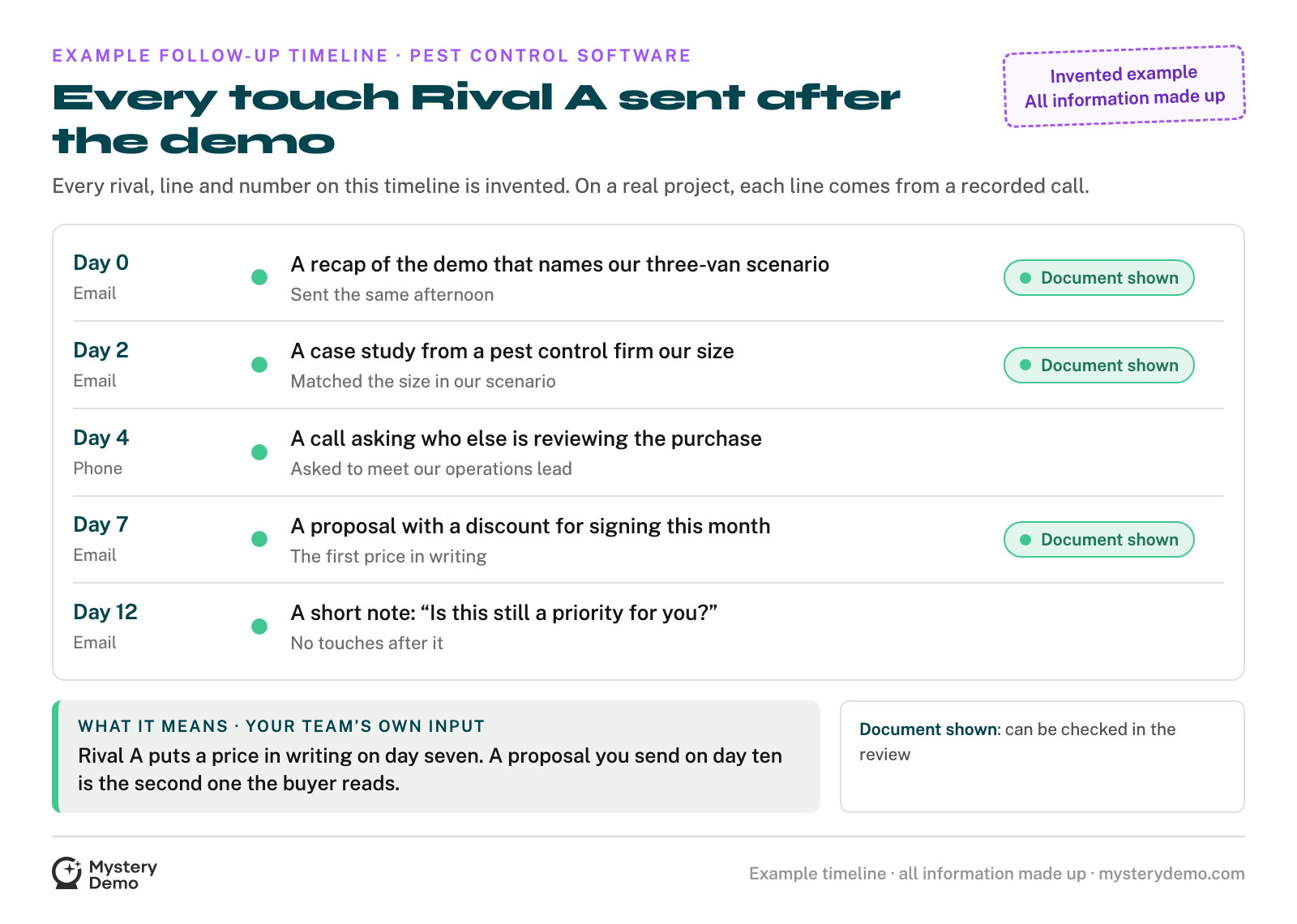
Set your own follow-up from a similar demo beside it, straight from your CRM, and your team sees the two the way a buyer comparing them would. A project can also put your own team through the same buying scenario, unannounced, in the same week or two as the rivals’ calls, so both sides are recorded the same way. The aim is a better sales process, never discipline.


Your own team could request a rival’s demo, but a rival that recognizes who is asking tends to give the generic tour and send the generic sequence. A follow-up worth comparing depends on who receives it:
One rival’s follow-up to one buying scenario is a single example. Scored across several rivals, the follow-up column shows how your market follows up and where your own sequence sits. Grading every rival’s sales process that way, from the first reply to the last follow-up, is what our competitor sales tactics research does.
The price is a flat €499 per competitor, everything included, and one competitor’s board is ready in one to two weeks. An intro conversation with the Mystery Demo team is enough to pick the rivals your deals meet most and plan the buyer each of them will follow up with.
What to Do With Your Last Three Quiet Deals
Silence after a demo is a question to investigate before it is an email to send. The table turns it into questions you can ask this week. The questions cannot reach how the other vendors followed up, because that evidence sits outside your deal.
Start with the deals that already went quiet:
If one vendor’s name turns up on more than one list, start there. Mystery Demo will take that vendor’s demo as a buyer like yours and keep every follow-up it sends, dated to the day. Set beside yours, that record shows what a buyer weighing the two sees, and the first step is an intro call with us.


