
Most win-back campaigns are a discount or a “we’ve improved” email sent to everyone who left for a rival. Neither one says why this customer would come back, and plenty of customers who left have no reason to. In The Reality Department’s August 2026 survey of 250 UK B2B buyers at companies with $50m or more in revenue, 59% reported little or no regret about the vendor they chose.
The customers worth calling are the ones the rival let down, and spotting them starts with knowing what the rival promised. That promise is made on its sales calls. Mystery Demo books competitors’ real sales demos as a credible buyer, records what each rep says, shows and quotes, and hands your team the calls and the analysis on a shared board.
This page is a win-back plan a sales and enablement team can run every quarter: five steps in one table, each with the evidence it needs and where that evidence comes from.
What Makes a Customer Rethink the Vendor They Chose
Your former customer now has the rival as its vendor, so the useful question is what makes a customer rethink a vendor. The same survey asked all 250 buyers what set off their last renewal review or switch consideration:
None of those triggers follows your campaign calendar. The survey’s authors put the opening at “the moment of a price rise, a service failure or a change of people,” and those moments happen while you are not in the room. A founder on Reddit described one such let-down in October: an outbound tool with “all the right promises and case studies tailored to my specific needs,” three weeks before the first reply came in, and then a switch to another tool.
Asked what would have tipped them into switching, 15% of the 203 buyers whose renewal was not automatic said a stronger competitor offer. 48% named something the authors call a decision for the current vendor: how fast it fixes flagged issues, how flexible its pricing is, how proactively it manages the account. Your former customer’s current vendor is the rival now, so a discount email speaks to the 15%, and much of the rest is in the rival’s hands.
Among the 161 buyers with at least some regret, four root causes made up half of the answers, and the authors call them “gaps between what was sold and what was delivered.” Each one points at something a rival says, or leaves unsaid, before the sale:
| What buyers regretted (share of the 161) | What the rival says before the sale | The question that pins it down |
|---|---|---|
| Pricing crept up at renewal (15%) | What the price does in year two | “What will we pay in year two, and what could change that?” |
| Implementation was under-resourced (12%) | Who does the setup | “Who on your side does the setup, and how many other customers are they running?” |
| Onboarding fell short of the pitch (12%) | What onboarding includes | “What is in onboarding, what costs extra, and who do we call in week three?” |
| Adoption was slower than expected (11%) | How fast people start using it | “How long before a team our size uses it every day, and what slows that down?” |
Those are the four things to listen for on every rival. The other half of the answers was spread across more than ten smaller reasons, so add whatever your own lost customers keep naming.
The survey’s advice to vendors says why the four matter: “Compare the sales deck with the onboarding plan. Where they differ, the customer will notice.” Your former customer may already have noticed, and the plan finds out, one customer at a time.
None of those answers is on the rival’s website, where the pricing page shows the plans it sells to everyone and the onboarding page shows the version it would like you to picture. The year-two price and the name of the person doing the setup come out on a sales call, one buyer at a time. Those calls go to buyers, and your team is not one.
How Mystery Demo Hears the Rival’s Pitch
Mystery Demo goes through the rival’s sales process as a buyer, on your behalf. The people doing it are operators who have sold B2B software, and a project runs in five stages:
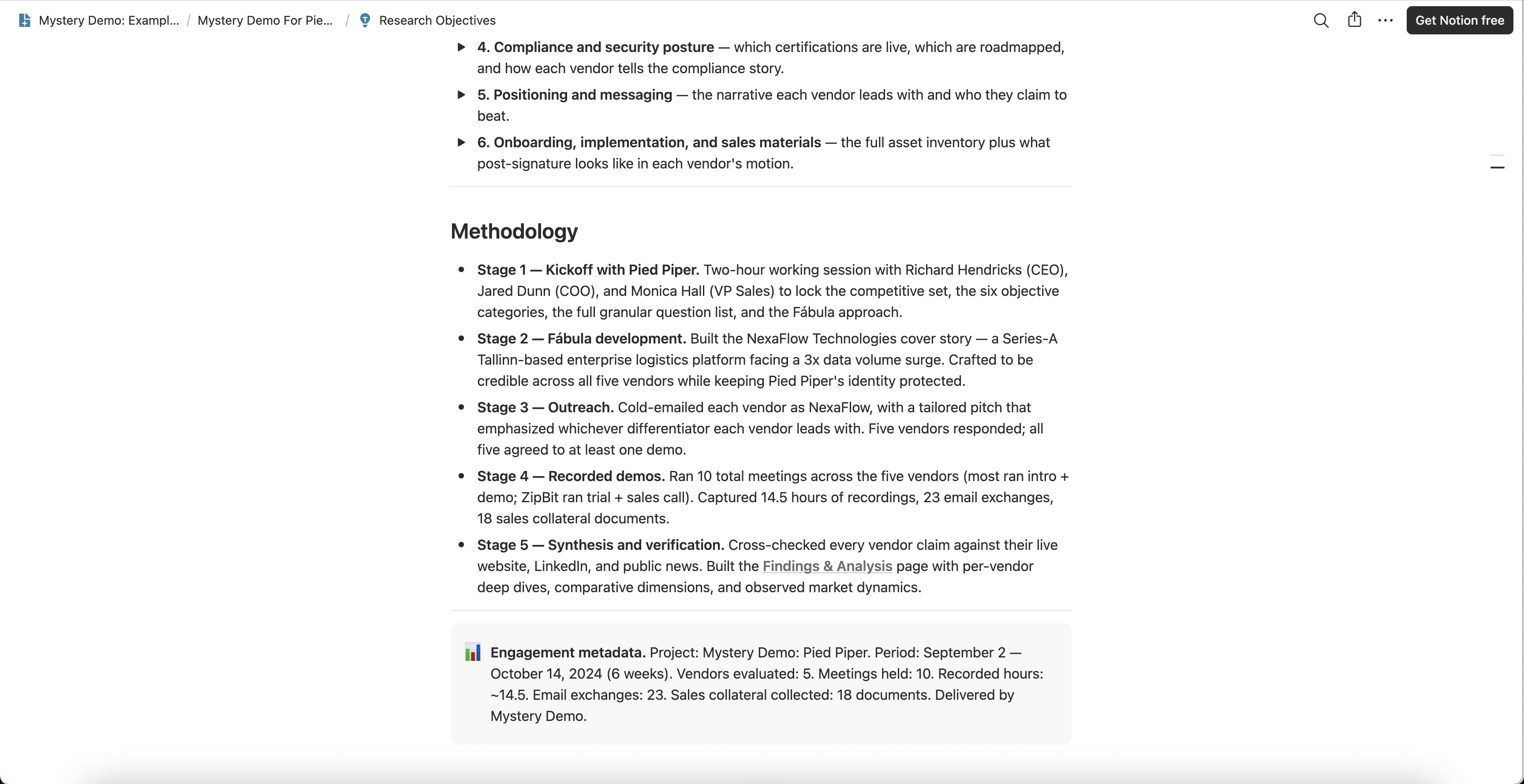
Here is that method on the Research Objectives page of our public example board, where the client and every competitor are invented. A real project’s board is built from that client’s own calls. The sixth objective, at the top of the page, covers onboarding, implementation and what happens after signing at each vendor, which is where this plan’s promises get asked about.
A call has limits, and this plan is built around them. Each source answers a different part of the question:
| Source | What it tells you | What it cannot tell you |
|---|---|---|
| The rival’s sales calls | What it promises a comparable buyer today | What your former customer was told, or whether the rival delivered for them |
| Public reviews | What other customers say happened | Whether it happened to your account |
| Your former customer | What they were sold, what happened and when they renew | What the rival promises buyers now |
One call is also one rep on one day. When a second call with a different rep gives the same answer, you are hearing the company’s line.
Why not just ask the former customer? You will, in step 3, but a customer who left you has little reason to walk you through their contract, and “how’s it going?” gets you “fine.”
Say you know the rival promises a go-live in two weeks with a named specialist. Now you can ask whether the specialist turned up, and one set of calls serves every account you lost to that rival.


All of it lands on a board, a shared Notion workspace with a page for each rival: its recordings, transcripts, emails and our analysis. If you lost customers to several rivals, start with the sales scorecard on the Executive Summary, the board’s verdict page. It grades each rival’s sales motion on how fast it answers, how good the demo is, how straight the rep is about price and how well it follows up.
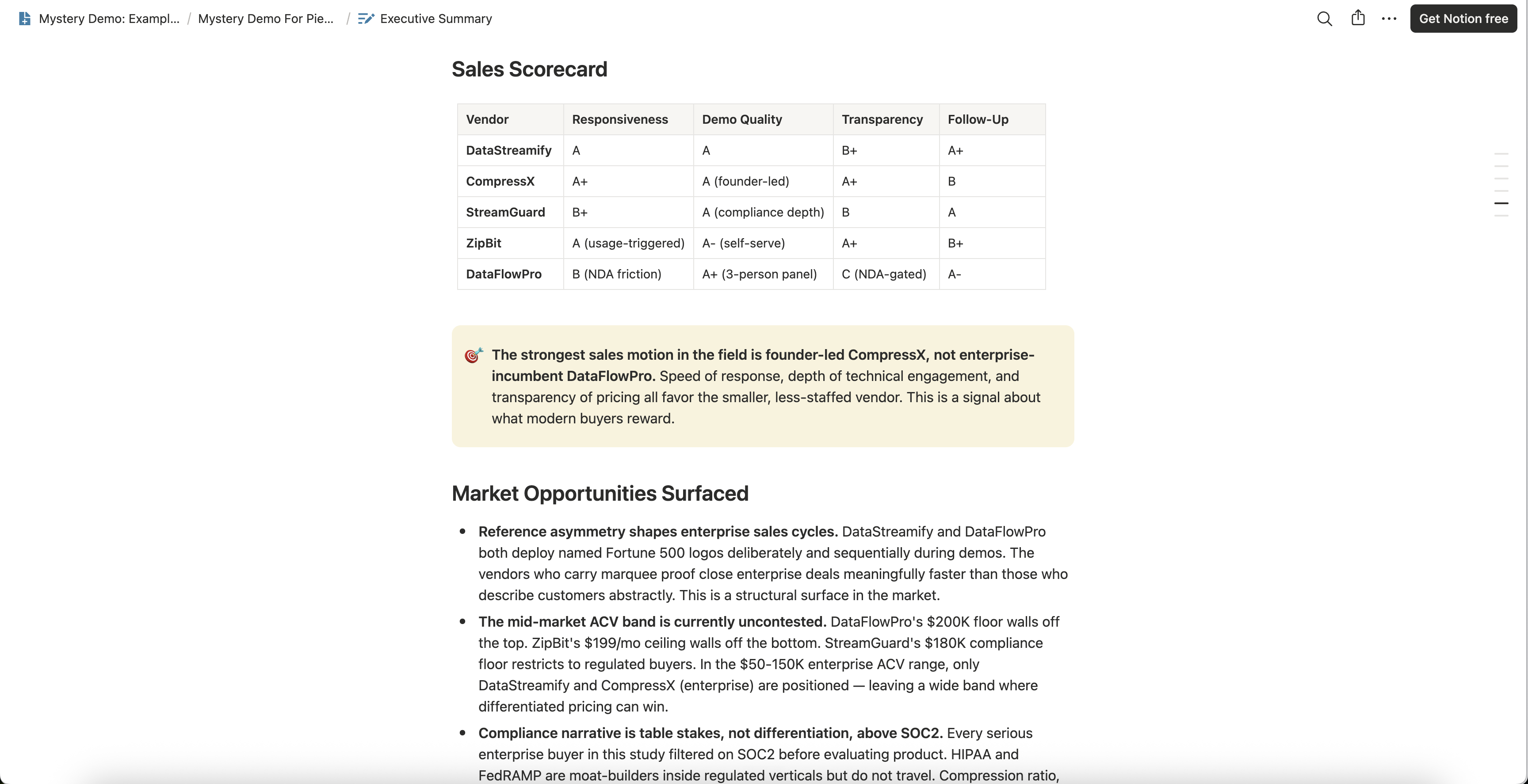
Read the Transparency column first. A rep who stays vague about price before the sale leaves more room for a surprise at renewal, so a low grade there says which rival’s reviews to open first. It proves no broken promise, and the later steps do that work.
That grading, from first touch to follow-up, comes from our competitor sales tactics research. Three things make it better than your own team booking the demo:
The price is a flat €499 per competitor with nothing added, and one rival takes one to two weeks. Which rival took the most customers from you this year? Tell us on a short intro call, and we will take its calls as a buyer like the ones you lost.
The Quarterly Win-Back Plan
Once the rival’s pitch is on record, the rest of the plan is yours to run. The board fills step 2, and the other four steps are your team’s own work.
| Step and timing | The evidence it needs | Where that evidence comes from |
|---|---|---|
| 1. Sort the list by rival and reason (weeks 1 to 2) | The loss record, and the exit conversation where you had one | Your CRM and call notes |
| 2. Hear what the rival promises (weeks 2 to 4) | The rival’s own words on the four points, recorded, with the minute | The board: the rival’s page, the pricing matrix, the implementation and onboarding comparison |
| 3. Check what it delivered (month 2) | Public reviews, which suggest a gap, and the former customer’s own account, which confirms it | Review sites, and a check-in conversation your team holds |
| 4. Read the signal (months 2 to 3) | A confirmed gap, and the moment to act on it: a price rise, a service failure or a change of people | The former customer, and your own account notes |
| 5. Approach on the gap (when the signal appears) | What you now offer on that exact point, stated honestly | Your own product, pricing and onboarding |
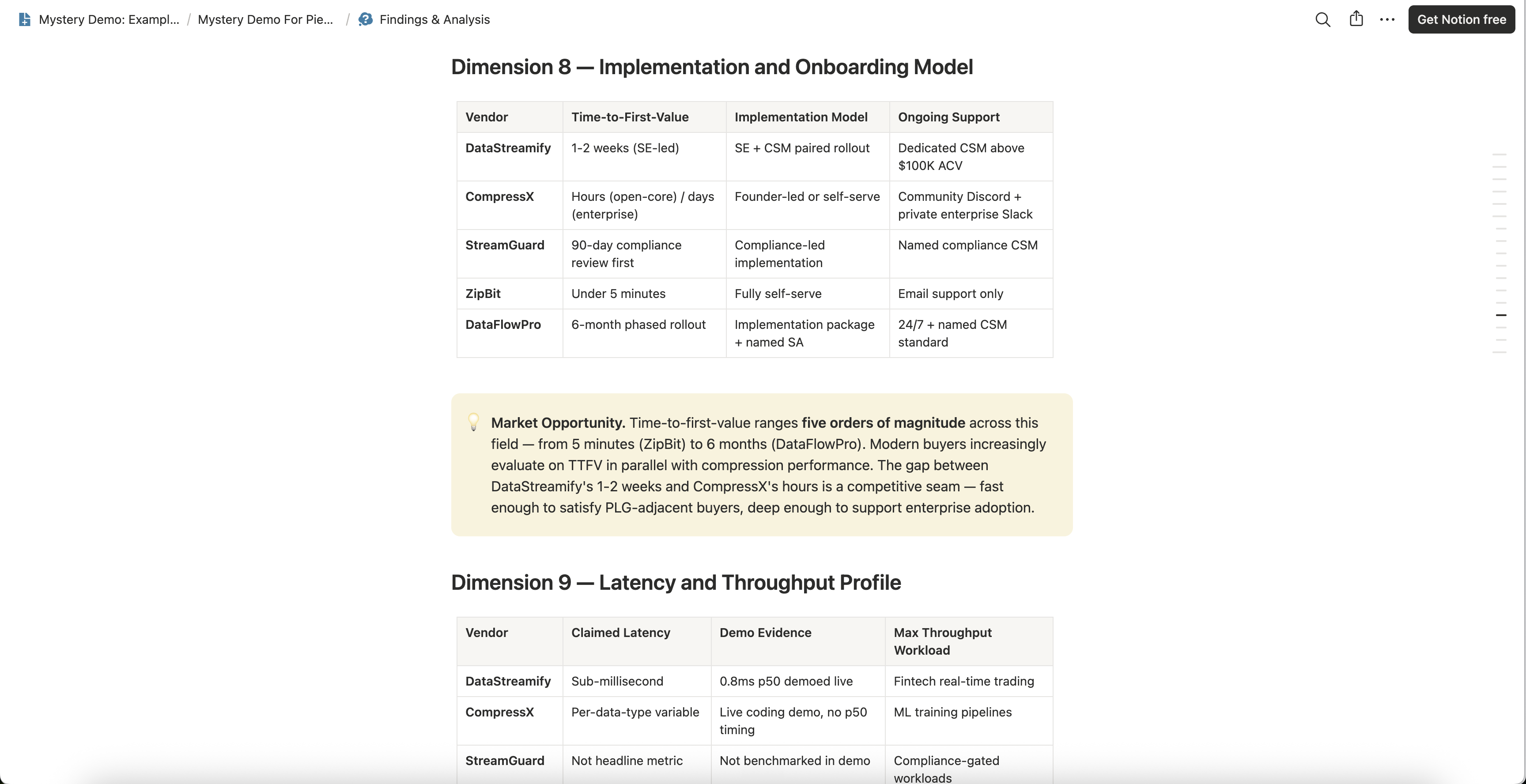
Step 2’s third source is the implementation and onboarding comparison, shown here on the invented example board. Each row gives how long a rival takes to get a customer running, who does the work and what support follows. That row is the promise you hold up against its reviews in step 3.
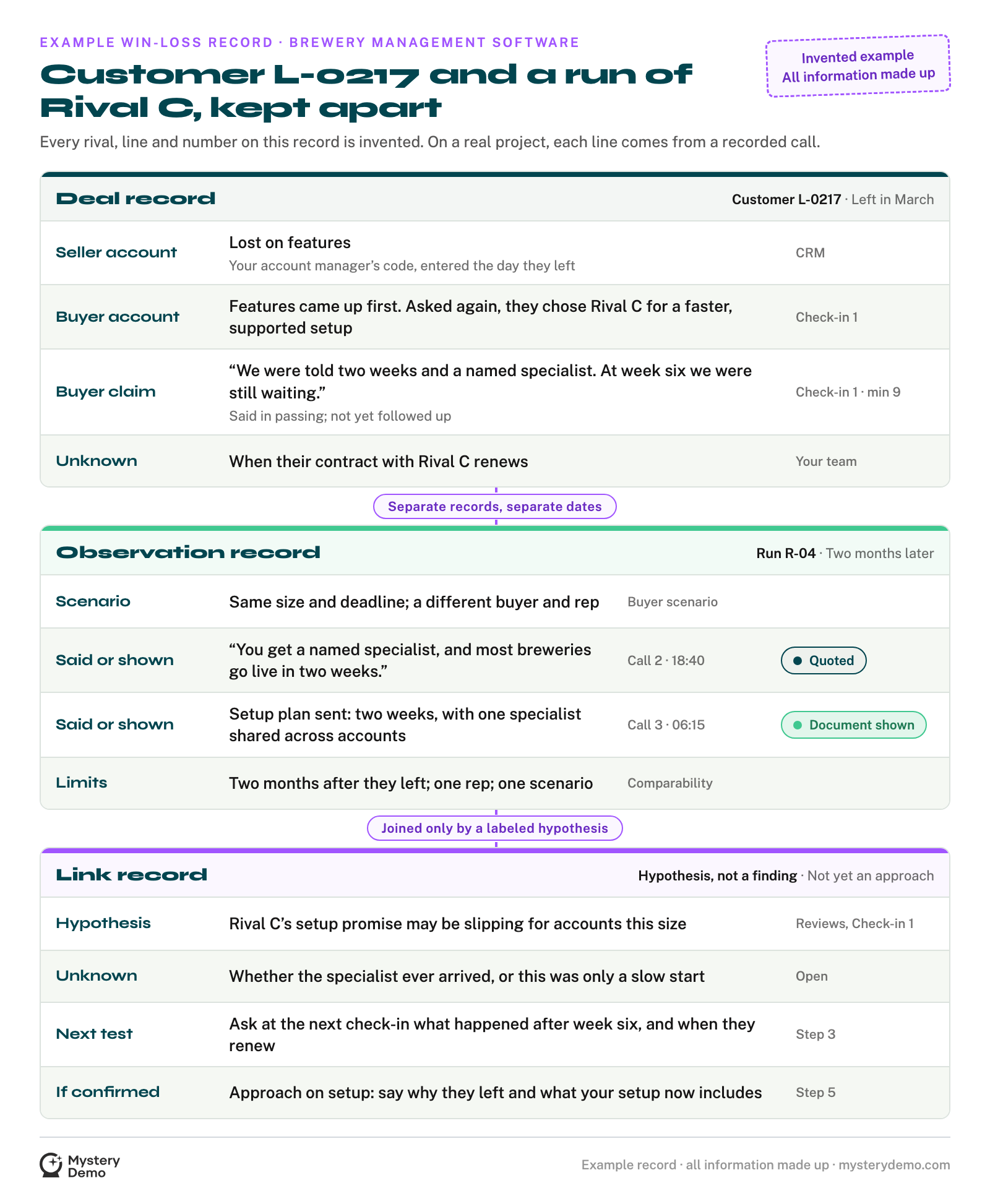
Keep these notes as separate records for each account. This example is invented, rival and all, and it borrows its layout from our win-loss template. What the customer told you, what the rival’s rep said and your win-back idea each stay in their own box, so a hunch cannot pass for a finding.
Each quarter brings a new list of lost customers on its own. A rival’s new pitch reaches your board only if someone goes and hears it.
Run It Again Next Quarter
The first quarter is the heavy one, because step 2 collects the rival’s calls. In later quarters your team reuses the dated board and runs steps 1, 3, 4 and 5 on the new list of lost customers. Fresh calls are worth commissioning when:
A win-back that knows what the rival promises and where the customer says it fell short has something specific to say. One that does not is a discount email.
Start this week with the five largest accounts you lost to one rival. Write down what that rival promises a buyer like them today on price at renewal, setup and onboarding. In a separate column, write what each customer has told you they were sold, and mark what you do not know.
If the first column comes up empty, hand us that rival on an intro call. We will go through its sales calls as a buyer like those five and bring back each promise, recorded and dated.


