
A deal can look won for weeks, with the buyer’s team on board and the next steps set, and then procurement asks for a competing quote. One seller on Reddit described exactly that: after both sides had agreed to move ahead, the buyer’s side decided to “add competition to the deal.” The reply with the most upvotes was shorter: “We have very different definitions of ‘done deal.’”
Procurement has the standing to do it. In Forrester’s survey of nearly 18,000 business buyers, across every kind of business purchase, procurement professionals were among the decision-makers in 53% of buying cycles. If the buyer’s team has already picked your product, procurement adds a round of its own: your price and terms against someone else’s.
If you are the seller holding that deal, or the enablement lead behind them, the five steps below take you from procurement’s criteria to a side-by-side comparison you can send this week, with what you know and what you do not. One step turns on something no website shows: how this rival prices and negotiates when a buyer pushes back. Mystery Demo books competitors’ real sales demos as a buyer and records exactly that, every quote and concession, so the next time this rival is added to a deal you already know its offer.
Step 1: Ask Procurement What It Will Compare
Before you touch your price, find out what the comparison is. Ask procurement directly, or ask your main contact on the buyer’s team to find out:
Then ask one more question: is any product requirement being reopened? If it is, settle that requirement with the buyer’s team, who picked your product, before it reaches the price comparison.
The deadline decides how much you can learn in time. The criteria decide the shape of the comparison, and procurement will build that comparison whether or not the two quotes match.
Step 2: Line Up the Two Quotes Like for Like
Your quote and the rival’s will not arrive in the same shape, and procurement still has to rank them. One procurement professional, writing on LinkedIn about how an award was decided, put the problem in one line: “The quotes just weren’t like-for-like.”
So build the comparison yourself, before procurement builds it without you. Give each thing procurement compares its own line, and note what you need to know about the rival on that line and where you can learn it:
| Procurement compares | What you need to know about the rival | Where you can learn it |
|---|---|---|
| Scope | What its quote includes, and what it leaves out or charges for separately | This week: the buyer, if they share the quote, and your notes from past deals against this rival. Before the next deal: a recording of the rival’s own pricing conversation with a buyer like yours. |
| Total cost over the term | List price, discount, the price at renewal, add-ons | This week: what the buyer tells you about the quote, and your win-loss notes on this rival. Before the next deal: the rival’s recorded pricing conversation, and the written quote that followed it. |
| Terms | Contract length, payment terms, renewal and exit terms | This week: what the buyer will tell you. Before the next deal: the rival’s recorded pricing conversation and its follow-up emails. |
| Implementation | Who does the work, how long it takes, what it costs | This week: the buyer’s notes from the rival’s calls. Before the next deal: the rival’s recorded technical call, where implementation comes up. |
| Support | What level is included, and what costs extra | This week: the rival’s published support terms. Before the next deal: what its rep promised on the calls, kept as a promise. |
Then mark every line one of three ways: confirmed in writing by the buyer or procurement, reported by the buyer, or unknown. Ask procurement about the unknown lines that decide the comparison. Never present a total you could not check as a matched comparison.
For a whole field of rivals, the same method becomes a competitor pricing grid built from their sales calls. In a live deal you need only one rival and one buyer.
Now read down the last column. This week you have little to go on, and almost nothing listed for before the next deal is published anywhere.
Step 3: Find Out How the Rival Negotiates on Price
When the buyer’s team has already chosen you, the product rarely decides this round. The rival’s offer decides it: what it will drop, what it will throw in, and what it asks for in return. That offer is the part you are most likely guessing at.
None of it can be read off the rival’s website. In one publisher’s review of 377 software tools, a third kept at least one pricing tier behind a sales conversation, and 18% published no usable price at all. In Gartner’s survey of 632 B2B buyers, 69% reported inconsistencies between a vendor’s website and what its sellers told them.
Even a published price is only where a negotiation starts. Across one procurement firm’s customers, average savings off list price topped 24% in all 16 software categories it tracked in the third quarter of 2026, by its preliminary count.
This week, work from what your team already has: every past deal against this rival, the win-loss notes, anything a buyer once forwarded. Fill in what you can, and leave the rest marked unknown.
The rest of the answer is said out loud on the rival’s own sales calls, and Mystery Demo is the buyer on the other end of them. We book the rival’s demo through its normal front door as a credible buyer, with a buying scenario built to fit what that rival sells. Then we carry the evaluation through to the pricing conversation, record every call, and keep every quote and follow-up email.
Each question we carry into that conversation matches a line procurement will compare:
One thing a mystery demo cannot do is beat a three-day deadline. A fresh study of one competitor takes one to two weeks, so it may not finish inside a short procurement window. Its value is having this rival’s offer on file before procurement adds it to your next deal.
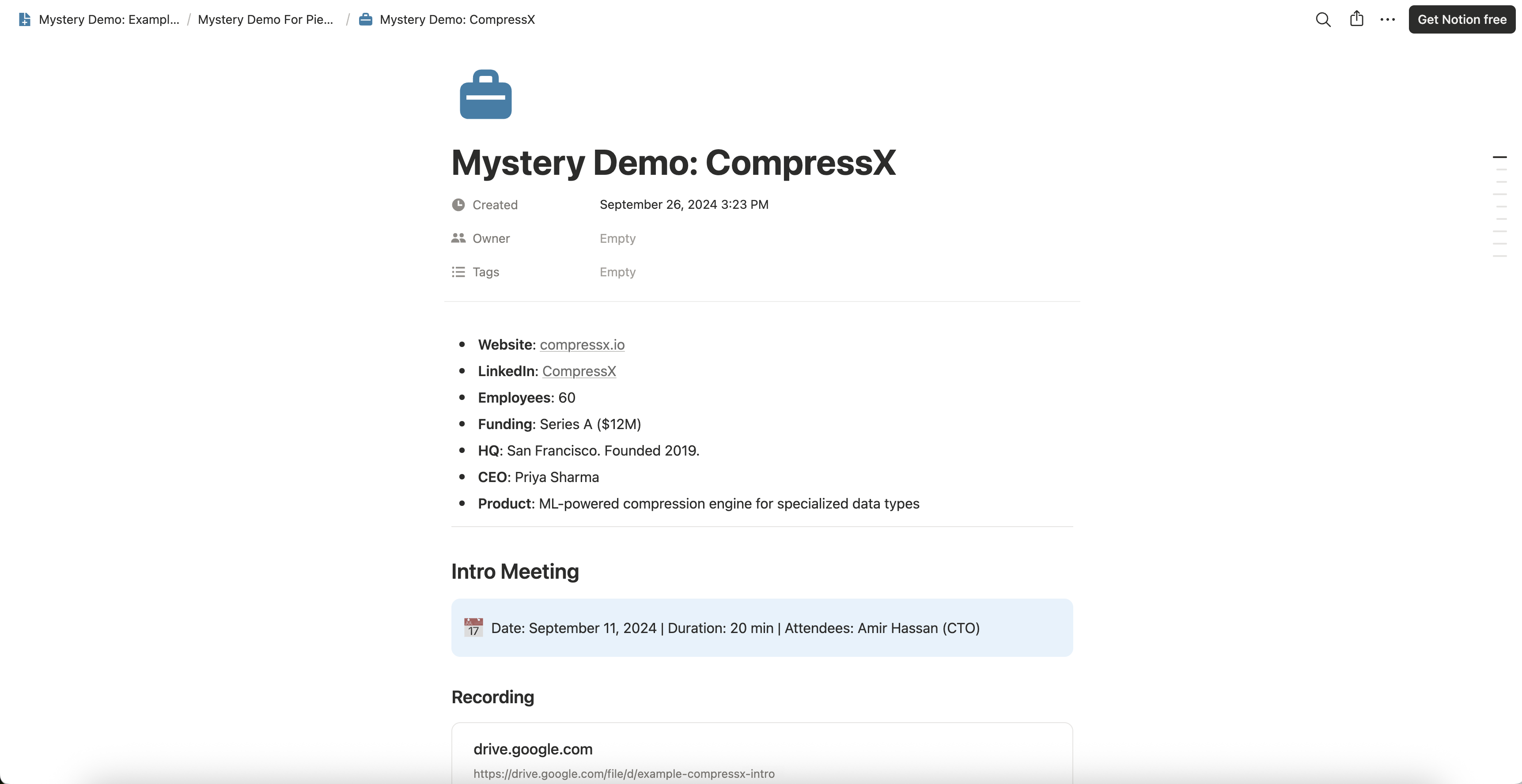
What comes back lands on a shared Notion board that the client’s team keeps, with a page for each rival holding its recordings, transcripts, emails and our analysis. Below is the top of one rival’s page on our public example board, where the client and every competitor are invented. A real project’s board is built from the calls we run on that client’s own competitors.
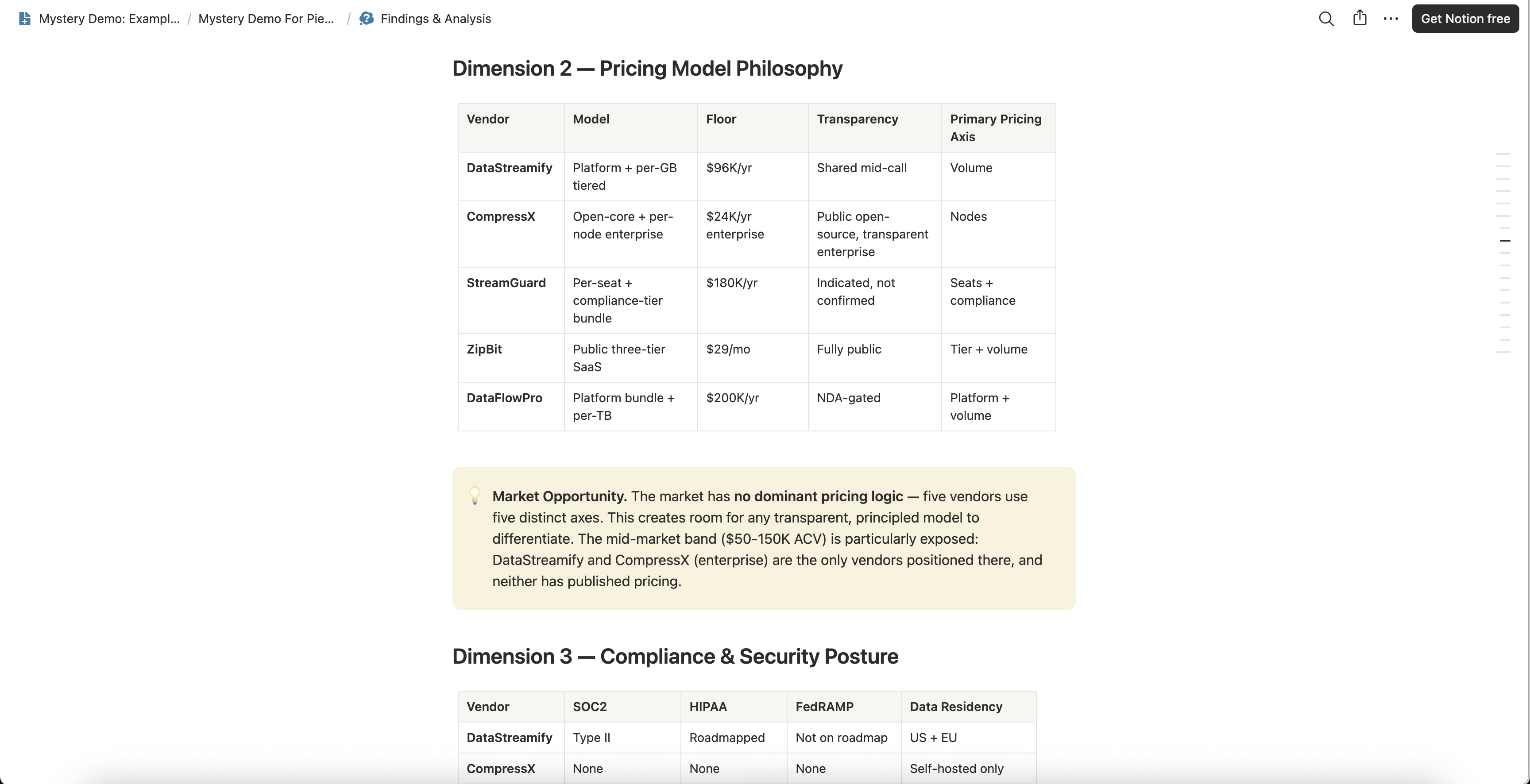
Across rivals, the answers to those pricing questions go into one table on the board’s Findings & Analysis page, the pricing matrix. It sets out each rival’s pricing model, the lowest price it named, how openly it shared its price, and what that price grows with. Each quote in it was made to one buyer scenario, so it shows which levers a rival pulls, not the exact number your buyer will get.

How a rival handles price is graded too. The sales scorecard on the board’s Executive Summary grades each rival’s selling step by step, and its transparency column says how straight each rep was about price.
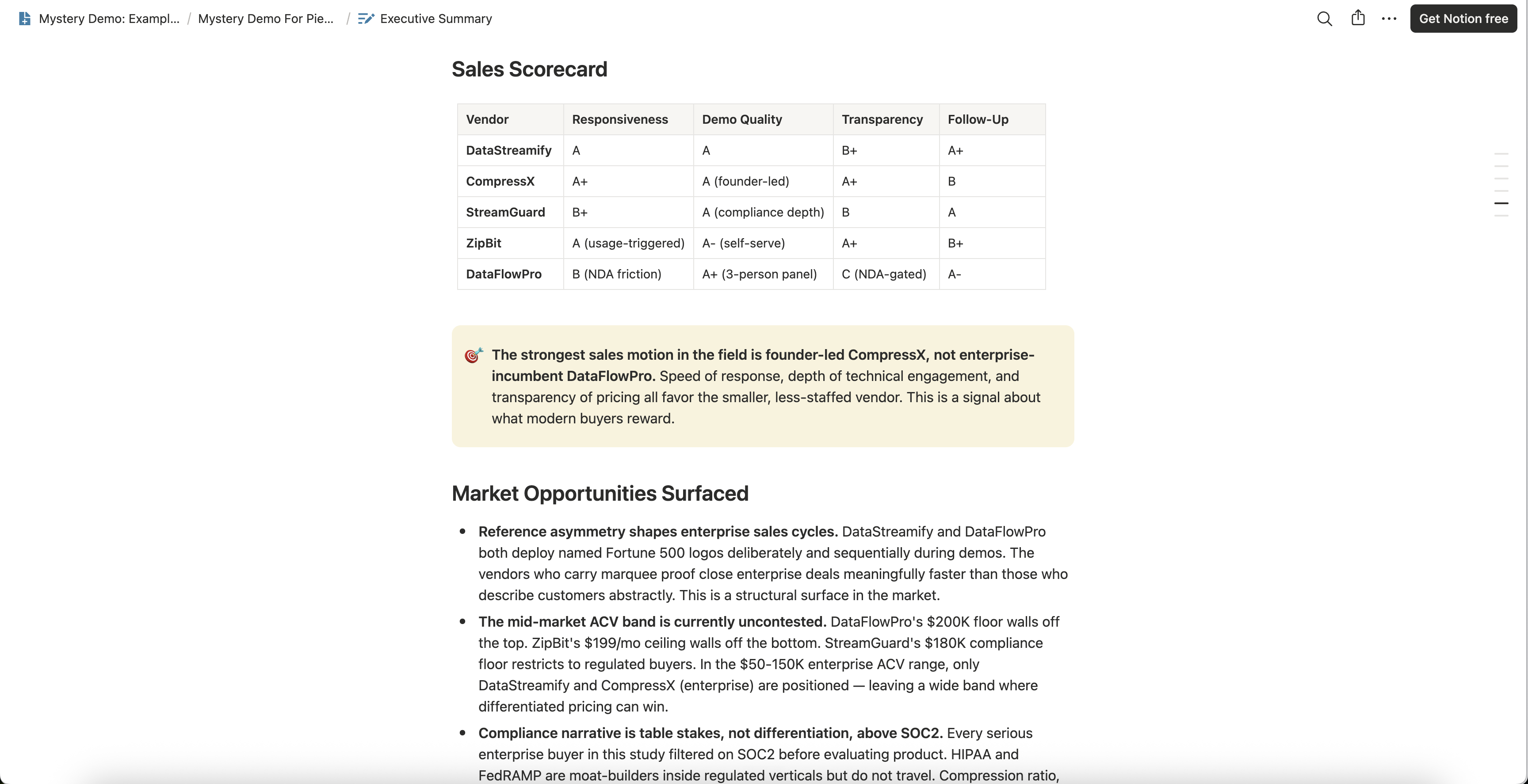
If a rival held its price back until late on the calls, expect the quote your buyer is holding to have room left in it. Competitor sales tactics research grades that whole motion for every rival, from the first reply to the last follow-up email.
Your own team could ask these questions. The rival’s rep would see your company’s name on the invite, and the call would become a polite tour that ends at list price. Here is what Mystery Demo brings to that call instead:
If one rival keeps showing up at the procurement stage of your deals, name it on a short intro call, and we will take its pricing conversation as a buyer, so its offer is on your board before the next round. For the deal in front of you, whatever you know by the deadline, the next move is to decide each line before procurement calls.
Step 4: Decide Your Concessions Line by Line
Go down your comparison one line at a time, and decide each before you speak to procurement:
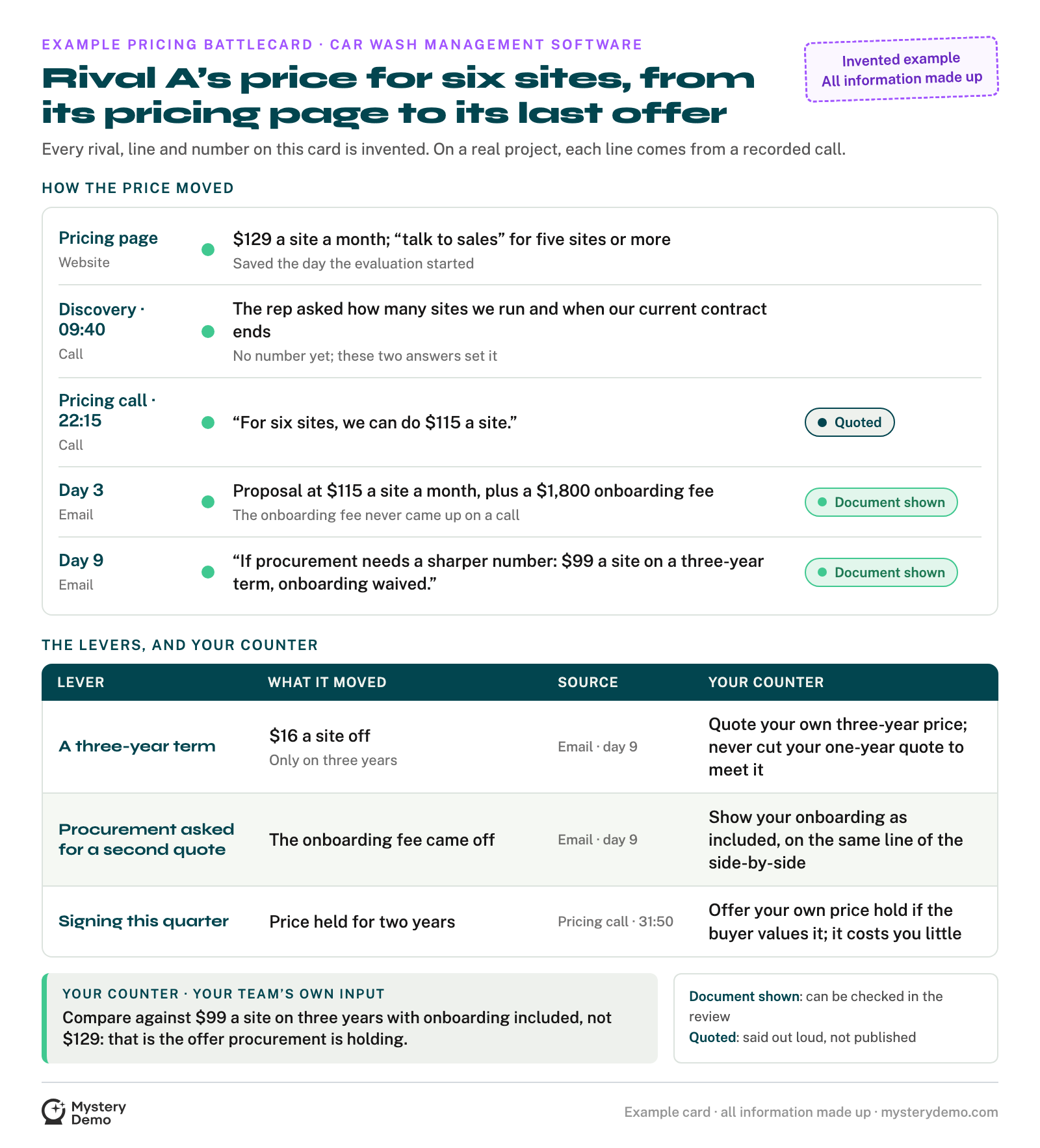
Here is an illustration of how a recorded finding changes one of those decisions. Say the rival’s recorded pricing conversation shows that its discount came only with a three-year contract. If your buyer’s scope matches, hold your one-year price and put your own three-year price beside the rival’s, so procurement compares three years with three years.
Now say that same call quoted implementation as a separate fee. If your price already includes onboarding, that line of the side-by-side is where you say so.
In the round itself, the rep holds something like the pricing battlecard below: one invented rival’s price, from its pricing page to its last offer, with your counter to each lever. Every rival, number and minute on it is made up.
Step 5: Send Procurement Your Side-by-Side
With every line decided, send procurement the comparison before the deadline, on its own criteria and in its format. Lead with total cost over the whole contract rather than the first-year price. One procurement services firm put it this way on LinkedIn: “the lowest quote doesn’t always mean the lowest cost.”
Your side-by-side carries four things:
A comparison that shows its gaps is easier for procurement to trust than one that fills them with guesses. Keep your contact on the buyer’s team in the loop as you send it. Another reply in that Reddit thread put the reason plainly: “Until you have ink on paper or the docusign in hand, you’ve got nothing.”
The Same-Day Checklist
When procurement adds a rival, the seller who knows how that rival prices and negotiates can show procurement which lines match and which do not. The seller who does not is guessing at a quote they have never seen.
For the deal in front of you this week:
The unknowns on the third line are the ones your team cannot fill from its own notes: what this rival says when a buyer asks for its best price. We can have that ready before procurement adds the rival to your next deal. Tell us which competitor procurement keeps bringing in, and we will hear its quotes and terms as a buyer and bring them back with the minute each was said.


