
What a software rival really sells, and for how much, sits behind its Request a Demo button. Mystery Demo goes through that button for you. It books your competitors’ real sales demos as a credible buyer, asks the questions that matter, records every call and email, and hands back expert analysis on a shared board: pricing, product, sales process and messaging, straight from the source.
That source is why it works. A competitor’s website says what it wants buyers to believe, and review sites, competitive intelligence tools and analyst notes report it secondhand. The sales call is where it quotes a real price, shows the product live, promises a roadmap and attacks the alternatives, and the only way to hear that is to be the buyer.
Mystery Demo gets on that call the way a serious prospect would. It brings a believable buying scenario fitted to each competitor, so the rep runs the real sales motion instead of the generic tour.
The people asking the questions have sold B2B software themselves and know which question pulls a rep off script. Every finding comes back as a recording, a transcript line or an email with a timestamp, for a flat €499 per competitor, ready in one to two weeks.
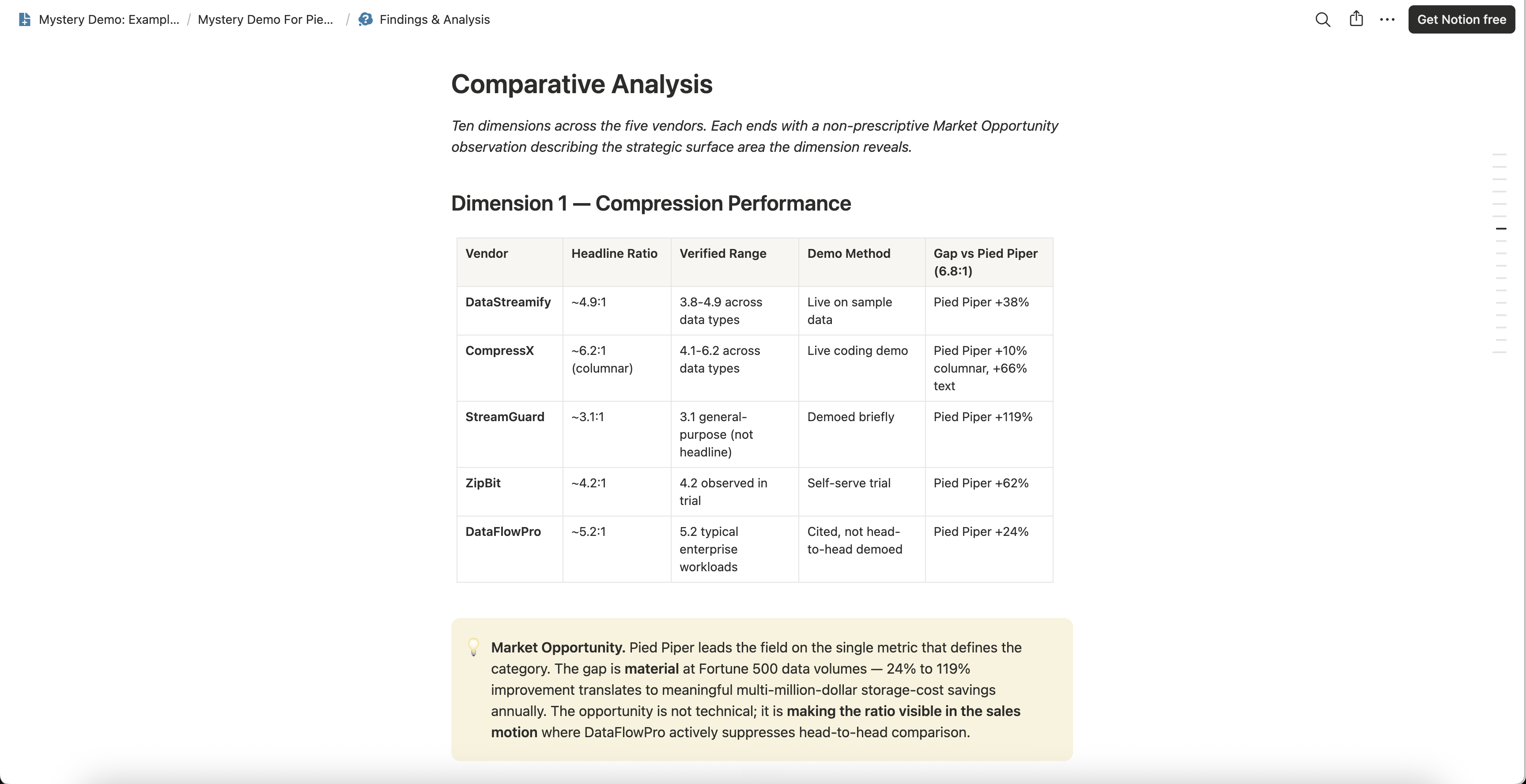
Below is the Findings and Analysis page from our public example board, which is invented: every company and number on it is made up, and a real project’s board is built from that client’s own calls. Each row sets a competitor’s headline claim about its product beside what the demo showed it doing, and says how the demo showed it. That gap, between what a product is said to do and what it was seen doing in the demo, is what a product comparison exists to find.
The method itself is old. Mystery Demo is mystery shopping for B2B software. Retailers, banks, insurers, hotels and car dealers have paid for mystery shopping for decades, so there are plenty of public numbers to count.
Those numbers come from public research, each one linked in References to where it was published, and none of them comes from our own calls. They show how big the practice is, what one shop costs, and how little of the published research reaches a B2B software sale.
Key Takeaways
The Market Is Worth About $2.3 Billion, and No Model Gives Software Its Own Line
Fortune Business Insights valued the global mystery shopping services market at $2.31 billion in 2025.1 Its model has the market growing from $2.42 billion in 2026 to $3.61 billion by 2034,1 a compound annual growth rate of 5.12%.1
North America held 43.89% of that market in 2025, worth $1.02 billion.1 Europe followed at 25.28%,1 then Asia Pacific at 20.03%,1 South America at 6.51%1 and the Middle East and Africa at 4.30%.1
Straits Research landed in almost the same place, at $2.35 billion in 2025, rising to $3.75 billion by 2034.2 It gave retail and consumer goods a 28.6% share in 2025,2 close to the 30% Fortune Business Insights gave retail for 2024.1
Not every model agrees. Worldwide Market Reports put the market at $3.5 billion in 2024 on one report page,3 and at $1.4 billion in 2025 in a press release for its separate services report.4
Anyone quoting the size of the market should say whose model the number came from.

The segments say more than the totals. Fortune Business Insights splits the market by service into banking and finance, retail, hospitality, automotive and others.1 Straits Research lists nine end-use industries, from retail and consumer goods to e-commerce and digital services, and software is not one of them.2
So no published model says how much of that money is spent on B2B software. The work itself is easier to count than the money, because one industry report adds up hundreds of thousands of shops a year.
The Smiling Report Counts 663,768 Evaluations, and B2B Is One of Its Rows
The 2025 Smiling Report, from MSPA Europe/Africa and Better Business Sweden, draws on 663,768 mystery shopping evaluations in 27 countries.5 The series has compiled about 33 million evaluations since 2004, supplied by mystery shopping companies in Europe, Africa, Asia Pacific and the Americas.5
The report scores three things a shopper can see: whether staff smiled, whether they greeted the shopper, and whether they offered an add-on sale. Across all industries in 2025, smiles scored 82.2%, greetings 85.2% and add-on sales 66%,5 up from 81.8%, 83.3% and 60.8% a year earlier.5
B2B appears in the report as its own industry, and its scores split. Its greeting score of 87% was the second highest of any industry, behind automotive at 91%.5 Its smiling score of 70.5% was the second lowest, ahead of only government,5 and its add-on score was 47.9%.5

The press release does not say what the B2B row covers, how many evaluations sit in it, or whether any of them involved software. Each of those evaluations is one visit, and in a store the whole sales conversation usually happens inside that one visit.
In a Store, What Staff Do in One Visit Moves What Shoppers Spend
A 2022 program in the BeNeLux ran 2,325 mystery shopping visits at fashion stores and set what staff did against what each shopper spent.6 MSPA Europe/Africa published the results as a client case. Shoppers who got each of four behaviors spent more than shoppers who did not:
Satisfaction moved with the spending. Shoppers asked about their needs gave an NPS 54 points higher than shoppers who were not,6 the widest of the four gaps. The case compares groups of visits and describes no controlled test.
The economics of a single shop are in the same case. Shoppers were reimbursed €30 at most per visit while the average spend was €68,6 and the case put the extra turnover across the 2,325 visits at €21,622.6
The case can tie staff behavior to spend because the behavior and the purchase happen in the same visit. Once a sale needs a reply or a second contact, one visit no longer covers it. Car dealers are where a mystery shop first stretches past a single visit.
Car Dealers Are Shopped by Their Regulator and by Their Manufacturer
Ontario’s vehicle sales regulator, OMVIC, ran 318 mystery shops in 2025, 268 of them new and 50 of them re-shops of dealers that failed in 2024.7 Its staff posed as consumers in 33 municipalities to check whether dealers met their legal obligations.7
The pass rate for new shops was 64%, which OMVIC reported as an 8% decrease from 2024.7 Re-shopped dealers passed at 68%,7 and of the dealers who failed a new shop, 69% received a warning letter and 24% were recommended for disciplinary action.7
Manufacturers shop their dealers too, online. In a Maritz case study, an automaker had an electric vehicle question sent through each dealer’s website form, once a month for three months.8 The study covers 2,594 dealers with completed analyses,8 and each reply was tracked over 48 hours.8
74% of dealers failed at least one of the three assessments.8 9% did not respond to the online inquiry at all,8 and 54% replied without an accurate, personalized answer.8
After three months of assessments, the dealers’ overall score rose 37%.8 Both programs go back to the same dealers, and both report better results on the later round.
Still, each Maritz shop covers one inquiry and the 48 hours after it. Where the product is a regulated financial one, the regulator shops the whole advice conversation instead.
Banks and Insurers Are Shopped Across the Whole Advice Conversation
The Financial Consumer Agency of Canada hired a mystery shopping firm for 712 shops at branches of Canada’s six largest banks, with fieldwork from October to December 2019.9 Shoppers asked about checking accounts and credit cards and reported how each conversation went.9
In 20% of credit card interactions, shoppers said the employee recommended a product that did not fit their needs, against 15% of checking account interactions.9 When a premium credit card was recommended, 80% of shoppers were never asked about their income.9 In 28% of shops, employees offered products beyond what the shopper came in for.9
EIOPA, the EU insurance supervisor, published its first coordinated mystery shopping exercise on insurance-based investment products in June 2025, run across 8 Member States.10 It recorded 568 visits and counted 454 as valid, each one a full sales process in which a product was discussed in detail.10
A full sales process might have needed several meetings, and EIOPA still counted it as one visit.10 Visits lasted 42 minutes on average, by the shoppers’ own account.10
Sellers explained risks to 74.3% of shoppers, returns to 72.6% and the recommended holding period to 71.7%.10 Costs came last: 45.2% of shoppers got full cost information,10 and 36% received the Key Information Document during the visits, before any sale was completed.10

The questions followed the same pattern. 73.6% of shoppers were asked how long they wanted to hold the investment,10 and 45.7% were asked about their risk tolerance.10
A regulator’s shop already spans more than one meeting. Hotels stretch the unit further, from a conversation to several nights.
Hotels Are Inspected Anonymously, for Several Nights at a Time
Forbes Travel Guide’s inspectors stay at a property anonymously for multiple nights and score it against up to 900 standards, from the reservation through departure.11 Its 2026 Five-Star, Four-Star and Recommended awards cover more than 2,000 properties in over 100 countries.11
In the 2025 Smiling Report, hospitality scored 81.5% on smiles, 83.5% on greetings and 52.9% on add-on sales.5 Fortune Business Insights projects the hospitality segment to grow at the highest rate of any service segment through 2034.1
A stay of several nights is the longest shop so far. The published price lists show what a single shop costs.
Published Prices for One Shop Run From About $40 to $450
A few providers publish a starting price per shop. Here are three of their price lists:
| Provider and market | Shop | Published starting price |
|---|---|---|
| Grace Hill, apartment leasing | Phone or internet inquiry | About $4012 |
| ClueCheck, UK | Call center analysis | £6913 |
| ClueCheck, UK | Online site audit | £12013 |
| ClueCheck, UK | Store visit | £12913 |
| ClueCheck, UK | Video shop | £18013 |
| ClueCheck, UK | Competitor benchmarking | £29913 |
| Wine Industry Sales Education, wineries | Text or email shop | $7514 |
| Wine Industry Sales Education, wineries | Phone shop | $15014 |
| Wine Industry Sales Education, wineries | In-person tasting room | $400, or $450 with a tour or food pairing14 |
The fee is not the whole bill. ClueCheck adds a separate shopper spend allowance of £20 to £100, depending on the purchase,13 and by its own comparison puts the market standard at £80 to £250 per evaluation.13
ClueCheck and Wine Industry Sales Education both price several kinds of shop, and on both lists a message costs less than a call, and a call less than a visit. Competitor benchmarking is the top of ClueCheck’s list, and it is still priced per assessment, the way a store visit is.
Every price in that table buys one message, one call or one visit. A B2B software sale runs for months, and that is where the published numbers thin out.
The Published B2B Software Shops Stop at the Demo Form
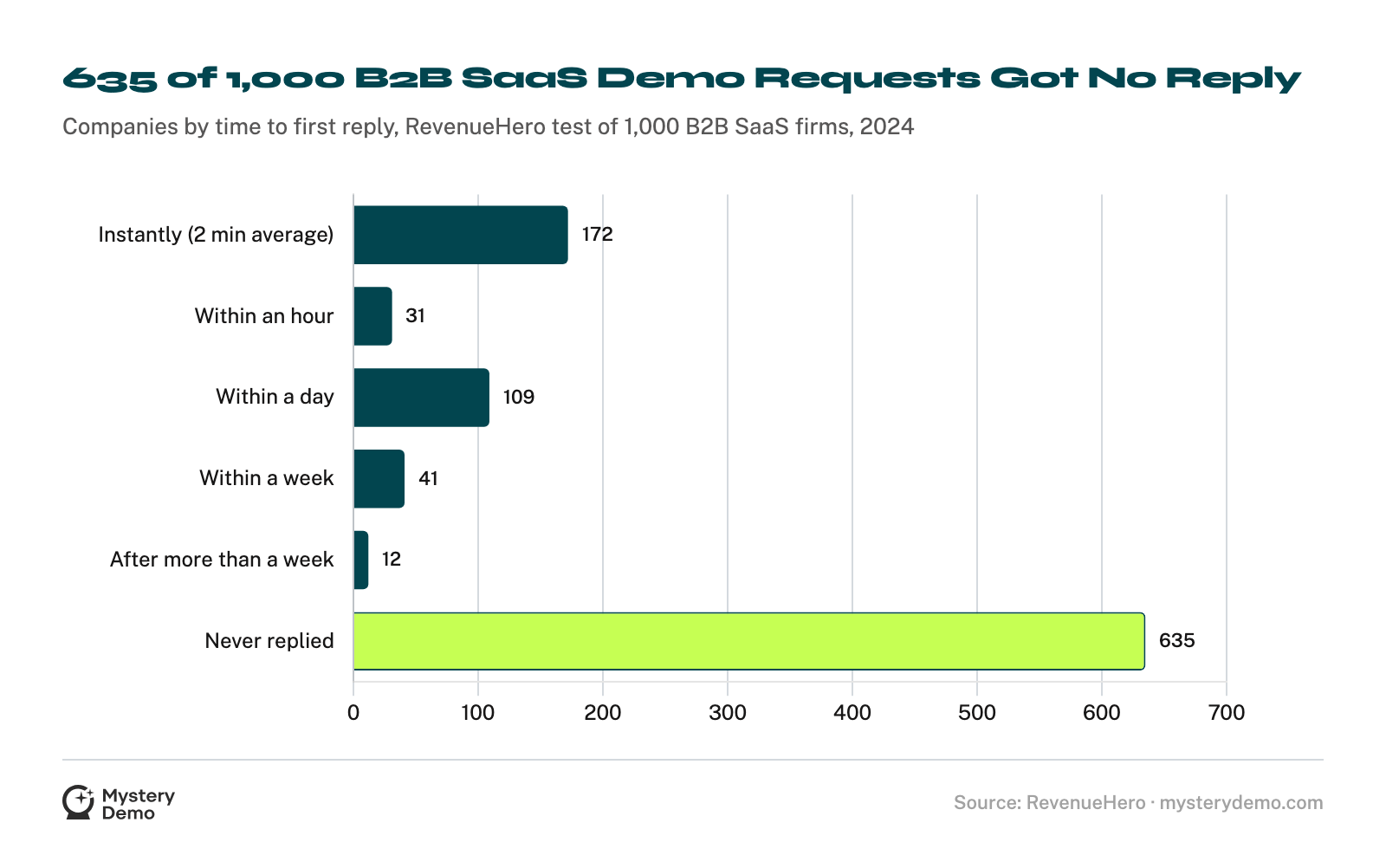
There are B2B software mystery shops in public, and they test the first step. RevenueHero sells software for routing and booking demo requests. In 2024 it submitted demo requests to 1,000 B2B SaaS companies and timed the replies.15
It received 365 responses, with an average wait of 1 day, 5 hours and 17 minutes.15 635 of the 1,000 companies never replied.15
Of the companies that did reply, 172 answered in what RevenueHero counts as instantly, 2 minutes on average.15 Only 113 of the 1,000 websites offered any way to schedule the demo on the spot.15
Chili Piper, which sells similar software, ran the same kind of test in 2022 across software companies of several categories and sizes. Nearly 30% never responded,16 and only 7% responded within 60 seconds.16 Among the companies that answered, the average reply took 4 hours and 50 minutes.16
Both tests stop where a B2B sale begins. A reply to a form is the first touch, and 6sense’s 2025 survey of B2B buyers puts the whole buying cycle at 10.1 months on average, down from 11.3 months the year before.17
In the same survey, buyers spent about 2 months on each vendor they evaluated,17 and they first contacted sellers about 27 weeks into the journey on average.17 When they did, 79% made that first contact themselves,17 and 77% said their first vendor conversation was with the vendor that won.17

A B2B software shop has to cover more than the first reply: the discovery call, the demo, the pricing conversation and the follow-up. A buyer spreads those over months, while one evaluation can run them all in a week or two. That sequence of calls is the main way B2B mystery shopping differs from the retail kind.
EIOPA already showed how to count a unit like that, a full sales process across several meetings, as one visit. We found no public study that measures a B2B software sale that way. That is how thin the published B2B software evidence is: it starts at the demo form and ends at the first reply.
.png)

The Public Numbers End Where a Software Sale Begins
Every one of these figures describes a market, a sector or a form. None of them says what your closest rival’s product does when a buyer asks to see it work.
That only happens in the room. A SaaS competitor product comparison records it across your rivals, feature by feature, and sorts each feature by what the demo showed:
Name the rival whose product claims keep turning up in your deals, and we will take its demo as the buyer, ask it to show the features its site promises, and bring back the recording. Tell us about that rival on a short call.
Frequently Asked Questions
How Big Is the Mystery Shopping Market?
$2.31 billion in 2025, in Fortune Business Insights’ model.1 Straits Research’s estimate for the same year is $2.35 billion.2
How Much Does One Mystery Shop Cost?
About $40 for a phone or internet inquiry at one apartment-leasing provider,12 and $400 for an in-person visit to a winery tasting room.14 A UK provider starts store visits at £129.13
How Many Mystery Shopping Evaluations Happen Each Year?
663,768 evaluations in 27 countries went into the 2025 Smiling Report alone.5
Which Industry Uses Mystery Shopping the Most?
30% of the market was retail in 2024, the largest service segment in Fortune Business Insights’ model.1 Banking and finance, hospitality and automotive are its other named segments.
Is There Mystery Shopping for B2B Software?
1,000 B2B SaaS companies got a demo request in RevenueHero’s 2024 test, and 635 never replied.15 Published B2B software shops like it stop at the demo form, while 6sense puts the average B2B buying cycle at 10.1 months.17
Do Regulators Use Mystery Shopping?
318 mystery shops were run by Ontario’s vehicle sales regulator in 2025,7 and EIOPA’s 2025 insurance exercise counted 454 valid sales processes across 8 Member States.10
How Long Does a Mystery Shopping Visit Take?
42 minutes on average in EIOPA’s insurance exercise, by the shoppers’ account.10 Forbes Travel Guide’s hotel inspectors stay for multiple nights.11
References
- Fortune Business Insights: Mystery Shopping Services Market Size, Share & Industry Analysis (2026)
- Straits Research: Mystery Shopping Services Market Size, Share & Trends Analysis Report (2026)
- Worldwide Market Reports: Mystery Shopping Market Size and Trends (2025)
- Worldwide Market Reports: Mystery Shopping Services Market to Reach USD 2.5 Billion by 2032 (2025)
- MSPA Europe/Africa and Better Business Sweden: Smiling Report 2025 Press Release (2025)
- MSPA Europe/Africa: How a 20% Increase in Spend in Fashion Retail Can Be Achieved by Creating the Right Customer Experience (2023)
- Ontario Motor Vehicle Industry Council: Results of OMVIC’s 2025 Mystery Shop Program (2026)
- Maritz: Lead Response Analysis Case Study (2026)
- Financial Consumer Agency of Canada: Mystery Shopping at Domestic Retail Banks (2022)
- European Insurance and Occupational Pensions Authority: Uncovering the IBIP Sales Process (2025)
- Forbes Travel Guide: Media Center (2026)
- Grace Hill: Pricing for Mystery Shopping Programs (2026)
- ClueCheck Mystery Shopping: Frequently Asked Questions (2026)
- Wine Industry Sales Education: Mystery Shopping (2026)
- RevenueHero: We Tested Lead Response Times of 1000 B2B Sales Teams. Here Are the Results. (2024)
- Chili Piper: Chili Insights: Average B2B Vendor Response Times (2022)
- 6sense: The B2B Buyer Experience Report for 2025 (2025)
.png)


