
A repositioning ships on a Tuesday. The site changes, the deck changes, the sales team gets the new language on a Friday call, and for about three weeks it looks like it landed.
Then one buyer takes four demos inside a single month and yours is the third of them. The line you spent a quarter building has already been said to that person twice, by two rivals, in rooms nobody on your team was in.
That gap is our work. Mystery Demo books your competitors’ demos and sits them as a genuine buyer.
We hand back what was said: the recordings, the transcripts, the follow-up threads, and a read on how each of them sells. We are operators who have sold this software ourselves, so the questions we carry in are the ones a rival’s rep was hoping nobody would ask.
Rebranding is one of the most common reasons a company calls us, and the call is nearly always the same one: we moved, and we cannot tell whether the space we moved into was empty.
It usually was not empty. It looked empty because of where they went looking.
The Website Is the Position They Published, and the Demo Is the One They Defend
A new position is a claim about other companies. April Dunford’s definition of positioning says so directly: how a product is different and better than the alternatives, for a particular set of customers. So your position is exactly as good as your picture of what those competitors are saying.
Every competitor has two versions of that. One of them is published.
| The position they publish | The position they defend in a call | |
|---|---|---|
| Written for | Every reader at once, including your team and their lawyers. | One buyer, in one meeting, who said what they already use. |
| Free to say | Whatever survives a competitor and a journalist reading it. | A rival by name, a number, and what they think of your product. |
| Where you can read it | Any afternoon, for free. | Nowhere, unless somebody sits the call. |
The published version has to survive every reader at once: the wrong-fit buyer, the journalist, a rival’s marketing team, you. The spoken version has an audience of one, in a meeting, which is why it can name a competitor, quote a number, and say the thing the page will not.
The spoken version also gets there first. In 6sense’s 2025 study of nearly 4,000 B2B buyers, 94 percent of buying groups put their shortlist in order of preference before engaging with sellers. The preferred vendor is then contacted first and wins in nearly 80 percent of cases.
So the ranking your new language is built to change was mostly settled somewhere you were not, out of material you cannot read.
The best advice in the category concedes exactly this, and then stops. A competitor messaging guide published this year by the studio Apricot lists “only analyzing websites” under common mistakes, on the grounds that “Public websites are sanitized for broad audiences,” and tells you to go get the sales decks and email sequences instead, “even if it means asking friendly prospects.”
That is the method in full: a favor from somebody else’s customer, with nothing to say about what happens when the favor does not arrive.
Nobody disputes the gap. What nobody does is go and find out where it starts.
.png)

Which Lines Are Already Taken
So we measured it. One category, every published page, read the way a researcher building a positioning map would read it, to establish how much of a rival’s position the desk can hand you before somebody has to sit a call.
The search a buyer runs is “best legal practice management software.” We ran it, took the twelve platforms named on the category review page it returned, and read every homepage and main product page among them on 28 August. Twenty-four published pages, two questions each: what does this vendor claim in its own voice, and does the page give a buyer any way to check it.
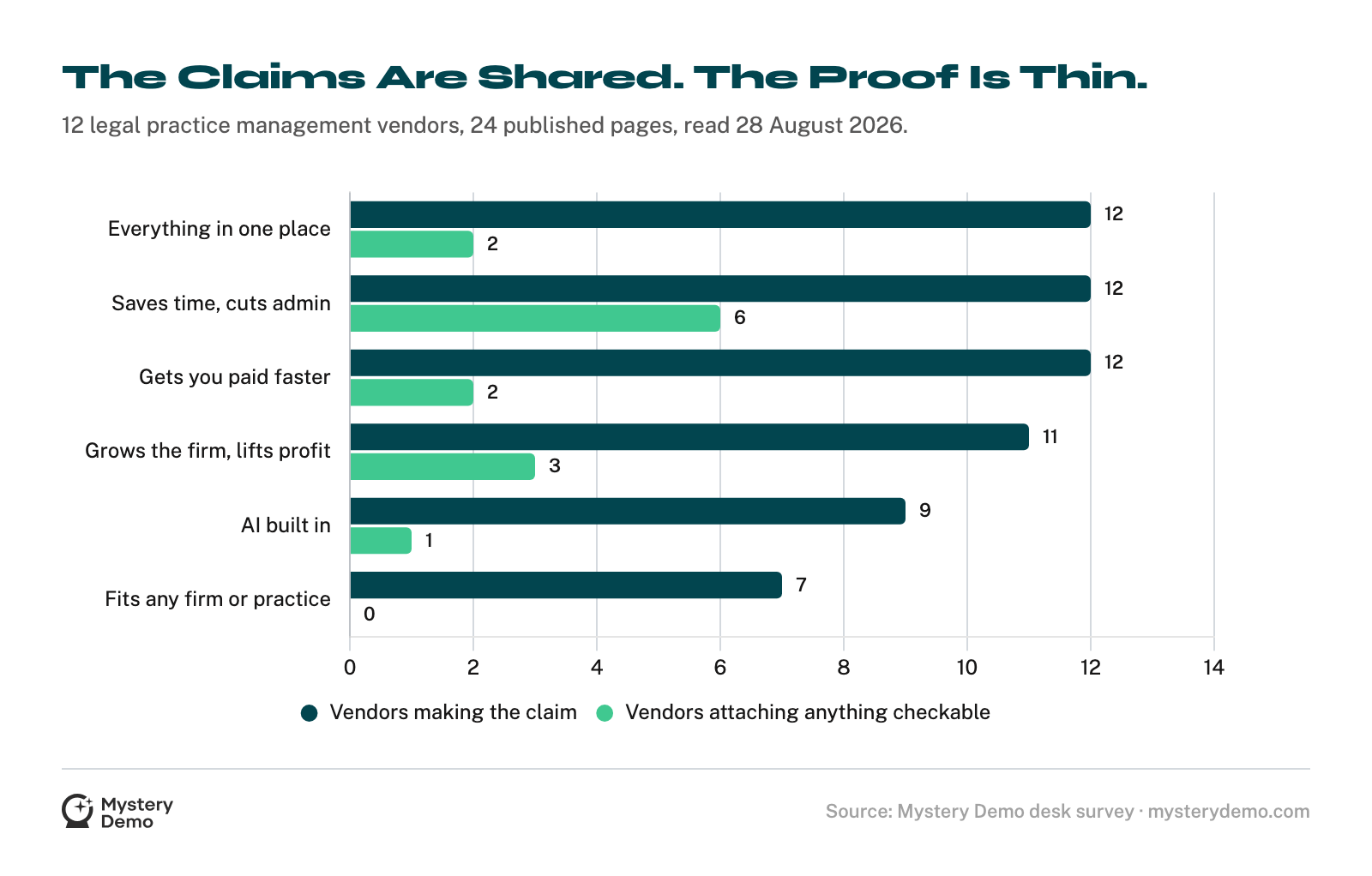
All twelve say they put everything in one place. Twelve out of twelve, in the headline or the section copy: all-in-one, end to end, one system, a single source of truth. Two of the twelve attach anything to that claim a rival could not say word for word tomorrow.
The pattern holds all the way down. Twelve of twelve promise to get you paid faster and two give you a way to check it. Seven claim to fit any firm or any practice area, and none of them back it at all.

One family behaves differently, and it is the tempting one. AI is claimed by nine of the twelve and backed by one, which means three vendors here have published nothing about it. On a map drawn from these pages that looks like open ground.
It is also the newest thing in the category, so it is the first place a repositioning reaches. And it is the likeliest place for a rival to be talking already and the least likely place for anyone to have written it down. White space on a website map is the least reliable thing on it.
The one backed AI claim in the set is Smokeball’s, and it takes a sentence: “Archie works in Microsoft Word and Outlook, uses only your firm’s own data, and never trains external AI models.” Three things a buyer can test, plus an accusation about everybody else, in nineteen words. One vendor in twelve had written a defensible line down.
That is where the desk stops. It can tell you which sentences are crowded and which are backed. It cannot tell you which of them a rep says to your buyer, or whether they can put it on a screen when asked.
Three Ways a New Position Collides
That is the published half, and it is the cheap half. The collisions that cost money come in three kinds, and what separates them is the evidence each one needs.
The first two are visible from a desk if you look hard enough. The third never is, because the thing being compared is not a sentence but a moment in a call: whether the claim goes on a screen while the buyer watches, or gets described instead.
A buyer settles that one in about ninety seconds and tells nobody. Going and hearing it is a standing piece of work here, and it has its own page: a competitor messaging comparison hands back the narrative each rival leads with, who they claim to beat, and how they frame the category, taken from the people who pitch it every day.
How We Find Out What a Category Says Out Loud
Which is where our half starts. We go through each competitor’s funnel the way their best prospect would, and we bring the same buyer to every one of them.
Send a different persona to each vendor and every difference in what comes back could be the vendor or could be the person asking, and you never find out which. So the buyer is held constant: one company, one situation, one set of needs, carried into every funnel in the set.
We call it the fábula. Nothing about the operators is faked, we never sign an NDA and we never buy the product, and the only invented element is the company we say we are evaluating for. Every rep in the category hears the same scenario, which is what makes their answers comparable.
The page below is from our public example project, where the client, the vendors and every number on it are invented. The structure is the real part, and it is what gets built for each engagement out of that engagement’s own calls.
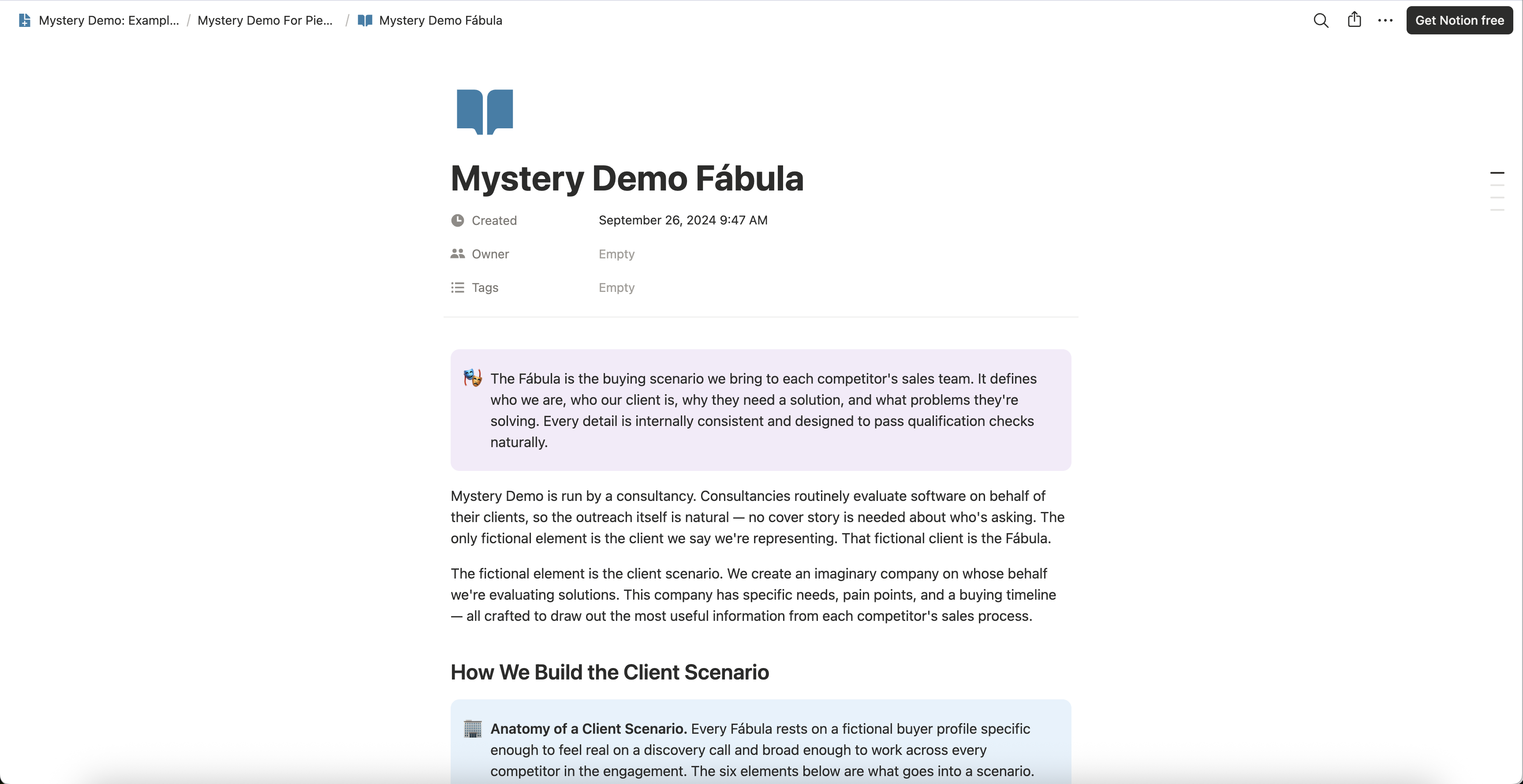
The work opens with a kickoff that settles three things: who the competitors are, what you want to learn, and the questions we carry into the rooms.
The third one is where projects are won and lost. A demo happens once, the questions we bring are the only questions asked in it, and a rep who has just given a ninety-minute walkthrough does not book a second call to cover what nobody thought of.
Then we book the demos, sit them, record them where the law allows it, and keep going through the follow-up: the pricing document, the security questionnaire, the nudge email three days later.
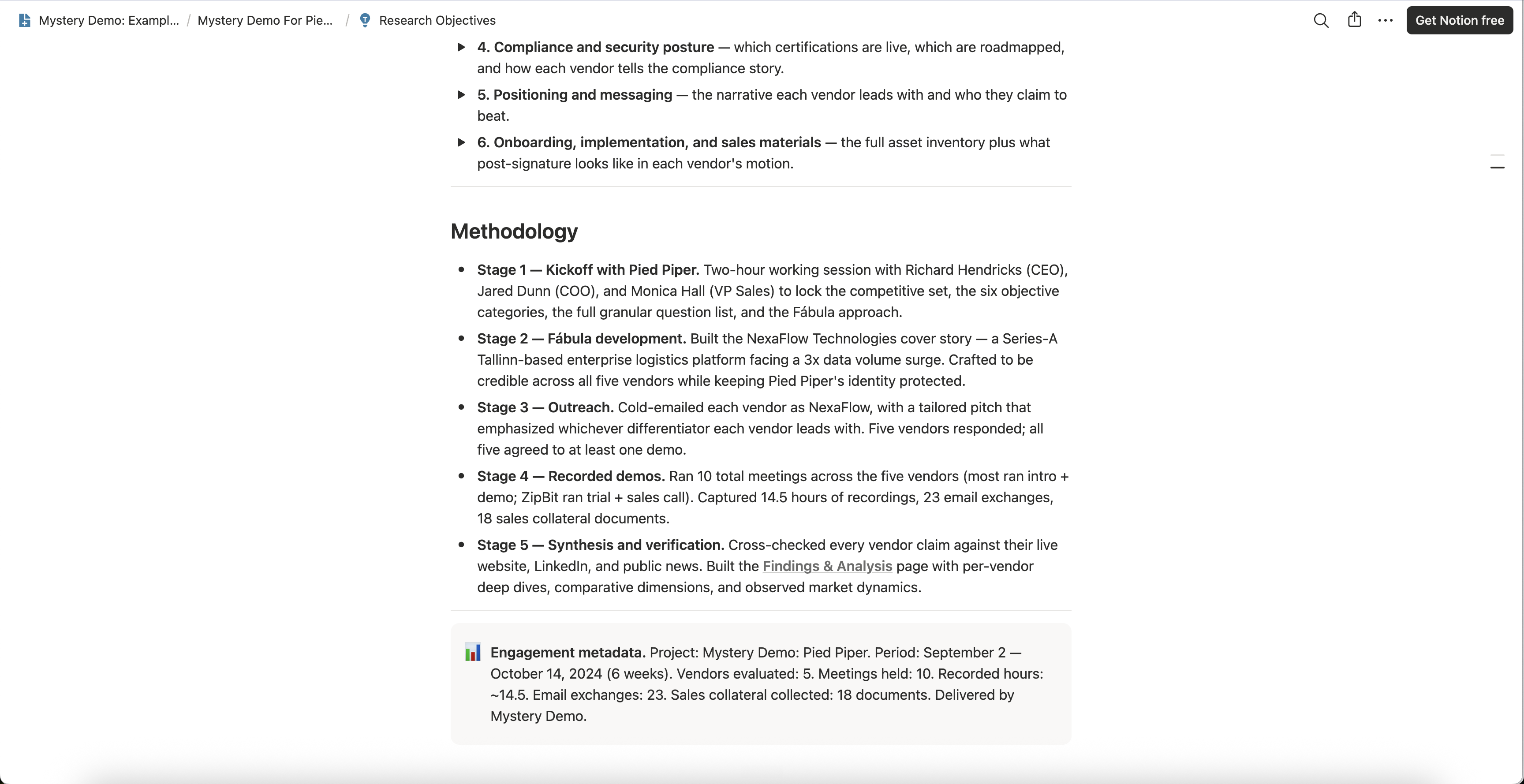
What comes back is a Notion board. Every recording, every transcript, every screenshot, every pricing document and every follow-up email, organized per competitor, with a page per vendor carrying our read on how they sell.
For a repositioning, three of its layers do the work. The messaging matrix sets every rival’s category framing beside the alternative they name unprompted, the comparative attack they run, and the subject they never raised once.
The per-vendor page holds the recording and the transcript with each positioning moment timestamped, so a line you want to argue with arrives attached to the minute somebody said it. The findings layer ranks what all of it adds up to, and that is the page a reposition is bought for.
Inside those, four moments answer the three collisions above.
The pricing runs per competitor and the number is flat: 499 euros a competitor, everything included, the scenario, the booking, every meeting, the recordings, the transcripts and the analysis. There is no second invoice. One competitor takes a week or two; a full field of ten to fifteen takes four to eight weeks, because the demos run in parallel even though the follow-up threads do not.
An average B2B SaaS company has ten to twenty rivals and most repositioning projects do not need twenty. They need the four or five names that land on the same shortlist as you, heard in the same month, before the new language is locked.
Keep It, Move It, or Wait
Four or five names heard inside one month settles the only question a repositioning has to answer, and it comes back as one of three.
| The answer | What it means | What has to be true before you can give it |
|---|---|---|
| Keep | The line is yours in the room as well as on the page, and the work is to say it louder rather than differently. | You have heard your rivals open their discovery calls, and none of them opens with your sentence. |
| Reposition | Somebody already owns it where the deal gets decided, and staying costs you every deal where both of you are heard. | A rival says it first, says it better, or demonstrates on a screen the thing you assert in a sentence. |
| Wait | The evidence is not there yet, which is the honest answer more often than anyone likes. | Your map is built from published pages, and nobody has checked what the category says out loud. |
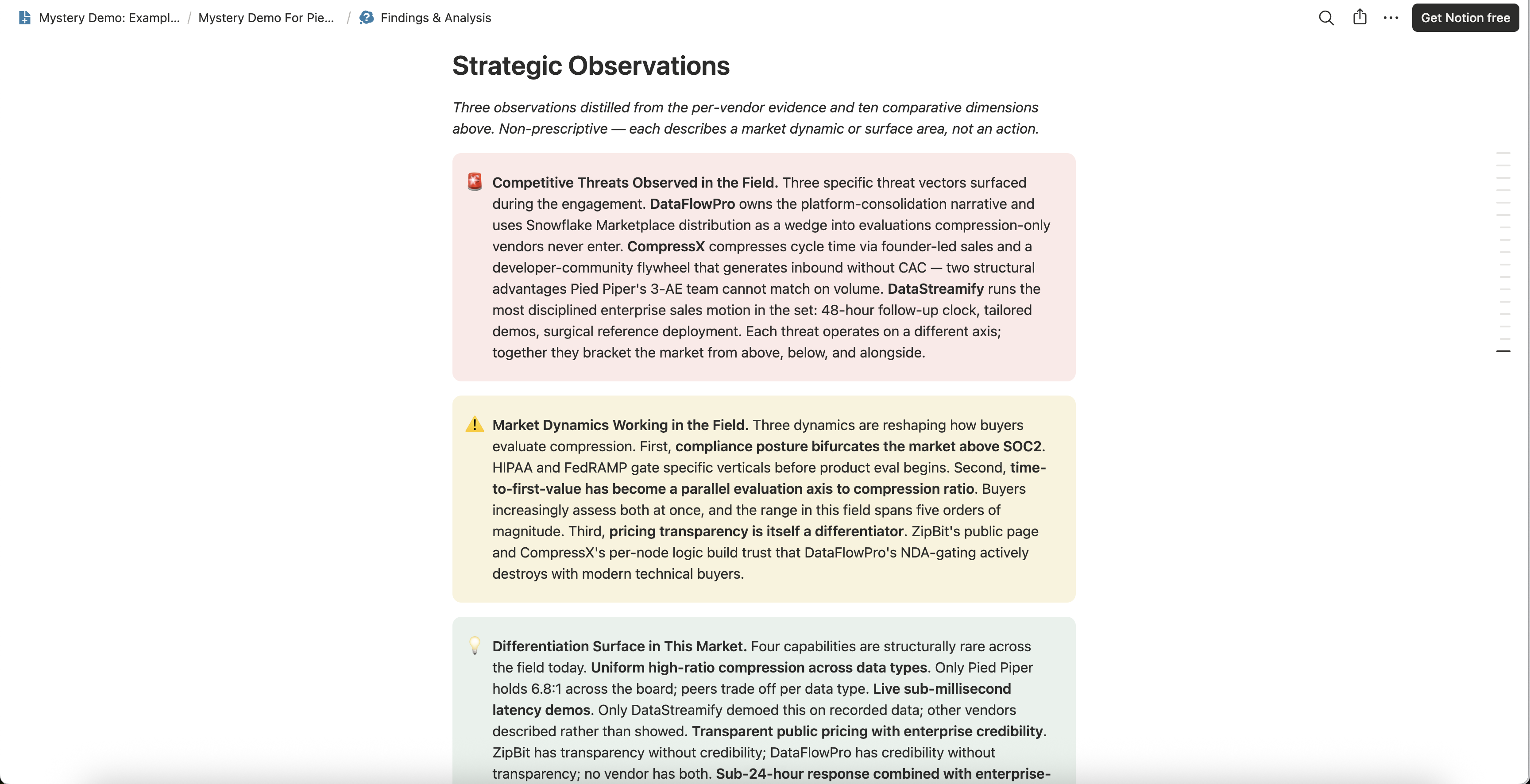
The page above is where evidence turns into a decision, and it is the layer a reposition lives or dies on. Not what each vendor said, but which of the things they said would still be standing after a buyer had heard all of you inside the same month.
You can run a rough version of that tonight, without talking to anybody. Write down the three sentences your new position rests on. Next to each one, name the competitor most likely to say it first in a discovery call, and how you know.
If that third column is empty, filling it is the work. Name the four or five rivals a buyer is most likely to hear in the same month you launch, and we will sit their demos as a genuine buyer and bring back what each of them says when the page is not in the room.
.png)


