
Eighty-six percent of B2B buyers say expertise is what earns their trust. In the same survey, 45% describe the sellers they meet as trustworthy.1
That gap has a cause worth naming. Vendors did not get worse. Buyers got better at checking, and most vendor claims are built to be believed rather than checked.
We work the other side of that check. A partner names a competitor, we build a fábula (a believable company profile and buying scenario), book the demo as an ordinary prospect, and compare what the rep says with what the pricing, the product, and the follow-up deliver.
The figures below come from seven studies published between 2024 and 2026. Every one carries the population it was measured on, because a number from 900 buyers across seven markets and a number from 2,058 software purchasers are different facts.
Buyers Rank Almost Every Other Voice Above the Vendor’s Own Claims
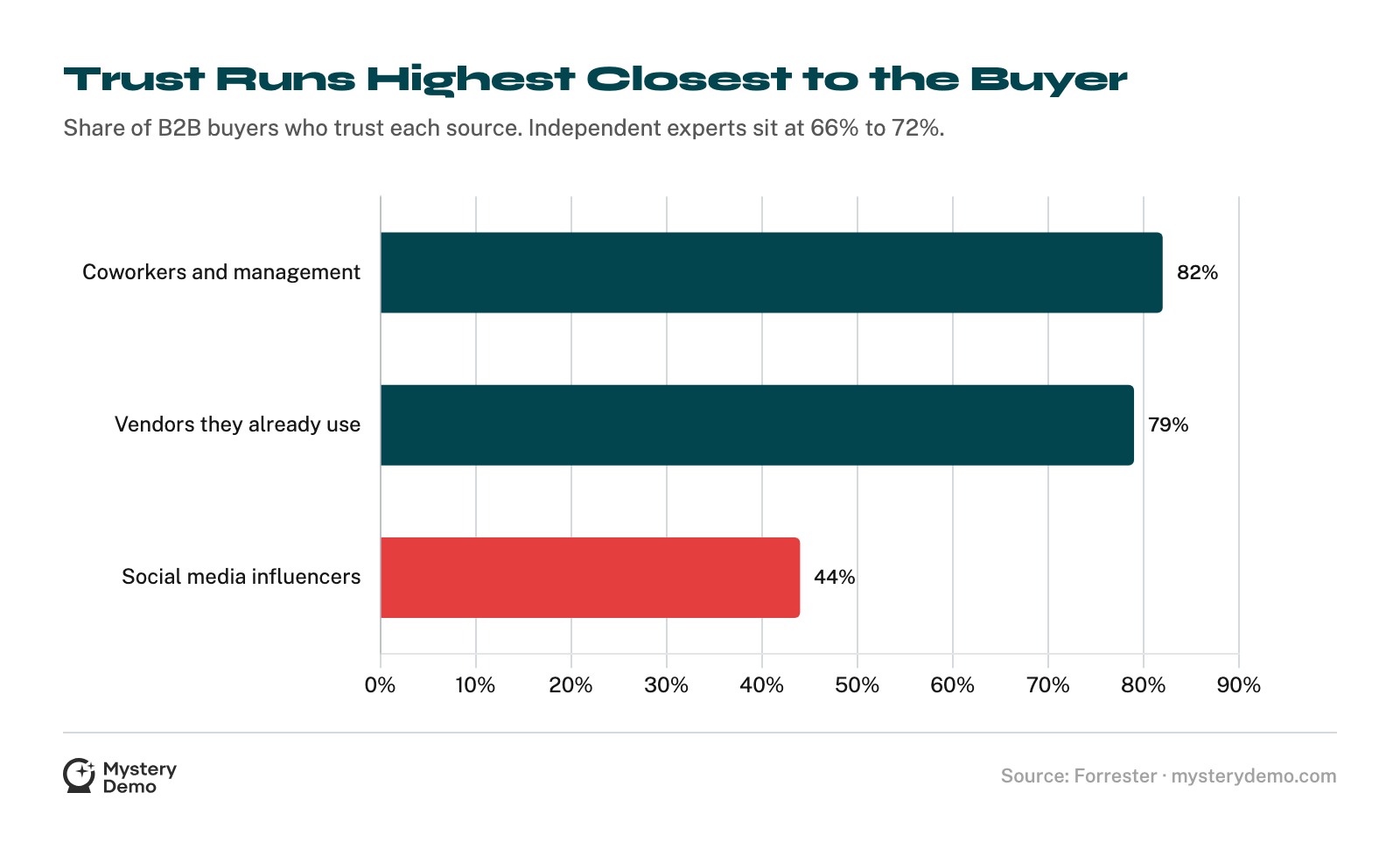
Forrester asked B2B buyers which sources they trust. Coworkers and management came first at 82%, and vendors the buyer already works with came second at 79%.2
Independent experts, meaning industry peers, analysts, vendor executives, and customers, landed between 66% and 72%.2 Salespeople, news media, and government officials scored lower. Social media influencers finished last at 44%.2
Read that ladder from the bottom and the pattern is hard to miss. The further a voice sits from something the buyer can check, the less it is trusted. The vendor’s own salespeople sit below every one of those voices, and the vendor’s claim is the one thing every marketing budget is built to produce.
G2 watched the same distrust arrive as a complaint. Among 1,940 B2B decision-makers surveyed in March 2024, 9% named unreliable vendor websites as the single biggest obstacle to a purchase decision, up from 3% the year before.4 Tripling in a year is not a mood. It is a measurement.
TrustRadius, surveying 2,058 technology buyers in January 2025, found the blunt version. Buyers’ own prior experience with a product ranked as both the most consulted resource, at 52%, and the most influential, at 74%.3 Vendor websites dropped out of the top five most influential resources altogether, replaced by asking a friend or a peer.3

Their summary of it: vendor-produced content is frequently consulted but does not often sway a decision.3
The third-party proxies are not filling the gap either. Analyst reports were consulted by 14% of buyers in 2025, an all-time low and a 60% fall since 2022.3 TrustRadius reads that as buyers declining to trust intermediaries they believe are pay-to-play.
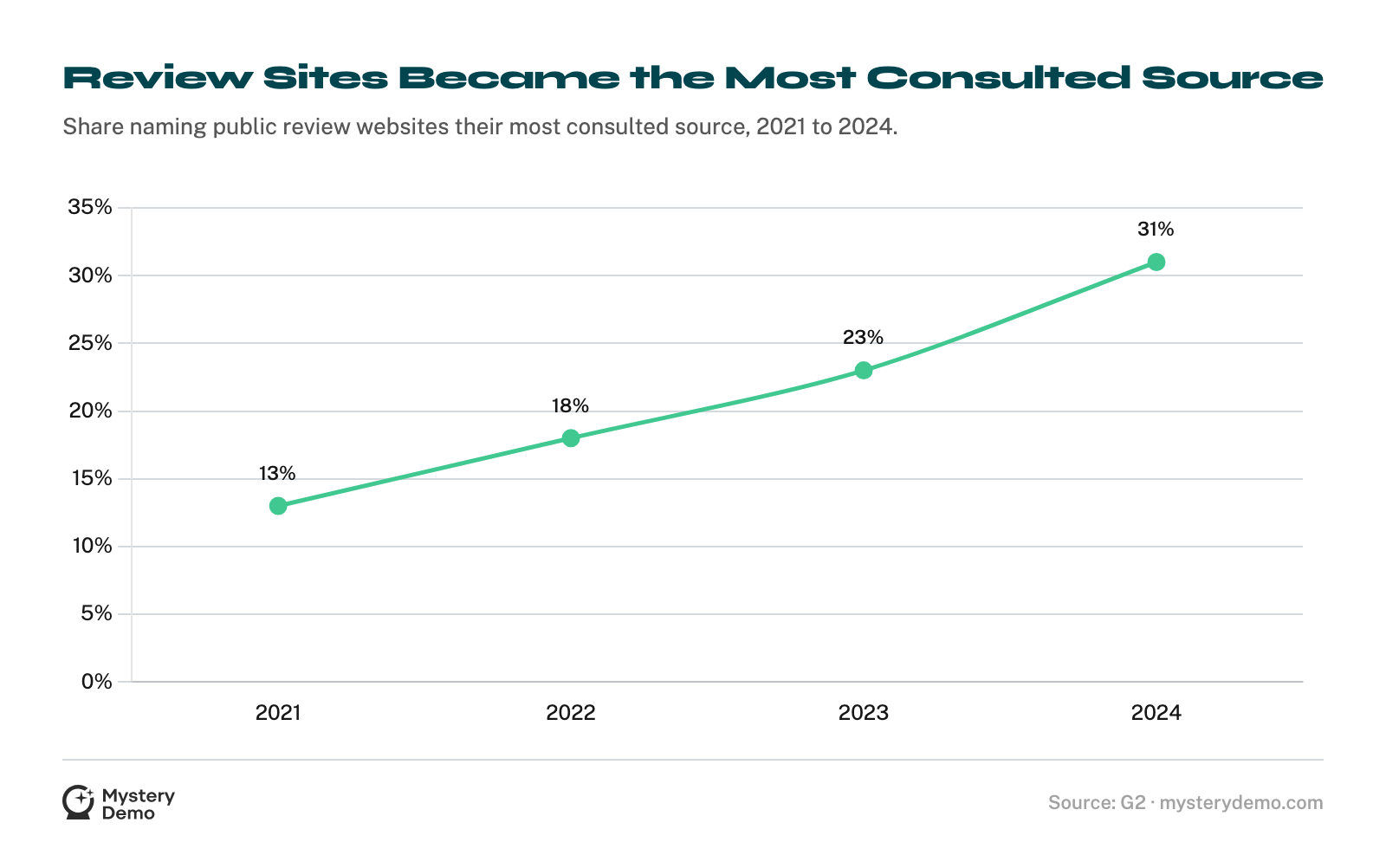
Review sites are the exception, and only because the content is not the vendor’s. G2 found review sites were the most consulted information source for 31% of buyers, up from 23% in 2023, 18% in 2022, and 13% in 2021.4 TrustRadius put review readership at 77% of buyers.3
The Evaluation Is Mostly Over Before You Know the Buyer Exists
Trust is not decided in the meeting, because by the meeting most of the decision has already happened.
Seventy-nine percent of buyers already knew about the product they eventually bought before they started researching.3 Eighty-two percent had a top product in mind when they built their shortlist, and 70% bought that one.3 The average shortlist holds 2.6 products.3
Sixty-nine percent of software buyers say they usually engage a salesperson only once they have already made their decision.4
So the evidence that moves a shortlist is the evidence that was sitting there before anyone picked up a phone. That is where thought leadership stops being a marketing word and starts being a measurable trust instrument.
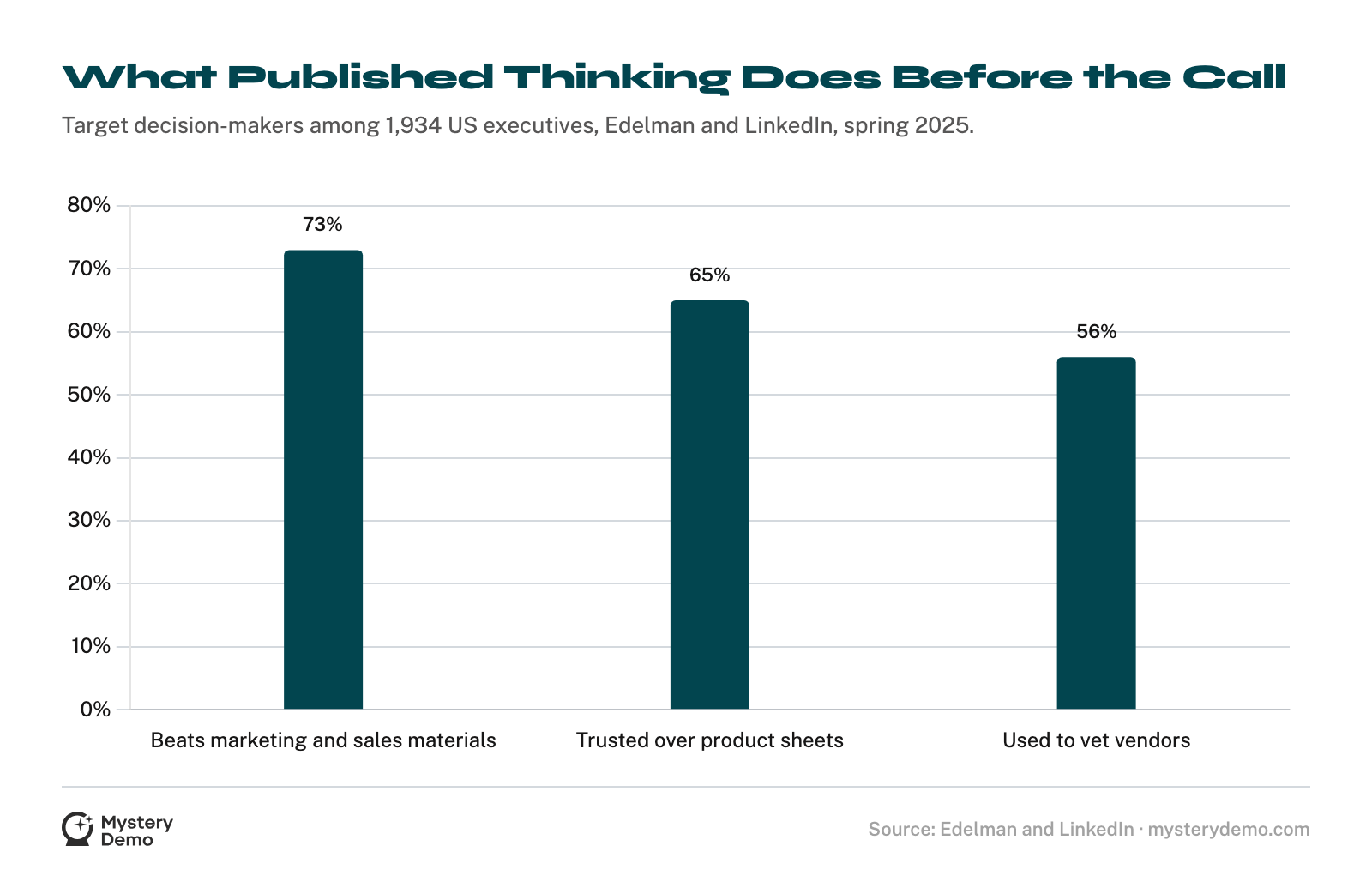
Edelman and LinkedIn surveyed 1,934 US business executives in spring 2025 and found:
The same study followed the buyers who never appear in a CRM: the finance, legal, operations and procurement stakeholders it calls hidden decision-makers. Seventy-one percent of them report relatively little or no interaction with sales.5 Ninety-five percent say strong thought leadership makes them more receptive to outreach, and 79% say it makes them more likely to champion that vendor’s proposal during an RFP.5 Thirty-five percent say a C-suite executive encouraged them to consider a vendor after reading that vendor’s thought leadership.5
Demand Gen Report’s 2024 buyer survey lines up from both directions. The thing buyers most want easy access to on a vendor’s website is content that speaks directly to their company, at 77%.7 And among the top five reasons they gave for choosing the vendor they finally bought: a strong knowledge of their company and its needs at 72%, a strong knowledge of the solution area and the business landscape at 72%, and content that made it easier to show ROI or build the business case at 67%.7
None of those are claims about the product. They are claims about whether the vendor understood the problem, which is the one thing a buyer can assess without taking anyone’s word for it. The wider pattern of how that journey runs sits in our B2B SaaS buyer behavior statistics.
Price Is the First Trust Test, and It Is Usually Failed in Silence
Asked to name the top five variables they weigh when evaluating potential vendors, Demand Gen Report’s buyers put pricing first at 86%, narrowly ahead of features and functionality at 85%.7 Asked separately what they want easy access to on a vendor’s website, 62% named pricing and competitive information.7
Ask them what they would change about buying software and the answer is the same thing from the other direction: transparent pricing is the number one item on the list, named by 45% of buyers, ahead of talking to peers at 26% and vendors backing off until they are ready at 20%.3
The cost of getting this wrong is measurable. Sixty-four percent of C-suite buyers say they are less likely to purchase when a vendor gates pricing behind personal information.4 When G2 asked which features are most helpful on a third-party review site, pricing information ranked first.4
A pricing page that says “contact us” is not neutral. It moves the price question to the one channel the buyer trusts least and cannot verify: a sales call.
That is the exact gap our partners hire us to close. Sitting the call as a real buyer is the only way to learn the number, the discount threshold, and the contract term a competitor will agree to in the end, which is why pricing transparency shows up in this research as a trust issue rather than a marketing preference.
ROI carries the same shape. Thirty-three percent of buyers wish it were easier to calculate return on investment, rising to 48% among buyers of high-priced software.3 Fifty-seven percent expect positive ROI within three months of purchase, and 78% expect it within six months of implementing the software.4
AI Turned Fact-Checking Into the Default Motion
Ninety-four percent of B2B buyers now use AI at every stage of the purchase process.1 Gartner, surveying 645 B2B buyers between August and September 2025, found buyers consulted an average of seven information sources on a recent purchase, and 45% used generative AI among them.6
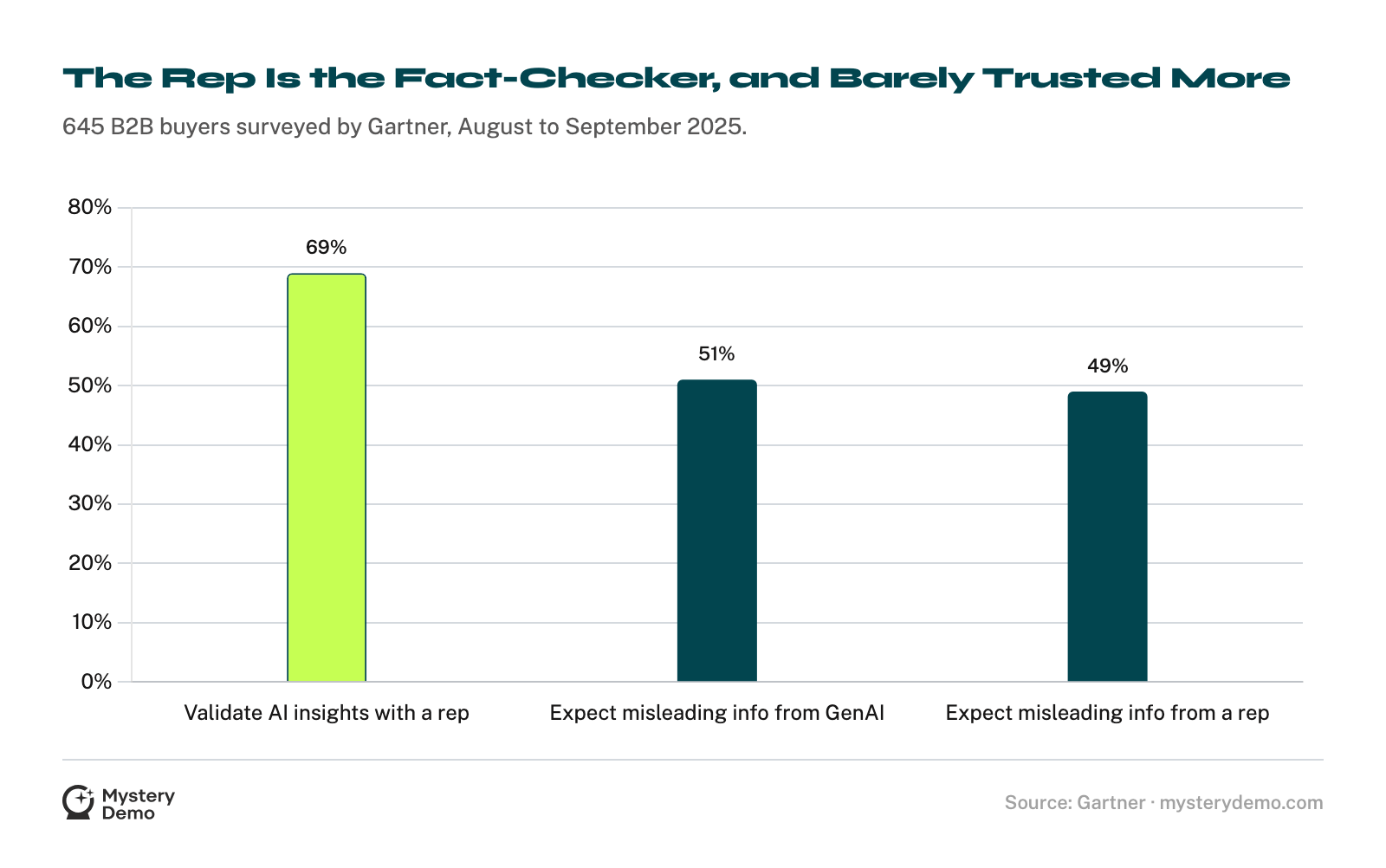
Then the interesting part. Sixty-nine percent of the 645 buyers Gartner surveyed prefer to validate AI-generated insights with a sales representative.6
Which sounds like good news for sellers until you read the next line. Fifty-one percent of buyers say they are more likely to encounter misleading information from generative AI, and 49% say the same about a sales rep.6 The rep is being used as a fact-checker, and buyers put the two at near-equal risk of misleading them.
The verification reflex shows up everywhere in the 2025 data. Seventy-two percent of buyers encountered Google’s AI Overviews during research, and 90% of them clicked through to the cited sources to fact-check.3 Eighty percent now say they trust AI content at least sometimes, up 19% year over year.3 Among the heaviest AI users, 62% say they always or very often fact-check what it tells them.3
The people using the tool most are the people checking it hardest, and the habit does not stop at the tool. It now applies to every claim a buyer meets, including yours.
The Sales Call Survives, as the Verification Stage
Buyers say two contradictory things about sellers, and both are true.
Seventy-five percent would prefer to complete a purchase without speaking to a sales representative.1 Yet buyers who go through with a seller-free purchase report 23% higher purchase regret.1
Only 3% of software buyers say they never want to talk to sales at all.4 What they want is control of the timing: 34% say the research stage is when contact is most useful.4
The window is narrow and specific. Eighty-eight percent of buyers value seller engagement most in the middle of the buying journey, compared to 57% in the early stages.1 The middle is where a shortlist gets defended to a committee, and a claim that cannot survive that room is a claim that loses the deal quietly.
Buyers also bring their own verification instrument. Fifty-four percent speak to an actual user of the product before buying, while vendors estimate only 38% do.3 And they route around the vendor to do it: 51% found that person through a former colleague or peer, and only 23% used a reference the vendor supplied.3
.png)
Even security follows the pattern. Eighty-one percent of buyers say they weigh a vendor’s history with breaches, and 48% closed a purchase anyway without the vendor completing a security assessment.4 Stated criteria and executed criteria are different things, which is the entire reason we watch what happens in the room rather than reading what buyers say they do.
The through-line across all seven studies is one sentence. Trust attaches to claims a buyer can check, and drains from claims they cannot.
What This Means if You Sell Software
Every number here points at the same operational question: which of your claims can a buyer check, and what do they find when they do?
Most teams cannot answer the second half about themselves, and almost none can answer it about a competitor. That is the work we do. A partner names the competitors, we run their funnels as a real buyer, and the recordings, transcripts, pricing, and messaging comparisons come back on one Notion board, with the difference between what was asserted and what was demonstrated marked on it.
If you want to know what a rival’s rep is claiming in the room this quarter, and whether those claims hold up, let’s talk about which competitors to run first.
Frequently Asked Questions
Do B2B Buyers Trust Software Vendors?
Not by default. Eighty-six percent of buyers say expertise drives trust, while 45% describe the sellers they meet as trustworthy.1 Forrester’s ranking puts salespeople below coworkers, existing vendors, and independent experts.2
Which Information Sources Do B2B Buyers Trust Most?
Coworkers and management at 82%, then vendors they already work with at 79%, then independent experts including peers, analysts, and customers at 66% to 72%.2 Social media influencers rank last at 44%.2 TrustRadius measures a different thing and finds a fourth answer: among 2,058 technology buyers, the most influential resource of all was the buyer’s own prior experience with the product, at 74%.3
How Do B2B Buyers Verify a Vendor’s Claims?
They triangulate. Buyers used an average of seven information sources on a recent purchase.6 Ninety percent click through the sources cited in AI Overviews to fact-check them.3 Fifty-four percent talk to a real user of the product, usually one they found themselves rather than one the vendor supplied.3
Does Thought Leadership Move B2B Deals?
The measured effects are large. Among target decision-makers, 56% use it to vet vendors and 65% trust it more than product sheets when assessing capabilities.5 Among hidden decision-makers, the finance, legal and procurement stakeholders outside the vendor’s line of sight, 79% say it makes them more likely to advocate for that vendor in an RFP, and 35% say a C-suite executive steered them toward a vendor after reading its thought leadership.5
How Has AI Changed B2B Vendor Evaluation?
It added a research layer and a verification layer at the same time. Ninety-four percent of buyers now use AI at every stage.1 In a separate Gartner survey of 645 B2B buyers, 69% say they prefer to validate AI-generated insights with a sales rep.6 In that same survey, 51% say they are more likely to encounter misleading information from generative AI, and 49% say the same about a sales rep.6
What Makes a Vendor Claim Credible to a B2B Buyer?
Checkability. The claims that score highest in this research are the ones a buyer can test against something outside the vendor’s control: a published price, a real user’s experience, a documented capability, or a demo they sat through themselves. A vendor’s strong knowledge of the buyer’s company and its needs was named by 72% of buyers as a reason they chose the vendor they bought from, and content that made it easier to show ROI or build the business case by 67%.7
Why Do Buyers Prefer Self-Service but Still Regret It?
Because self-service removes the friction and the verification at once. Seventy-five percent would rather buy without a rep, and seller-free purchases carry 23% higher regret.1 The middle of the journey is where 88% value seller input most, and it is the stage where a claim gets tested against a committee.1
How Long Does a B2B Software Purchase Take Now?
Longer, under heavier scrutiny. Forty-nine percent of buyers took four months or more on a purchase above $20,000, up from 41% the previous year.4 Shortlists shrank at the same time, averaging 2.6 products.3
References
- LinkedIn Sales Solutions and Ipsos: The Trust Advantage
- Forrester: B2B Buyers Rate Their Most Trusted Information Sources
- TrustRadius: Bridging the Trust Gap: B2B Tech Buying in the Age of AI
- G2: Buyer Behavior Report 2024: Proving Value in the Age of AI
- Edelman and LinkedIn: 2025 B2B Thought Leadership Impact Report
- Gartner: Gartner Survey Finds 69% of B2B Buyers Turn to Sales Reps to Validate AI-Generated Insights
- Demand Gen Report: The 2024 B2B Buyer's Survey
.png)


