
A competitor’s page comparing itself to you is a sales pitch that runs without a rep. Buyers can read it before your team ever speaks to them, and so can the AI assistants that answer their questions. One marketer, listing the places where AI answers pick up wrong prices, included “a competitor’s comparison page that listed your prices incorrectly.”
The page is only half of what you are up against. The other half is what the rival’s reps say about you on their sales calls, and no page shows you that. The job takes four steps:
Mystery Demo does the second step for you. We take the rival’s sales calls as a genuine buyer, ask how it stacks up against you, and hand back the recording of every word its reps say about you, with our analysis beside it.
Audit the Page Claim by Claim
Copy every sentence on the rival’s page that says something about you into a sheet, one claim to a row. Save a dated copy of the page too, because pages change and the copy is your proof of what it said.
Then check each claim against your own evidence: your current pricing page, your product docs and release notes, your standard contract terms, and what customers say about you in public reviews. Give each claim one label, and keep the evidence that earned it beside the label:
The sheet has four columns, and here is what goes in each one:
| Column | What goes in it | Where it comes from |
|---|---|---|
| The claim | Their words about you, and the date you read them | The rival’s page |
| Your evidence | True, false, outdated or misleading, with the proof beside the label | Your pricing page, docs, release notes, contracts and reviews |
| On their calls | Not yet known, heard as printed, said differently (with the rep’s words) or not heard on the calls reviewed, each with its recording and minute | The rival’s sales calls |
| Your response | Correct publicly, a talk track (the answer your reps give), both, or nothing | The two columns before it |
One bar applies to both sides. US policy has long welcomed comparisons that are truthful, are not deceptive and say what is being compared, as the Federal Trade Commission set out in 1979. If a claim looks false and damaging, take it to your lawyer, and bring the sheet.
You can fill the claim and evidence columns from your desk. The calls column stays empty, because no page records what the rival’s reps say about you, and the response waits on both.
Find Out What Its Reps Say About You
Your rival compares itself to you in two places, and they work differently:
| The comparison | On their page | From their rep on a call |
|---|---|---|
| Written | Once, and edited when someone gets to it | Fresh on every call |
| Reaches | Anyone who finds it, AI assistants included | One buyer, in the middle of a decision |
| Shaped by | What the rival wants every buyer to believe | What this buyer just said |
| Checked by | Anyone with a screenshot | Only someone on the call |
On a call, a rival’s rep can treat the page in four ways:
The calls column records which one happened, and no page can fill it.
Mystery Demo fills it from the buyer’s side of the table. A project starts with your question and the rivals you name. For each rival, we write a buying scenario that fits the customers it chases: the industry, the team size, the reason to buy now.
Then we request the demo the way any prospect would and take the calls that follow: discovery, the demo, the technical deep dive, the pricing conversation and the follow-up. Somewhere along the way we ask how the rival compares with you, the way a buyer weighing both would. Every call is recorded, so each answer comes back as the rep said it, with the minute.


Everything lands on a Notion board, a shared workspace with a page for each rival: its recordings, its transcripts and our analysis. Its first page holds your company and the rivals you named. The one below comes from our public example board, where the client and every competitor are invented, so nothing on it is a finding.
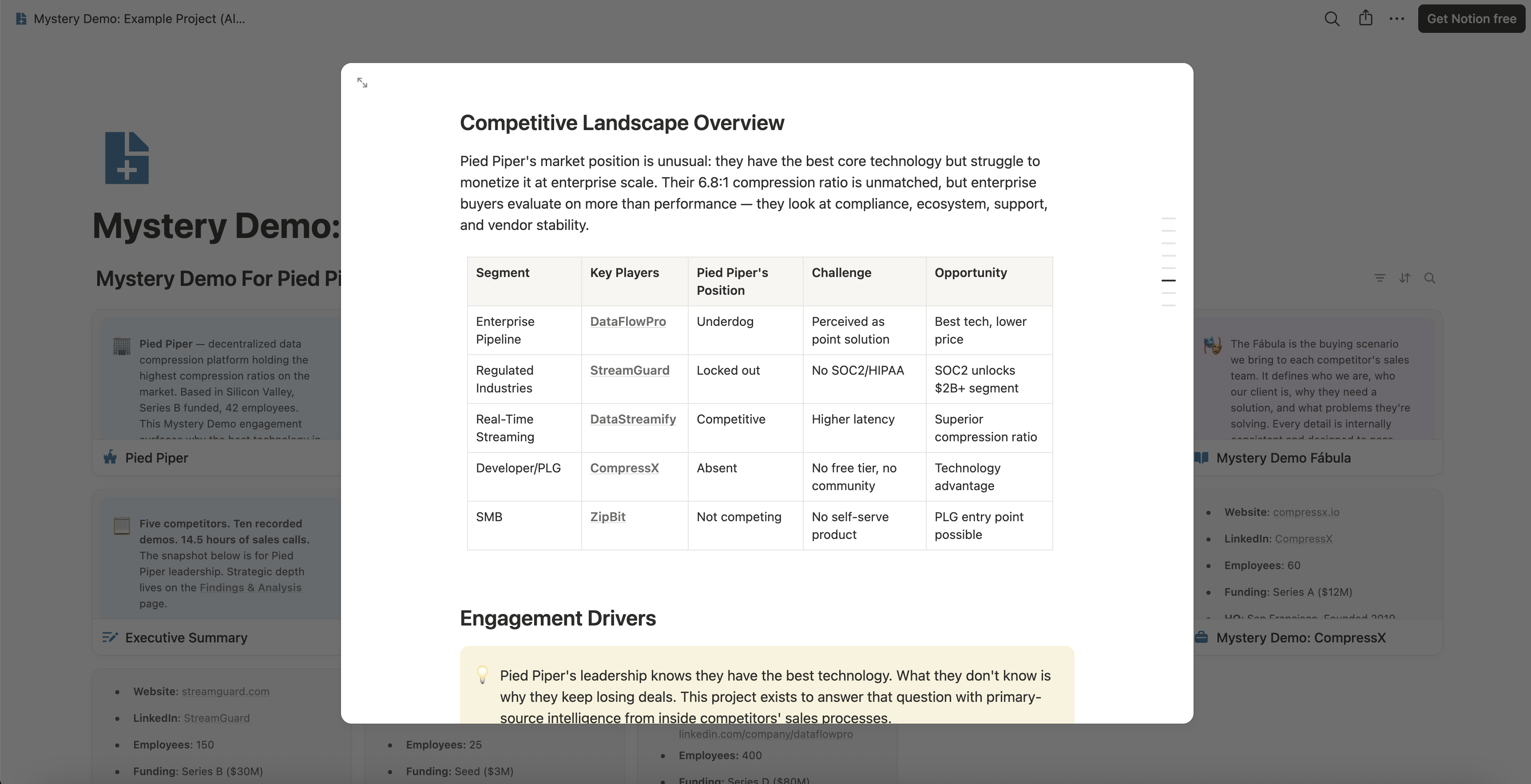
Each row names a segment, the rival that leads it, where the client stands against it and what the project has to find out. A real board is built from your own question and your rivals’ calls. On yours, the rival with the page about you gets a row like these, and its question is what its reps tell buyers about you.
The calls come back as a competitor messaging comparison. For each rival, it records:
Across rivals, the patterns go to Findings & Analysis, the page where the competitors are compared side by side. It opens its observations with the competitive threats heard in the field: what each rival says against the others.
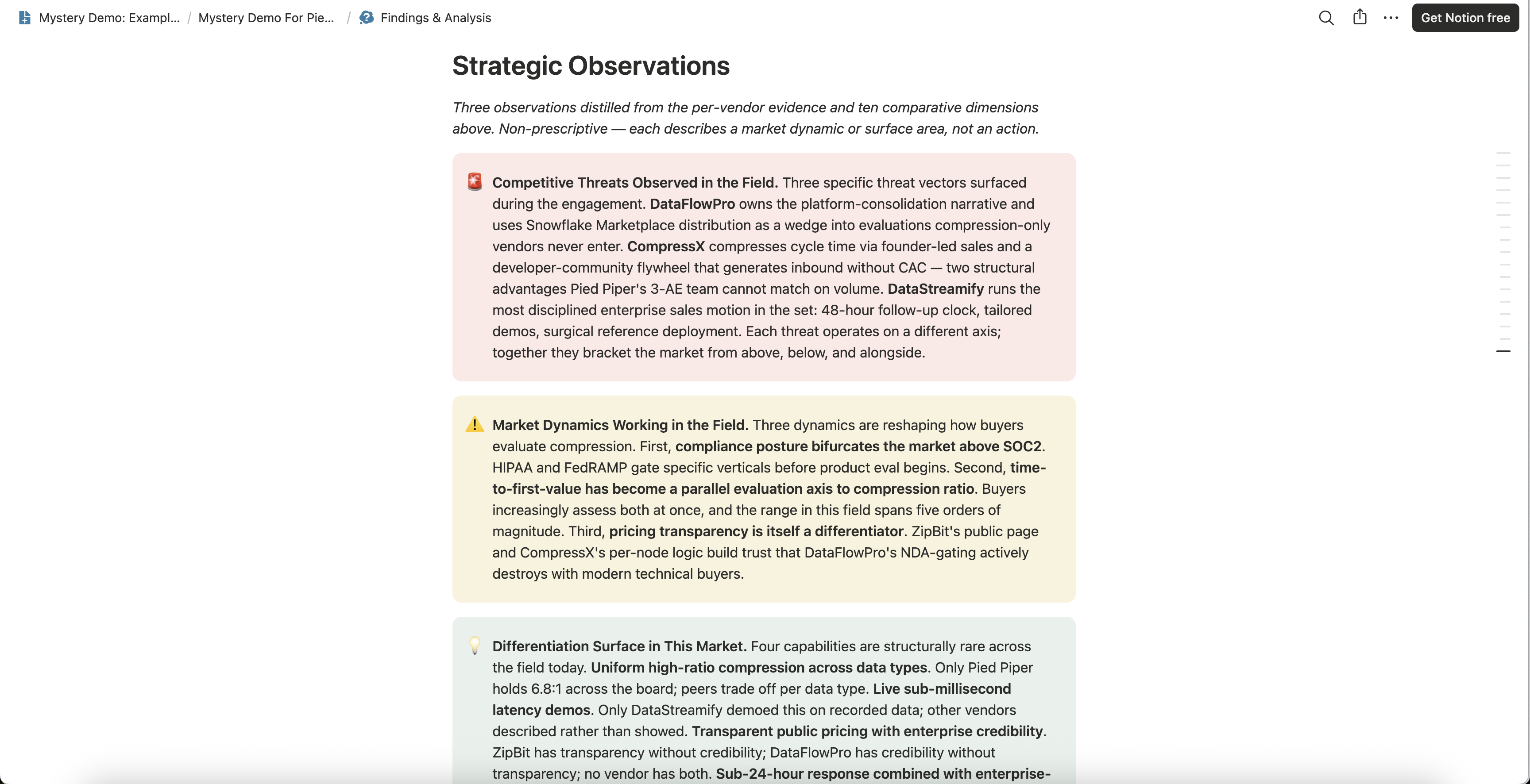
On the example board, the first callout says how each invented vendor competes, read from the calls rather than from the vendors’ websites. On yours, what the rival’s reps say about you sits there, and every line traces back to the call it came from.

Your own team can’t hear what the rival’s reps tell a buyer. A rep who sees your company’s name on the demo request gives the careful tour, or none at all.
Mystery Demo hears the version buyers get:
If a rival’s page about you is live, send us the link. Over an intro conversation, we agree which of its claims matter most, and then we take the rival’s calls as a buyer who is also looking at you. Your calls column comes back filled, every entry with its recording.
Match Each Claim to a Response
Each claim’s response comes from two separate questions, one for each column you filled:
Put together, the two columns give each claim one of four responses:
| The claim on their page | Heard on their calls | Not heard on the calls reviewed |
|---|---|---|
| False, outdated or misleading | Both: correct it publicly and give reps a talk track | Correct it publicly |
| True | A rep talk track | Nothing, until your own buyers bring it up |
A claim heard only on the calls has no page to correct, so it gets a talk track. Where the calls are not in yet, mark the public answer now and leave the rep answer open, because “not yet known” never counts as “not heard.”
Build each talk track from the rep’s own words on the recording, not from the page. Your reps will meet the version buyers heard. Each line should name the call it answers, the way every line on a sourced battlecard names where it came from.
Here is a whole sheet, filled in for an invented rival and an invented page. Its five claims need four different answers. Read each row from left to right to see why.
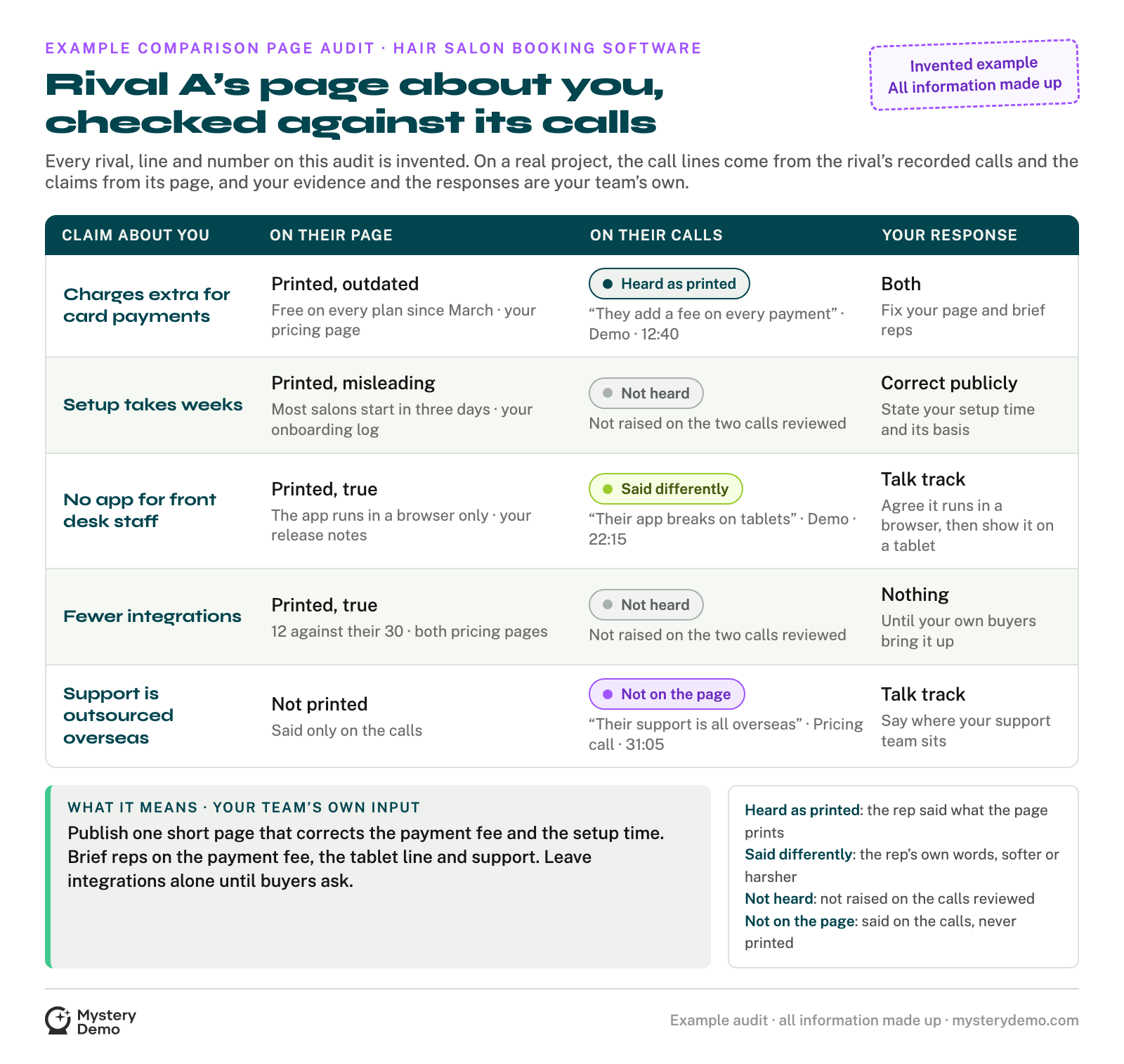
Decide Whether to Answer in Public
The sheet now answers the question you started with. Read down the last column:
If you publish, hold your page to the bar you held theirs to. One marketer’s rule for comparison pages fits word for word: “Do not make unsupported claims about the competitor.” Write a comparison a buyer can check, with the basis of every claim stated.
Whatever you decide, date the sheet. Look again when the rival changes its page, when new calls come in, or when your own buyers start quoting the page to your reps.
A rival’s page about you calls for an audit, and for a public answer only where it misleads in public. The calls decide where else you answer, and only a buyer can fill that column. Name the rival, walk us through its page, and we will bring back which claims its reps repeat, which they change, and what they say about you that the page never prints.


