
Yes, some competitors make offers aimed at buyers leaving another vendor: help with the migration, free or cheaper months, a rebate while the old contract runs out, or a promise to match what the buyer pays today. The size of those offers changes from one competitor to the next and from one month to the next, so the only reliable way to know what a particular rival offers a buyer leaving you is to get its quote as that buyer.
If the buyers being courted are your own customers, that quote is given in a rival’s sales process, and nobody from your side hears it. Mystery Demo takes competitors’ sales calls as a genuine buyer and hands your team the recordings and its analysis on one shared board. On this question, the buying scenario is a company running on your product today, asking the rival what it would give to win that company over.
Some vendors do put a switch incentive in writing. Acronis, a backup software company, published a 2025 promotion for the service providers that buy its software, and called it a competitive displacement promotion. A provider switching over from a competitor got:
Acronis’s program is published and open to any provider who qualifies. The offer a rival makes to one of your customers is negotiated, and no public study measures how often switchers get better terms than other new buyers, or by how much. You can still know in advance what such an offer is made of.
The Switch Incentives Worth Asking About
Each switch incentive takes away one reason to stay put. One seller’s advice on LinkedIn shows the thinking behind them: “Next time a deal stalls because the buyer is scared of switching, ignore discounting and offer to fund the migration instead.”
Every incentive comes with terms, and the terms decide what the deal is worth:
| The incentive | The question to ask | What to get in writing |
|---|---|---|
| A rebate or free months while the old contract runs | How long does it last, and what has to happen first? | The price when the free period ends |
| Migration help or credits | What exactly is included, and what does it depend on? | What services cost once the move is done |
| A lower price for the first term | Is this price for switching, and how long does it hold? | The renewal price, or a cap on it |
| Matching what the buyer pays today | Which terms would you match, and for how long? | The contract length and the exit terms |
The last column is where a switch deal can turn into an ordinary one, and where the vendor being left still has an argument. In August 2026, The Reality Department surveyed 250 UK B2B buyers at companies with $50m or more in revenue. Among the 161 who reported any regret about a purchase, the most common single cause was pricing creeping up at renewal, named by 15%.
That survey covers renewals in general, not switch deals, but a price set to win a switcher still has to be renewed. One buyer on Reddit said the renewal term was the thing worth negotiating: “An upfront discount is cool and all but I got them to put in writing that they couldn’t increase the renewal price by more than 12%.”
The table tells a buyer what to ask. It cannot tell you how a particular rival would answer.
A Rival’s Switch Offer Is Made in Its Sales Process
A published program tells you what a vendor offers everyone who qualifies. The offer to your customer depends on what the rep learns about that customer: how many people use your product, when the contract ends, and how hard the move looks.
Timing moves it as well. One founder who studied competitors’ sales emails wrote on X that the emails showed “how big a discount they offer once a lead goes quiet.”
Each place you might look for a rival’s switch offer shows a different part of it:
| Where you look | What it tells you about the switch offer |
|---|---|
| A published switch program | The terms for everyone who qualifies, if the rival runs one |
| The pricing page | The list price every buyer sees |
| Review sites and competitive intelligence tools | What past buyers and the rival chose to make public |
| Your customer’s retelling | Whatever your customer chose to pass on |
| The rival’s quote to a buyer leaving you | The offer, its conditions and the renewal, in the rep’s own words |
Only the last row is the offer itself, said by the rival to a buyer. To hear it, you need a buyer the rival quotes as someone leaving you.
How a Mystery Demo Gets a Rival’s Switch Offer
A Mystery Demo project starts with a kickoff, where the questions in the first table become the question list, asked of every rival in the same words. Everything the project finds lands on a Notion board, a shared workspace with a page for each part of the work.
Below is the Research Objectives page from Mystery Demo’s public example board. The client and every rival on it are invented; on a real project, the board is built from the calls taken for that project. Its first objective is pricing: how each rival structures its price, and where the discount levers live.
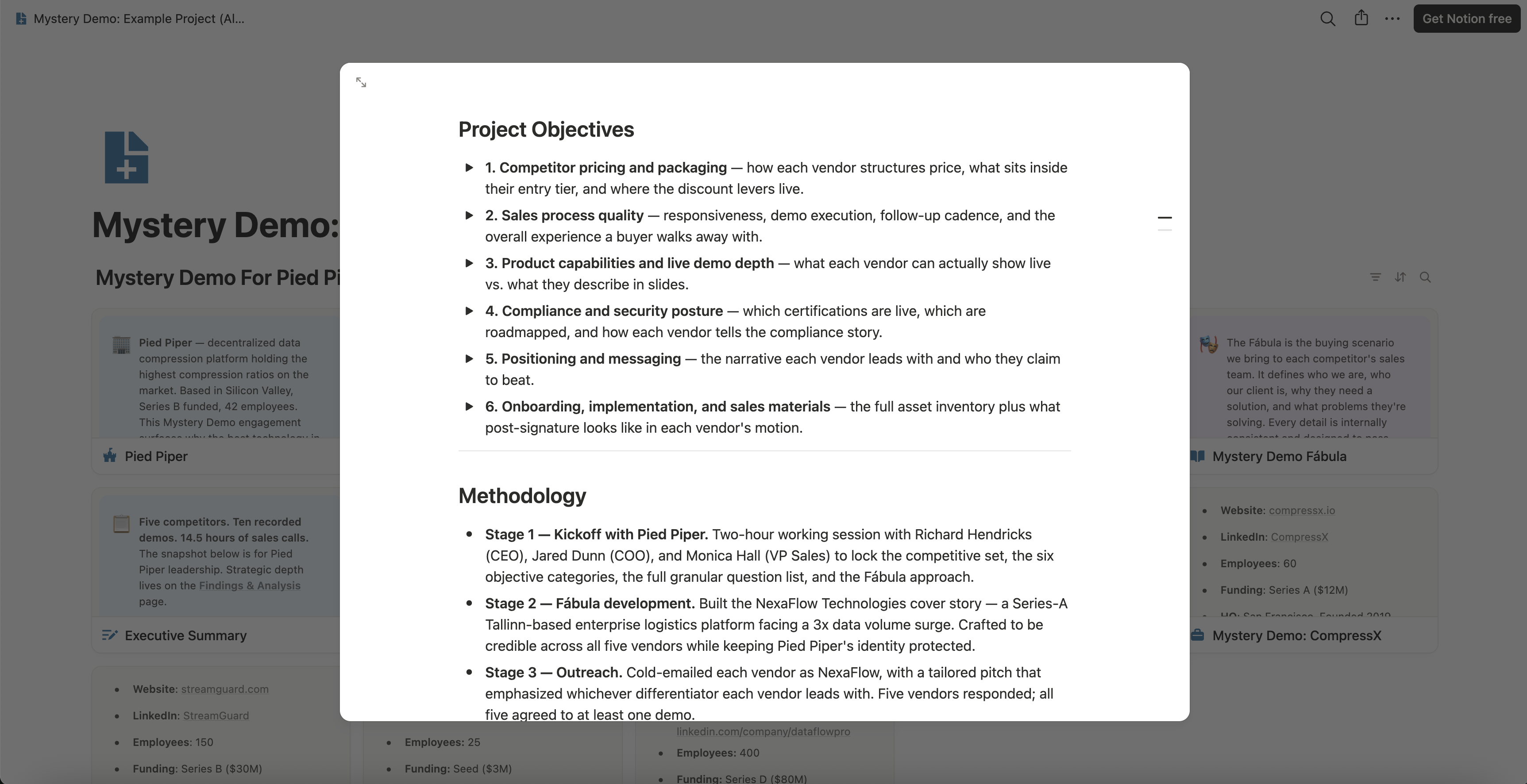
Next comes the buying scenario, the backstory the buyer brings to each rival: who the buyer is, what they use today and why they are looking. For a switch project, the tool they use today is your product, and their contract with you has an end date. As that buyer, the team books each rival through its normal front door and goes through every step a serious buyer would:
Mystery shopping a competitor’s demo is legal: the evaluation is genuine and nobody is impersonated.
Each rival’s offer lands on its own page of the board, with the recording and the minute behind every term:
The rivals are then compared on Findings & Analysis, the page that sets them side by side, topic by topic. Its pricing table lines up each rival’s pricing model, entry price and how openly it gave its price. The figures on this example are invented, so read it for the columns your own comparison would hold.
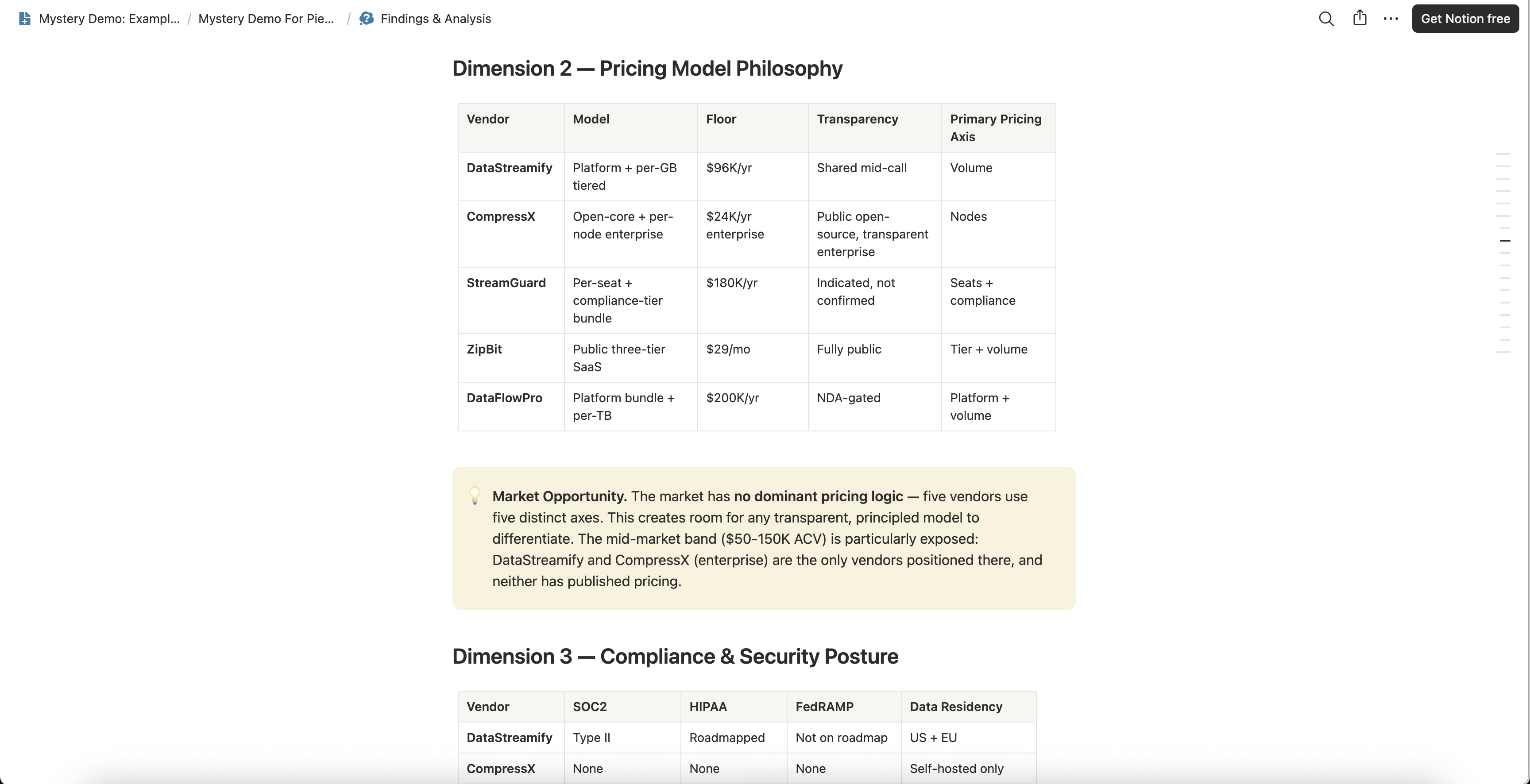
For a switch project, the sheet your reps would work from looks more like the one below: each rival’s published price beside what its rep quoted a buyer leaving you, and what came with it. The rivals and numbers on it are invented, to show the shape.
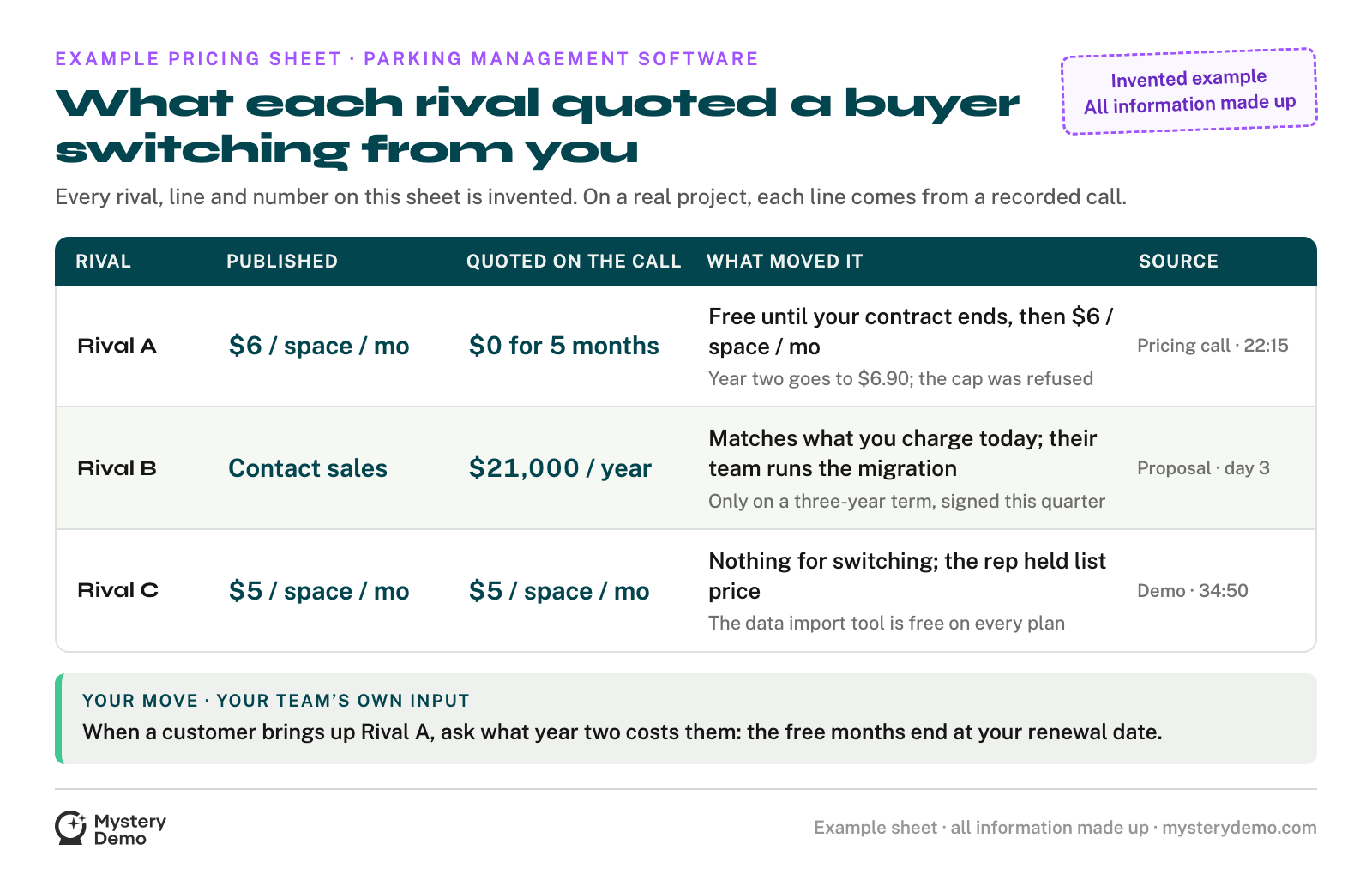
One quote is what one rep offered one buyer on one day, so read it as that rival’s offer to a buyer leaving you, not as its price list. The switch terms are easy to pick out, because each one names the contract the buyer is leaving.


Your own team cannot get this offer by asking. A rival’s rep who recognizes your company is not going to quote you a deal for leaving yourself. A believable buyer fitted to each rival gets the real pricing conversation, and operators who have sold software know how far to push a rep on terms.
SaaS competitor pricing research costs a flat €499 per competitor, everything included. One competitor takes one to two weeks, and a full landscape of rivals takes four to eight weeks. If one rival keeps coming up when your customers renew, tell us which one, and we will ask it, as a buyer leaving you, what switching would be worth.
Start With the Rivals Your Customers Leave For
So, do competitors offer switchers better deals? Some make offers built for switchers. To know whether a particular rival’s offer beats what it gives other buyers, you need its quotes, not a general rule.
Before your next renewal season, write down two lines for each of the two rivals your customers leave you for most often:
If the second line says a lost customer told you, check whether you also know the conditions: how long the offer lasts and what the renewal becomes. If you do not, bring those two rivals to a short intro call, and we will come back with each one’s switch offer and its terms, on recordings your team can play.


