
Your own phrases on a competitor’s website usually mean someone there read your site. They don’t show whether the rival’s reps now pitch buyers the same claims, and no page will. Here is how to find out how far a copy goes, claim by claim, and what to change once you know.
Websites were already a weak way to tell vendors apart. In June 2026, Wynter, a company that sells message testing, surveyed 100 B2B SaaS marketing leaders who had recently evaluated vendors, and 64% found it difficult to tell the vendors apart from their websites and messaging. When two homepages say the same thing, a buyer hears the difference on the sales call, or hears your story twice.
Mystery Demo finds out which one the buyer gets. Its team books the rival’s real sales demo as a credible buyer, asks about each claim you found copied, and brings back the recording of what the rep said and what proof followed.
What a Copied Page Can’t Tell You
Copying a page is quick and cheap. One founder on Reddit found that a rival had copied their “paragraphs and titles almost word for word.” A line they added to their own site turned up on the copy within days, word for word.
The page shows what the rival published. It leaves out the three things that decide how far the copying goes:
Websites, review sites and tracking tools show what a rival wants buyers to believe. Its real positioning is spoken to one buyer at a time, on a call your company is never invited to. Hearing it takes a buyer in the room.
How Mystery Demo Hears the Rival’s Pitch
Mystery Demo is that buyer. We book the rival’s demo through its normal front door, the way a serious prospect would, with a buying scenario built to fit what that rival sells.
The rep then runs the sales process as it runs for any prospect, from discovery and the demo to the pricing conversation and the follow-up. Every call is recorded.


Everything from the calls lands on a Notion board, the client’s shared workspace, with a page for each rival: its recordings, transcripts and our analysis. Below is the Research Objectives page, where every project starts, from our public example board. The client and every competitor on that board are invented; a real board is built from the client’s own questions and calls.
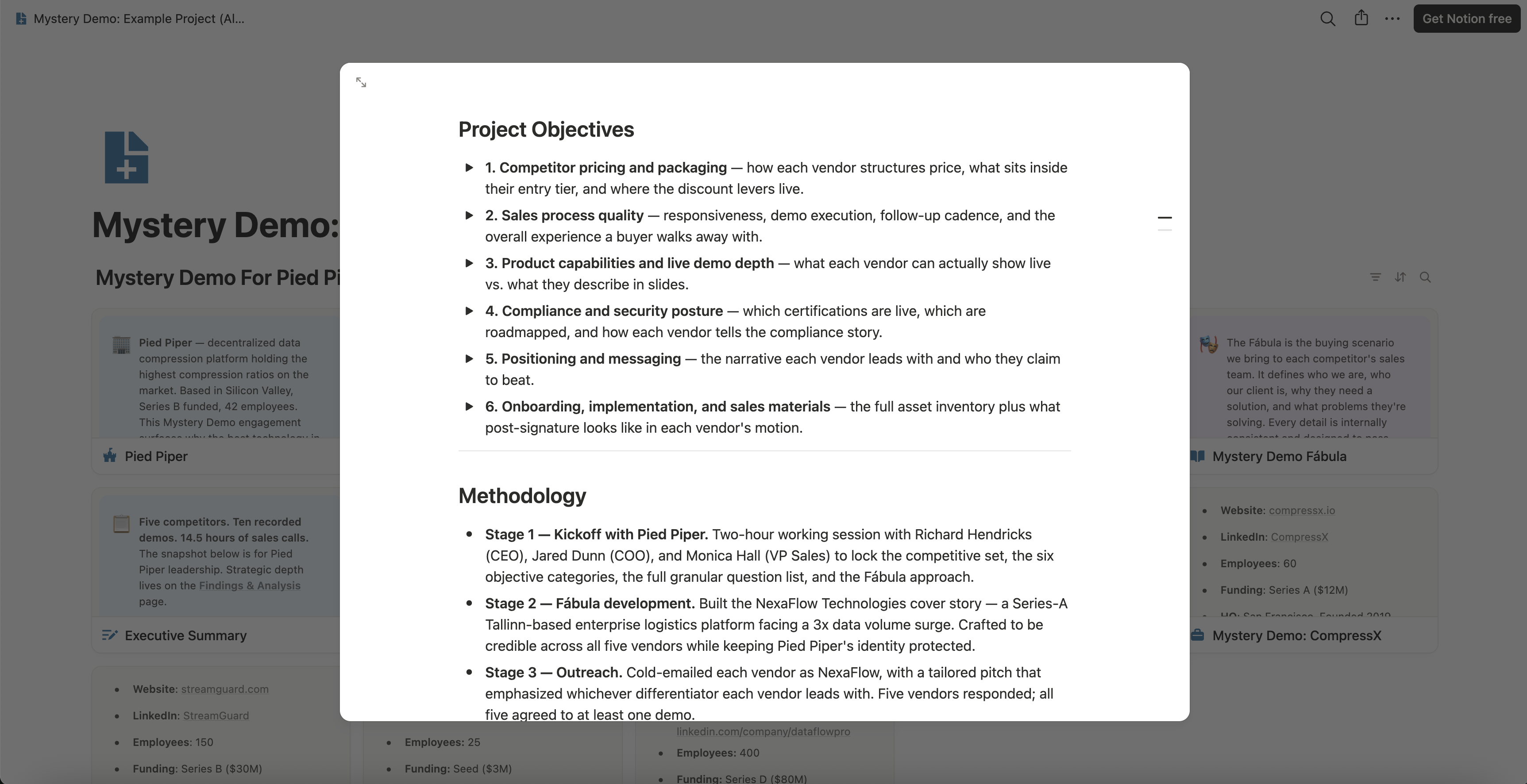
The fifth objective covers messaging: the narrative each vendor leads with, and who it claims to beat. On your project, each claim you found copied becomes a question under that objective.
The calls come back as a competitor messaging comparison, rival by rival:
Each claim on your list comes back marked as heard on a recorded call, with the minute, or not heard on the calls reviewed. Where a rep said it, the board also notes whether proof followed when our buyer asked.
The board’s Findings & Analysis page compares the rivals topic by topic. Its Strategic Observations section pulls the calls together. On the invented board, it opens with the threats seen in the field: the story one rival has made its own, and how each rival sells.
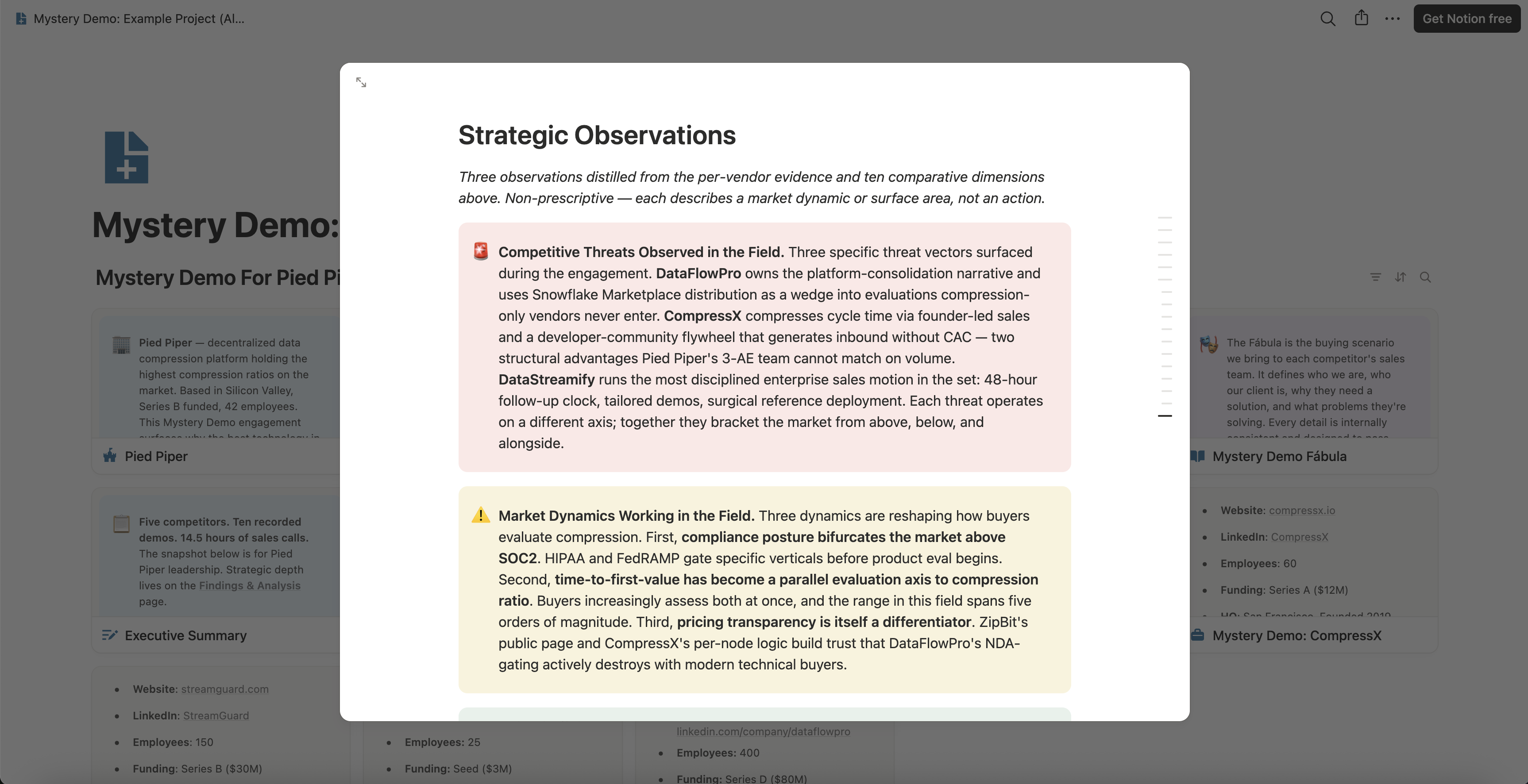
For copied messaging, that section shows which story each rival’s reps tell across its calls, which no homepage can show.

If your own team books the demo, the rep can see whose email it came from, and a recognized competitor gets the generic tour. Mystery Demo’s buyer is believable because the scenario is built for each rival.
The people asking have sold B2B software themselves, so they know which follow-up question moves a rep off the prepared pitch. Each finding comes back as a recording, with the minute it came from. One competitor costs a flat €499, everything included, and its board is ready in one to two weeks.
If one rival’s homepage now reads like yours, name it on a short intro call. We will go through its sales process as a buyer and bring back which of your lines its reps say, and what they show when asked. The list of claims to test is yours to write, and it starts at your desk.
List the Copied Claims Side by Side
The desk half of the job is one list. It shows you how far the copy goes on the page, and it becomes the brief for the calls.
1. Collect every claim of yours the rival now uses. Read the rival’s homepage, its pricing page and any page that compares it with you, and mark each line that makes one of your claims. A copy shows in the specifics:
A claim most vendors in your category make is shared language, not a copy, so leave it off. Save a dated screenshot of each page that carries a copy.
2. Give each claim its own row. The invented example below runs through the rest of the job: you sell scheduling software to veterinary clinics, and so does Rival A.
| Column | What goes in it | The invented example |
|---|---|---|
| Your claim | Your words, and where you say them | “Set up in a day,” on your homepage |
| Rival A’s version | Its words, the page and the date you saw them | “Live in a day,” on Rival A’s homepage, seen November 3 |
| Where it appears | Every page that carries it, then its calls: not yet checked, heard (with the minute), or not heard on the calls reviewed | Homepage and pricing page; calls not yet checked |
| Proof on the call | Not applicable until a rep says it, then: not requested, requested and shown, or requested and not supplied | Not applicable yet |
Everything in the example column came from the rival’s website, which is why its calls read “not yet checked.” Only someone who hears the rival pitch a buyer can fill the last two rows.
3. Decide which copies are a question for a lawyer. Guidance from the US Copyright Office says the original writing on a website may be protected by copyright, while ideas, slogans and short phrases are not. If whole passages of your own text, or your name or logo, appear on the rival’s site, take the dated screenshots to counsel.
The rest of the list waits for the calls.
Change the Claim the Rival Repeats
Now say the board comes back with the invented row filled in. Rival A’s rep said “live in a day” on the demo, at minute 12, and again on the follow-up call. Asked how, the rep named no customer and gave no figure, so the proof row reads “requested and not supplied.”
The words now belong to both of you, on the page and on the call. A buyer heard the claim from Rival A’s rep with nothing behind it.
Check what you can show. Say your onboarding records give a median setup of one day for clinics with up to ten vets, across your last 40 setups, and one of those clinics has agreed to be named. Then the claim changes:
The new claim says less, and every word of it can be checked. If Rival A copies it too, it has to copy the number, and a buyer can ask where the number came from. Give your reps the same line, with the number, so buyers hear the proof on your calls too.
A messaging agency founder, writing about this exact problem, puts it plainly: “Most pages carry one sentence, sometimes two, that a competitor couldn’t truthfully copy.” The same post says what such claims are made of: “a named customer, a number from your own data, or something specific you did that’s on the record.”
Every claim on your list gets the same test, against your own proof:
Start with the claims the rival’s reps said on the calls, and among those, the ones where the rep gave no proof when asked. Buyers hear those claims from both of you, so a number they can check is what sets yours apart.
Filled in after the calls, the invented list looks like this, with a decision on every row.
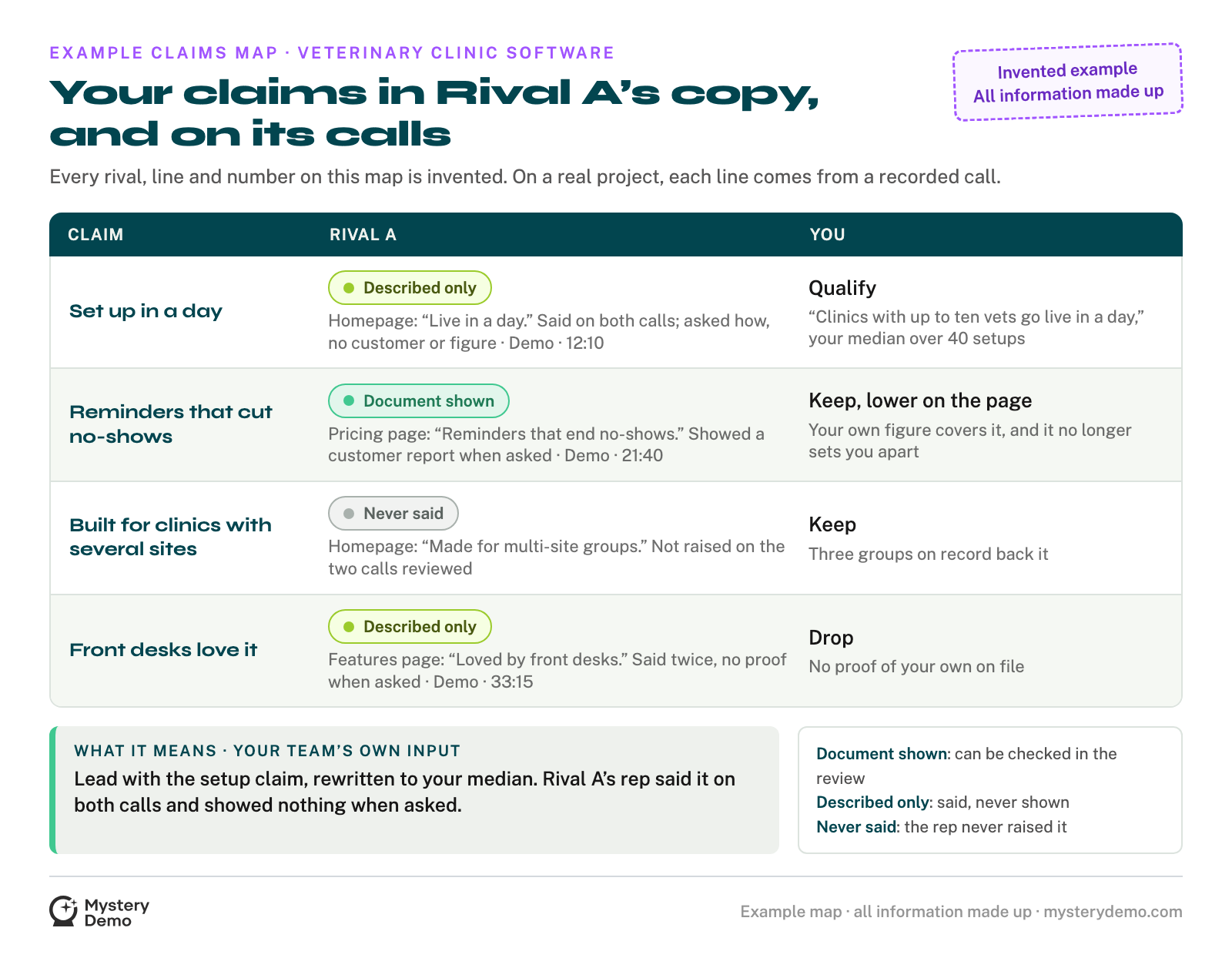
The second row is the uncomfortable one, because Rival A’s rep showed a customer report when asked. Both of you can back that claim now, so it no longer helps a buyer choose and moves down your page. On the third row, the copy stayed on Rival A’s homepage, and its reps did not raise it on the two calls reviewed.
Find Out Before You Rewrite
A copied homepage tempts a quick rewrite. Made from the page alone, a rewrite answers the rival’s website, not what its reps say. The calls tell you which lines are taken and which are worth answering:
Rewrite from that list, one claim at a time, with proof of your own.
Send us your side-by-side list and name the rival. On a short intro call, we will agree which claims to test. Then we go through the rival’s sales process as a buyer and bring back, for each claim, the minute its rep said it and what proof followed, or a note that it did not come up.


