
Many B2B buyers expect a price before the first call, not on it. In a 2025 survey of B2B buyers by the agency Mixology Digital, 74% of the IT buyers expected clear, detailed pricing upfront, and only 23% were comfortable leaving it until later in the process.
Having to ask is what buyers complain about. In TrustRadius’s January 2025 survey of 2,058 technology buyers, 49% of the software buyers named transparent pricing as the one thing they would most like to change. On Reddit, under a post from someone who hates booking a sales call just to see what a product does, one reply was shorter: “Winds me up that there’s no pricing info either.”
On the first call itself, a buyer who has called several vendors may be weighing your answer against theirs. Mystery Demo takes those vendors’ first sales calls as a credible buyer and records when the price came up, in what form, and who raised it. Your team gets the recordings and the side-by-side comparison on one shared board.
Four Ways Vendors Handle Price on a First Call
No study measures what buyers expect on the first call specifically. Vendors, though, handle that moment in four common ways, and the ways often overlap. Each row says what kind of evidence stands behind it, because the research is thin:
| How the vendor handles price | What the buyer gets | What the evidence says |
|---|---|---|
| A published price | A number before any call | It matches what 74% of the IT buyers in the Mixology survey said they expect (a survey finding) |
| A range or a starting price on the call | A sense of whether the product fits the budget | “If it’s genuinely complex, ranges work fine,” argues one LinkedIn post on “contact sales” pages (one person’s view) |
| An exact number once the buyer asks | The figure, after the buyer has had to ask for it | No study measures this. A buyer who expected pricing upfront is likely to notice the wait (our reading of the survey) |
| Deflection until a later call | No number yet | A sales advisory firm warns that refusing any indication “sounds evasive and can lead clients to walk away” (advice). One seller wrote that when price came up “in the 3rd minute of this call, I just sidestepped it” (one seller’s account) |
The first row is a website decision, and whether to publish your price when rivals only quote on calls has its own answer. The other three happen on a call, and that is where the buyer hears your rivals answer the same question.
Your Rivals Answer the Same Question on Their First Calls
Say a buyer books first calls with three vendors in one week. One gives a range ten minutes in, one promises a proposal after the demo, and one says pricing depends on scope. The buyer now has three answers to set side by side, and yours is one of them.
No study has measured whether that comparison decides a deal. It is still the comparison a buyer can make. One seller on Reddit, explaining why prospects went quiet after getting a price by email, put it plainly: a price on its own “is just a figure they can set next to somebody else’s figure.”
You can see half of that comparison from your desk. A rival’s pricing page shows what it publishes, and only its call shows the rest: when the number comes, how exact it is, and what conditions come with it. Your own team can’t simply call and ask, since reps tend to recognize a competitor calling, or give it the generic tour.

How a Mystery Demo Hears Each Rival’s Price
A project starts at kickoff, where you and our team agree on the questions every rival will be asked. For this subject, they are about the price:
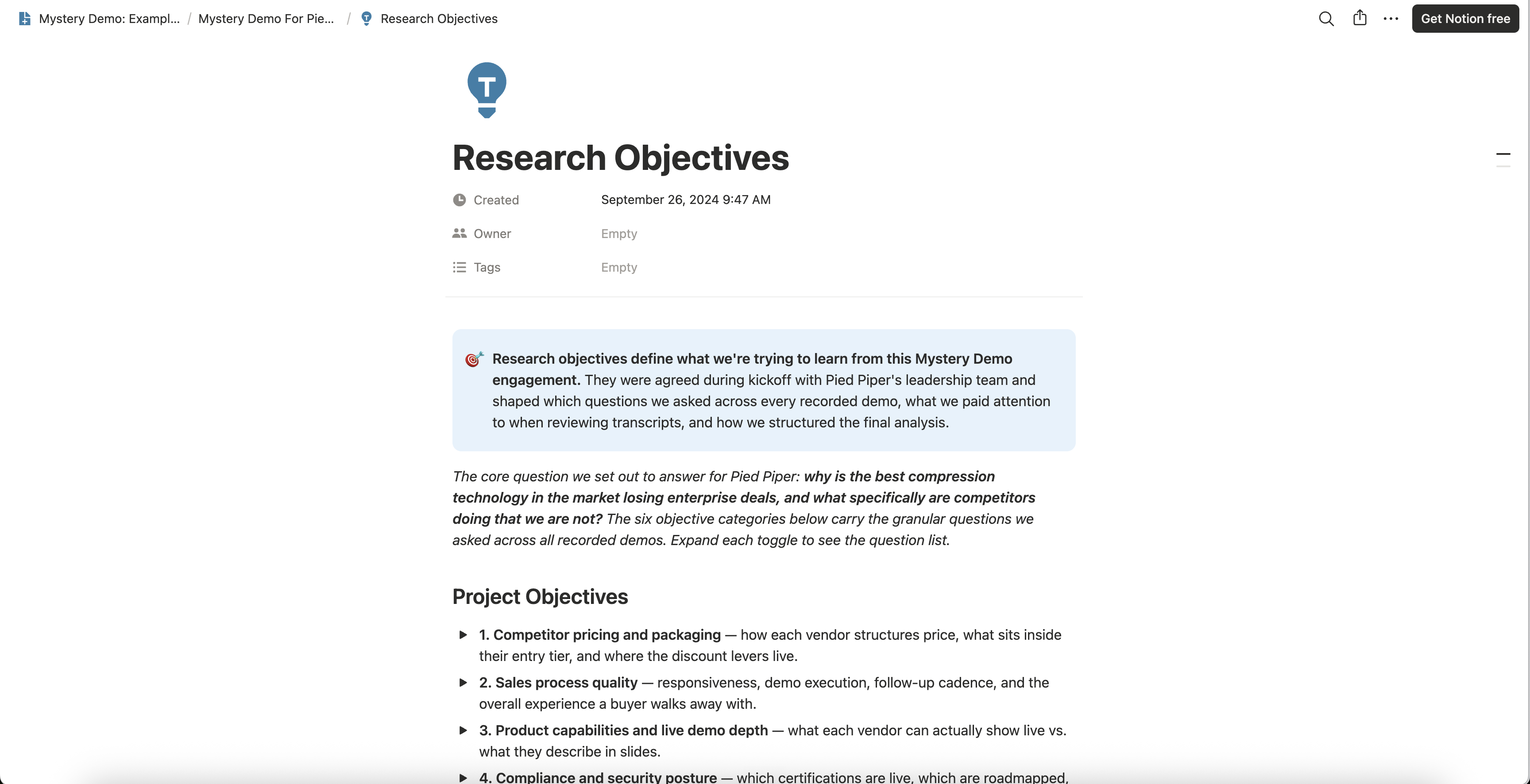
That is the objectives page from our public example board, where the client and every competitor are invented. On a real project, the board is built from the calls we take for that client. The first objective here is competitor pricing and packaging, and its questions go to every rep in the same words, so the answers line up.
Next comes a buying scenario fitted to each rival’s usual customer: a believable company with a size, a timeline, and a reason to buy. The evaluation is real, and the only invented part is which company it is for. Taking a competitor’s sales call that way is legal, and why mystery shopping is legal sets out the reasons.
The team books through each rival’s normal front door and takes the calls as that buyer, with every call recorded. Our operators have sold B2B software themselves, so they ask about price the way a buyer with a budget would, and they notice when a rep steps around it. Afterwards, the rivals’ answers are set side by side, each with the minute it was said, and each checked against that rival’s pricing page.
What Lands on the Board
Everything lands on a Notion board, a shared workspace with a page for each rival that holds its recordings, transcripts, and analysis. On the page called Findings & Analysis, the rivals are compared one subject at a time, and pricing is one of them.
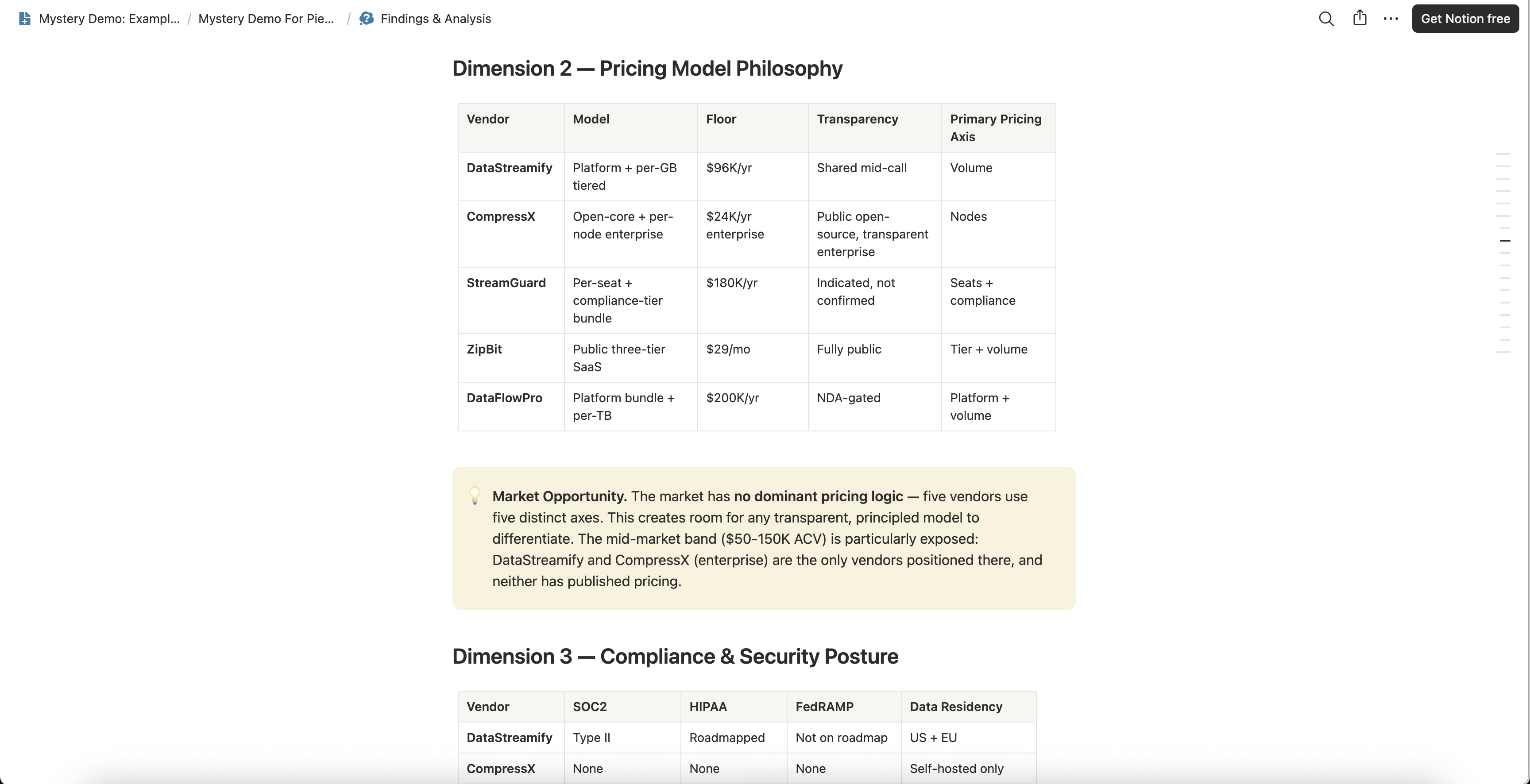
This is the pricing comparison from the same invented board. In the column headed Transparency, each rival’s entry says how its price reached the buyer: published, given partway through a call, hinted at and never confirmed, or kept back behind paperwork. On a real project, that column is filled from the recordings, with the quoted price beside the published one.
One first call is one rep’s answer to one buyer. It becomes a pattern only when another call with the same rival goes the same way.


The work is our SaaS competitor pricing research, aimed at the price question. Each rival costs a flat €499, with nothing added, and its page is ready in one to two weeks. About six to fifteen rivals at once take four to eight weeks, because their calls run in parallel.
Which vendors do your buyers say they are also talking to? Bring that list to an intro conversation, and we will take each one’s first call as the buyer and come back with the minute, the words, and the number, if one came.
Set Your Own Rule After You Hear Theirs
Do B2B buyers expect a price on the first call? Many expect one before it, and 49% of the software buyers in one survey named transparent pricing as the change they most wanted. No survey can tell you whether your rivals give their number on the first call, the second, or only in a proposal.
Your rivals’ timing is the part your own rule turns on. If every rival gives a range on the first call, a team that waits for the proposal is the one making the buyer ask. If every rival deflects, a range from you is the answer that stands apart.
Write down when your team gives its number today, then ask your reps when each rival gives theirs, and how they know. If the honest answer is a guess, we can replace it with the rivals’ own words. We take each first call as the buyer, and you get the minute the price came up before you decide when yours does.


