
Open the competitor grid your team trusts most and pick a cell. Say it reads that a rival has single sign-on, an open API, and a native CRM sync. Now ask where that cell came from.
If the answer is the rival’s website, the cell records what the rival wants buyers to believe. Search for a competitor analysis framework and the first page offers the same few: SWOT, Five Forces, and a grid of features, pricing, and positioning. Each one is a set of boxes, and none of them asks who filled the boxes, or from where.
Mystery Demo built its own competitor analysis framework to fill those boxes from somewhere else: the rivals’ own sales calls. Mystery Demo books your competitors’ real sales demos as a believable buyer, sits every call, records it, and hands back a board where each finding points to the moment it was said. We built it to help SaaS companies validate what a rival really ships, charges, and says, before they bet a roadmap or a positioning decision on it.
Every Mystery Demo project runs on this framework. It has seven layers, and each one is tied to the stage of a project that collects it and the page of the board where it lands.
Most Frameworks Are Filled From What Rivals Publish
A rival writes its website for every buyer at once. Its job is to make the product look finished and the price look simple. The answers that decide your roadmap are said somewhere else: on a call, to one buyer, after the rep has asked about seats and deadlines.
| The question | What the website shows | What the sales call settles |
|---|---|---|
| What does it cost? | A starting price, or a Contact Sales button | The number quoted to a buyer like yours, and what moved it |
| What does the product do? | Every feature, each one sounding finished | Which features the rep can show working, on screen |
| How do they sell? | A form that says Request a Demo | Discovery, the deep dive, the pricing talk, and the follow-up |
| What do they say about you? | A comparison page, if there is one, written for search | What the rep says when a buyer names your product |
A website is still worth reading, because it tells you what a rival wants to be known for. It cannot tell you whether the rest is true. Validating the rest is the real job of a competitor analysis, and for anything a rival only shows to buyers, that means being on the call.
There is a limit on the other side too. A demo shows what a rival sells. It does not show the rival’s internal roadmap or its win rate, and a framework that claims to know those from the outside is guessing.
To hear the call, you have to be the buyer on it. That is the work Mystery Demo does.
How Mystery Demo Runs a Project, From Kickoff to Verification
Mystery Demo does mystery shopping for B2B SaaS. Every project runs in five stages, and the framework is built into them.
The calls are sat by operators who have sold B2B software themselves. They know which question pulls a rep off the script, and they can hear when an answer has been rehearsed. A team that shops its own rivals rarely gets that far: the rep recognizes the email domain, or the buyer gets the generic tour.
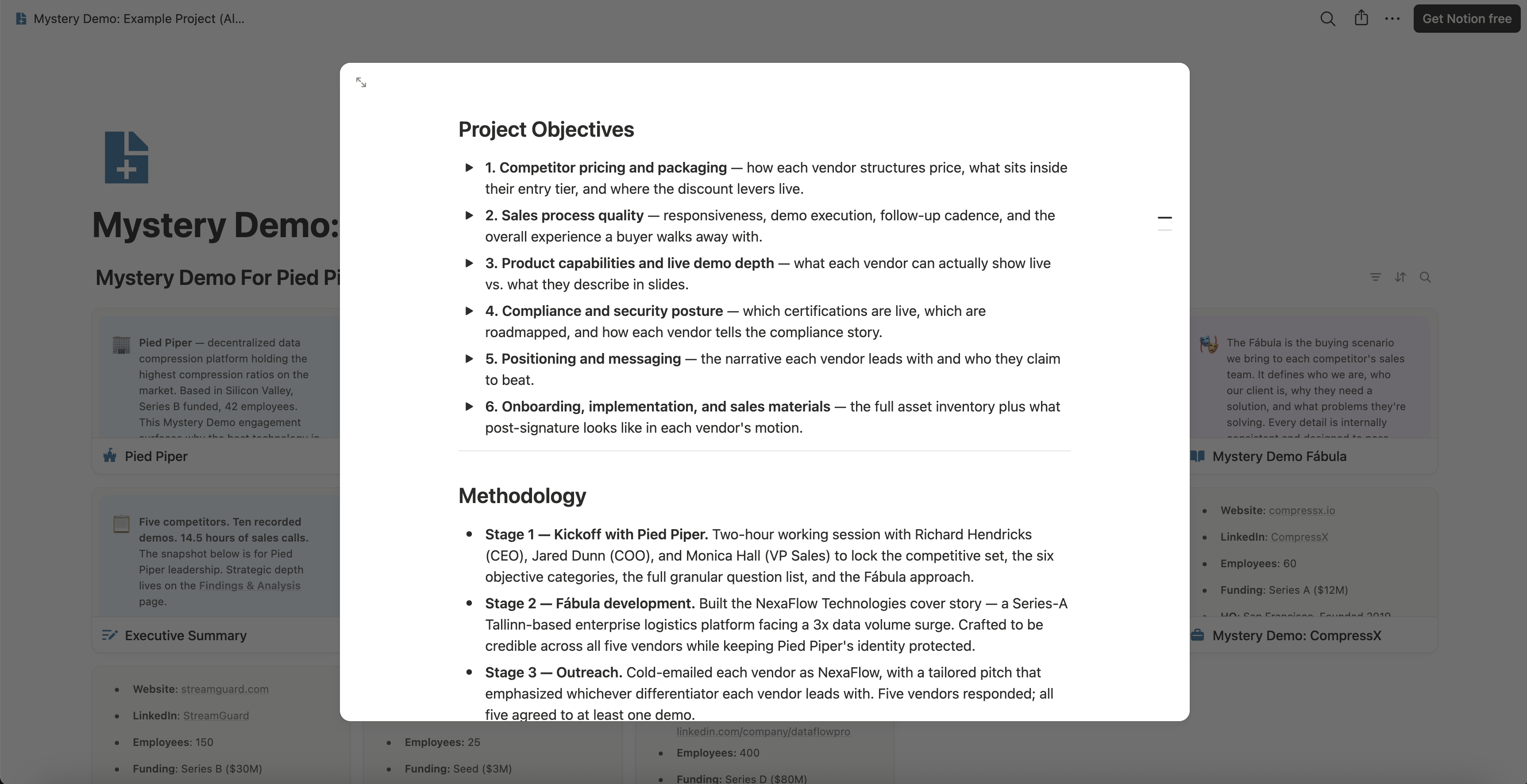
Here is the Research Objectives page from our public example board. The company on it and every competitor are invented, and a real project’s board is built from that client’s own calls. The six objectives at the top are the kind of brief a kickoff produces, and the first stages of the method sit below them.
Five stages produce a lot of material: hours of calls, threads of email, decks, and price sheets. None of it helps a team until it is sorted, and the sorting happens on the board.
Everything Lands on One Notion Board
The board is a set of linked Notion pages your whole team can open. It has eight kinds of page: the Client Profile, the Research Objectives, the Research Companies, the Mystery Demo Fábula, one page per competitor, the Database, Findings & Analysis, and the Executive Summary.
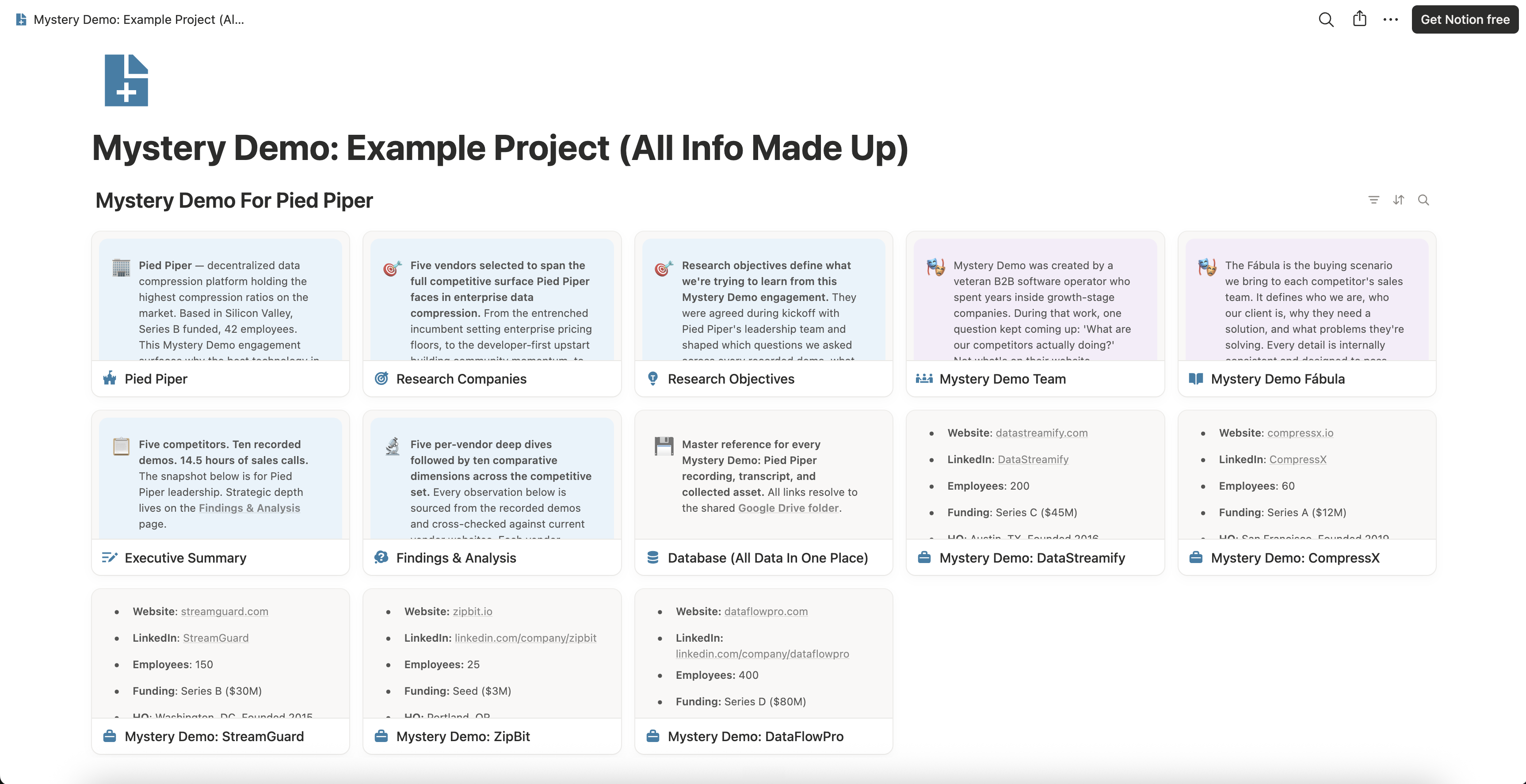
Each card opens a page, and the pages hold different things. Some hold the raw record, such as the recordings and the emails. Others hold the reading of it, such as the comparison and the verdict.
Every finding on the board points back to a recording, a transcript line, or an email. Nobody on your team has to take a summary on trust, because the moment behind it is one click away.
The stages say when each piece is collected, and the pages say where it is kept. The framework joins the two, so you always know which page answers which question.
The Framework in Seven Layers
Here is the whole model in one table. Each layer is a question the project settles, with the stage that collects it and the page that keeps it.
| Layer | The question it settles | Collected at | Where it lives on the board |
|---|---|---|---|
| The brief | What do you need to know, and for which decision? | Kickoff | Client Profile, Research Objectives |
| The field | Which rivals matter, and why each one? | Kickoff | Research Companies |
| The buyer | Who walks into each demo, so the rep runs the real motion? | The buyer scenario | Mystery Demo Fábula |
| The record | What did each rival say, show, and quote? | The demos | A page per competitor, the Database |
| The check | Which claims hold up, and which are only words? | Synthesis and verification | The feature matrix, each competitor’s analysis |
| The comparison | How do the rivals line up, dimension by dimension? | Synthesis | Findings & Analysis |
| The verdict | Where does each rival win, and how well does it sell? | Synthesis | Executive Summary |
Read down the table and you get the order of a project. Read across a row and you get the job one layer does, and the page you would open to see it done.
What Each Layer Settles
Each layer feeds the one after it, so a gap early on shows up later as a question nobody asked.
The brief. The Client Profile and the Research Objectives come out of kickoff. They hold who you are, what you sell, and the questions the project has to answer, such as price and packaging, product depth, security, positioning, and onboarding.
Every later page answers these questions, so a question missing here is missing from every call.
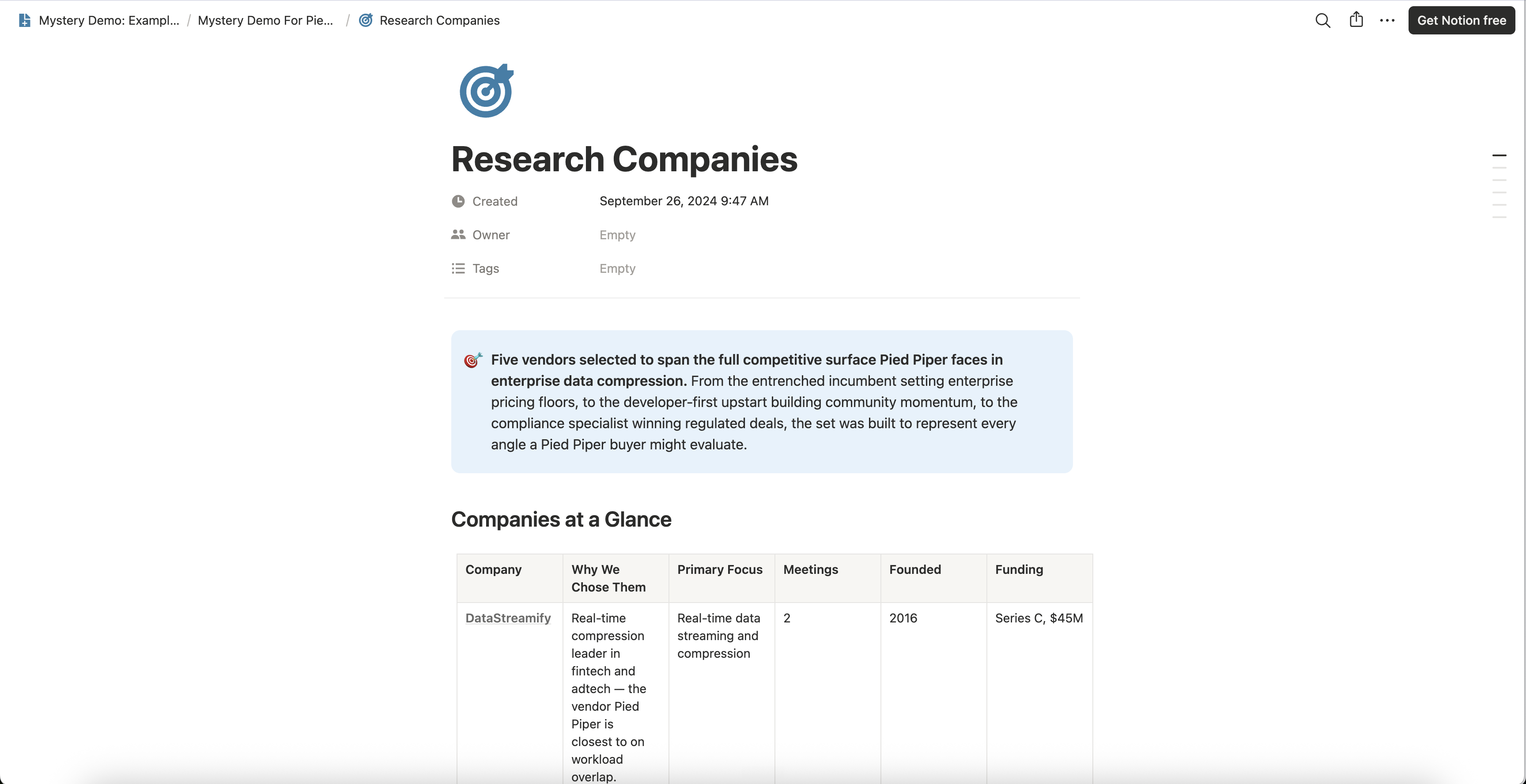
The field. The Research Companies page lists the rivals in the set and why each one was chosen. The reason matters, because it decides what each rival gets asked.
A rival that keeps winning your deals gets different questions from one that only just entered your market. On the example board, the reasoning for the selection comes before the table starts, so anyone who reads the comparison later knows why each name is on it.
The buyer. The Mystery Demo Fábula holds the buying scenario each rival’s sales team meets. It has six parts: the industry, the headquarters, the team size, the funding stage, the current stack with the growth that is straining it, and the decision timeline.
Each part is tuned to the rival’s ideal customer, because the scenario decides which questions sound natural. A buyer headquartered in the EU can ask about data residency without raising an eyebrow, and a tight decision timeline makes the rep treat the evaluation as real.
The record. Each competitor gets its own page, with every meeting logged and its recording, transcript, emails, and collateral attached. The Database holds the same material in one place, so anything on the board can be traced in a click.
When a rival sells self-serve and there is no call to book, its page holds a log of the trial instead.
Extra meetings belong in the record too. If a question needs a product manager, an engineer, or an executive on the other side, we ask for that meeting, and it is included in the fee.
The check. This is the layer where the framework validates, and it runs both ways. It holds the website up against what the demo showed, and the rep’s words up against the website, LinkedIn, and public news.
Every capability a rival claims ends up with one of three grades in the feature matrix.
A grade says what the evidence supports. A stub may exist somewhere, but no buyer in the room got to see it work.
A rival’s website, its rep’s words, and its product on screen are three different kinds of evidence, and the check keeps them apart. One rep’s promise is what the company told one buyer on one day. When a second rep makes the same promise on another call, it stops being one rep’s line and becomes the company’s position.
Say a rival’s site lists a native integration, and on the call its rep shows a CSV export instead. That cell on your grid drops from “has it” to “partial,” and every deal where a buyer needs that integration now needs a different answer.
The feature matrix is the core of a SaaS competitor product comparison: every rival’s shipped capability laid against your own product, with the timestamp of the moment each one was shown.
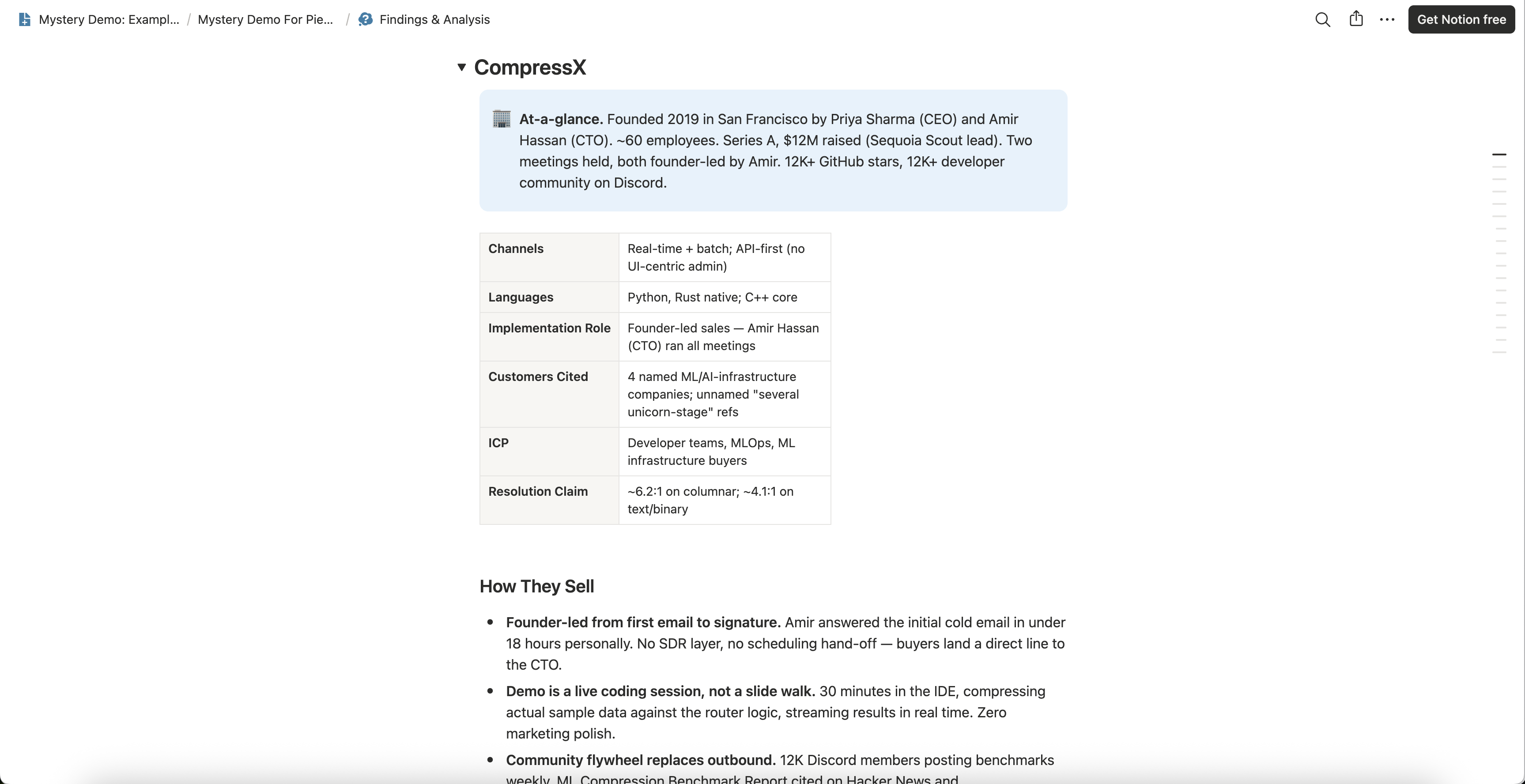
Each competitor’s analysis keeps the same split. The findings section for one competitor on the invented example board shows it: the facts table records the rival’s own claims as claims, next to how it sells.
.png)

If one row of your own grid is carrying a decision you are not sure of, that row is where to start. Talk to us about the rival behind it, and we will run all seven layers on that rival first.
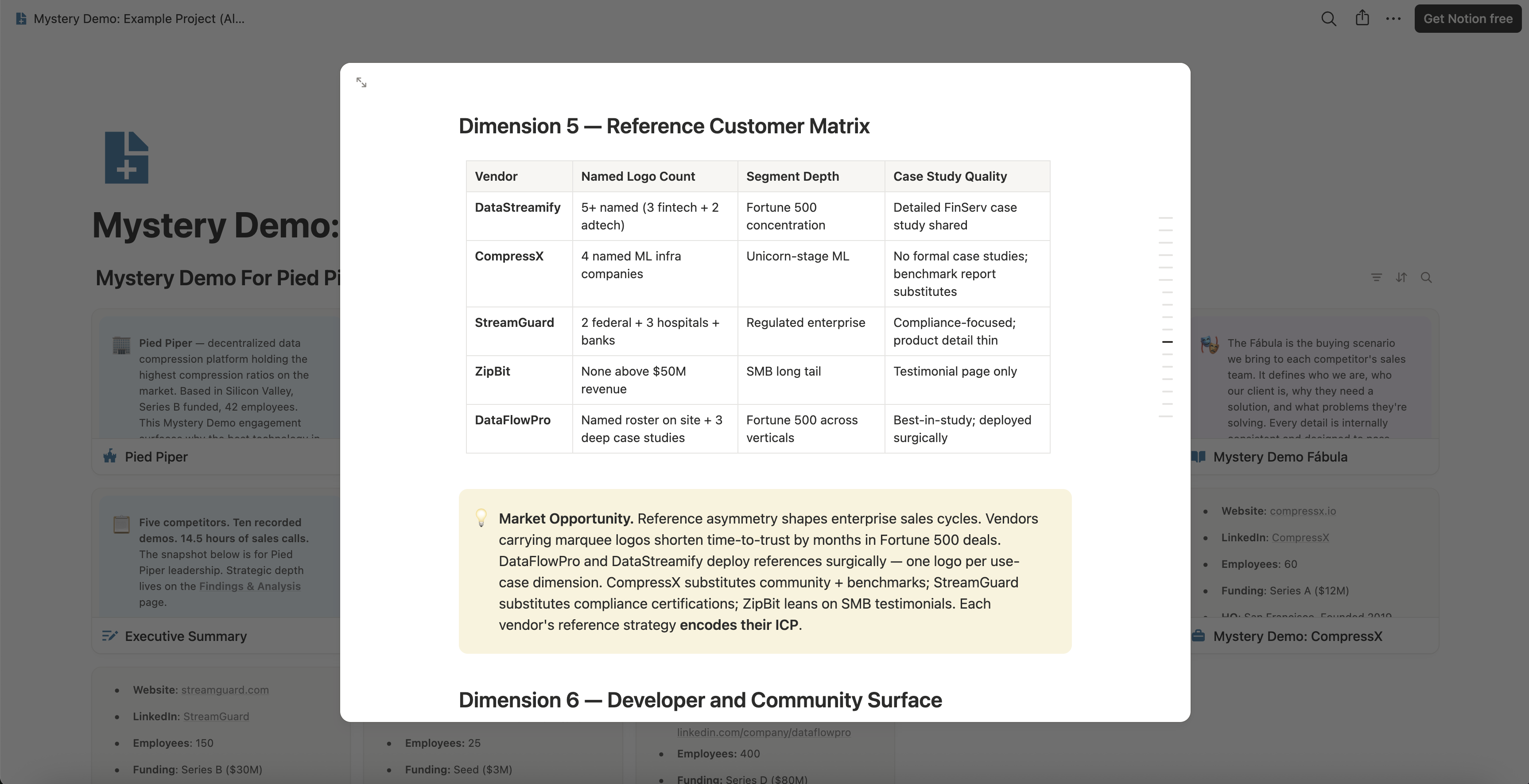
The comparison. Findings & Analysis lines the rivals up dimension by dimension: pricing, product, compliance, references, onboarding, and sales. Each finding is written fact first, then what it means, and every dimension closes with the market opportunity it shows.
Here is one dimension from the example board, reference customers. Every rival is scored on the same columns, and the page shows what the market is doing without telling you what to build. That call stays yours, because only you know your roadmap and your constraints.
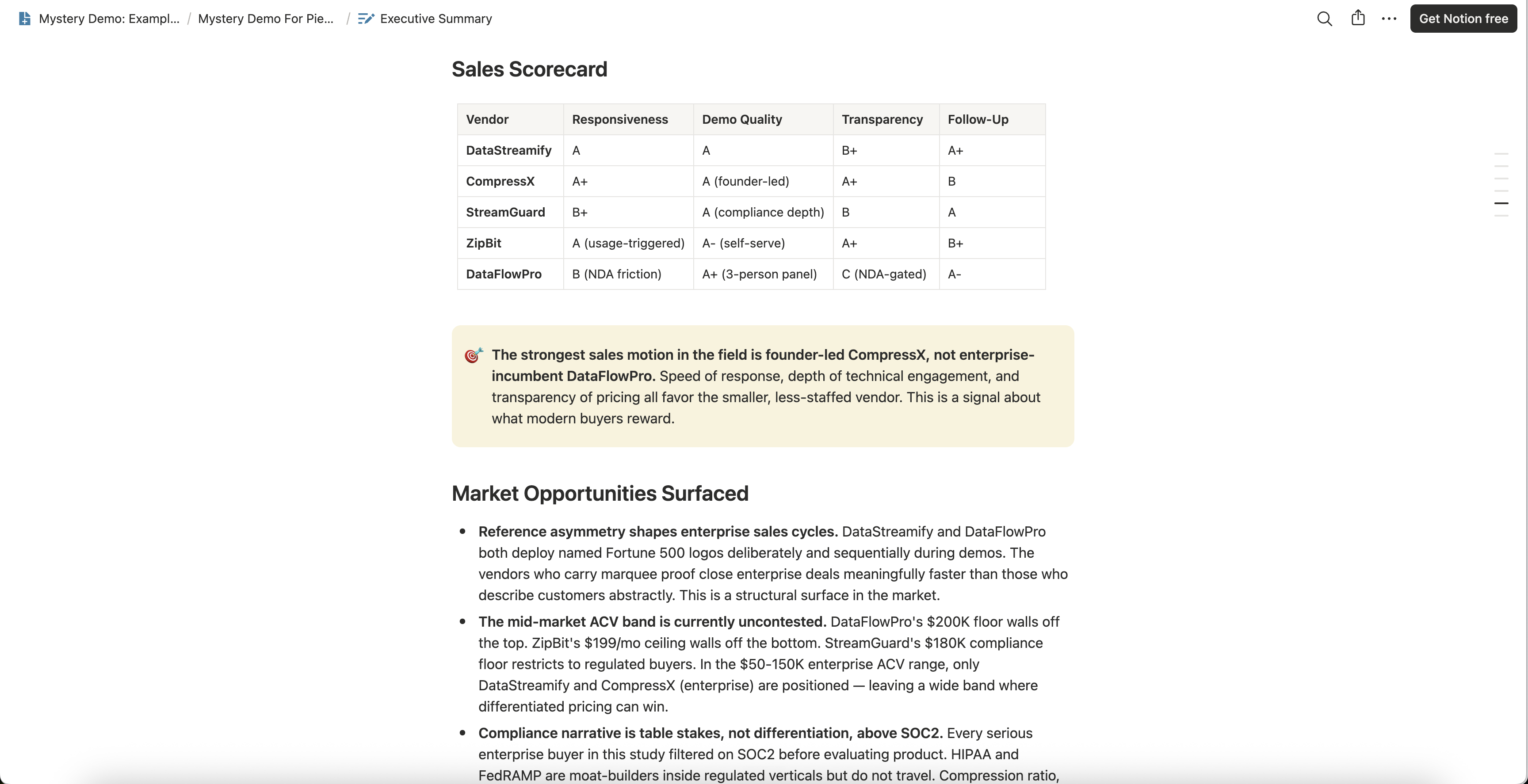
The verdict. The Executive Summary is the page leadership reads first. It holds where each competitor wins, the key findings, and a sales scorecard that grades each rival on responsiveness, discovery, demo quality, transparency, and follow-up.
The scorecard grades how each rival sells, apart from what it sells. A rival with the better product and a slow, evasive sales process can be beaten in a way its website will never show.
Here is the scorecard on the invented example board, with every rival graded on the same columns and the market opportunities listed below it.
Running the Framework Costs €499 a Competitor
One competitor costs a flat €499 with everything included: the buyer scenario, every meeting booked and attended, the recordings, the transcripts, the analysis, and the board. Five competitors cost €2,495 and ten cost €4,990. There is no second invoice.
One competitor takes one to two weeks. A full landscape of about six to fifteen competitors takes four to eight weeks, because the demos run in parallel and each competitor’s analysis lands as it finishes.
You bring the list of rivals, the questions you need answered, and a walk through your own product at kickoff. We do everything after that.
A board built this way is true on the day it lands. The rival keeps selling after that.
When a Rival Changes Its Pitch
A rival can ship the feature its rep promised, rewrite its pitch, or change how it discounts. Its website will catch up long after your reps have heard about it in deals.
So treat every finding as dated. When your reps start hearing something new about a rival, its findings are stale, and only one layer can refresh them: the record, which means new calls.
The right rhythm depends on how fast your market moves. Partners re-run a whole project one to three years later to see how each rival has moved, and a single rival can be re-checked on its own as soon as a new line turns up in your deals.
Your grid will be wrong again the next time a rival changes its pitch, and a lost deal is a slow way to find out. Ask us to re-check the rival your grid depends on most, and we will sit its demos as the buyer and bring back every finding with the recording behind it.
.png)


