
A competitor’s price increase gives its customers a reason to look around, and their renewal is when they can act on it. In an August 2026 survey of UK B2B buyers by The Reality Department, pricing that crept up at renewal was the most common single cause of regret, named by 15% of the buyers who had any. Regret, the authors add, is what makes a customer open to switching at renewal.
The trouble is that you may hear about the increase last. One seller on Reddit described their own company’s plan to raise prices heavily after customers’ first multi-year term, and added that “none of our customers are aware.” Then they asked the forum whether to jump to a competitor and win that business.
Mystery Demo goes through a rival’s sales process as a buyer and records the price its reps quote, so you hear about a change sooner. Getting that quote is the first of four steps to winning the rival’s customers. The other three are your team’s: list the customers the increase will reach, ask each one about their renewal, and answer with an offer built from what they tell you.
Find Out What the Rival Quotes a Buyer Today
A rival’s price shows up in three places, and they do not tell you the same thing:
| Where the price shows | What it tells you | Where it stops |
|---|---|---|
| The rival’s pricing page | The list price it wants every buyer to see, if it publishes one | A tier marked “contact sales” shows no number, and the page can stay the same while quotes change |
| Its customers’ renewals | What the increase means for one customer, in their words | You hear it only from a customer who tells you, later in this job |
| Its quote to a new buyer | The price, discounts and terms its reps offer today | It is said privately, to a buyer, on a sales call |
Nobody tells you when the third one changes. A rival can change what its reps quote without touching its pricing page, and no one sends its competitors a note when it does.
The seller on Reddit showed how far apart those prices can sit. New customers were quoted a full annual price, while existing customers paid about a third of it until their contract ended, when the full price applied. In that seller’s case, the quote a new buyer heard was the price waiting for customers at renewal.
Not every rival works that way, but the new-buyer quote is still the first number worth having, because you can get it before any of the rival’s customers tells you anything. Only a buyer hears it, so Mystery Demo goes and asks for it as one:
The demos are run by operators who have sold B2B software themselves, so they know which question moves a rep past the list price. On the pricing call, they ask the questions that make one quote comparable with a later one:
Everything lands on a Notion board, a shared workspace with a page for each rival: its recordings, transcripts, emails and our analysis of them. The page below comes from our public example board, where the client and every competitor are invented. A real board is built from that client’s own calls.
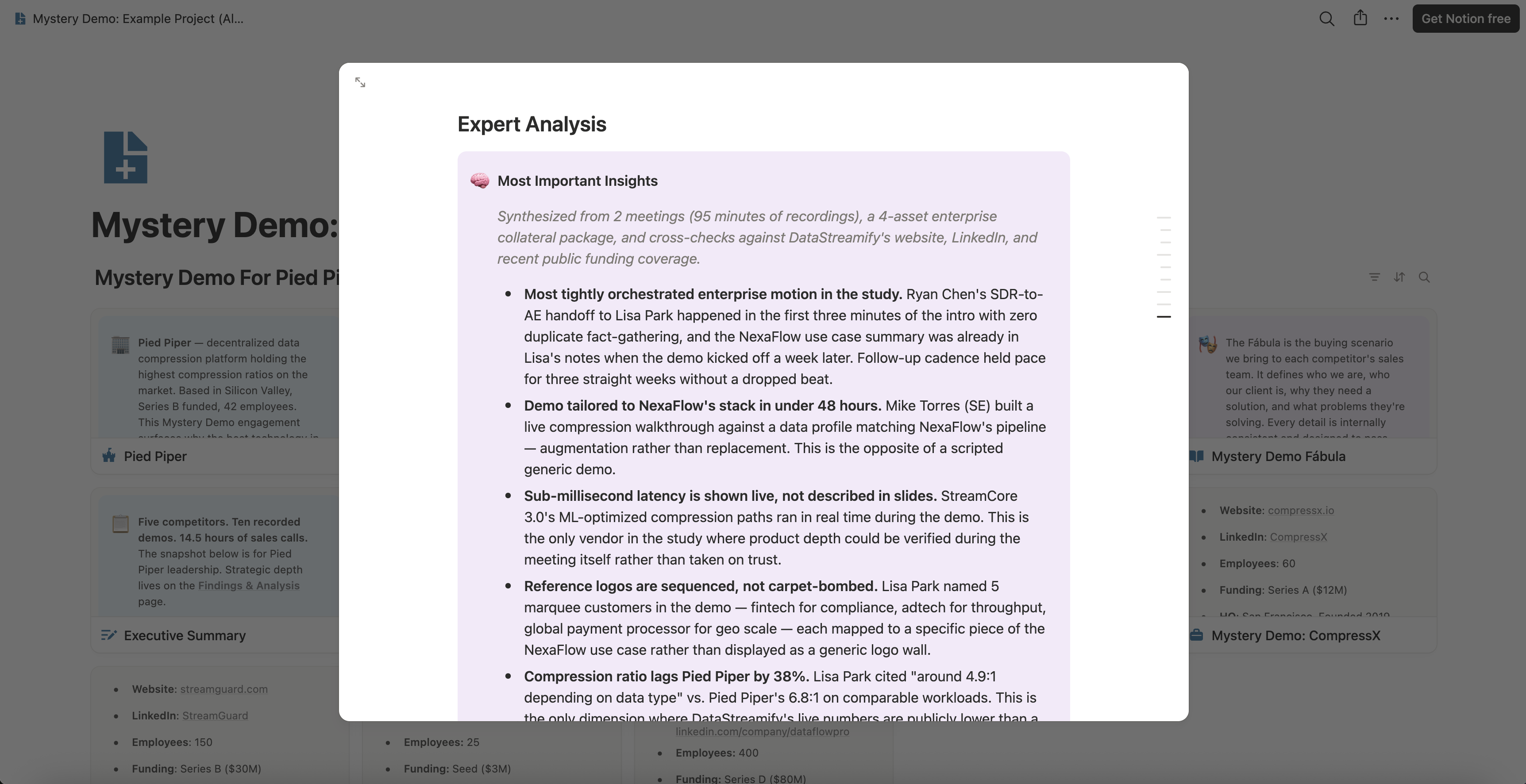
Under the Expert Analysis heading, an italic line says which meetings the insights came from and how much recording they rest on. Every quote on a real board carries the same trail back to its call and the day it was said.


The quotes then meet in the pricing matrix, the part of the board’s Findings & Analysis page that sets every rival’s pricing side by side. Below is that section on the same invented example board.
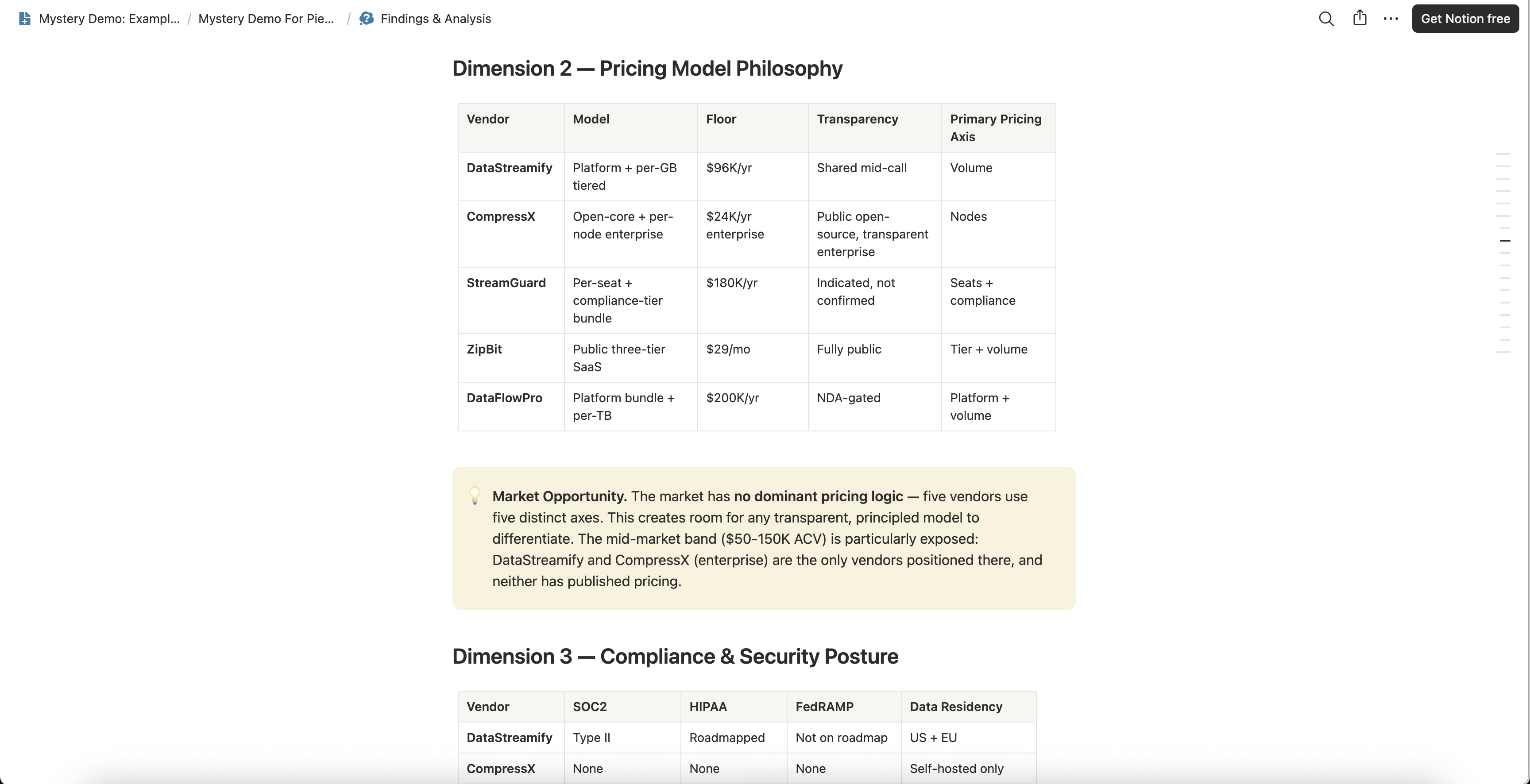
Each rival gets a row: its pricing model, its floor, how openly it shares its price, and what the price moves with. On a real board, every quoted number in that row is dated by its call. Each repeat of the same buyer scenario tells you more than the last:
| What you have | What it shows | What it cannot show |
|---|---|---|
| One quote | What one rep offered one buyer scenario on one date | Whether that price is new |
| Two quotes on the same scenario, months apart | Whether the rival’s price to that kind of buyer moved, and by how much | What its existing customers pay at renewal |
| The same change heard from different reps | A pattern in how the rival prices that kind of buyer | Any one customer’s renewal terms |
Clients re-run a whole project one to three years after the first to see how a competitor moved. For the one or two rivals you lose to most, repeat the quote every few months, so a quiet increase shows up within a season and not in a deal you lose.
A repeat is only worth comparing if each quote went to a believable buyer. A team that shops its own rivals gets recognized or gets the visitor’s tour, while a buyer built for each rival gets the discount conversation a real prospect gets. SaaS competitor pricing research costs a flat €499 per competitor, everything included, and one competitor takes one to two weeks.
If one rival’s price is the one you most need to watch, an intro conversation is where we plan its first quote. We then go through its sales process as a buyer and bring back what it quotes today, recorded and dated.
List the Customers the Increase Will Reach
A change in any of the three places a price shows can start this step: a higher quote, a new pricing page, or a customer who mentions an increase. The next question is which of the rival’s customers will face the new price at renewal, and your own records hold most of the answer:
Next to each name, write the date they signed with the rival and the contract term, if you know it. The signing date and the term tell you roughly when each renewal comes up. Without the term, the anniversary of the signing date is a first guess.
The list that comes out is short, and every date on it is an estimate. Only the customer can confirm it, and that takes a conversation.
Ask About Their Renewal Before the Notice Date
Timing decides whether there is a deal at all. On Common Paper, a contract platform, 87% of the cloud service agreements signed from June 2025 to June 2026 renew automatically unless someone gives notice, and about 70% set that notice at 30 days. A customer who misses that window may roll into another term at the new price.
Open with their renewal, not with the rival. The increase is their problem before it is your opening, and a message that sounds pleased about it will read that way. Here is an invented first message that keeps the tone right:
Then, in the same conversation, ask the questions that tell you whether there is a deal:
The fourth question came up on the same Reddit thread, from another seller: “Can customers terminate during increase?” If the answer is no, your offer is about the next window, not this one.
The answers leave you with each customer’s renewal terms in their own words, a deadline, and whether a switch fits before it. Your offer is built from those three.
Match Your Offer to What They Told You
Set two prices side by side for your own decision: the renewal price the customer says the rival is asking, and the price the rival now quotes a comparable new buyer. They are different prices, and neither stands in for the other.
If the renewal is higher than the new-buyer quote, the rival may be asking loyal customers for more than new ones, and that gap is worth a closer look. If the two match, the increase may be the rival’s new price for customers like this one. Either way, the comparison guides your offer and is never a promise to the customer about what the rival would give them.
Then match your reaction to what the customer says or does:
| What they say or do | What it may mean, and what to ask | Your reaction, if the answer confirms it |
|---|---|---|
| They are renegotiating with the rival | They may want to stay at the right price. Ask what number would keep them. | Show the full cost over the term, including the next renewal, and leave the door open |
| They plan to cut seats or scope | They may value the product and not the price, or need less of it. Ask which. | If it is the price, offer a plan sized to what they use, with the price held in writing |
| They have started looking at alternatives | The decision may be open. Ask what would have to be true for them to switch. | Move fast, and make the switch look manageable with the offers buyers get for switching: help with the migration, an overlap period |
| They want to leave but are locked in | The contract may be the barrier. Ask the notice date. | Time your offer to that window, and agree a start date now |
| The increase does not bother them | The product may be worth the price to them, or the increase may be small. Ask how it sits against their budget. | Stay in touch, and ask again before the next renewal |
The rival may fight for the account too. Another seller on that thread watched a planned 200% increase get dialed back when customers refused to pay it, and turn into “a retention scramble of previous price plus a small percentage.” Your offer has to hold up against a rival that just remembered how much it wants to keep them.
A few reactions undo all of it:
The last one matters most. A customer who left over a price surprise will watch for the next one, from you.
A pricing battlecard keeps the rival’s side in one place for your reps. The one below is invented, rival and numbers included. Rival A’s pricing page stays the same while its quote to a comparable buyer rises between two runs, and each lever the later quote added has a counter beside it.
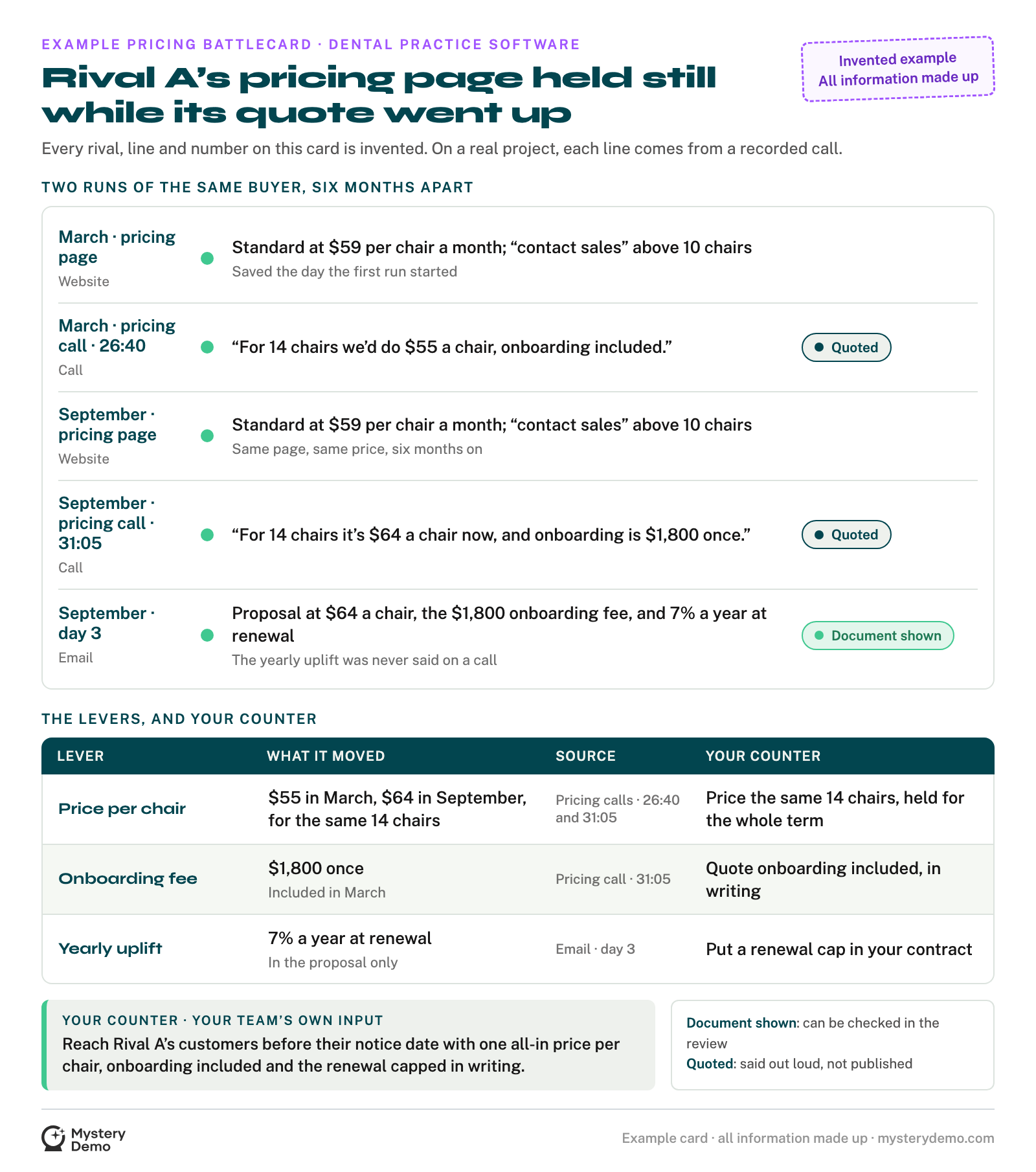
The card holds only what a buyer hears from the rival. Each customer’s renewal ask stays in your own notes beside it, because only that customer can tell you.
What to Have in Hand Before the Next Increase
When a rival raises its prices, go to its customers with three things:
Your team can start on the second and third this week, from your own records and conversations with the customers. The first comes only from the rival’s sales process, and it can change again without notice, so it needs asking more than once.
For the two rivals whose price moves would cost you most, set up a first quote and a repeat with us. We go through each one’s sales process as a buyer now and again later, so the next increase reaches you as a dated recording instead of a deal you lost.


