
Competitor intel stays accurate until the thing it describes changes, so its shelf life depends on events, not on a calendar. Prices and plans change often. In a 2026 survey by Nalpeiron, a licensing software vendor, 82% of 255 product and engineering leaders at B2B software companies had changed their pricing or packaging within 12 months.
When a rival changes its plans and pricing, the objections your reps meet on deals change too. One sales operations practitioner on Reddit wrote that packaging and feature moves “change what reps hear faster than any calendar review can catch.” A rival’s website shows some of those changes, and its sales calls carry the rest.
Mystery Demo hears the rest first-hand: what a rival quotes, how its reps pitch against you, and what they show working. Its operators go through the rival’s sales process as a genuine buyer. Your team gets the recording of every call, each dated, on a shared board that sets the rivals side by side.
What Makes Each Kind of Competitor Intel Go Stale
In an April 2026 survey by Wynter, a B2B research company, 47% of 101 product marketers at mid-market and enterprise B2B SaaS companies said their battlecards go stale within three months.
The same practitioner treats intel as “useful for about 90 days” before assuming “parts of it are stale.” That is one person’s rule of thumb, not a standard. The telling words are “parts of it,” because each kind of intel goes stale for its own reason:
| Intel | What makes it stale | How to check it |
|---|---|---|
| Price | A price change or a new tier | The pricing page. A rep’s quote and discount come out only on a call. |
| Packaging | A product change, or a move by a competitor | The plans page. What a quote bundles comes out only on a call. |
| Pitch | Plans or features that moved, and objections that stop coming up | The rival’s comparison pages and ads. What its reps say about you comes out only on a call. |
| Product | A release, or a feature retired | Release notes, docs, and any free trial. What a rep shows working is seen only in a demo. |
| Positioning | A relaunch, or a new claim about its category | The homepage and campaigns. How reps frame the category is heard only on a call. |
In 2025, SBI, a growth advisory firm, surveyed 321 SaaS operators and executives who own or influence pricing. Asked why they changed packaging, 80% named changes to the product and 56% named responding to competitors. So when you launch something, a rival may answer with new packaging, and your notes on that rival go out of date.
Read down the last column and every row splits the same way. The public half can be rechecked from your desk in an afternoon. The other half is only said on the rival’s calls, so it can go out of date while nothing public changes at all.
The Signs That Your Intel on a Rival Is Out of Date
The date on a battlecard tells you how old a claim is, not whether it still holds. Sales operations practitioners on Reddit name the same few signs that a claim needs checking:
Start with the public source a sign points to. A changed pricing page takes minutes to read, and sometimes it settles the question.
Often it leaves the question open. The page shows the new list price, not what a rep now quotes a company your size, what reps now say about you, or which new features they can show working. Your deal notes and review sites help, but they report the rival secondhand, through a buyer who was on the call.
Those answers are given on the rival’s next sales call, to whoever is the buyer. Your own team can’t easily be that buyer, because a rep who recognizes a competitor gives it the generic tour, or none.
How a Mystery Demo Hears What a Rival Says Today
Mystery Demo takes that call as the buyer. Its operators have sold B2B software themselves, so they know which question pulls a rep off the script and onto what the company charges and ships today. A project runs in five stages, and each one leaves a page on the board, a Notion workspace your team keeps:
| Stage | What happens | Where it lands |
|---|---|---|
| Kickoff | The signs you spotted become the questions every rival is asked, in the same words | Research Objectives |
| Buyer scenario | A believable company is fitted to the customers each rival chases | The fábula page |
| The calls | Discovery, demo, deep dive, pricing, and follow-up, all recorded | The rival’s own page |
| Checking | Each claim a rep made is checked against the rival’s website and public news | Findings & Analysis |
| Handoff | Where each rival wins, and the key findings, for leadership | Executive Summary |
The evaluation is real, because our operators assess each rival’s software for you. The only invented part is the buying company in the scenario. Booking a rival’s demo this way breaks no law, and why mystery shopping is legal walks through the reasons.
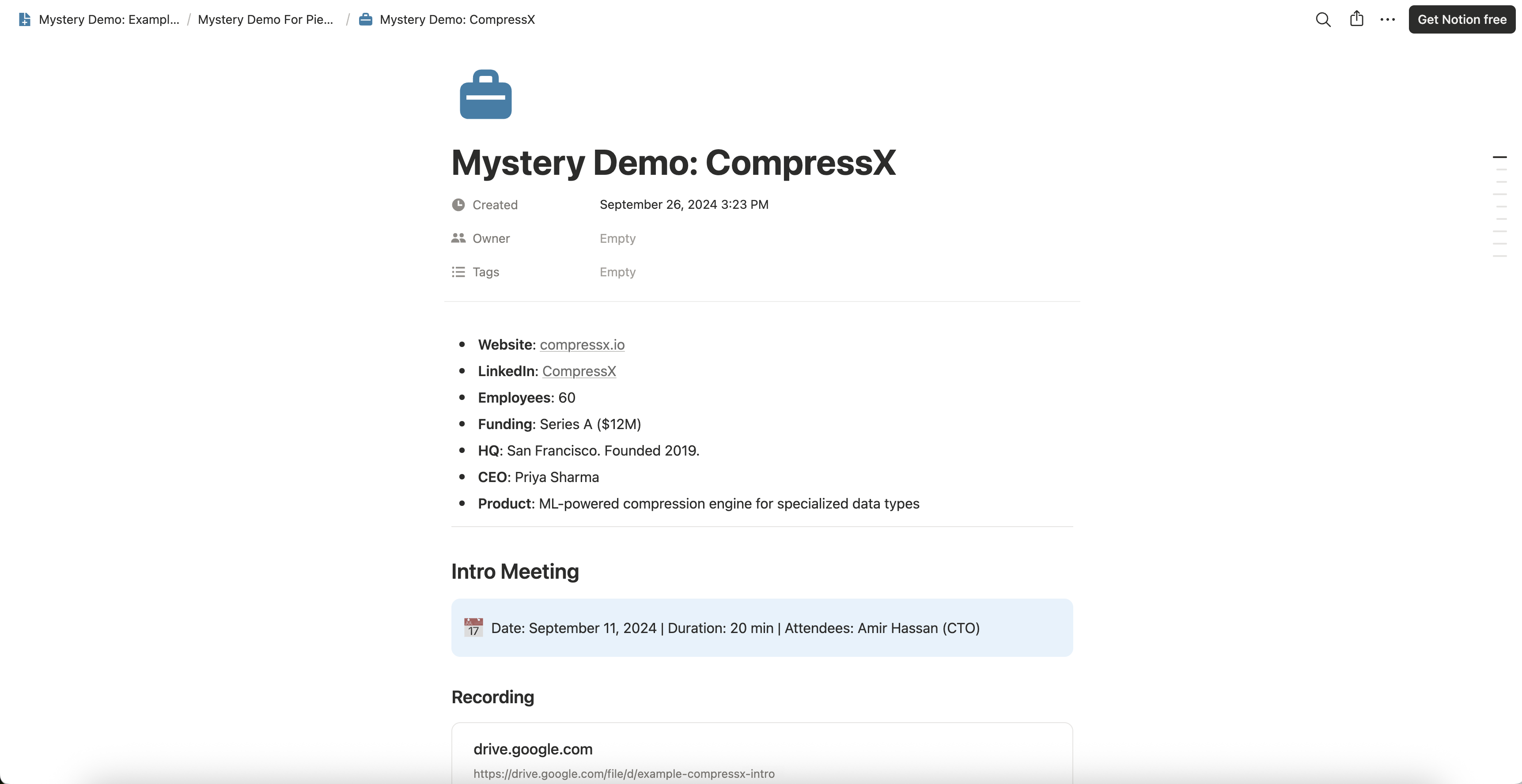
This is one rival’s page from our public example board, where the client and every competitor are invented. A real project’s board is built from the calls taken for that client. The page opens with the company’s facts, then each meeting with its date and length, then the recording.
For intel that goes stale, the date is the part that matters. Every finding on the board traces to a call, and every call has a day. Your team can see how old each claim is, and look for any sign that has appeared since that day.
A Rival’s Claims Beside What Its Demo Showed
Once the calls are in, the page called Findings & Analysis compares the rivals one subject at a time. For product intel, that comparison is the feature matrix. Each feature a rival claims is marked by what its rep could show working: all of it, part of it, or only a stub.
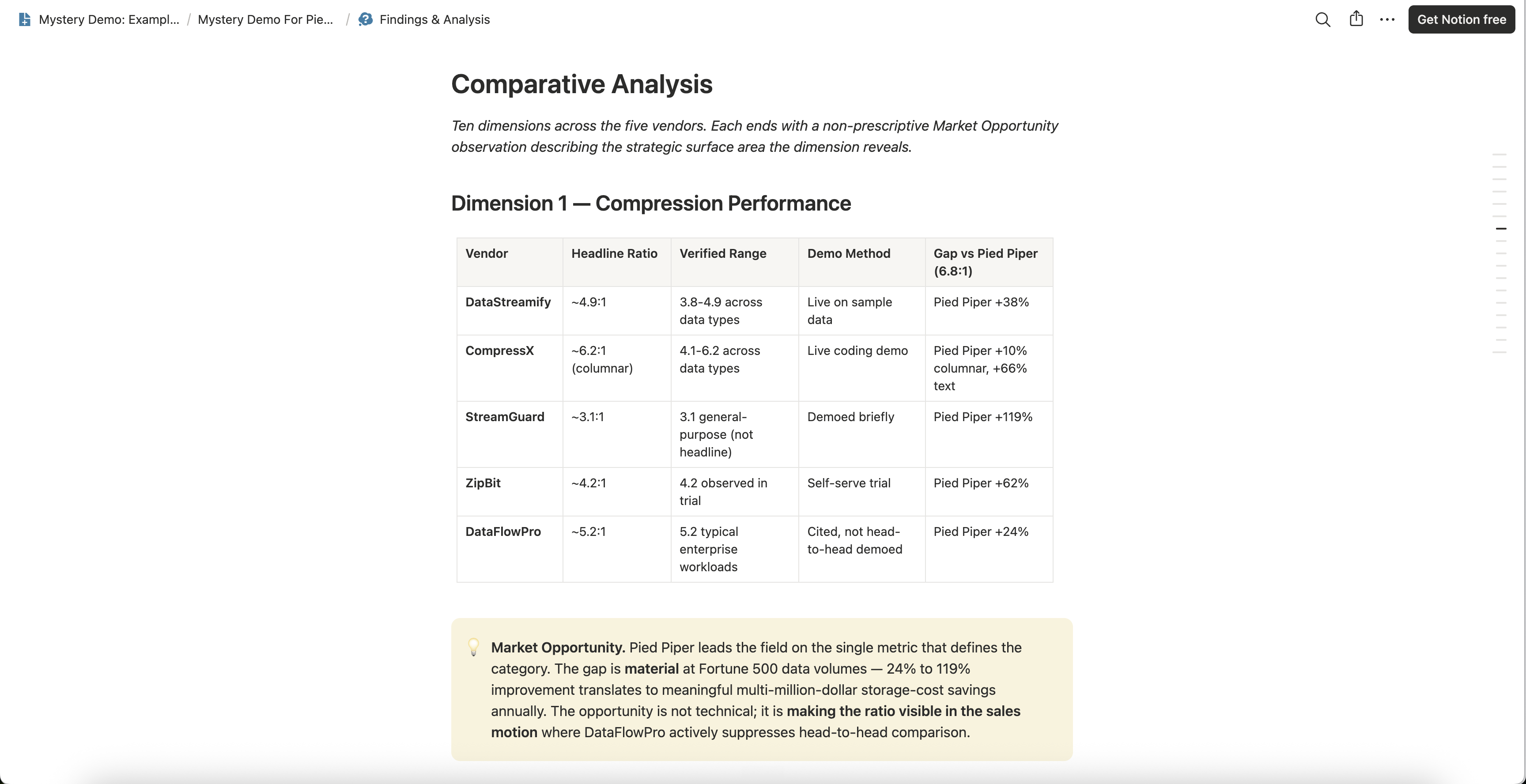
This is the first comparison on the same invented board. Each row sets a rival’s headline claim beside the range its demo showed, and how the demo showed it. The headline column is the part a desk review can refresh.
The range column only gets updated when someone hears the rival sell again. It records what one rep showed one buyer on one day, which is evidence about the demo, not a hands-on test of the product. When a second call shows the same thing, it starts to look like the rival’s pattern rather than one rep’s.


Our competitor product comparison puts those questions to every rival you name, as a buyer, and fills the feature matrix from the answers. One rival costs a flat €499, everything included, and its page is ready in one to two weeks. A full landscape of six to fifteen rivals takes four to eight weeks, because their calls run in parallel and each page lands as it is finished.
Clients come back one to three years later and run a project again, to see how each competitor has moved. Between those projects, a sign on one rival is reason enough to check that rival alone.
If a rival has repriced, repackaged, or relaunched since your team last heard it sell, bring that change to a first conversation. We will go through that rival’s sales process as a buyer and hand back what it quotes and pitches now, recorded and dated.
Check the Claim Your Reps Lean On Most
Competitor intel stays accurate until the thing it describes changes, and an old date alone doesn’t make a claim wrong. The public part can be rechecked from your desk the day a sign appears. The quote, the pitch, and what a rep shows working can only be rechecked on the rival’s own calls.
So start with one claim this week, and write down three things:
A battlecard is one place to keep that note, and a shared doc works as well. Where the answer is a sales call, we can take it as the buyer. Start with that one claim, and the rival’s current answer comes back on a recording, dated.


