
When a rival cuts its price, sales asks the pricing owner and the enablement lead one question: what do we say? Matching the new price and ignoring it are the quick answers, and both are guesses until you know what the new price buys. A lower headline can come with a smaller plan, a feature that now costs extra, a longer contract, or an offer that ends.
Cuts are common enough to plan for. The pricing advisory firm hy looked at 100 software providers on a German review platform whose cheapest paid plan changed price by June 2025. Of those, 37% had cut it, and the rest had raised it.
The terms behind a cut come out when a buyer asks for a quote. Mystery Demo brings that quote back for you: its team requests your competitor’s demo the way a buyer like yours would, records the pricing conversation, and returns with what the new price includes and what it asks in return. The answer to sales comes out of four steps, each one leaving you with something to use in the next:
An invented example runs through all four. Rival A, whose price used to sit close to yours, announces a much lower price on its main plan, and your reps start hearing about it in deals.
Work Out Which of Your Buyers the Cut Could Reach
Start on the rival’s pricing page, the first of the places a competitor’s pricing shows, because it says who the cut is for even when it says little else. Save a dated copy of the page and write down what it shows:
Then name which of your own buyers would look at that plan. Describe that buyer the way you would to a rep: the size of the company, what it needs, how it likes to buy. Treat it as a first guess, because your own deals will check it later.
In the example, the cut is on Rival A’s main plan, and the page pitches that plan at mid-sized teams, the same teams you sell to. So the buyer worth asking about is a mid-sized team like the ones in your pipeline.
The page has told you who the cut is aimed at. It has not told you what that buyer would pay, and that number only comes out in a quote.
Get the Price a Buyer Like Yours Is Quoted
Even a published cut is only part of the price. A 2025 survey by Price Intelligently by SBI, a pricing advisory firm, found that 69% of sales-led and sales-led-assisted SaaS companies did not publish their prices and packages on their website, and only 9% published all of them. In the same survey, 23% of horizontal software companies, the kind sold across many industries, said they give 26% or more off list price.
So the cut on the page is the new opening number. The number you need is the one a rep quotes for your buyer’s scope, with its terms, and the two can differ on every line:
| What to check | What the published cut shows | What a quote shows |
|---|---|---|
| The price | The new headline number | The number for your buyer’s seats and scope |
| What is included | The plan as the page describes it | What the price covers for this buyer, and what moves to a higher plan |
| Extras | Add-ons, if the page lists them | Which features or seats cost extra, and how much |
| The term | Monthly or yearly, if stated | The contract length the price requires |
| How long it lasts | An end date, if stated | Whether the price holds at renewal |
| Minimums | Seat or usage floors, if stated | The floors the quote applies |
The right-hand column fills only when a buyer asks the rival for a quote. The page announces the cut to everyone, and the terms behind it are said to one buyer at a time, on a call. A team that asks its own rivals for quotes gets recognized, or gets the generic tour.
How the Quote Is Asked For
A quote that answers your question takes preparation. Before any call, the team writes the fábula: the buying scenario it brings to each rival, saying who the buyer is, why it needs a solution and what it is solving. For a price cut, the scenario is fitted to the buyer you named in the first step, from its size to what it uses now and when it has to decide.
Then the team requests the rival’s demo through the normal front door and goes through discovery, the demo and the pricing conversation, keeping every quote and email. The evaluation is real and nobody is impersonated: the one invented detail is which client it is for. Because the rival prices the buyer in front of it, a scenario fitted to your buyer gets a quote you can use.
The people taking the calls have sold B2B software themselves, so they know the follow-up a rep expects once a price is on the table. The Chief Mystery Officer, who runs the demos, puts it this way:


Everything lands on a Notion board, a shared workspace with a page for each part of the project: the scenario, a page per rival with its recordings, transcripts and emails, and the analysis. The page below comes from our public example board, where the client and every competitor are invented. A real project’s board is built from that client’s own calls.
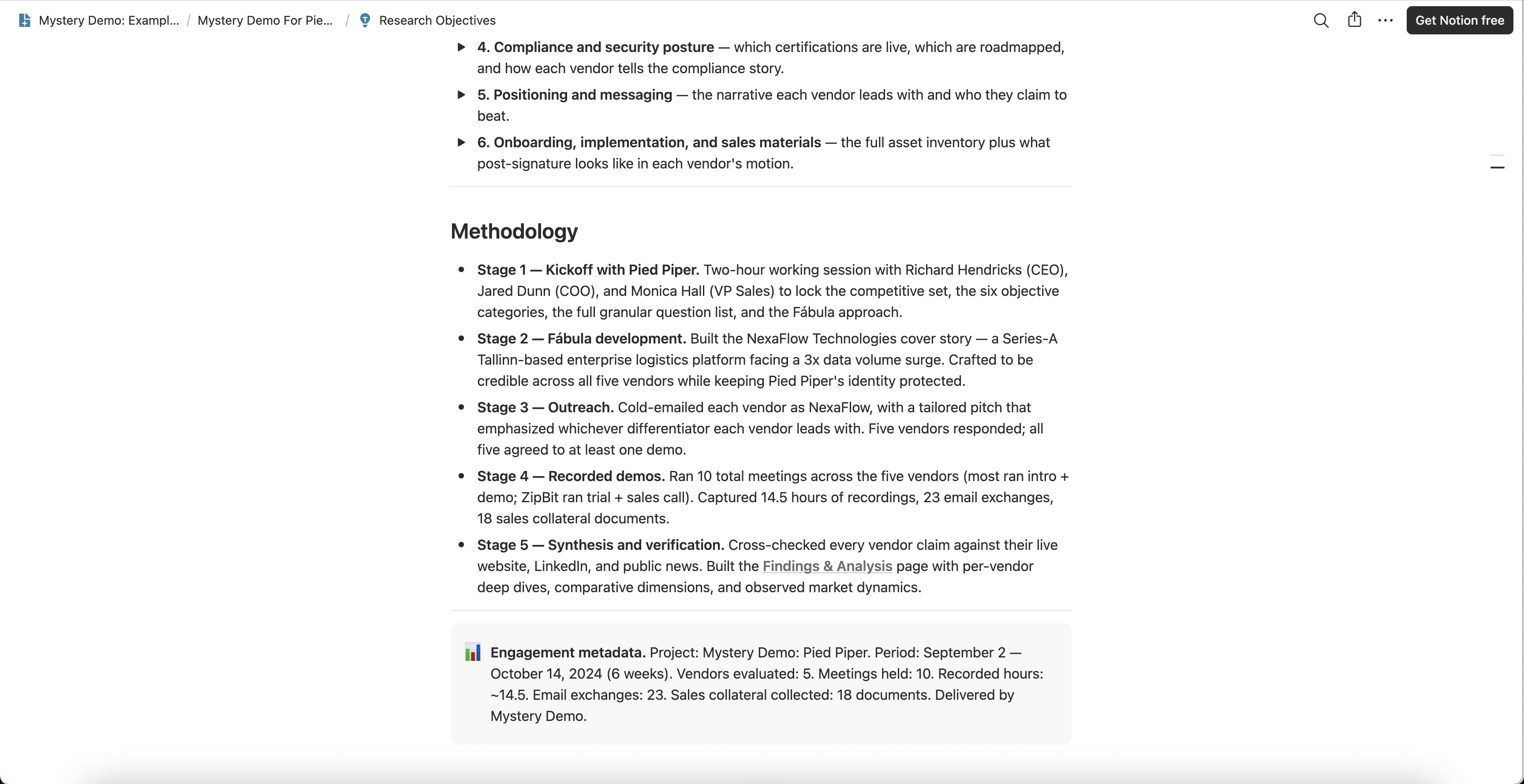
Its Methodology section lists the five stages every project runs. The fábula is written in the second stage, and the recorded demos come in the fourth. In the fifth, every claim a rep made is checked against the rival’s website and public news before the analysis is written.
What Comes Back to Your Team
SaaS competitor pricing research is built to bring back what the page leaves out: the price quoted to a buyer mid-negotiation, the tiers, the discounts, the upgrades kept for a later conversation, and the contract terms. On the board, those answers meet in the pricing matrix, the section of the Findings & Analysis page where every rival’s pricing sits side by side. Here it is on the same invented example board.
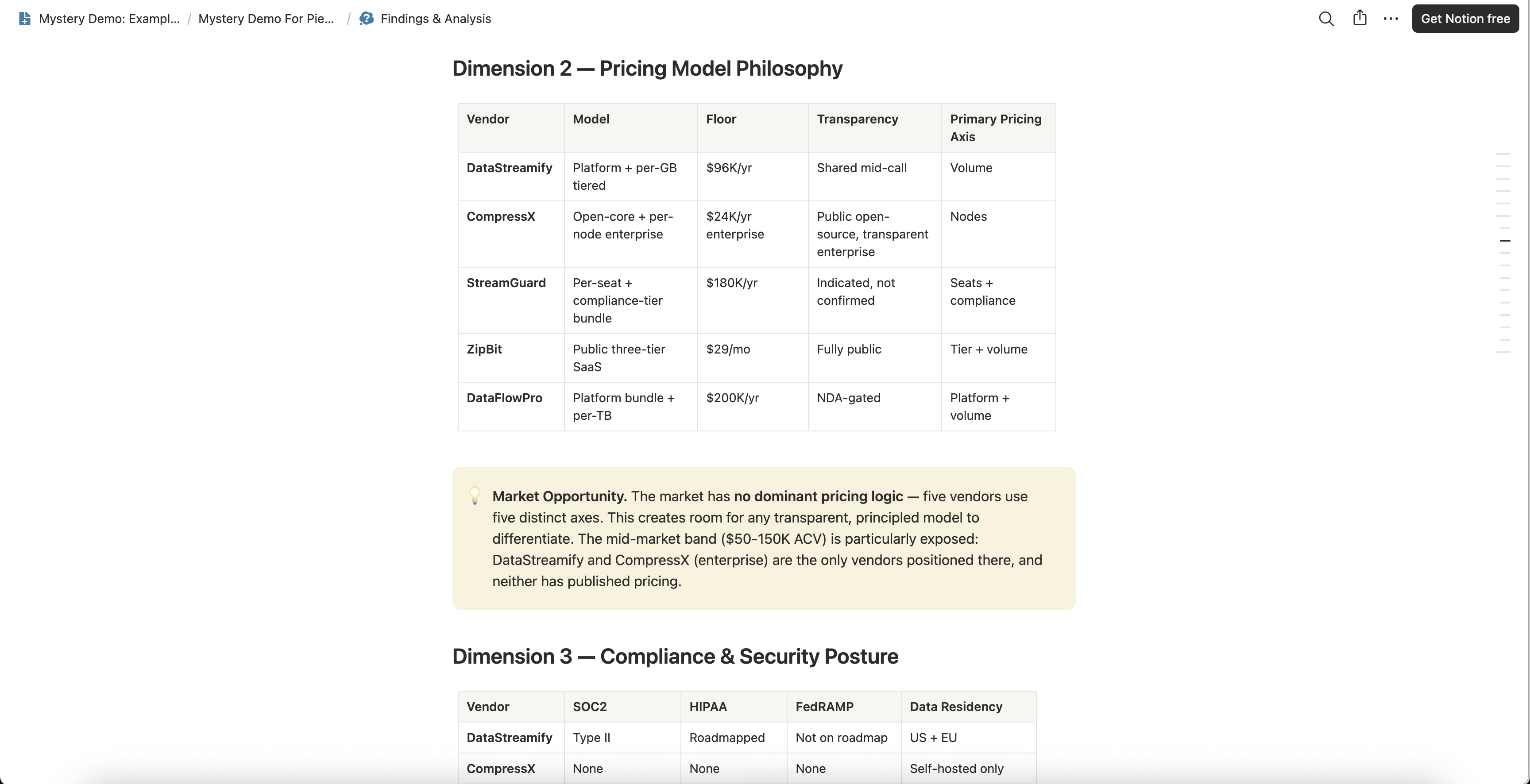
Read across one row and you have one rival’s pricing logic: the model, the lowest price it goes to, how much of its price it shows in public, and what the price scales with. On a real project, a cut shows up here as the quote beside the published number, with the call it came from. The pricing sheet below shows that for one rival’s cut, line by line, with Rival A and every price and term on it invented.
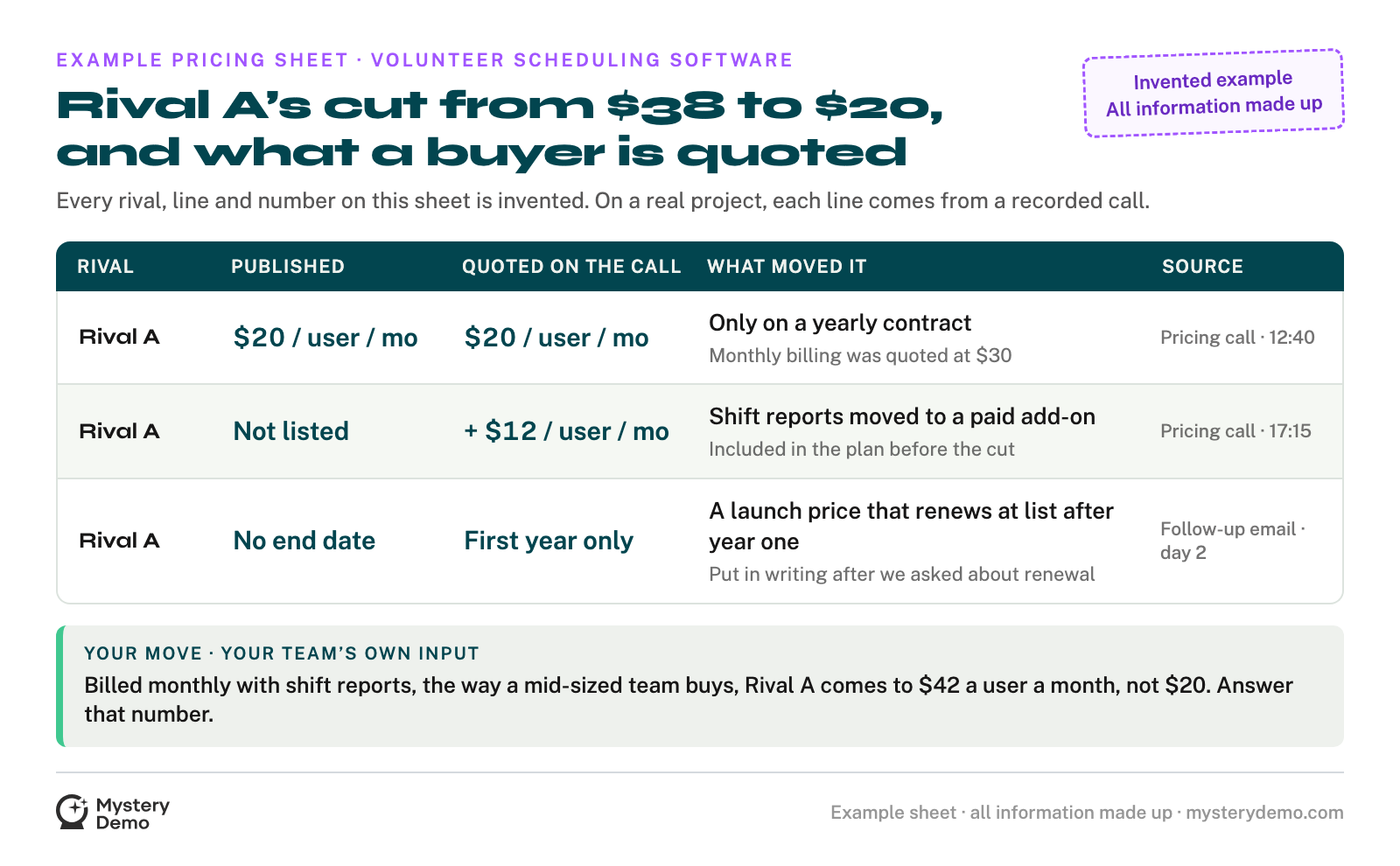
In the example, the quote shows three terms that Rival A’s pricing page never mentions:
A quote is evidence of one rep, one buyer scenario and one date, so a quote for a buyer unlike yours does not settle your answer yet. A second quote, from another rep or a month later, shows whether the terms repeat. Terms that repeat look like the rival’s pricing, and terms that do not may be one rep’s deal.
Running this on one rival costs a flat €499, everything included: the buyer scenario, every call, the recordings, the transcripts and the analysis. It takes one to two weeks. If a rival’s cut is already showing up in your deals, we can find out what it includes before your team answers it, and bring back the price, its terms and the recording.
Now you hold two numbers for the same buyer: the rival’s headline and its quote. The quote is the one to set beside what you would charge that buyer.
Set Their Quote Beside Your Own Offer
Check the buyer first. Pull your recent deals where the rival came up, and note the size of each buyer and what it needed. If those buyers look like the one in the quote, the quote applies, and if they do not, the cut may be aimed at someone else.
Then compare like for like. Write your own price for that buyer beside the rival’s quote, and line the two up so they price the same thing:
An open line is a question for the next call, not a gap to fill with a hopeful number. A comparison with one line open is still more use to sales than a headline with every line missing.
In the example, Rival A came up in several of your recent mid-sized deals, and those buyers sign monthly. On a monthly term, with the feature added at its quoted price, Rival A’s quote comes out above its old list price. A buyer ready to sign for a year would see a lower number, which is why the term belongs in the comparison.
You now know whether the cut reaches your buyers and what it is worth to them like for like. That is enough to choose.
Choose to Hold, Reframe or Match, in That Order
Ask four questions in turn, and stop at the first one that settles it. Holding and reframing cost no margin, so they come before matching:
| Ask, in this order | If the answer is no | If the answer is yes |
|---|---|---|
| Does the cut reach your buyers? | Hold your price, and tell reps which buyers the cut is for | Ask the next question |
| Like for like, is their quote lower than yours? | Hold, and give reps the comparison with the date of the quote | Ask the next question |
| Can you show a difference your buyers value? | Ask the next question | Reframe: sell on that difference, not on price |
| Does a match fit the margin floor the pricing owner approved? | The pricing owner decides: accept the risk in that segment, or change your own offer | Match, for that buyer and those terms only |
The floor is the margin or discount floor the pricing owner has approved for that scope and term, so the last question has one owner and one answer. A match that fits it is a decision about one kind of buyer, not a new list price.
A reframe needs a difference the buyer can check. Give reps only what your deals and the rival’s quote back up, because the buyer can ask the rival too.
Each answer also costs something different:
| Answer | When it fits | What it may cost you |
|---|---|---|
| Hold | The cut misses your buyers, or the gap closes once both offers are compared like for like | Sales time to explain the difference, and a risk of losing deals at the edge of the rival’s segment |
| Reframe | Their quote is lower like for like, and you can show a difference your buyers value | A risk of losing the buyers who decide on price alone |
| Match | Their quote is lower, there is no difference to show, and the match fits your approved floor | Margin, directly, and a risk that the lower price becomes the starting point in later deals |
| Not decided yet | Their quote is lower, there is nothing to reframe on, and a match does not fit the floor | Whichever risk the pricing owner accepts: the segment, or a change to your own offer |
Reframing only works on a difference the buyer already values. One founder on Reddit, facing a funded rival priced at a third of theirs, wrote: “So here is what I am not doing: cutting my price.” Their reframe was the setup work the rival would not do, and they named the catch in the same post: it only works if the buyer already values setup.
In the example, the second question settles it. On the monthly term your buyers sign, Rival A’s quote is higher than your price, so you hold. Reps get the quote’s terms: the yearly contract the low price needs, the paid feature, the one-year limit, and the date it was quoted.
A few moves undo the whole exercise:
The Answer You Can Give Sales
Your answer to a rival’s price cut is built from four inputs, and only one of them needs a buyer:
| What you need | Where it comes from | How soon |
|---|---|---|
| Your own offer for that buyer, on the same term | Your deals and your price list | This week |
| A difference your buyers value, if there is one | Your won deals, set against the rival’s quote | As soon as the quote is in |
| The floor a match must stay above | The pricing owner | This week |
| The rival’s quote for that buyer, with its terms | A buyer on the rival’s sales call | One to two weeks, through us |
The last row is the step we take for you. Talk the cut through with us, and we will go to the rival with a buyer scenario built on your buyer. You get back the quote, its terms and the recording, so the answer you send to sales rests on what the rival offers a buyer.


