
An American competitor keeps winning deals in your home market, and the explanations arrive fast: more money, a bigger brand, a bolder sales culture. Some of that may be true of your rival. None of it is something your team can change before the quarter ends.
A seller who has spent over two years bringing a European tech company into one regional market asked Reddit in October why American companies win everything. The post wanted to know how the big rivals sell, down to whether they “invest everything in massive marketing campaigns” or rely on “expensive dinners.”
That is the right question, because a rival’s way of selling is the part you can study and answer. Four steps take a European sales team from that question to answers it can test:
The third step is the one your team cannot take from its own desk, and Mystery Demo takes it for you. It books competitors’ real sales demos as a credible European buyer, records every call, and hands back what each rival said, quoted and promised, on a board your team reads.
Write Down What You Can’t Change This Quarter
Start with a short list of the rival’s edges that nobody on your team can touch before the quarter ends. A larger budget goes on it, and so does a better-known brand, if your rival has them.
The funding gap is real across the whole market. Venture funds based in the US hold about €930 billion, around six times the roughly €150 billion held by funds based in the EU, according to a 2026 bulletin from the European Central Bank. The figure compares two markets, so it says nothing about your rival’s budget or about why you lost your last deal.
Written down, those edges stop being the end of every lost-deal conversation. This quarter’s plan keeps the part you can study: how the rival sells to your buyers, step by step.
Read What the Rival Publishes for Europe
Open the rival’s public pages first, because they are quick to read and show what it wants a European buyer to see. Note what each one says, with the date:
Those notes fill the middle column of the table, step by step. The right column is what the same step looks like to a buyer inside the rival’s sales process, and no public page shows it.
| Step | What its public pages show | What only its sales process shows |
|---|---|---|
| First reply | Nothing you can rely on | How fast it came, from whom, in which time zone |
| Discovery | Nothing | Whether the rep asked about the buyer’s market, rules and language |
| Demo | Local pages and languages | What the demo showed of the buyer’s market |
| Pricing | Published prices and currency, if any | The quote, its currency, minimum terms and discounts |
| Contract | Published terms, if any | The signing company, the governing law and the data terms offered |
| Data questions | Hosting and trust pages | What the rep answered when the buyer asked |
Record your own team’s answer at the same six steps too, from your recorded calls and CRM records in comparable European deals. That puts your sales process and the rival’s side by side.
Give the data row extra care. In a 2025 Gartner survey of 241 CIOs and IT leaders in Western Europe, 61% said geopolitical factors will increase their reliance on local or regional cloud providers. That survey is about cloud providers, not software in general.
For software, one European software company’s chief executive told a European tech publication that buyers have “quietly stopped asking where the servers are.” By that account, they now ask where the data is hosted and who governs it.
See How the Rival Sells to a European Buyer
A trust page shows what the rival publishes about data, and nothing about what its rep tells a buyer who asks. The whole right column works that way. The quote, the contract terms and the answer about data go to one buyer at a time, and you hear them, if at all, secondhand from a buyer who chose to tell you.
Your own team could request the rival’s demo. In your home market, its reps probably know your company, and a team that shops its own rival gets recognized or gets the generic tour.
Mystery Demo goes through it for you. Before any call, it writes a buying scenario fitted to what that rival sells: a believable company with a real reason to evaluate software, represented by people the rival has never met. Then it requests the demo through the rival’s normal front door and follows every step a real European prospect meets:
The demos are run by operators who have sold B2B software themselves. They know which questions take a rep off the script, such as asking for the price in euros, or for the name of the company that will sign the contract, before any proposal exists. Every finding comes back as a recording or an email, with its timestamp.
A project starts by choosing the rivals. You can name only the American one, or add the European rivals you meet in the same deals, so every rival meets the same buyer. Everything lands on a Notion board, a shared workspace with a page for each part of the work:
The pages below come from our public example board, where the client and every competitor are invented. A real board is built from the calls with that client’s own rivals.
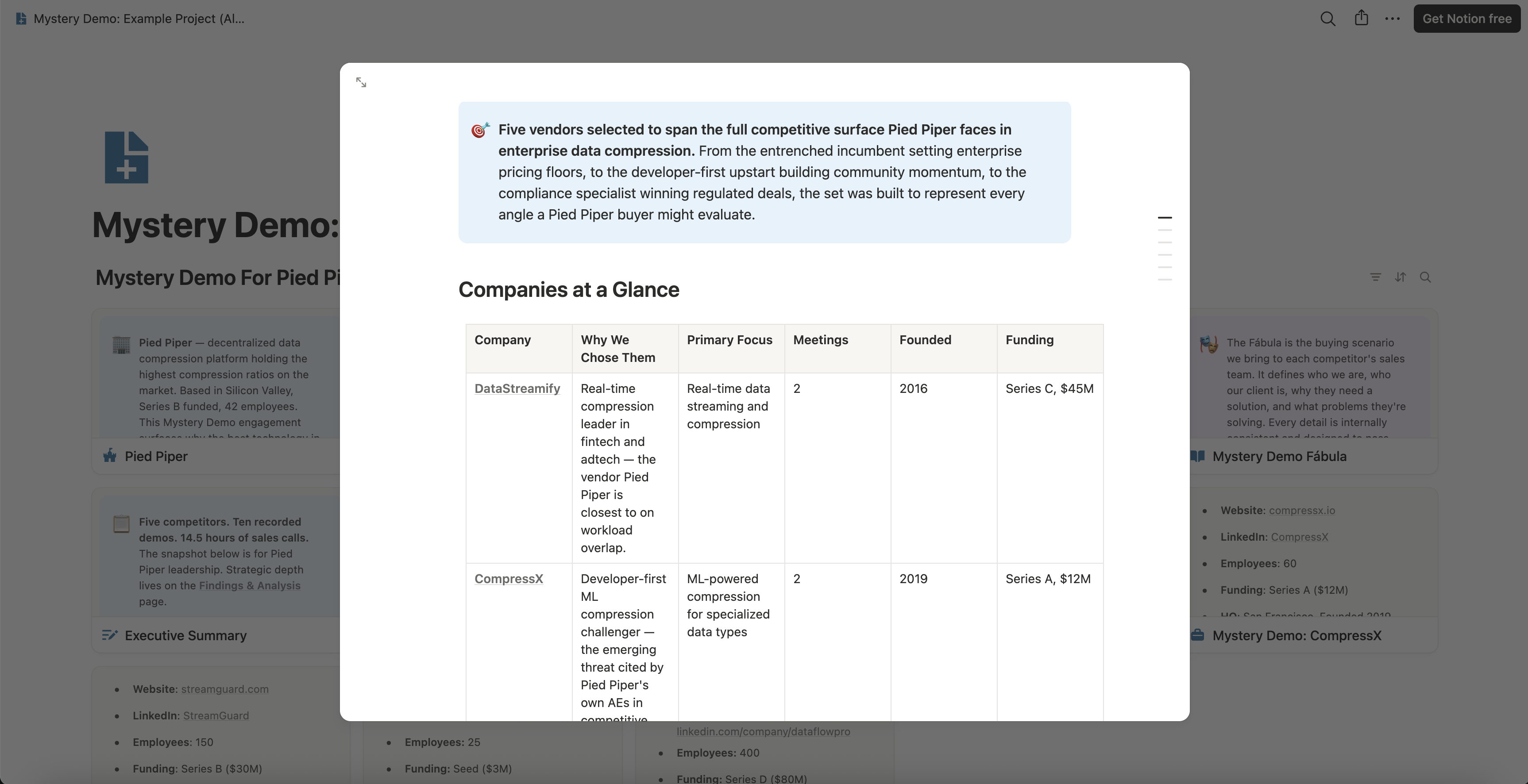
On Research Companies, each rival has a row saying why it was chosen and how many meetings it took. On your board, one of those rows is the American rival you keep losing to.
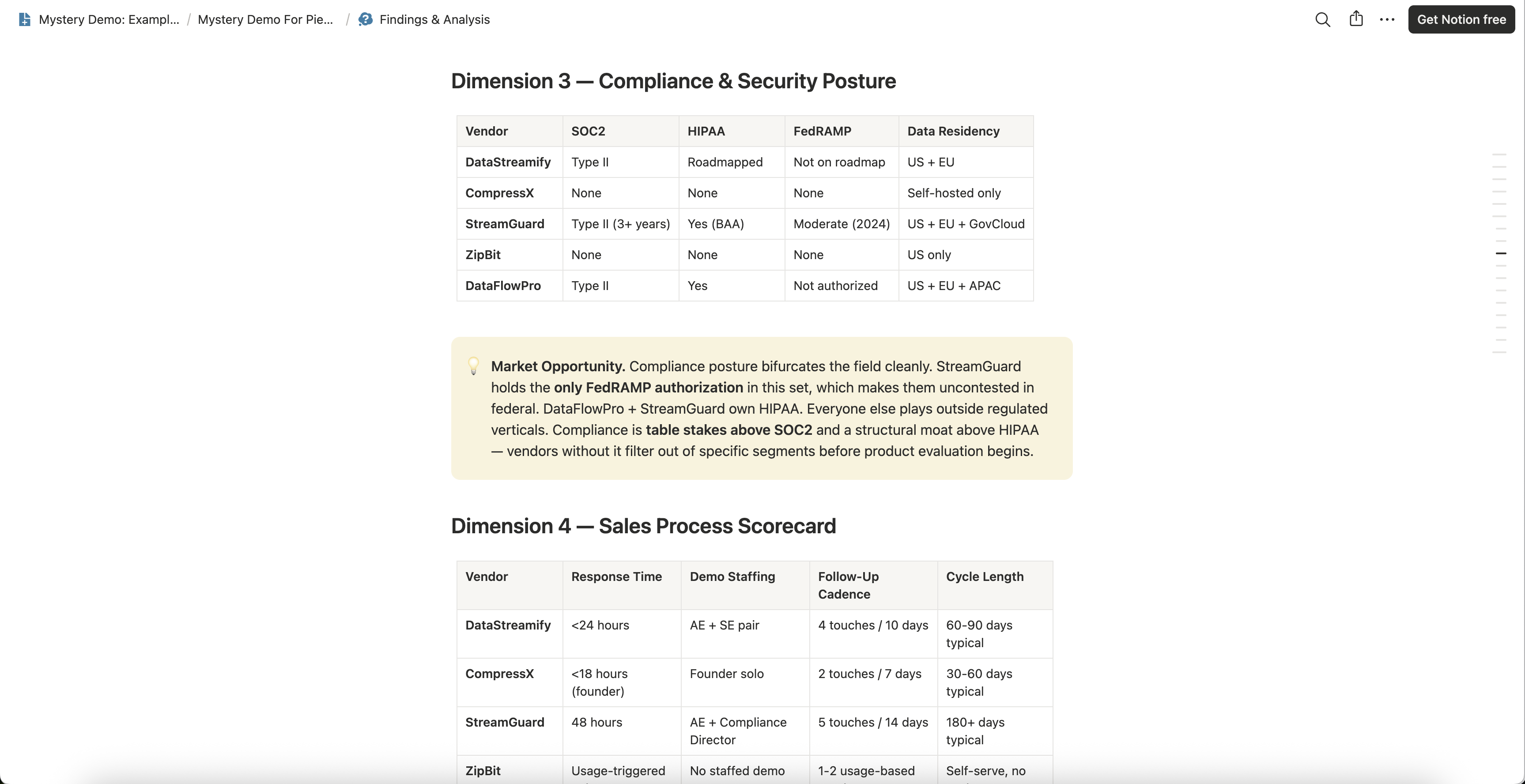
Findings & Analysis is where the contract and data answers land. On the invented board, one table compares each rival’s security certifications and where it hosts data. Below it starts the sales process scorecard, which grades each rival’s sales steps, from response time to follow-up.


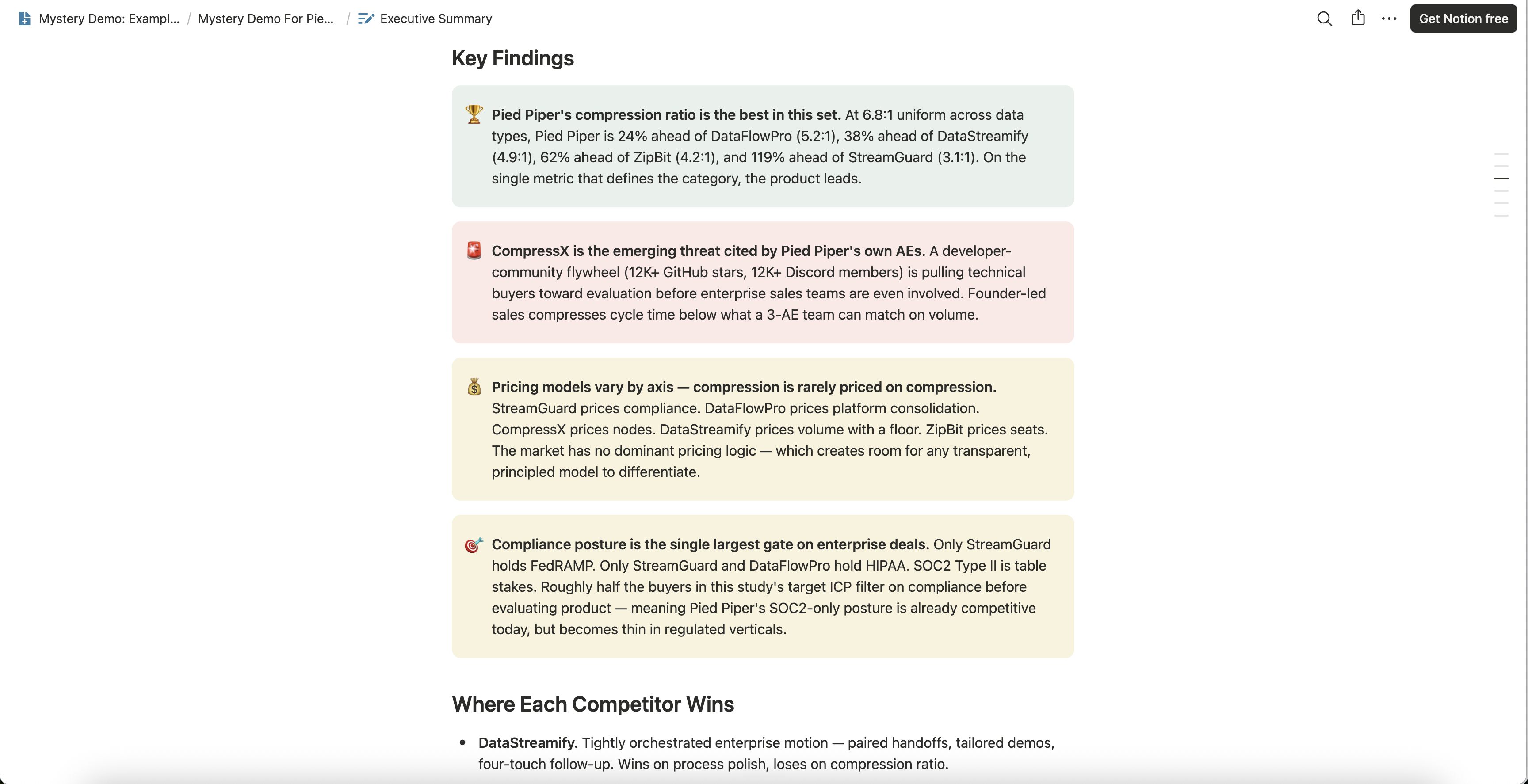
The board ends in the Executive Summary, the page leadership reads first, where each finding is a short verdict with its evidence attached.
If you meet more than one rival in those deals, the same buyer can go through every one of them, which is what SaaS market entry research covers. One rival costs a flat €499, everything included, and takes one to two weeks. A full set of rivals takes four to eight weeks.
Which American rival keeps taking your home deals? Name it on a short intro call, and we will go through its sales process as a European buyer, from the first reply to the contract.
Test Your Answers Where the Rival Fell Short
With the rival’s column filled beside your own, you can see the steps where it fell short for that buyer. Those steps are evidence about one rep and one buyer scenario. They show how that rival treated that buyer, not how American vendors sell, and not on their own why you lost.
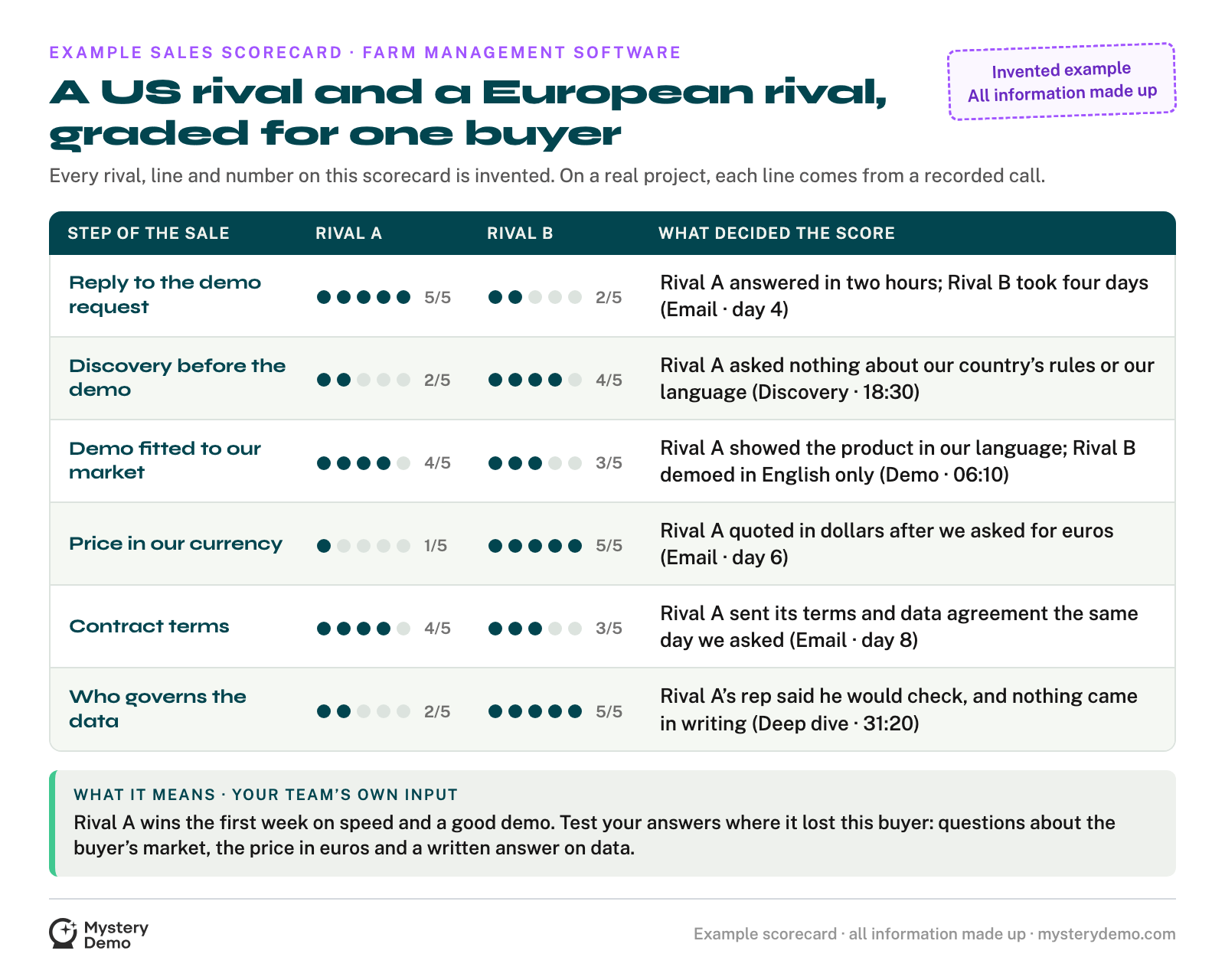
This invented scorecard grades a US rival and a European rival on the six steps, for one invented European buyer. Rival A wins the first week with a fast reply and a strong demo, then loses where the buyer raised their own market: its rules and language, a price in euros, and a written answer on data. Your rival may be the other way round, which is why the grades have to come from its own calls.
A step counts as a shortfall only where it mattered to that buyer:
A different currency, or a question the rep never asked, is not a weakness by itself. Read the strong steps too. Where the rival won the buyer, as with Rival A’s two-hour reply, it set the bar your own process has to meet.
Pick the two or three shortfalls your team can meet better, given what your buyers ask for and what you can offer. Then change your own sales process at those steps, as a test on the next comparable deals:
| Step | A shortfall that mattered | A response to test |
|---|---|---|
| First reply | Days to reply, with the buyer on a deadline | Reply within the buyer’s working day |
| Discovery | No question on the buyer’s rules or language, after the buyer raised them | Add those questions to your discovery |
| Demo | Nothing of the buyer’s market, though the buyer asked | Show their language, their currency or a local case, if you have one |
| Pricing | A quote in another currency, or unclear minimum terms | Quote in the buyer’s currency, with the terms on the page |
| Contract | No signing company or data terms, though the buyer asked | Send the terms you can offer, in writing, early |
| Data questions | A vague answer on who governs the data | Your own answer in writing, as far as it is true |
In the invented scorecard, that means three tests: ask about the buyer’s rules and language in discovery, quote in euros, and send your answer on who governs the data in writing. Check each one at its own step on the next deals:
These are hypotheses about one observed sales process. Only your next deals can show whether they win.
What to Do Before Your Next European Deal
Funding and brand, where your rival has them, stay on the list you wrote first. Everything else is the rival’s sales process, which you can record step by step and answer where it fell short.
Start with the rival you meet most often, and gather what each source can give:
That last one takes a buyer. Tell us which American rival it is, and we will be that buyer, then hand you the recordings and the rival’s page of the board, ready to set beside your own notes. If you would rather have your own team’s steps recorded the same way, we can shop your sales process too, unannounced, in the same week or two.


