
Should the SDR who booked a meeting stay on for the discovery call? A sales leader asked exactly that on LinkedIn in August, and the post drew 158 comments. In the habit they asked about, the SDR joins the call, greets the buyer, and hands over to the account executive.
For the sales leader who owns that handoff, the answer in most deals is no. Hand the buyer over before discovery begins, in a written note the account executive has read, and keep the SDR off the call. The buyer judges the handoff by whether the call picks up the conversation they had with your SDR or starts it again.
Mystery Demo sees handoffs from the buyer’s side. It books your competitors’ sales demos as a credible buyer and records every step of each one, the handoff from SDR to account executive included. Two practitioners on the selling side point the same way:
Three findings would change this verdict: rapport holding up in your own recordings when the SDR stays, buyers asking to keep the SDR, or a rival whose buyers get a plainly better call with its SDR on. Only a buyer can see the third, and that is the seat Mystery Demo takes.
The Best Case for Keeping the SDR on the Call
The fair objection is continuity. The buyer said yes to a person, not to a job title, and the SDR is the one person at your company the buyer has met. Keeping the SDR for the introduction carries that trust into the call, while a stranger opening it starts from nothing.
That holds in three cases, and in those the SDR should stay:
Your own recordings show whether one of these cases is yours. If buyers talk to the SDR during the call, not only at hello, or rapport holds up when the SDR stays, the continuity is real.
Teams also keep the SDR on so the SDR can learn by watching. That is a training goal, not an exception, and the recording serves it without a third voice on the buyer’s call.
Outside those cases, the continuity has to travel some other way, and the handoff style decides if it does.
What the Buyer Experiences in Each Handoff Style
The three handoff styles differ in what the buyer meets on the call. We found no study that measures it, so each row is our reading of what practitioners report. Each cell says what can happen, not what always does.
| Handoff style | What the buyer may experience | What it depends on |
|---|---|---|
| The SDR hands off before discovery, in writing | One seller on the call, who opens with what the buyer already said | Whether the account executive read a note with enough in it; without one, the buyer may have to repeat themselves |
| The SDR joins the call to hand over | A greeting from someone they know, then a new seller and a second start | Whether the second start is planned; one leader’s review of recordings found weaker rapport on calls opened this way |
| The account executive books directly | One seller from the first email, and no handoff at all | Whether the account executive has the time to book their own meetings |
The first row wins only when the note does its job. A buyer who already told your SDR why they are here, and gets asked again, learns that nobody wrote it down.
One practitioner puts the rule bluntly: “If a handoff needs a verbal ‘let me fill you in,’ it isn’t a handoff.” Our version of that written note answers five questions before the account executive joins:
You can check a note like that in your own recordings, because the account executive either opens on it or asks for it again. Your recordings cannot show how that opening compares with the one the buyer got from your rival.
Your Buyer Compares Your Handoff With Your Rivals’
A buyer who is comparing vendors goes through each vendor’s handoff and remembers them side by side. The account executive who already knew the problem sets the bar for the one who asked for it again. Your recordings show only your side of that comparison.
A rival’s website shows its demo request form and nothing after it. It cannot tell you who books the call, whether the SDR stays on, or whether the account executive knew what the buyer said. A buyer learns those things on the call, and everyone else hears them secondhand.
Mystery Demo gets those answers by being that buyer, the same way at every rival:
The operators who run the demos have sold B2B software themselves, so they notice what a buyer notices. Everything lands on a Notion board, a shared workspace with a page for each rival: its recordings, transcripts, emails and our analysis. The page below is from our public example board, where the client and every competitor are invented, and a real board is built from that client’s own calls.
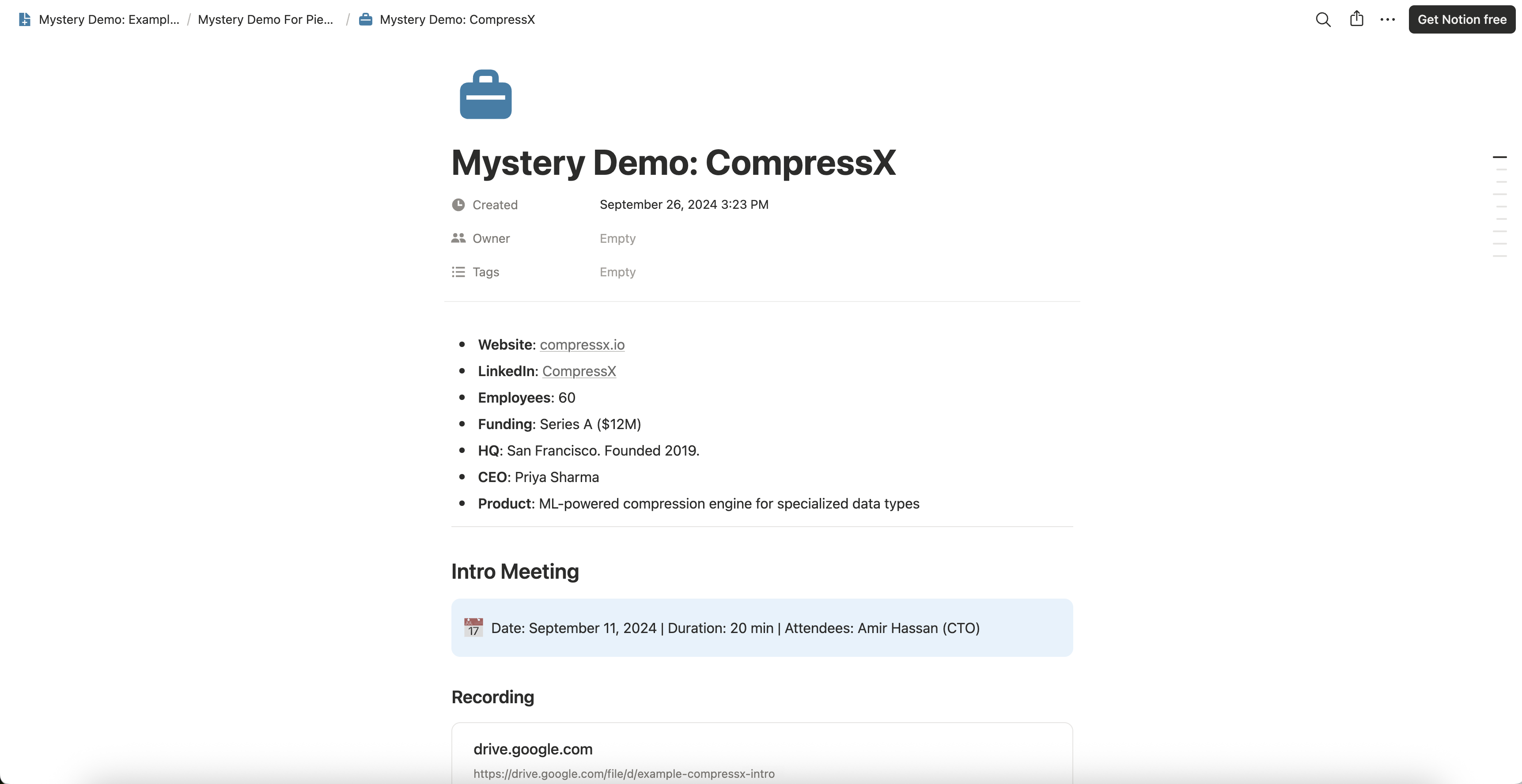
The top of one rival’s page holds its basic facts, then the intro meeting and the recording of that call. On a real board, that recording is where the handoff is heard, from who opened the call to what they already knew.


Each rival’s calls are then graded on the sales scorecard, the part of the board’s Executive Summary that scores every rival’s sales motion step by step. On the same invented board, it gives each competitor a letter for responsiveness, demo quality, transparency and follow-up.
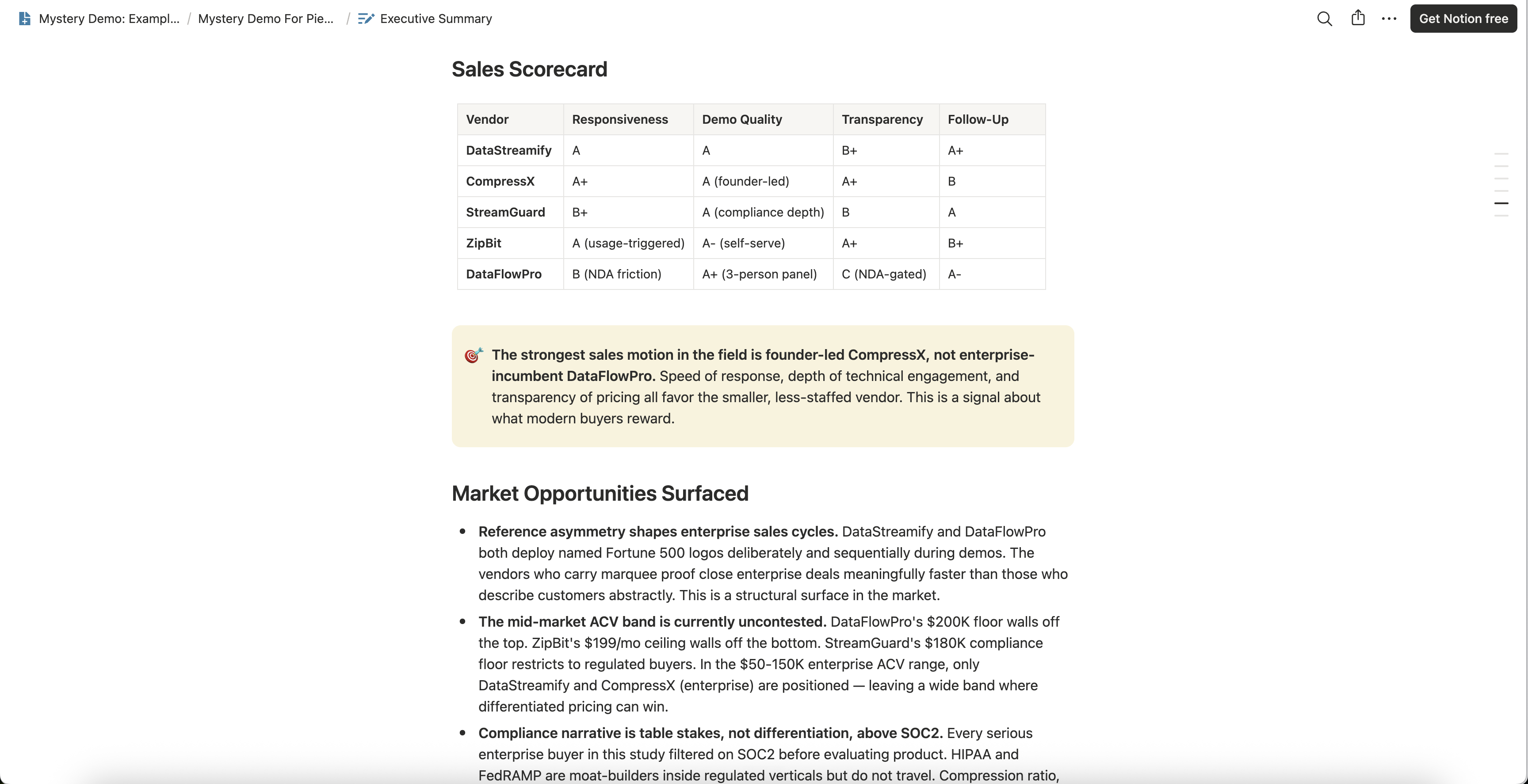
The columns follow the questions agreed when a project starts, so a team that brings the handoff question gets the handoff graded too. Your own team can be graded beside the rivals, shopped unannounced on the same buying scenario in the same week or two. The point is a better handoff, never catching a rep out.
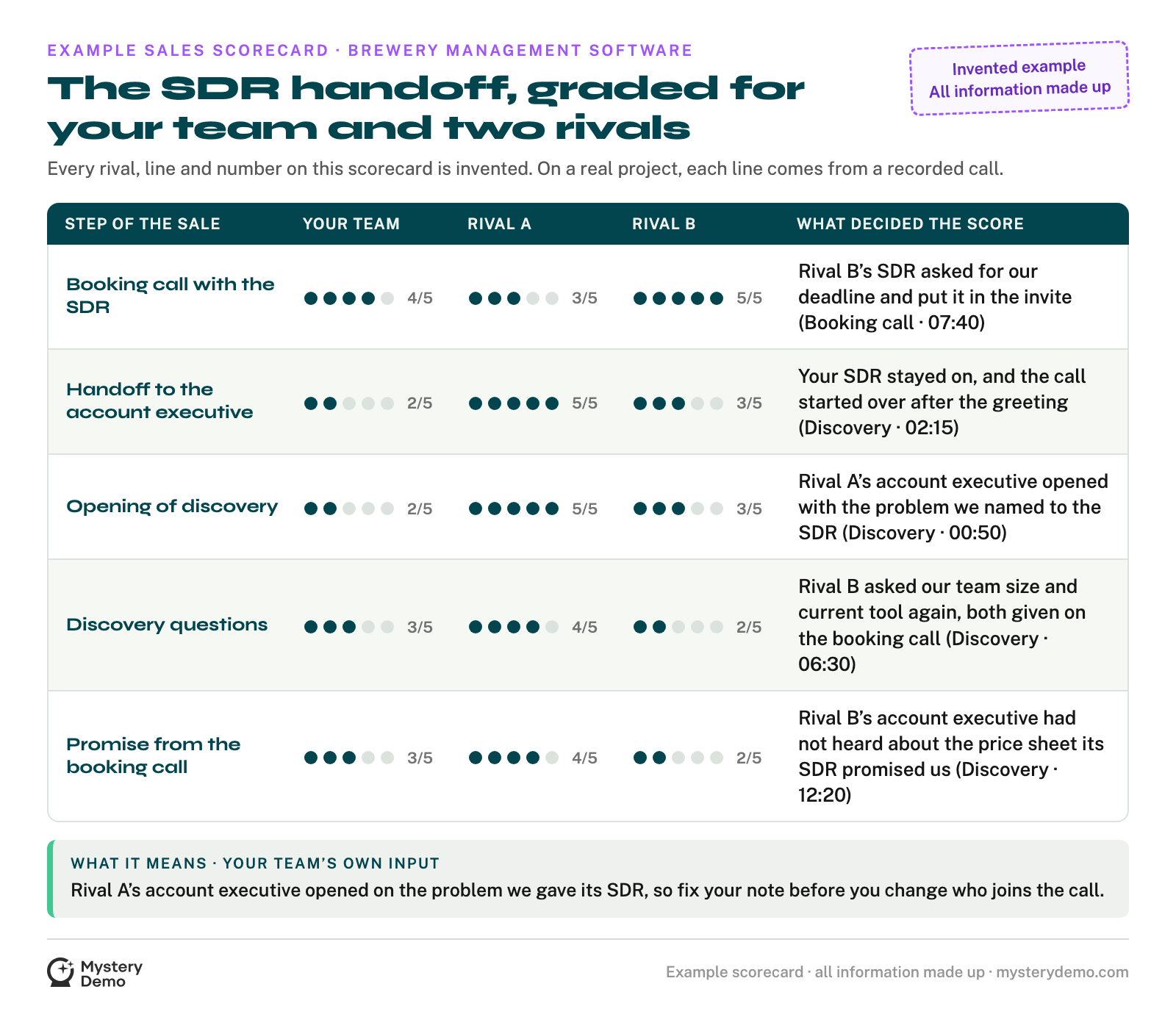
This invented scorecard narrows that view to the handoff, with your team graded beside two rivals. Grade every handoff against the same questions, not only against the rivals, because scoring level with two weak rivals is no reason to keep a weak handoff. The comparison also keeps two decisions apart:
Your own SDRs could request a rival’s demo, but its team would recognize them, or give them the tour reserved for people who are not buying. A buyer built for each rival gets the handoff a real prospect gets, and every finding comes back as a recording with a timestamp.
In competitor sales tactics research, we grade each rival’s sales motion from the first touch to the follow-up, handoff included. One rival costs a flat €499, everything included, and the work on it takes one to two weeks.
Which two rivals does your buyer meet before or after you? Give us their names on an intro call, and we will go through both handoffs as the buyer, from the first email to the account executive’s first question.
Make the Note the Handoff
The first change is to the note, not the guest list. Make the written note the handoff itself, and have the account executive read it before the call, so discovery picks up the conversation instead of starting it again.
The change to attendance comes second, on its own evidence. Keep the SDR off the call except where continuity wins: the buyer asked, the context will not fit in a note, or the team sells together by design. Run any exception a rival’s handoff suggested as a test on some calls, not as a new rule.
Then check both in your recordings. Pick a few recent discovery calls and listen for three things:
Hand off before discovery, in writing, and judge the handoff by what the buyer lived through, not by who was on the invite. Until your recordings or a rival’s handoff show a buyer better served with the SDR on the call, the SDR’s last job is the note.
Your recordings already hold your side of the handoff. For your rivals’ side, let us be the buyer they hand over, and add your own team if you want every handoff on the same buyer scenario, side by side.


