
Five real CRM value propositions, unedited, with the brand names taken off. A hundred B2B SaaS marketing leaders were asked to match each one back to the company that wrote it.
They averaged 1.86 out of five. Guessing scores 1.0.
That is Wynter’s June 2026 survey of a hundred marketing leaders who had recently evaluated competing vendors, and Wynter sells message testing, so read it knowing who benefits from the result. Discount it as far as you like and the shape holds, because the same people were trying. Ninety-two percent said they put real effort into finding distinctions when vendors seemed similar.
Effort was not the problem. What they were reading was: a homepage, which is the one version of a value proposition every competitor has already sanded flat.
The version that decides deals is spoken, once, to one buyer. Mystery Demo books your competitors’ demos and sits them as that buyer, then hands back the recordings, the transcripts, the email threads and our read on what they mean.
So we get to watch what happens to a value proposition after the website is closed, which is the part nobody in your building has seen.
A homepage is written to be read by everybody at once, which is why it drifts toward whatever the whole category can safely say. A demo is spoken to one buyer who is allowed to ask a follow-up question. Those are two different documents, and only one of them is on the internet.
The Same Evidence Has to Do Two Different Jobs
Two people in your building need a competitor’s value proposition, and they need different things out of it.
Marketing needs it to decide what to say. Which claim is already taken, which one is contested, where there is still room to stand up and be believed.
Sales needs it for Thursday. A rep is about to hear “we’re also looking at them” and needs to know what comes next, in what order, and what that competitor does when somebody pushes back.
One is a positioning document. The other is a rebuttal. They are built from the same evidence and they are not interchangeable, which is why a single competitor slide usually fails both.
Most teams have neither, and it is not laziness. They captured the declared version once, put it on a slide, and the slide is still accurate. It just never went anywhere near a live sales conversation.
Corporate Visions, which sells sales training, asked more than 5,200 enterprise B2B sellers across 78 companies to rate their own confidence. Sixty-nine percent said they understood competitors’ value propositions.
That is sellers grading themselves, generously, on the one thing they need most when a rival’s name comes up. Nearly a third would not even claim it.
The Website Is the Version Everyone Already Has
Start with what the public layer is good for, because it is good for something.
Nearly everybody reads it. In Wynter’s 2024 study of a hundred B2B SaaS marketing executives at companies with 200 or more employees, 97 percent said they interacted with the supplier’s website on the way to a purchase.
So nobody is arguing the site does not matter. The trouble is the opposite of neglect: everybody reads it, which means everybody already has it, including your competitor’s other competitors.
The same study asked those executives how they typically buy. Half said they prefer to buy through a sales meeting, and 83 percent named going through a rep as one of their usual routes.
Then it asked them to rank four things by what adds the most value when choosing a vendor. Forty-nine percent put the sales presentation or demo first, ahead of an interactive demo on the site, third-party reviews, and the website itself.
Four options, one producer, so read it as a ranking. It still points one way. The interaction they rate highest is the one you cannot read.
Reading a competitor’s homepage tells you what they decided to say to strangers. That is real information about them, and almost none about the deal where their name comes up against yours.
One of These Lines Could Be Published by Every Rival in the Category
So we ran the same test ourselves, in a category we have never worked in.
The search was the one a buyer would run: best feature flag management tools. Four ranked lists came back on the first page. Twelve vendors were named by at least two of the four, and that was the set, which means nobody hand-picked it to make a point.
Eleven of the twelve had a value proposition at the top of the page. One question per line: how many of the other ten could publish this as their own without saying something untrue about what they are?
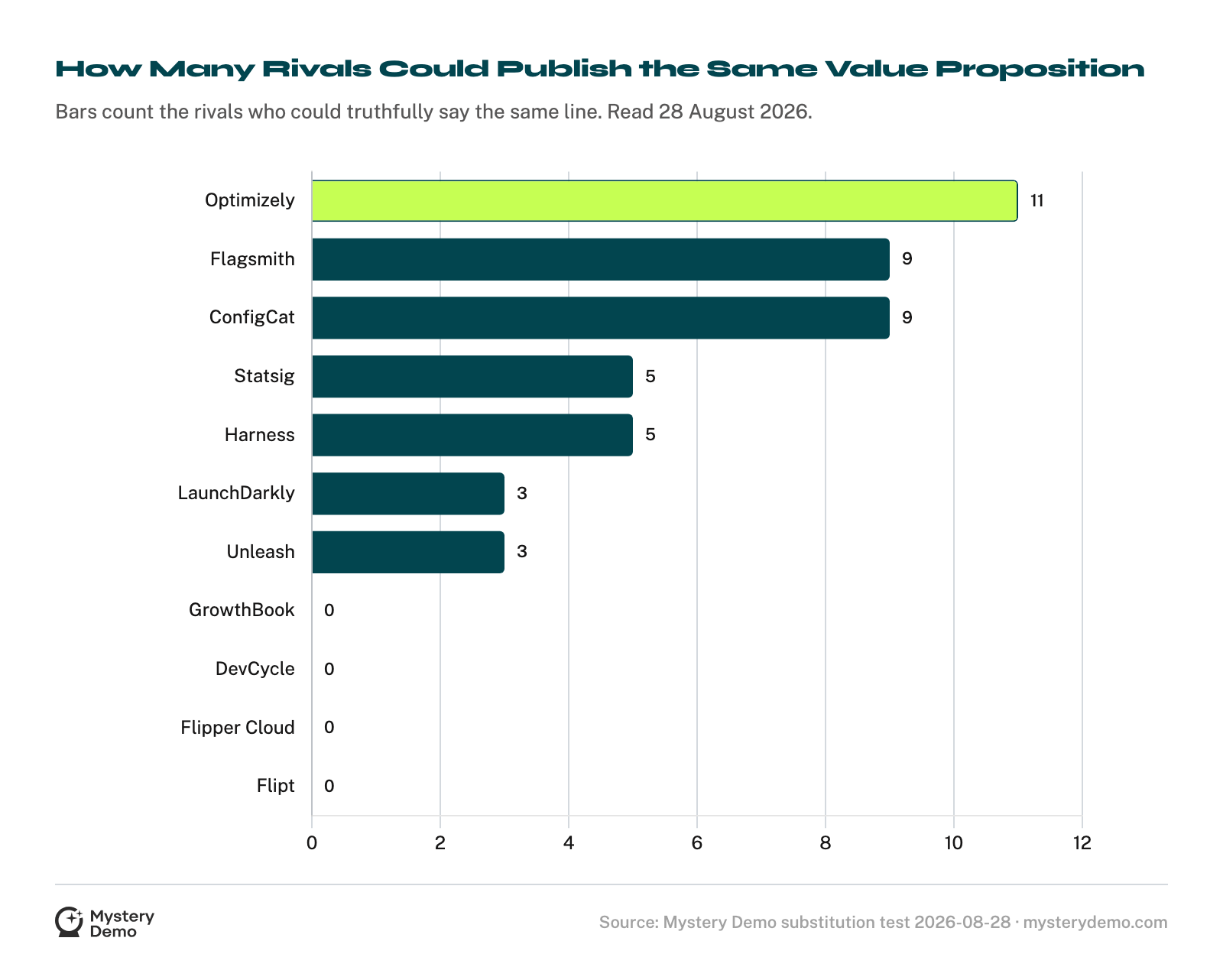
Optimizely’s line scored eleven. Every other product in the study could have run it word for word.
Flagsmith and ConfigCat scored nine. Those lines are about safe rollouts, full control, powerful flags and releases that land perfectly, which is to say about nothing that would shorten anybody’s shortlist.
Four scored zero: GrowthBook, DevCycle, Flipper Cloud and Flipt. Nobody else in the category could publish their lines at all.
Here is what I did not expect. All four of those are anchored on a checkable fact about how the product is built or what it runs on: a warehouse-native architecture, a Git-native change model, Ruby applications, being first to a named open standard.
Not one is anchored on a benefit. The lines that survived are the ones making a claim a person could go and verify.
The anchors are also not in the headlines. Two of the four open on sentences about deploying without fear, which is the most crowded sentiment in the whole set, and the distinguishing part shows up underneath.
The second surprise runs the other way from what I assumed. The interchangeable lines belong to the largest, best-funded names in the category, and the four nobody could copy belong to smaller and open-source vendors.
Five of the eleven lead on AI, so the category’s newest differentiator is already its most crowded one.
One last thing came back. Of the twelve vendors the search returned, one no longer states a value proposition anywhere on its own site: the page is an acquisition band, the words Switch and On, and a raw code sample somebody left rendering above the fold.
A competitor who has stopped saying anything is a finding. A website audit files it as a blank cell.
One category, one day, one reader’s judgment on every row. What it points at is bigger than the counts: a line survives the swap when it makes a claim somebody could check, and a claim somebody could check is a claim a rep can be asked to prove.
Every Claim Is Absent, Asserted, or Demonstrated
Which is where the desk runs out.
You can read a competitor’s claim from anywhere. You cannot tell from reading it whether they would stand behind it in front of a buyer, and that is the difference that decides what you do about it.
Any element of a competitor’s value proposition is in exactly one of three states.
| The state | How you know you are in it | What you can build on it |
|---|---|---|
| Absent | You raised the area it covers in a real conversation and it never came back | Nothing yet, and that absence is itself the finding |
| Asserted | They said it out loud, or it was sitting on the slide | A quote with a date on it, and a question for the next call |
| Demonstrated | They put it on a live screen, under a question they did not choose | A claim you can attack or concede on the merits |
This is not a grading scheme for your own evidence. That one already exists, and the ladder running from an artifact down to inference is worked through in what an evidence grade is.
The two describe different things. A grade says how you came by a claim. A state says what happened to that claim in a room.
They come apart in both directions. You can hold a perfectly good artifact for something no rep ever demonstrated, and a capability you watched run live can sit lower down the ladder if all you kept was your own memory of it.
Below is one dimension from our public example project, an invented engagement we publish so the deliverable is not an abstraction. Five vendors, one capability, four columns.
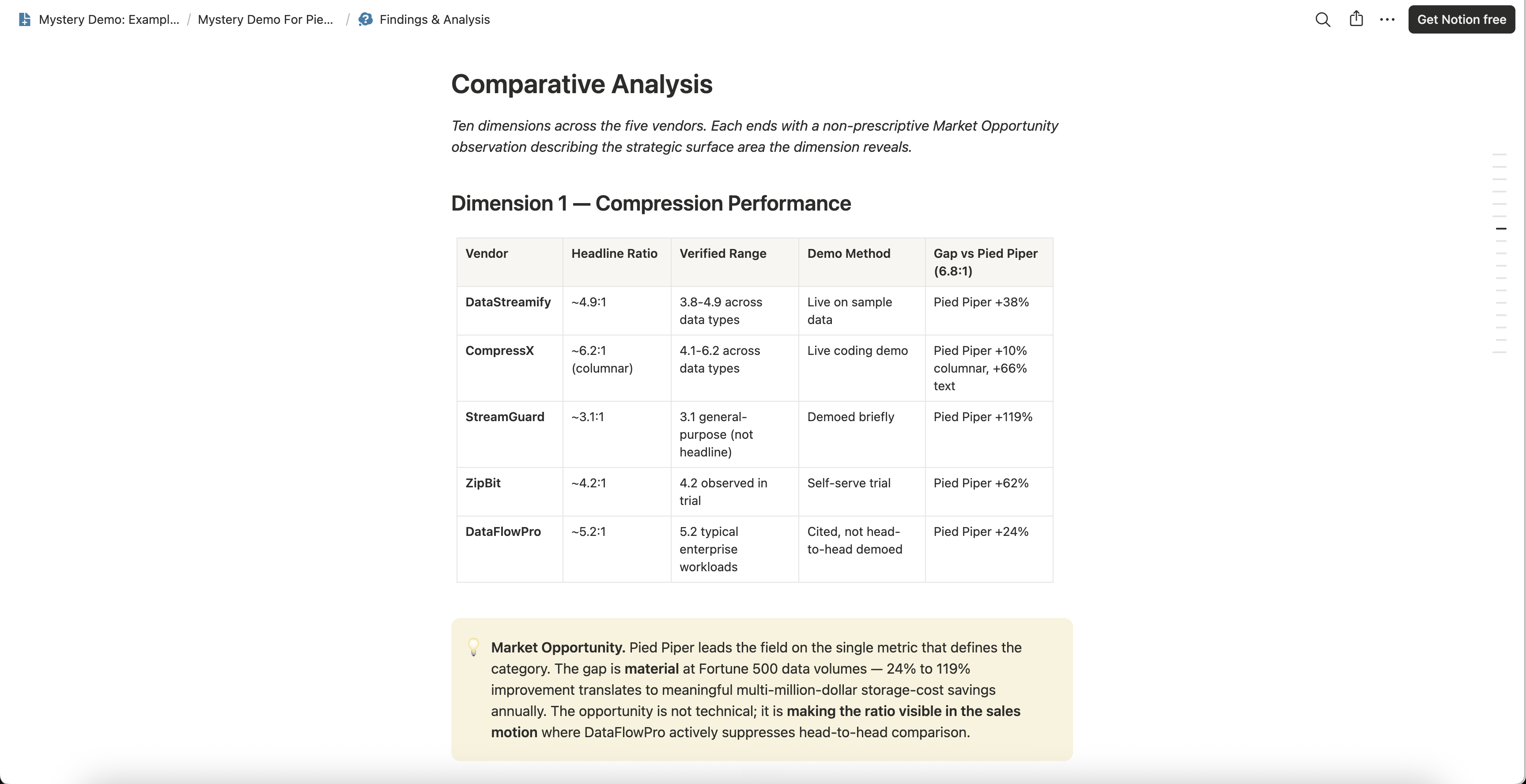
The fourth column is the one to look at. It records how each vendor produced its number, and the entries are not the same: live on sample data, a live coding demo, a brief demo, a self-serve trial, and one that was cited and never run head to head.
That column is the three states, written down. Every engagement gets pages like it, built from its own calls.
And that column only exists because the same question went to all five. Ask a vendor nothing about the thing their headline promises and the cell stays empty, and an empty cell is not evidence that the product is weak. It is evidence that nobody checked.
So the state is not a property of the claim. It is a property of what happened when somebody asked, which is why two honest evaluations of the same vendor can disagree about what that vendor proved.

A claim that sits on the homepage and never surfaces across an hour of questions about that exact area is not an oversight. It is the vendor telling you what they do not think will win the deal.
The Comparison Only Means Something If the Buyer Never Changes
Which makes the question set the instrument, not the recording.
Send three different buyers at three vendors and you get three anecdotes with a shared cover page. One asked about scale, one raised a compliance requirement, one mentioned that budget was already approved.
When the answers differ, nobody can say whether the vendor differed or the question did.
Hold the buyer still and that ambiguity disappears. One company profile, one situation, one list of questions, walked through every funnel in the set, so a difference in what comes back is a difference in the vendor.
On our side that constant has a name. The fábula is a believable company and a believable buying situation, rooted in truth, and it is what we carry into every conversation. Nobody is impersonated, and the only invented part is the client we say we are representing.
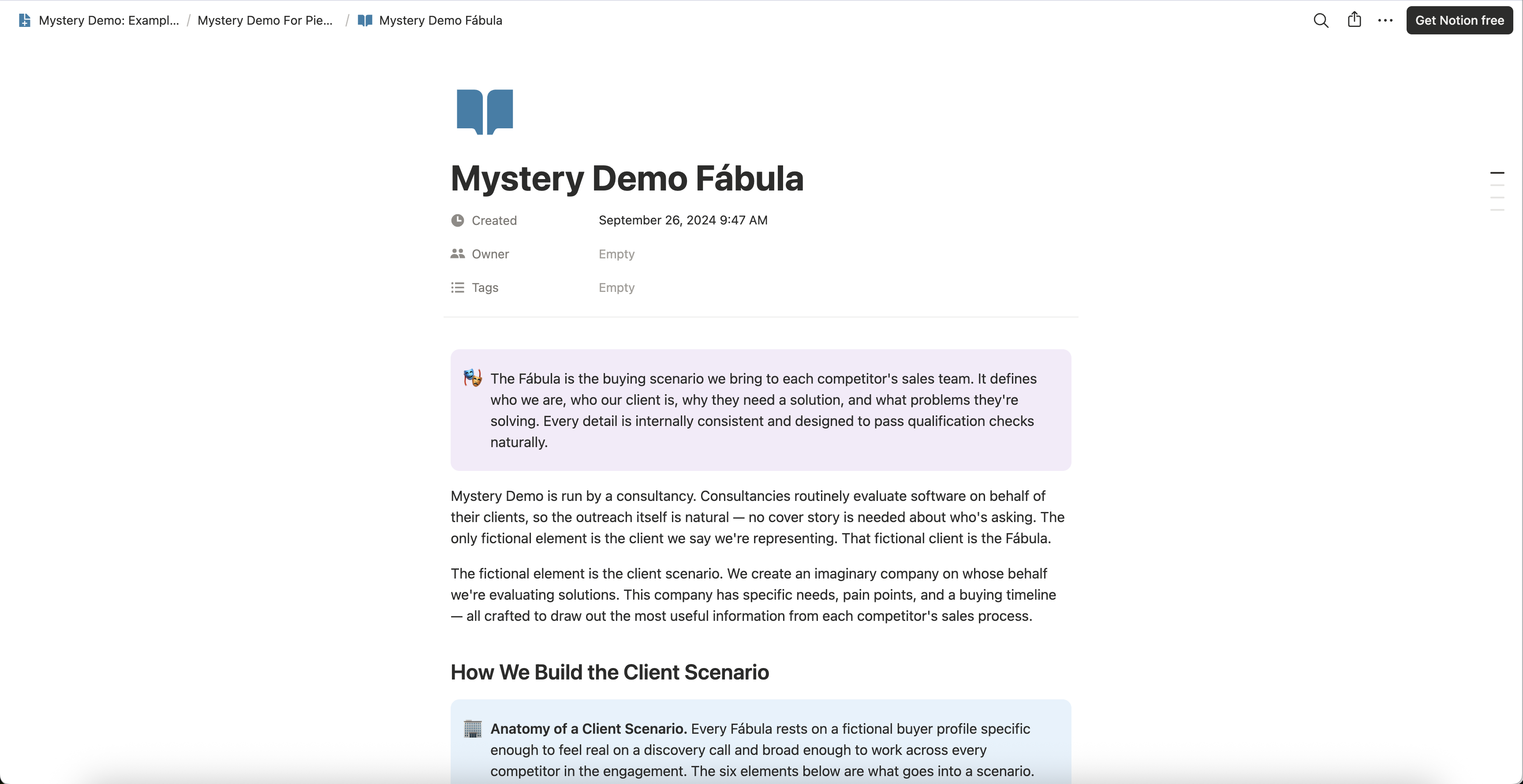
It has to arrive identical at the first vendor and the last, which is more discipline than it sounds like six weeks into a project.
The other half of the constant is written down before anybody books anything, and it is the step almost nobody takes. We read the competitor’s public material and list every claim on it, one line each.
That list is what makes absence detectable. Without it, a claim that never came up in an hour of conversation leaves no trace at all, because nothing in a recording marks the place where a subject did not arrive.
With it, the empty rows are as legible as the full ones. You finish the call and you can see which of their own promises they never reached for.
So the list we carry in for value-proposition work is short, and every item on it exists to move a claim from one state to another:
Each of those either turns a claim from asserted into demonstrated or fails to, and the failure is the result. The rep who moves to a case study when you ask for a live screen has answered you.
The last one is worth the trouble on its own. A vendor’s account of who they beat and why is the part of their positioning that never appears in writing anywhere, because writing it down invites a comparison page from the other side.
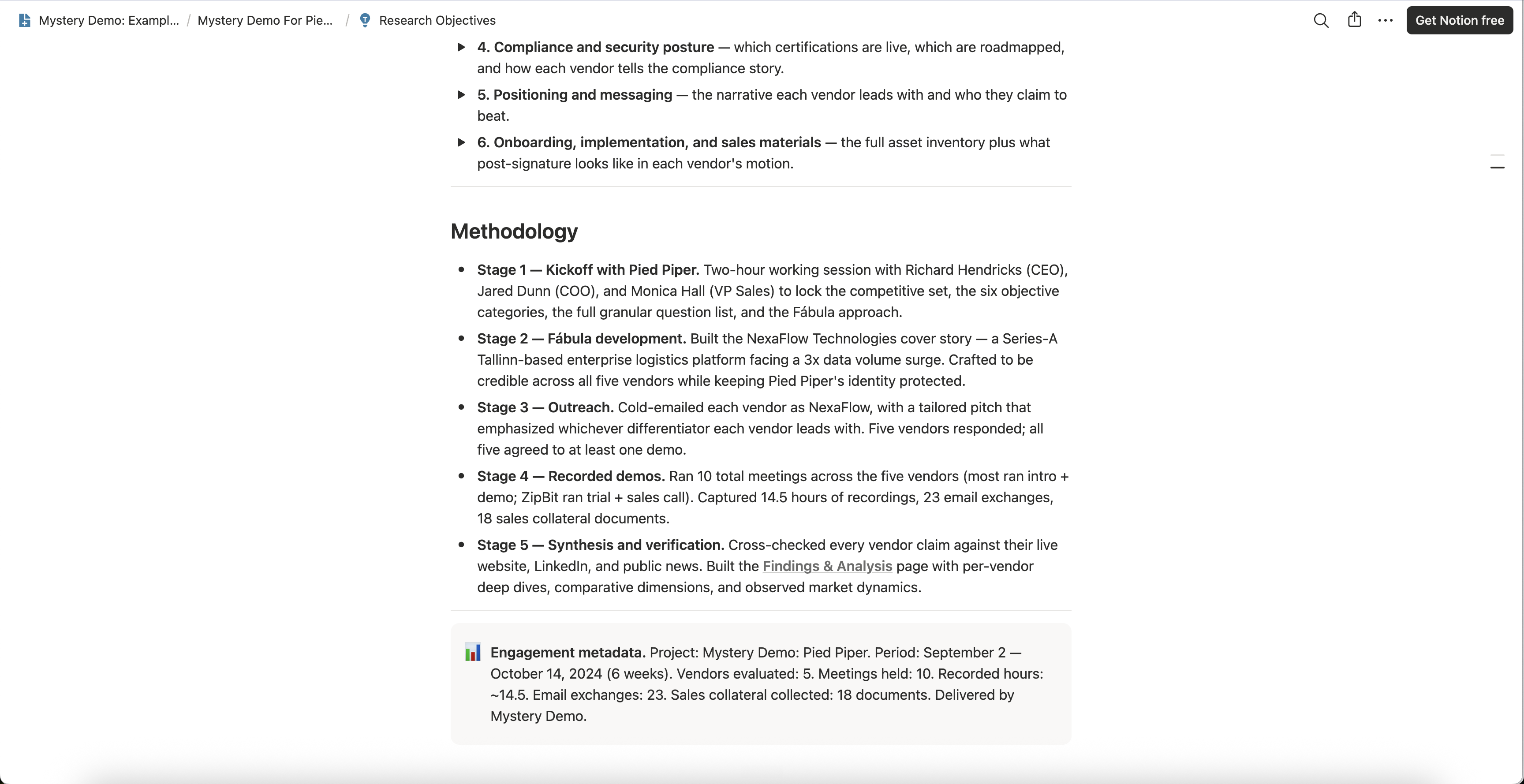
Stage two is where the constant buyer gets built. The rest is the evaluation running in parallel across every vendor in the set, which is why the calendar does not stretch much as the set gets wider. How wide it should get is a separate decision with its own tradeoffs, worked through in how we run a competitive landscape review.
What comes back is a Notion board rather than a summary. The recordings, the transcripts with the moment timestamped, the email threads, the collateral they sent, and one page per competitor.
Above those sit the layers a messaging team lives in. A claim-state table per vendor, and a messaging matrix across the set: what each one calls the category, who they name as the alternative, which comparison they attack, and the subject they never raised.
On top of both, an executive summary that says where each of them wins, which is the page you hand your CEO.
499 euros a competitor, flat, everything included, the scenario, the booking, every meeting, the recordings, the transcripts and the analysis. A single competitor takes a week or two. A full field of ten to fifteen takes four to eight weeks, because the demos run in parallel.
For this kind of work that page is mostly one table. Every claim the competitor makes in public, what state it reached in the room, and the timestamp of the moment it got there or the note that it never came up.
A claim with a timestamp is a claim you can hand to a rep without arguing about it. A claim with an empty cell is a question for the next call.
Which is the other reason the same buyer walks every funnel. Run two conversations with one vendor and the same claim can land in two different states, once demonstrated and once dodged, and that difference is only readable if nothing else moved between them.
This is the work behind our competitor messaging comparison, and the reason it produces a matrix rather than a write-up is that every cell in it was collected the same way.
.png)

What to Do Before You Change a Word
There is a version of this you can run yourself this week, and it costs nothing but honesty.
Take the claim your reps hear most often from your closest competitor. Write it down. Then say which of the three states you can prove it is in, and what you would put in front of somebody who asked you to show your work.
Most teams find they cannot. They have the claim, and they have opinions about the claim, and they have nothing that separates the version that competitor publishes from the version that competitor defends.
That is a completely normal place to be. It is just not a place to reposition from, because a message built against a claim nobody has tested is a message aimed at a homepage.
Somewhere this quarter, a rep at your closest competitor is going to be asked to put their headline claim on a live screen, and they will either do it or change the subject. It will happen in a call you are not on. Tell us whose call to sit, and we will go and be the buyer who asks.
.png)


