
You searched for the best B2B SaaS mystery shopping company. Frankly, it is us, and we can vouch for exactly one firm in this category: the one we run.
Mystery Demo is a team of SaaS professionals who know software inside out. We book your competitors’ sales demos as a credible buyer, ask the questions that get real answers, collect everything that matters, and turn it into expert analysis on one board, for a flat €499 per competitor.
Only a few firms do this work for software companies at all, and we respect the others. Here is the frank case for ours: the people behind it, how much of this work we have done, our process and framework, and what you get at the end, so you can check every claim before you hire anyone.
Only a Few Firms Run Mystery Shopping for SaaS
Search for mystery shopping and most of what comes back is retail: firms that send shoppers into stores, restaurants and bank branches. That is a real trade, and it is not this one. Retail and B2B mystery shopping share a name, but one checks a store against a list and the other puts a buyer in a rival’s software demo.
Mystery shopping for B2B SaaS is a much smaller field. Besides us, a handful of firms offer it to software companies, and we respect them. Their own pages describe their people as trained analysts or as professionals recruited for each project, and software is one of several sectors they serve.
Prospects who evaluated those firms before coming to us told us the people there are not sales professionals, have no background in B2B SaaS, and know very little about how software is bought and sold.
That gap matters more in software than anywhere else, because a SaaS rep’s first call is an interview of the buyer. Before showing a single screen, the rep wants to know:
A buyer who goes vague on those questions often still gets a demo, usually the standard tour with the list price. So ask any provider who will be talking to that rep, and how much that person knows about software.
SaaS Professionals Who Know What to Ask
Mystery Demo is run by B2B SaaS professionals who have sold software themselves, and it is the only firm in this space we know of with that background. We have spent more than a decade in marketing and go-to-market, including at some of the largest software companies in the world, and we have used hundreds of tools along the way.
That experience shows from the first question. When the rep asks what the buyer runs today, we name tools a company like that would really use and explain why it wants to switch. When pricing comes up, we know which questions move a number, because we have answered them from the other side of the table.
When the demo turns technical, we keep up. Then we ask the question that takes the rep off the script.
.png)

Hundreds of Competitor Demos Behind Every New One
Background gets a buyer into the room. Experience at this exact job is what turns a conversation into findings.
Our team has run hundreds of live competitor demos across SaaS and finished dozens of projects, in hospitality tech, fintech, dev tools, HR and EOR, AI support and more. Clients come back to extend their landscape, and they re-run projects one to three years later to see how a competitor moved.
The pattern recognition comes from that volume. After that many evaluations, we can tell:
Through all of it, no competitor has found out that an evaluation was a mystery demo.
The same experience is why the sales call is our primary source, and public sources are how we check it. A website shows what a competitor wants buyers to believe, and a review site shows what customers felt long after signing. Only the sales call shows what the rep quotes, demos, promises and says about you, and only a buyer gets to hear it.
One call is still one rep on one day. When a second rep repeats the same price or the same line about you, it becomes a pattern worth acting on, and finding those patterns is what most of our analysis is for.
Our Process, From Kickoff to the Board
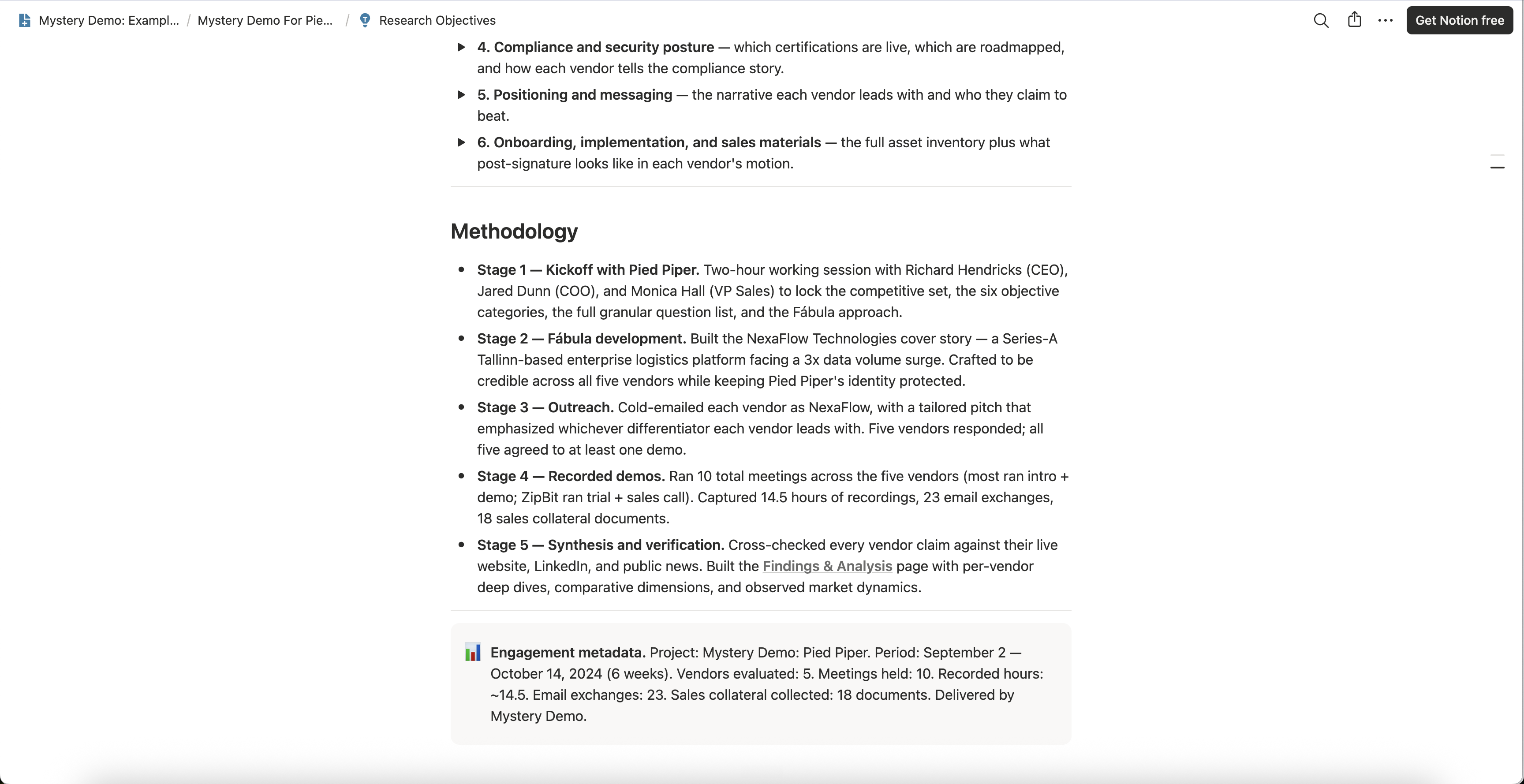
Every Mystery Demo project runs the same five stages:
Nobody real is ever impersonated. The people running the evaluation are who they say they are, and the only invented part is the company they are evaluating for.
Below is the Research Objectives page from Mystery Demo’s public example board, where the client and every competitor are invented. A real project’s board is built from that client’s own calls, and this page lays out the same five stages in order.
Our Framework: The Buyer We Build and What We Capture
The process is the order of the work. The framework is what goes into it, and it has two halves.
The buyer. Every fábula is built from six elements: industry, headquarters, team size, funding stage, current tools and reason to switch, and decision timeline. We fit each one to the competitor’s ideal customer, so an enterprise vendor meets an enterprise buyer and a tool built for small teams meets a small team.
What we capture. Every conversation is read against the same six subjects, so competitors line up side by side: pricing, product, compliance, references, onboarding and the sales process itself. The Findings & Analysis page compares every competitor on each of them, and five sections pull the answers together for the teams who use them:
For a product question, the feature matrix is the page to read, and it is the core of our competitor product comparison work. Here is one of those comparisons on the invented example board: each competitor’s headline claim beside the range the demo verified, and how it was shown.
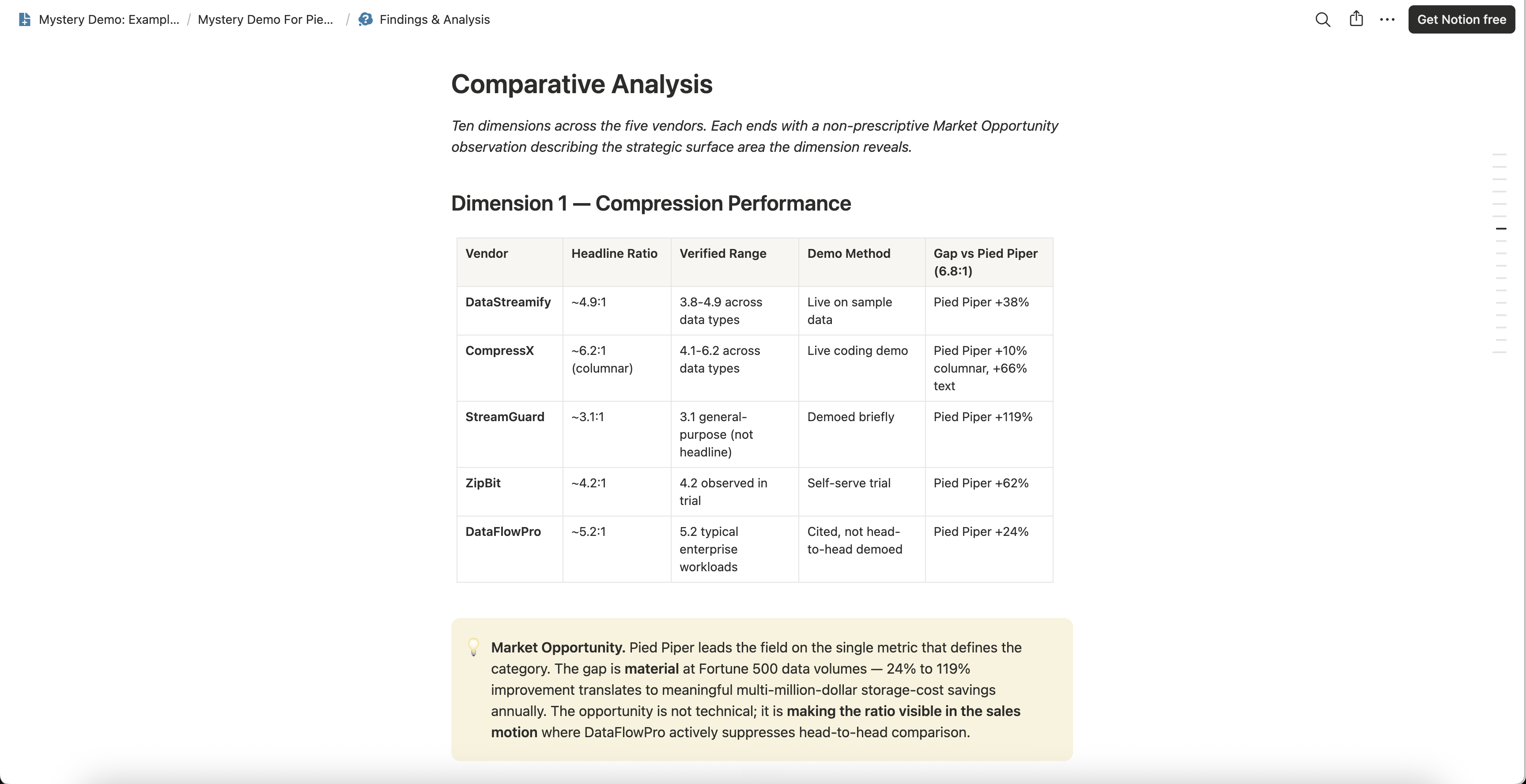
The column that matters is the one beside the headline. A number a competitor only cited and a result it showed working in front of a buyer are different evidence, and the board never lets one pass for the other.
What You Get, and How It Reaches You
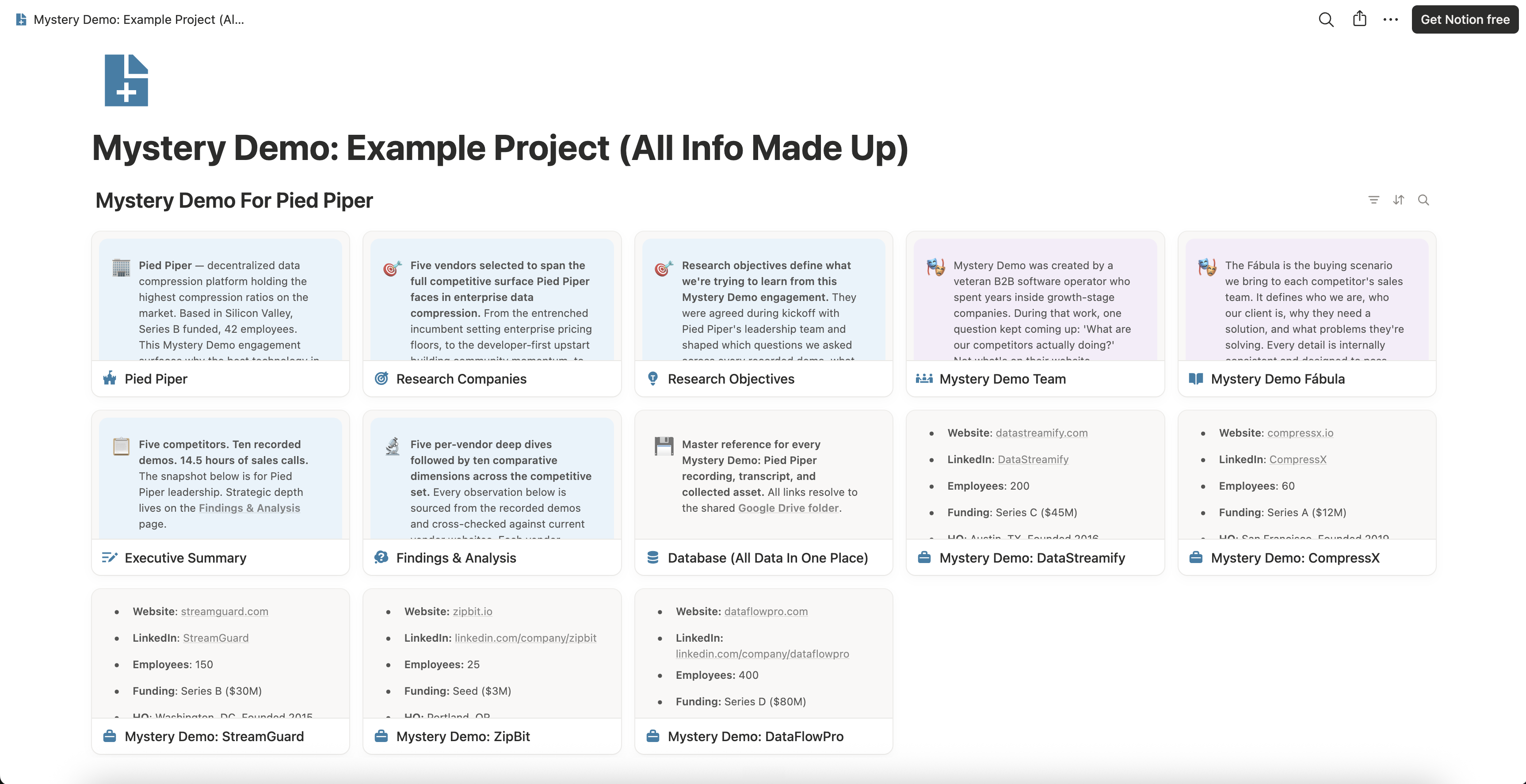
Everything lands in one shared Notion board. It holds your profile and objectives, the competitors and why each was chosen, the fábula, a page per competitor, a database of every recording and transcript, the findings and analysis, and an executive summary for leadership.
This is the front page of the invented example board, with every page of the project laid out as a card.
The demos run side by side, and each competitor’s analysis lands on the board as soon as its calls finish. You do not wait for the last competitor before reading about the first.
Each competitor’s page opens with its most important insights and names what they were built from: the meetings, the minutes of recording, the collateral the rep sent, and the public checks. Here is that layer for one competitor on the invented board.
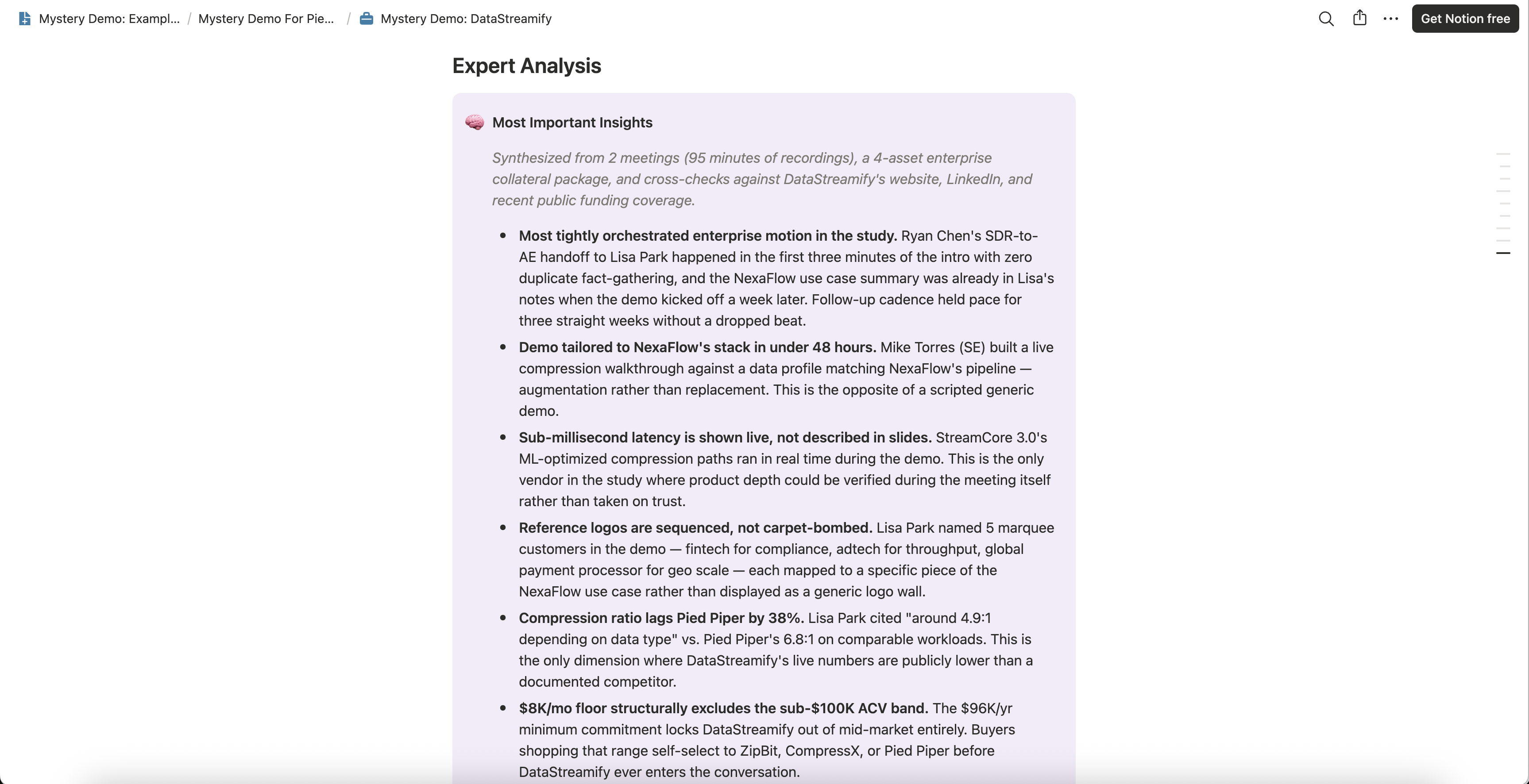
Underneath every insight is the recording, transcript line or email it came from. Your team never has to take our summary on trust.
One competitor costs a flat €499, with everything included: the buyer, every call, the recordings, the transcripts, the analysis and the board. It takes one to two weeks, and a full landscape of six to fifteen competitors takes four to eight.
Pick the competitor your reps lose to most. Tell us who it is on an intro call, and its page on your board will be done in one to two weeks.
Mystery Demo Next to the Other Firms
Set the options side by side, and the difference is in the second column: who runs the evaluation.
| Option | Who runs the evaluation | What you receive | Price and time |
|---|---|---|---|
| Mystery Demo | B2B SaaS professionals with more than a decade in marketing and go-to-market; the same buyer from the first email to the last | One Notion board: recordings, transcripts, analysis per competitor, the side-by-side comparisons and an executive summary | €499 per competitor, everything included; one to two weeks each, four to eight for a landscape |
| The other firms that run this for SaaS | Trained analysts or professionals recruited per project; by prospects’ account, not SaaS sales people | A first-hand account of each competitor’s sales process, with analysis to the scope you agree | Quoted per project after a discovery call; no published turnaround |
| Your own team | You or a colleague, under your own name | Your notes, and the tour a rival gives a buyer it may recognize | Your team’s hours on every call and email |
The other firms do careful work, and where a project reaches outside software, they cover ground we do not. For a software sales process, though, that column decides the rest, because a buyer the rep doubts gets a shorter evaluation, and nothing downstream can add back what was never said.
Running it yourself is the other honest option. You know your product best, and you are also the buyer a rival is most likely to recognize, by your email domain or your face on the screen.
Our own row has limits too. If a rival never says it on a call or shows it in a demo, we cannot hand it to you, and we see a competitor’s sales-facing side, never its internal roadmap.
So whichever firm you talk to, ask who exactly will run your evaluations, and what they know about software. Ours are SaaS professionals with more than a decade of selling and marketing software behind them, and that answer is why the one firm we vouch for is ours.
Bring us the competitor you most need to understand, and our team will go through its sales process as the buyer, from the first email to the written quote.
.png)


