
When a buyer asks your rep about a competitor, the answer that keeps the buyer’s trust is a fact about what that rival offers, says or charges, with its source and its date. The answer that costs that trust is an opinion with nothing under it, like “they overpromise” or “they cut corners.” Reps reach for the opinion when they have no checked fact to give, so the fix is facts about each rival, verified before the buyer asks.
For an enablement lead, the fix has two parts: teaching reps what a fair, specific answer sounds like, and getting them the facts it needs about each rival. Mystery Demo does the second part. Its team books competitors’ real sales demos as a credible buyer and records what each rival offers, says and charges, so your reps can answer with what the rival told a buyer.
Buyers already treat a rep as the place to check what they have heard. In a Gartner survey of 645 B2B buyers, run from August to September 2025, 69% said they prefer to validate AI-generated insights with a sales rep. A question about a rival puts the rep’s own answer up for the same check, and one sales leader on LinkedIn calls it “a trust test.”
Five Buyer Questions About Competitors, Answered Two Ways
Each row below takes a question a buyer might ask about a rival and answers it twice. Every answer is invented and composite, and the months are there only to show where a date goes.
| The buyer asks | The weak answer | The strong answer |
|---|---|---|
| “How are you different from them?” | A list of features, awards and years in business | “For the reporting problem you described, the difference is who builds the reports. In their March demo, custom reports were a job for their services team. Your team builds ours in the product, and I can show you now.” |
| “They say they sync with our CRM. Do you?” | “They overpromise.” | “Yes, and I can show you our sync now. On their calls in March, they said two-way sync is coming later this year, so ask them for the date.” |
| “Why are they cheaper?” | “They cut corners.” | “Their quote in March for a team of 40 covered the core plan and email support, and onboarding was extra. Ours includes onboarding, so let’s compare the two totals.” |
| “What do you think of them?” | “Honestly? They’re a mess.” | “Their dashboards looked strong when they demoed them in March. For what you told me you need, I’d weigh approvals more, and here is how we handle approvals.” |
| “Someone told me you’re hard to implement.” | “That’s just their sales pitch.” | “Here is our onboarding plan for a team your size, and a customer you can call about it. If a competitor told you that, ask them what their own plan includes.” |
Each strong answer takes the question as asked, names a fact the buyer could check, and ties that fact to what this buyer needs. Each weak answer asks the buyer to take the rep’s word for it. The facts in those strong answers come in four kinds, and each kind proves something different:
Buyers weigh what a rep tells them, and they weigh it with some suspicion. In the same Gartner release, 51% of buyers said they are more likely to run into misleading information from generative AI, and 49% said the same of a sales rep. A dated fact holds up under that suspicion, because the buyer can check it.
Good reps object at this point. The buyer asked what the rep thinks, not what the rival quoted.
A Rep’s Opinion Helps When It Rests on a Fact
A buyer often asks about a rival because your rep knows the market, and what they want is an expert’s view of fit. A rep who recites dated facts and stops holds back the one thing the buyer asked for. The objection is right, and a rep should give the view.
The view holds up when it rests on a fact and is said as a view: “For a team like yours, I’d weigh approvals over dashboards, and here is why.” In the fourth row of the table, the demonstration is the evidence, and the rep offers the view on fit as their own judgment.
The view falls apart when it rests on nothing, or when it turns into an attack on the rival. One LinkedIn post on trash-talking a competitor describes the client left feeling “judged for a decision they may have helped make.”

Every strong answer starts from a fact, the opinion row included, and four of the five need a fact about the rival. For an enablement lead, the harder question is where a rep gets one.
Where a Rep Gets a Fact About a Competitor
Take the third question, “Why are they cheaper?” The strong answer needs what the rival quoted a buyer like this one, and what that quote covered. The rival’s website may show a starting price, but not the quote its rep gave or what that quote left out.
| The fact the answer needs | What the rival’s website shows | What the rival’s sales call shows |
|---|---|---|
| The price for a team this size | A starting price, or “contact sales” | The number the rep quotes after asking about seats and timing |
| What the price covers | A grid of plans and features | What is included, what costs extra, and what the rep offers to close |
| When a feature arrives | “Coming soon,” or nothing | The timing the rep gives a buyer who asks |
| How setup works | A promise that you will be live fast | The onboarding plan the rep describes, and who does the work |
A website and a tracking tool show what the rival chose to publish, and a review site shows what some customers chose to say. Everything in the right-hand column is said out loud to a buyer, and nobody from your team hears it. Mystery Demo exists to be that buyer.
A mystery demo is a genuine evaluation of the rival’s product, done for a client, and the rival’s rep never learns which client. For the price question, the team writes a buying scenario fitted to what that rival sells, down to the team size and the timeline that set a quote. It books through the rival’s normal front door and takes every call, from discovery to the pricing conversation, where it asks what the number includes.
Nothing from the evaluation is left to memory:
Everything the team gathers comes back on a Notion board, a shared workspace with a page for each rival. The page below comes from the example board we publish, which is invented from the client down to every rival. A client’s own board is built from the calls run for that client.
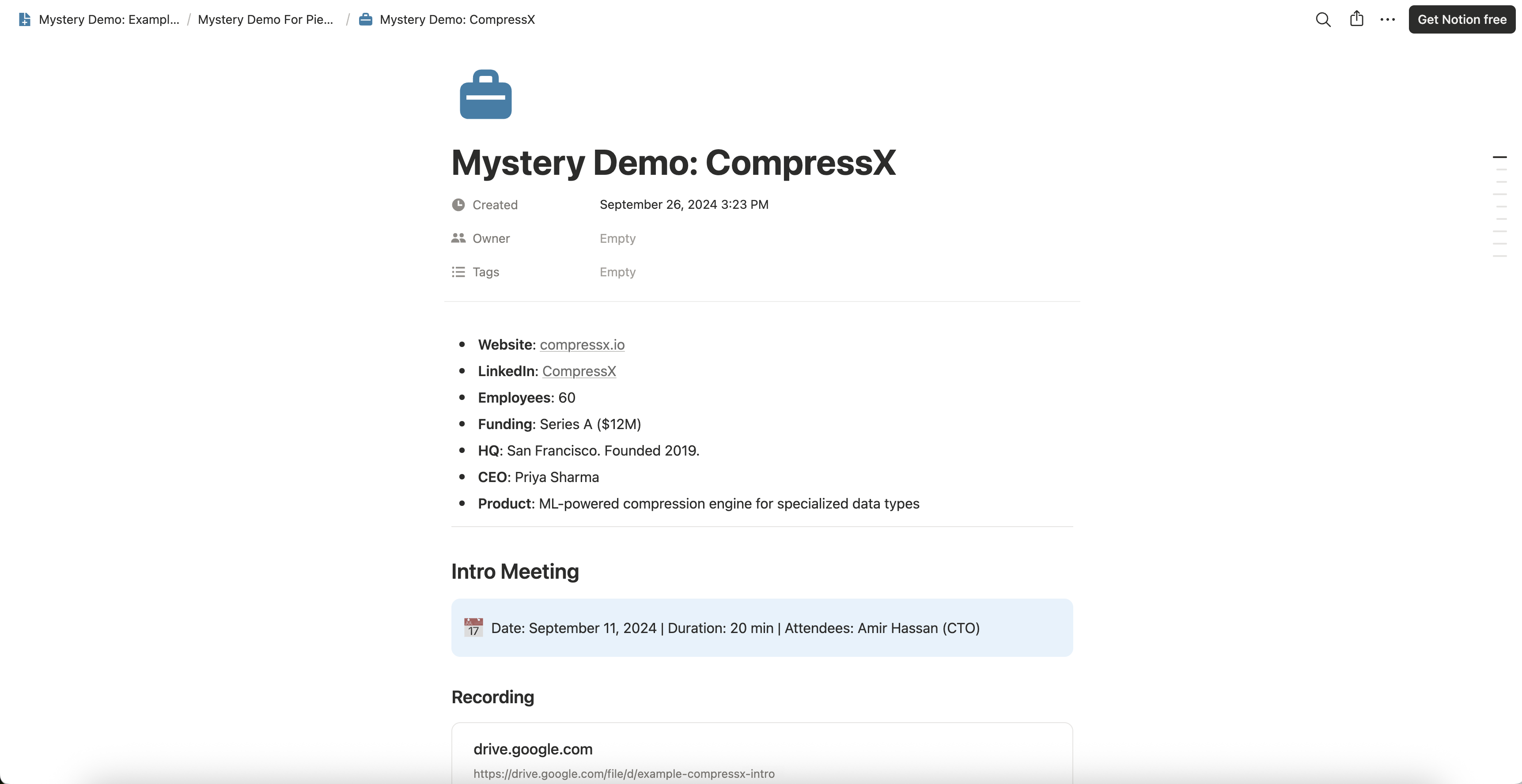
The page starts with who the rival is, then logs the meeting and holds its recording, so the evidence behind any fact on it is one scroll away.
What Your Reps Get From a Rival’s Sales Call
The quote and what it covered go on that rival’s page, with the minute the rep said them. Further down, the page carries the expert analysis: what the calls amount to, written up by operators who have sold B2B software. In the capture below, the rival and its insights are invented, and the line at the top is the part every real board shares.
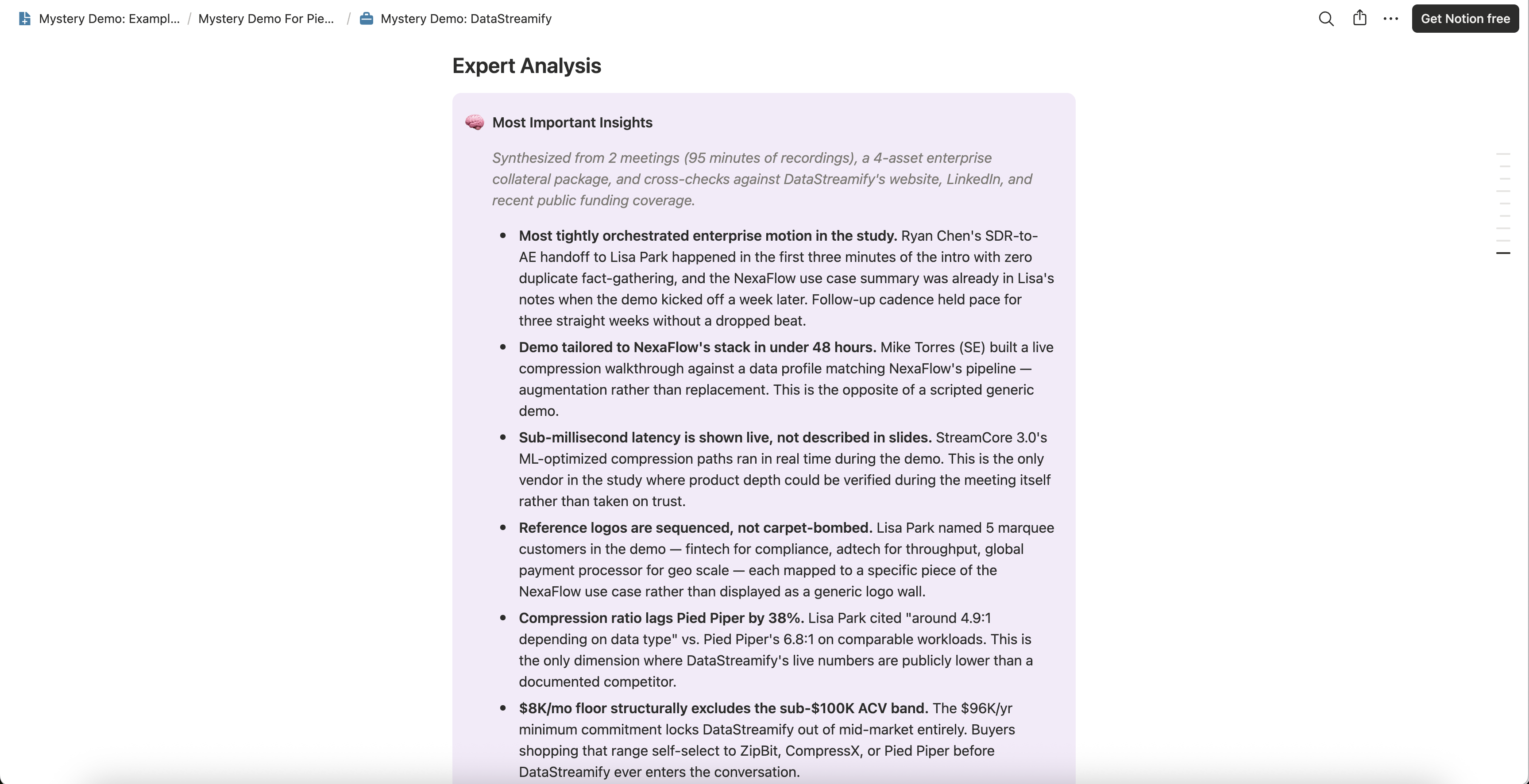
That line names what the analysis was built from: the recorded meetings, the documents the rival sent, and the checks against its website, LinkedIn and public news. It lets your team weigh each conclusion against the calls that produced it. Those pages then feed the battlecards, where everything a rep can say about a rival links to the recorded moment behind it.
For the price question, the battlecard entry reads like the third strong answer in the table: what the rival quoted, when, what the quote covered, and how your rep answers it. Reps carry those entries into calls on an objection card, a one-page sheet kept open during the conversation. On the example below, every rival and line is invented, and the last column marks which kind of fact each one is.
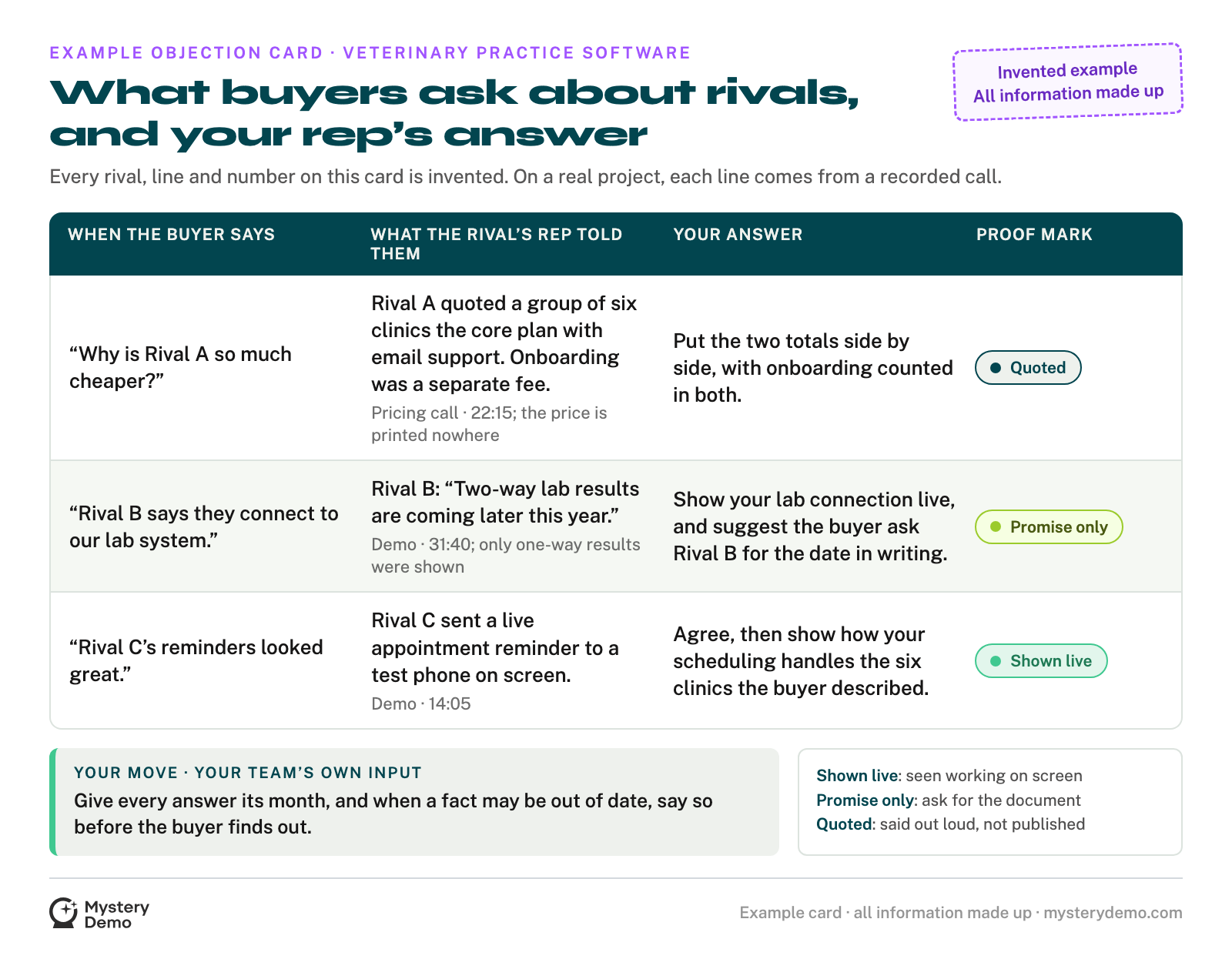
Battlecards built this way, with every entry tied to a recording, are what SaaS competitor battlecard research delivers for each rival you name. Your team could take a rival’s demo itself, but the rival’s rep would spot a competitor’s email on the invite. Your reps would then learn the tour everyone gets, not the answers buyers hear.
Mystery Demo hears what a real prospect hears, for three reasons:
One rival costs a flat €499, everything included, and its page is ready in one to two weeks. A full landscape of about six to fifteen rivals takes four to eight weeks, because the demos run in parallel and each page lands as its calls finish.
Name the competitor your buyers ask about most in a short intro call with us. We will bring back what it offers, says and charges a buyer like yours, every fact tied to the minute it was said.
One call is what one rep told one buyer on one day. When a second call at the same rival, with a different rep, brings the same answer, it starts to look like the company’s line rather than one rep’s. Your reps should say which it is, and that is where training starts.
How to Train Reps to Answer With Facts
Facts on a board change nothing until reps can say them out loud. The training starts from your own calls:
The practice is the step that slips. In an April 2026 survey of 101 product marketers at mid-market and enterprise B2B SaaS companies, run by the research firm Wynter, 37% said sales mostly ignores or freestyles around their competitive content, and 33% said sales uses it consistently. A rep freestyling about a rival is working from memory, which is where opinion creeps in.
A fact also ages, and how long competitor intel stays accurate depends on what it is about. When a rep cannot be sure a fact is still current, the honest answer keeps the date in plain sight:

A rep who badmouths a rival is usually a rep with nothing checked to say about it. Give that rep a recorded, dated answer about what the rival charges, and they will reach for it before they reach for “they cut corners.”
The first step is a short list: the three rivals your buyers ask about most, and the questions they ask about each. Talk that list through with us, and we will put those questions to each rival’s rep as the buyer, then hand back every answer with its recording.


