
Your competitors talk in public all the time. Their founders post, their executives go on podcasts, and their employees comment in threads your team reads. Social listening means following all of it, and it gives you the message each rival chose to send.
Your reps compete with a different message. It is what the rival’s rep tells a buyer on a sales call, with a price on the table and your product in the conversation. If you follow rivals in public, the question is how much of that sales call your listening can show you.
Mystery Demo hears the call firsthand. Its operators have sold B2B software themselves, and they book your rival’s real sales demo as a serious prospect would. You get every call recorded, on a board with an analysis of what the rep said, showed and quoted.
| Compared on | Social listening | A mystery demo |
|---|---|---|
| What it shows | The message the rival chose to publish | What its rep tells a buyer, with a price on the table |
| Who hears it | Anyone who follows the rival | One buyer, asking that buyer’s own questions |
| What it misses | How reps answer a buyer’s questions about price, fit and you | What the rep did not say to that buyer, and the rival’s internal plans |
| Effort | Low and ongoing: your team’s reading and listening time | A flat €499 per competitor and one to two weeks, with the work done for you |
| Proof | The exact words, dated; any strategy read into them is your inference | A recording behind every finding, with the minute it was said; one call is one rep and one buyer |
| How current | Continuous, as the rival publishes | Dated to the call, and run again when the public message changes |
What a Rival’s Posts and Podcasts Tell You
Social listening is cheap, and it never stops. Every post, episode and comment is dated, and the words are exactly the ones the rival picked. Read closely, a rival’s posts and episodes show you:
One SaaS founder went further, in a post on X: “If your competitors build in public or run podcasts, you have a massive edge: they’re telling you their strategy for free.”
The same post is more careful than that line. It goes on to share a prompt for an AI assistant. That prompt asks for stated fact to be kept apart from inference, and it ends by asking what should be verified.
That caution is the honest limit of social listening. A rival publishes what it decided to publish, so any strategy you read from it is your inference, however well made. And none of it shows what the rival’s reps say when a buyer pushes back.
Your Own Sales Calls Hear the Rival Secondhand
If the posts are the rival’s chosen message, the natural check is your own sales calls. In April 2026, Wynter, a company that sells B2B audience research, asked 101 product marketers at mid-market and enterprise B2B SaaS companies where they get competitive intelligence. Their own sales calls were the most common answer, at 44%, and social media came in at 24%.
Those calls are popular, but on them you hear about the rival secondhand. When a buyer repeats what the rival promised, you get it in the buyer’s words, and only if the buyer brings it up. One product marketer on Reddit, writing about the competitor monitoring they had stopped doing, put the gap this way: “Reps get beaten by whatever the competitor says about us in the room and none of that was ever a public information.”
That leaves the call between the rival’s rep and that same buyer, and nobody from your side is on it.
Where the Message Meets a Buyer’s Questions
That call is where the rival’s public message gets tested. A post says the same thing to everyone who reads it. On a sales call, the buyer asks how the new positioning fits a team their size, what it costs, and how it compares with you, and the rep has to answer on the spot.
That answer is the version of the message your reps run into. Nobody on your team can hear it from a desk, because it is only ever said to a buyer. Mystery Demo exists to be that buyer.
A mystery demo is a genuine evaluation, and the one thing kept from the rep is which company it is for. It runs the way a real evaluation does, from the first step to the last:
Questions about the rival’s public claims go into the evaluation where a buyer would naturally ask them. Every call is recorded.
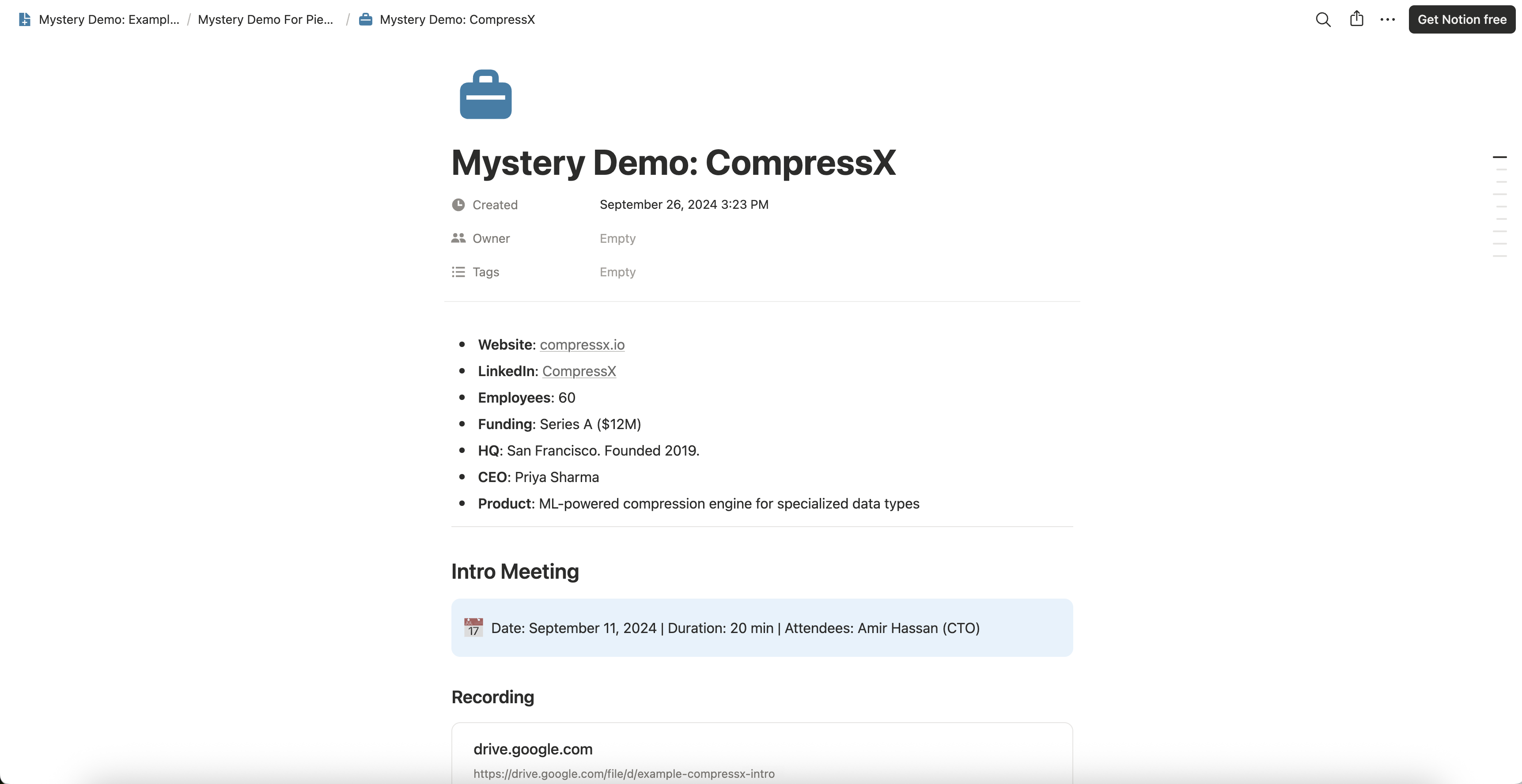
All of it lands on a Notion board, a shared workspace with one page per rival. Each client’s board is built from the calls run for that client, so the page below comes from our public example board, where the client and every competitor are invented. It opens with the rival’s basic facts, then the intro meeting with its date and length, then the recording of the call.
What Comes Back From the Rival’s Call
Each rival’s page holds the evidence: recordings, transcripts, emails, and an expert analysis of what the rep said. Then a page called Findings & Analysis sets the rivals side by side, one dimension at a time.
The part you will use most is the messaging matrix, a table that records, for every rival:
Each entry carries the rep’s own words and the minute they were said, so a claim reaches your reps with its proof. A competitor messaging comparison sets that out across every rival you name.
On the example board, those entries add up in the Strategic Observations section of Findings & Analysis. It opens with the threat each rival poses in the field, and the story each one leads with.
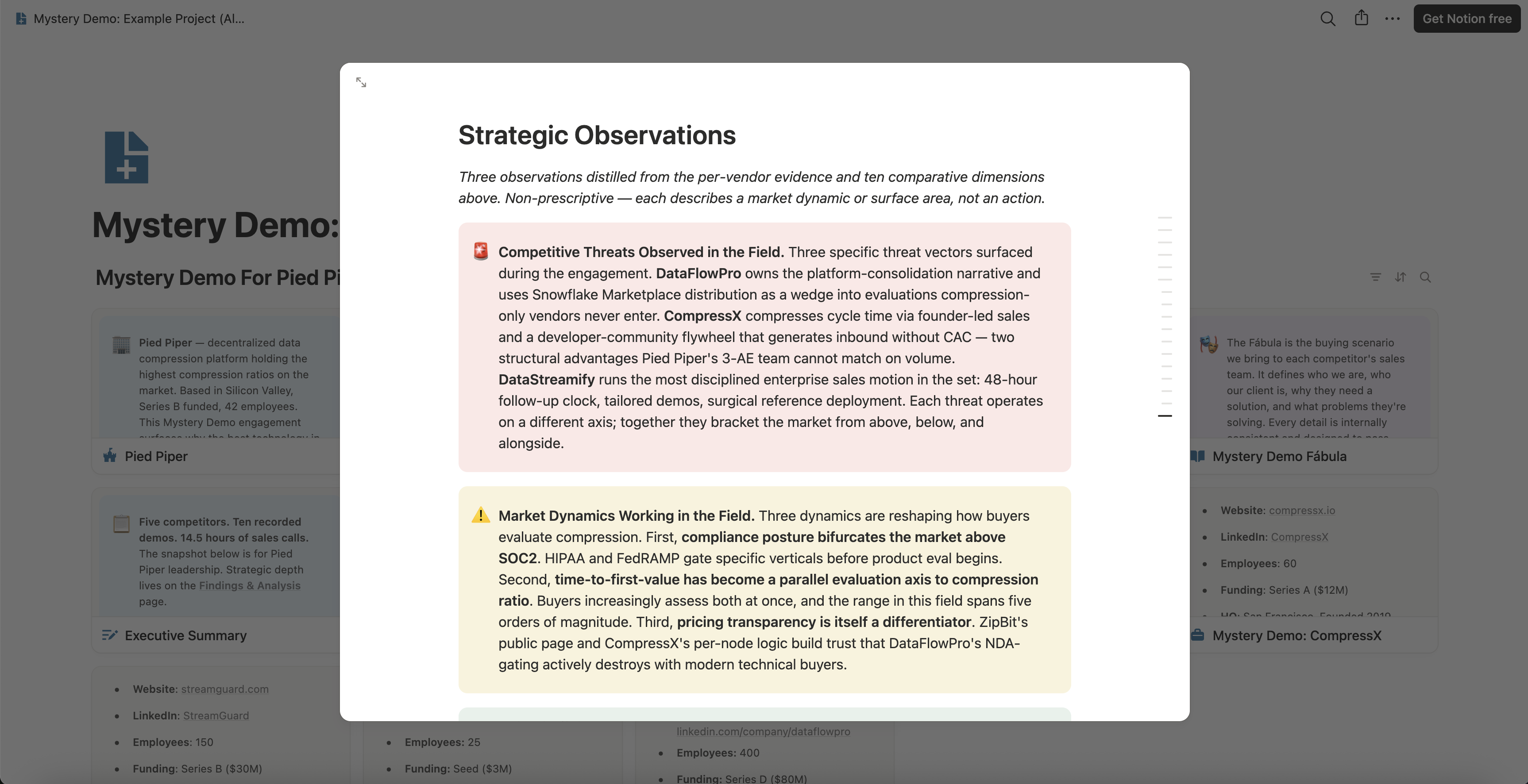
The rivals in that capture are invented, and so is every claim about them. The shape is the real part: each observation names a rival, says what it leads with, and traces back to the calls it came from.
Why Not Take the Demo Yourself?
You could, and you would hear the rival’s rep firsthand too. It costs your team’s hours and a sign-up under your own company’s name. A rep who recognizes a competitor, or never quite believes the buyer, gives the generic tour.
Three things separate a mystery demo from that:
One rival costs a flat €499, everything included, and its page is ready in one to two weeks. A full landscape, about six to fifteen rivals, takes four to eight weeks. The demos run in parallel, and each rival’s page lands as it finishes.
One call is what one rep told one buyer on one day. When a second rep at the same rival gives the same answer, it becomes a claim about the company, and one your reps can plan around.
How to Turn a Rival’s Posts Into Questions for Its Rep
The questions worth asking on those calls come from the posts. Social listening tells you what to ask, and the call tells you whether the rival’s reps say it to buyers.


In practice, the routine has five steps:
One team on Reddit already works this way. In a thread on passing along a competitor move nobody had confirmed, a reply set out its rule: “we tag every item signal, likely or confirmed, and only confirmed goes into battlecards.”
Say a rival’s founder announces a new positioning on a podcast. On the call, the rep leads with the old pitch and mentions the new one only when the buyer asks about it. The podcast told you what the rival wants to be, and the call tells you what its buyers hear this month.
Bring the posts your team has been collecting on one rival to a first conversation with us. We will turn the claims that matter into a buyer’s questions, put them to that rival’s rep, and send back each answer with its recording.
When to Add the Sales Call
Keep following your rivals in public. It is cheap, it never stops, and it tells you what each one wants the market to hear. It can’t tell you what your reps face in deals, because that is said to a buyer on a sales call.
The call is worth adding the moment a public claim starts to matter to your deals:
You already have the public half of the picture. Start with the rival your team watches most closely, and we will take the call its posts can’t reach, as the buyer, so its rep’s words sit beside its founder’s.


