
A competitive pilot can go well and still lose the deal. One seller, writing on LinkedIn about a successful pilot that never closed, traced it back to the start: “No one had agreed upfront” on what success would lead to.
If you are heading into a pilot against a competitor, you can set it up in three moves:
The second move is the hard one, because the competitor’s reps state that offer on sales calls, where nobody from your side is listening. Mystery Demo books the competitor’s real sales demos as a credible buyer heading toward a pilot, and brings back every term the rep offers, with the recording.
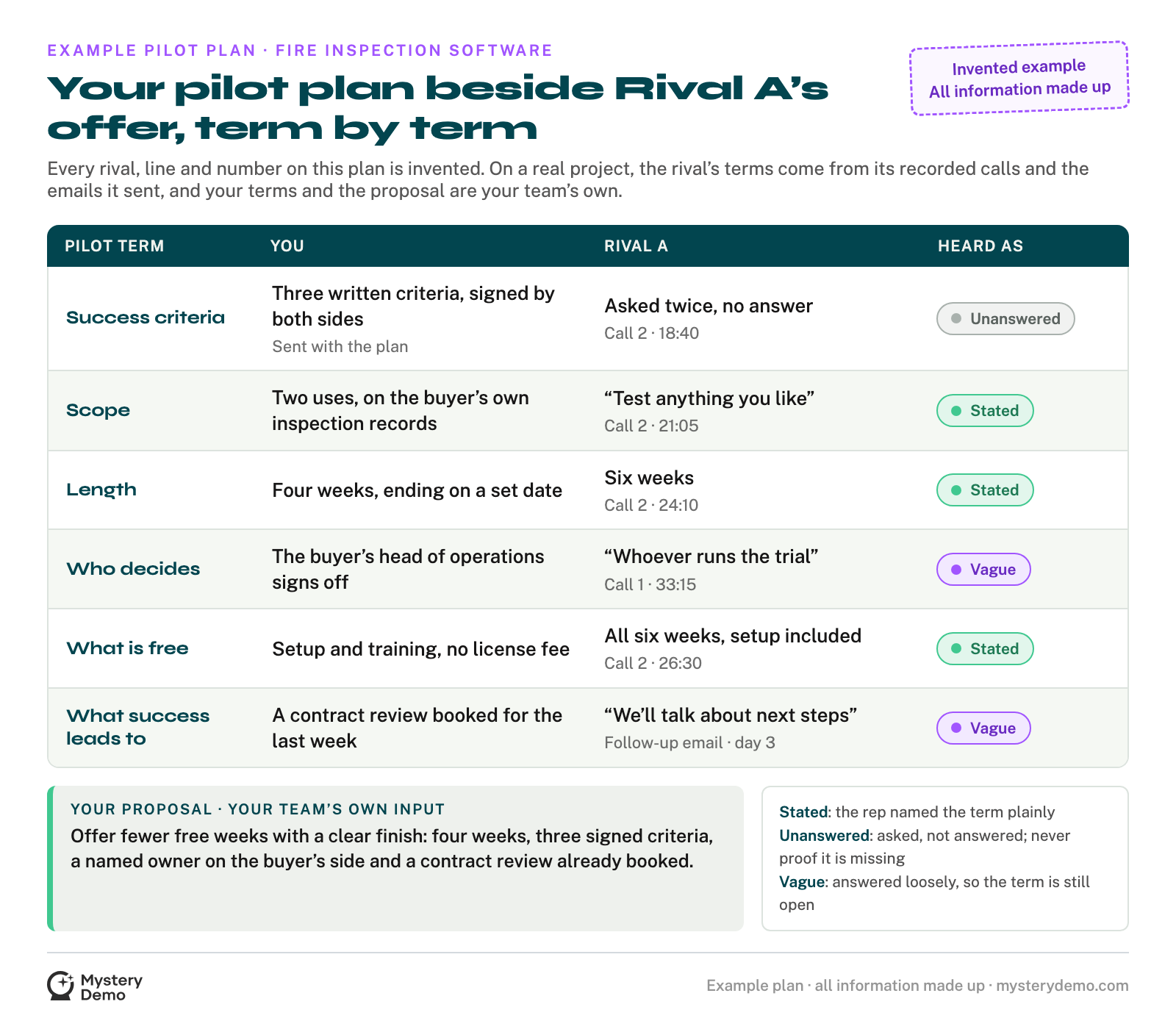
Here is a plan filled in for an invented rival. Your terms sit beside the offer its rep made, and each of the rival’s terms is marked for how plainly it was said.
Write Your Pilot Terms Before Anything Is Installed
A pilot, or proof of concept, has the same few terms whoever runs it. Write each one down with the buyer before the work starts, because a term nobody wrote down gets settled at the end of the pilot, when you have the least room to bargain. One seller’s advice on LinkedIn covers the whole step: “Before you start, agree on what happens if the POC succeeds.”
| Pilot term | What to push for | What to learn about the competitor |
|---|---|---|
| Success criteria | Written, measurable criteria that both sides sign | Whether its rep proposes criteria, and who writes them |
| Scope | The few uses your product proves best, on the buyer’s own data | What its pilot covers, and what it leaves out |
| Length | A fixed end date | How long its rep says the pilot runs |
| Who decides | A named person who can say yes, and an owner on the buyer’s side | Who its rep asks to bring in |
| What is free | What the buyer pays for, if anything, and what each side puts in | What its rep gives free, and what it asks in return |
| What success leads to | The next step, agreed before the pilot starts | What its rep says happens after a good pilot |
The pushes in the middle column are not new advice. A recruiting firm’s guide to hiring a first solutions engineer puts the first one bluntly: “A POC without written success criteria is not an evaluation.” A head of sales who stopped offering free pilots gave the reason for naming an owner: “A free pilot has no owner on their side.”
For the end date, a growth agency’s guide to proofs of concept suggests two to six weeks. The same guide calls a pilot without its four basic terms “unpaid custom work.”
The middle column is yours to write. The right-hand column is about the competitor, and it starts with what the competitor publishes.
Read What the Competitor Publishes About Pilots
Start with the competitor’s own pages, and copy every pilot term they state into the right-hand column, with the date you read it. Three places are worth the time:
Then mark every row the pages leave open. A page that says “free pilot” has told you the price of the pilot and nothing about its length, its owner or what the rep will ask for at the end. Every marked row is a question for the next step.
A competitor’s pages carry the offer it makes to everyone. The offer its rep makes a buyer heading toward a pilot is said out loud, on a call.
Find Out the Pilot Your Competitor Offers on Sales Calls
A rep can shape a pilot to the buyer in front of them: the length, the scope, what is free and what has to happen next. Your buyer is weighing an offer shaped that way against yours, and that version is not on any web page.
Mystery Demo gets that offer the way a buyer does. Before the first call, the team writes a buying scenario fitted to what the competitor sells: a believable company with a real reason to evaluate, heading toward a pilot. It books through the competitor’s normal front door and takes every call, from discovery and the demo to the pricing conversation and the follow-up.
On those calls, the team asks what a buyer asks before a pilot, starting with the rows you marked:
Every call is recorded, and every email the competitor sends is kept. It all lands on a board, a shared Notion workspace that starts from the client’s questions on its Research Objectives page. The example board shown here is invented down to the client and every competitor, while a real board is built from the questions its client sets.
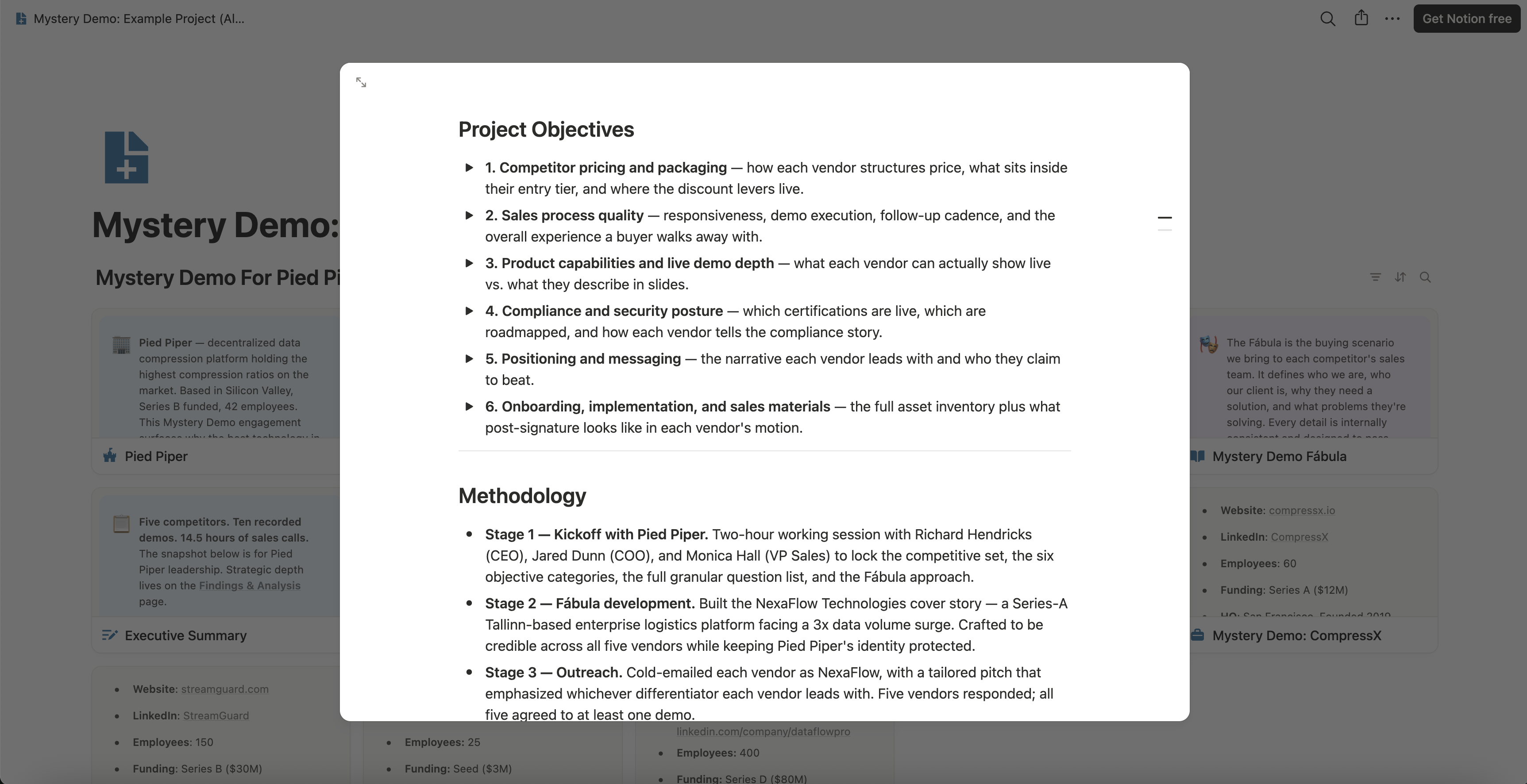
The page lists what a project must answer, from pricing to onboarding. When the question is a pilot, the competitor’s pilot terms become one of these objectives, and the rows you marked become the questions under it.
Your own reps could request the demo themselves. A team that books its competitor’s demo gets recognized from its email domain, or gets the tour everyone gets. Mystery Demo is treated as a real buyer, for three reasons:
What comes back has limits, and for a pilot they matter. It is the offer one rep made one buying scenario on one date, not the terms in your live deal. When a second rep makes the same offer on another call, it starts to look like the company’s standard pilot.
No demo shows how the competitor’s pilots end: whether buyers sign, how many stall, or what the rep gives up in the last week. That stays with the buyers who ran one.
What You Get Back From the Calls
Everything comes back on that board, with a page for each competitor. Each page holds the competitor’s recordings, transcripts and emails, and its pilot offer written up term by term.
Take the length row from the invented example at the top. If the rival’s rep proposes a pilot length on a call, as Rival A’s rep does on the second call, that sentence goes into the length row of your plan with the minute it was said. A follow-up email is cited beside it only when the email repeats the term.


A pilot also tests how each side treats the buyer while it runs. One sales engineer on Reddit describes winning deals where a competitor had the better feature, because the prospect “felt we’d be a better long-term partner” after the POC. The board’s summary page grades the competitor’s side of that, in the sales scorecard from the same invented board.
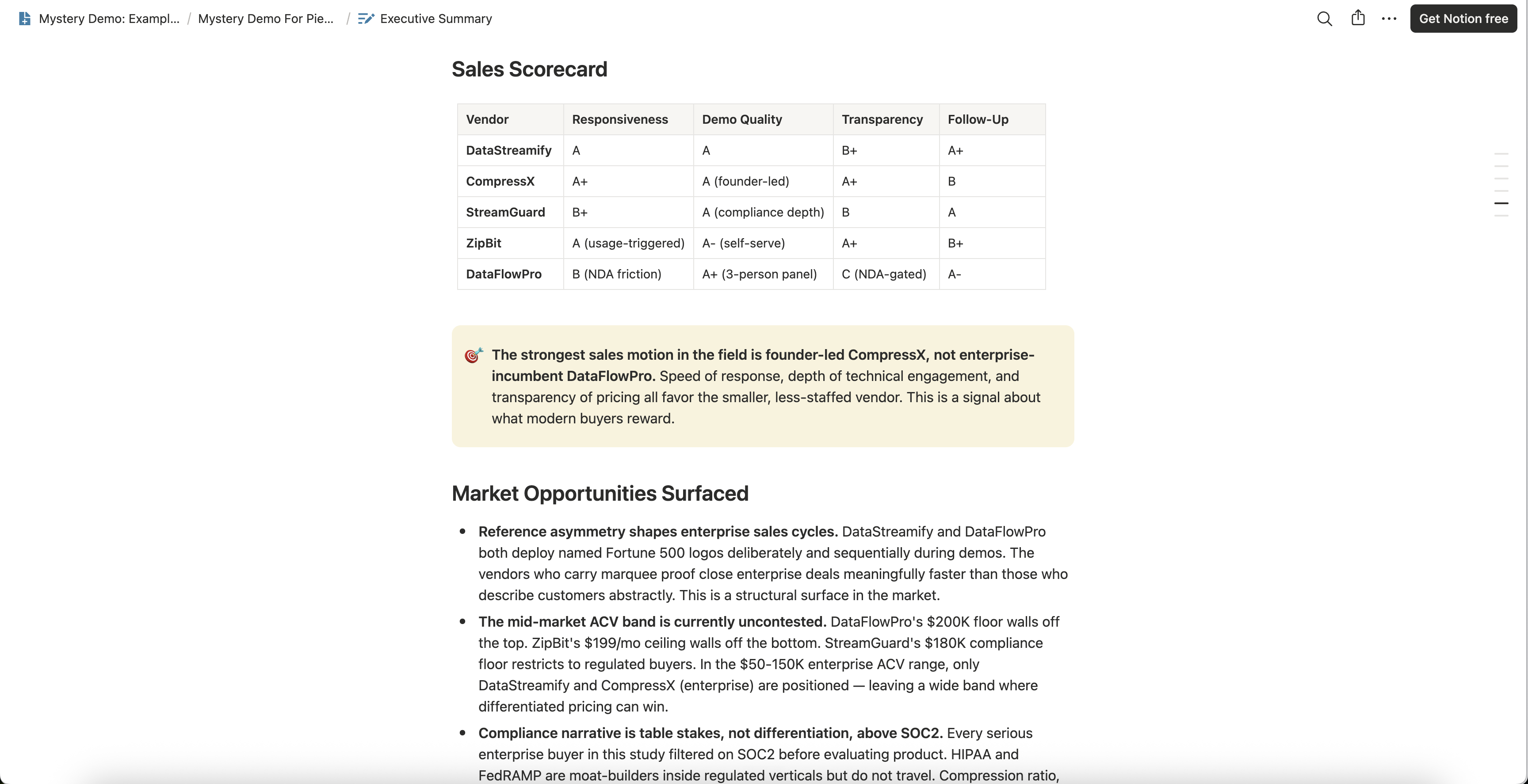
Each competitor is graded on how fast it answered, how good its demo was, how straight it was and how it followed up. Those grades show how it treated a buyer before any pilot began. Competitor sales tactics research grades every step of a competitor’s sale this way, from the first reply to the follow-up, and the pilot offer is one of those steps.
One competitor costs a flat €499, everything included, and its page is ready in one to two weeks. If you know which competitor your next pilot is against, tell us which one it is, and we will bring back the pilot offer its rep makes a buyer in a position like your prospect’s.
Turn What You Learned Into Your Proposal
Whoever fills the competitor’s column, its terms come back uneven, some said plainly and some not. Before you write your proposal, sort each one into one of three groups:
An unanswered term is not something the competitor lacks. It means one rep did not answer, on one call. Never tell a buyer the competitor “doesn’t offer” a term because a question went unanswered.
Then make your proposal clear wherever theirs was unanswered or vague. In the invented plan at the top, Rival A offered a comparable buyer six free weeks and room to test anything. Its rep left the success criteria unanswered, and was vague about who decides and what follows a good pilot.
The proposal on that plan answers each gap:
That proposal offers fewer free weeks, and the last of them ends in a meeting booked to decide.
Where the competitor is more generous, you choose. Match it, or offer less with a clearer path to a decision, and tell the buyer why your shorter pilot ends in an answer. Keep the scope on what your product proves best, even when the competitor offers to test everything.
Send the Plan Before the Next Call
Put your column on one page: the success criteria, the scope, the end date, the owner on the buyer’s side, what is free and the agreed next step. A sales engineer on Reddit, advising a peer on pilots, put the step plainly: “you need to create a POC definition document.”
Send that page to the buyer before the next call, with a short note asking them to sign it:
A signed plan does not win the pilot for you. It means that if the pilot works, both sides have already agreed what happens next, which is what the pilot that never closed was missing.
If the competitor’s column is still empty when you sit down to write it, start with a short call about that competitor. We will bring back the pilot offer its rep makes a buyer like yours, with the recording behind every term.


