
“Your competitor is offering something similar for a lower price. Can you match it?” That is the buyer’s line as one founder writes it, and the right answer is not yet. A discount to meet a rival should be measured against what that rival charges for the same scope, and a number repeated across a negotiating table rarely says what it covers.
Sales enablement and the pricing owner make the rule work between them: enablement supplies the evidence, and whoever approves discounts asks for it. Mystery Demo produces that evidence before the deal needs it. It books your competitors’ real sales demos as a credible buyer, asks for the price the way that buyer would, and records what each rival quotes and what the price includes.
The buyer’s number may well be real. It rarely arrives with what a pricing owner needs to compare it:
The buyer owes you none of those. A pricing advisory firm, writing about the line “We have another supplier offering the same product for 8% less,” put it plainly: “Procurement does not need to prove that the alternative is equivalent.” Some reps fill the silence with a discount anyway, and one sales leader has “seen reps offer 20% off before procurement even asked.”
The rule has one boundary. Where checking would cost more than the discount, approve it as a commercial exception: a choice made for your own reasons, named as one, and never presented as matching the rival.
A Deal Closing This Week Can Still Be Checked
The deal closes on Friday, the buyer is probably telling the truth, and a mystery demo takes one to two weeks for one competitor. All three are fair points. Research will not arrive in time for this deal, and the buyer’s number may be exactly what they were quoted.
A smaller check fits in a day, and it starts with the buyer:
Expect gaps. A seller on Reddit who asked buyers for a rival’s quote put it this way: “we did ask, and they gave us only parts and saying it was the total cost.”
Asking about scope starts the check, and it does not finish it. If the answers leave the number unclear, the discount waits or goes through as a named exception. Research belongs to the next deal against that rival, so the evidence is on file before the next “they’re cheaper” arrives.
How Far to Trust Each Competitor Price
A competitor number reaches a deal from one of five places. None is strong just because of where it came from. Judge it by its scope, date and terms: do you know them, and do they match the deal in front of you?
| Where the number comes from | What it tells you | How far it can carry a discount |
|---|---|---|
| The buyer’s word | A figure, with its scope and date unknown | Not on its own: ask what it includes |
| A quote the buyer shows | Scope, term and date as written, if the copy is whole | As far as its scope matches this deal |
| The rival’s pricing page | A public price for a listed plan, where one exists | As a reference: check what it covers |
| An old quote on file | A known scope on a known date | Only if the scope matches and the price still holds |
| A quote from research | Scope, terms, date and the recording | As far as that buyer looks like this one |
The pricing page looks like the easy row, and it is often blank. In a 2026 survey by Wynter, which runs a B2B research panel, 62% of 50 B2B SaaS leaders said their companies hide pricing behind “contact sales,” and only 10% were fully transparent.
Even a page that shows a price may not show the one a buyer was given. A seller in a Reddit thread on competitive intel put it this way: “Sometimes the competitor is cheaper, but a lot of the time they’re just bundling differently, discounting one SKU, or anchoring higher then giving a dramatic ‘special’ discount.”
Of the five, only the last can be commissioned for a buyer like yours before the deal starts. The others depend on what a buyer brings, what an old deal left behind, or what the rival chose to publish.
The Real Quote Comes Out in the Rival’s Pricing Call
That last row, a quote for a buyer like yours, is said in the rival’s pricing conversation, after its rep has asked how many seats you need, how soon you must decide and what you use today. The pricing page is a public reference at best. The call is where the rival names the number, what it covers and what it would take off.
Mystery Demo gets that quote by being the buyer. Before any call, the team writes a buying scenario for each rival, with a believable company, a reason to buy and a scope sized like your typical deal. Then it requests the rival’s demo through the normal front door and goes through discovery, the demo and the pricing conversation, asking what the price includes and keeping every quote and email.

Everything lands on a Notion board, the client’s shared workspace, with a page for each rival holding its recordings, transcripts, emails and analysis. The page below is from our public example board, where the client and every competitor are invented. A real project’s board is built from that client’s own calls.
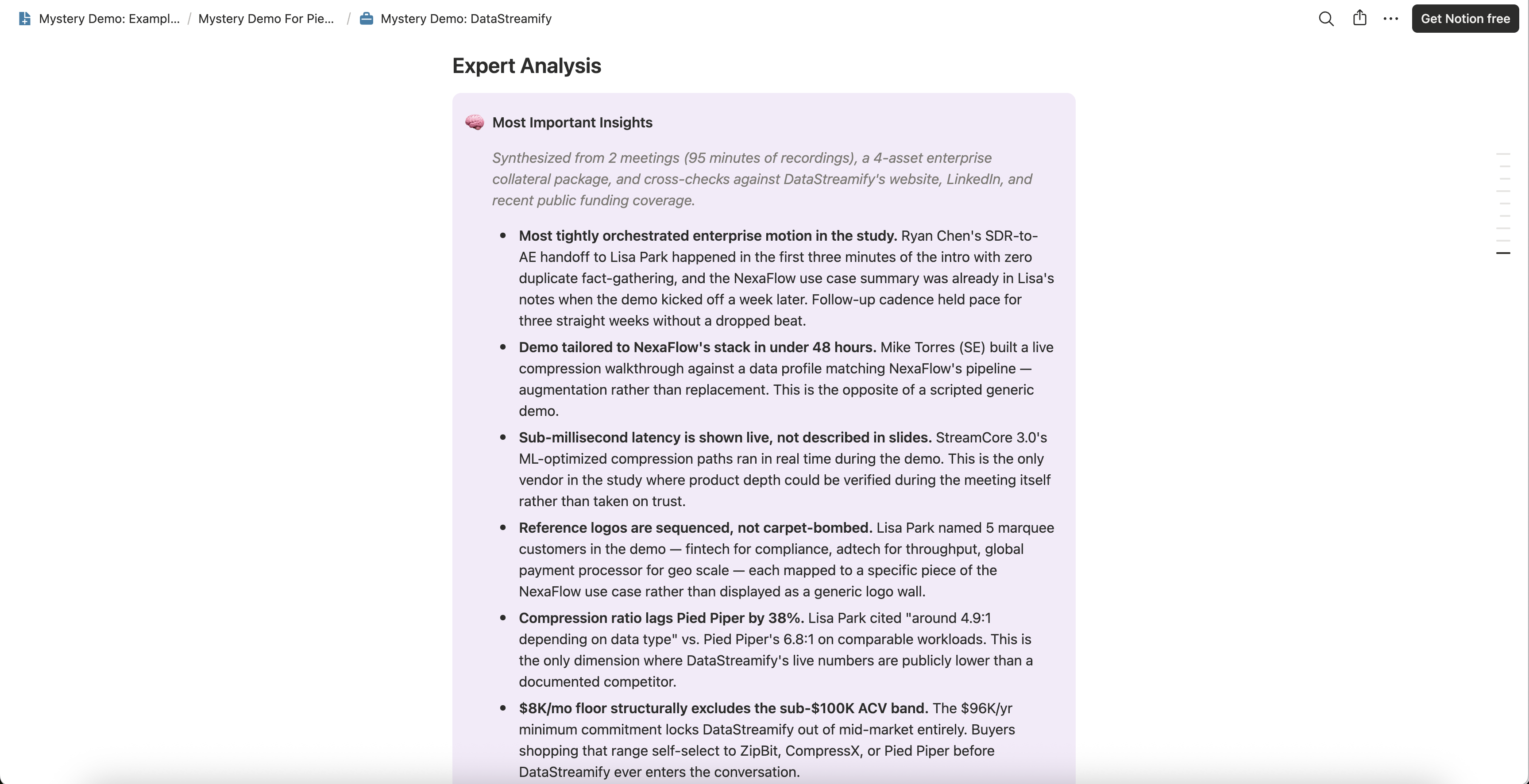
The grey line under the heading says what the analysis was built from: the meetings and their recordings, the sales material the rival sent, and checks against its website and public news. That trail makes a number documented: anyone on the client’s team can go back to the minute a price was said and hear what it was for.
SaaS competitor pricing research gets that kind of documented price from every rival you name. On the board, every rival’s pricing meets in the pricing matrix, the part of the Findings & Analysis page that sets out, rival by rival:
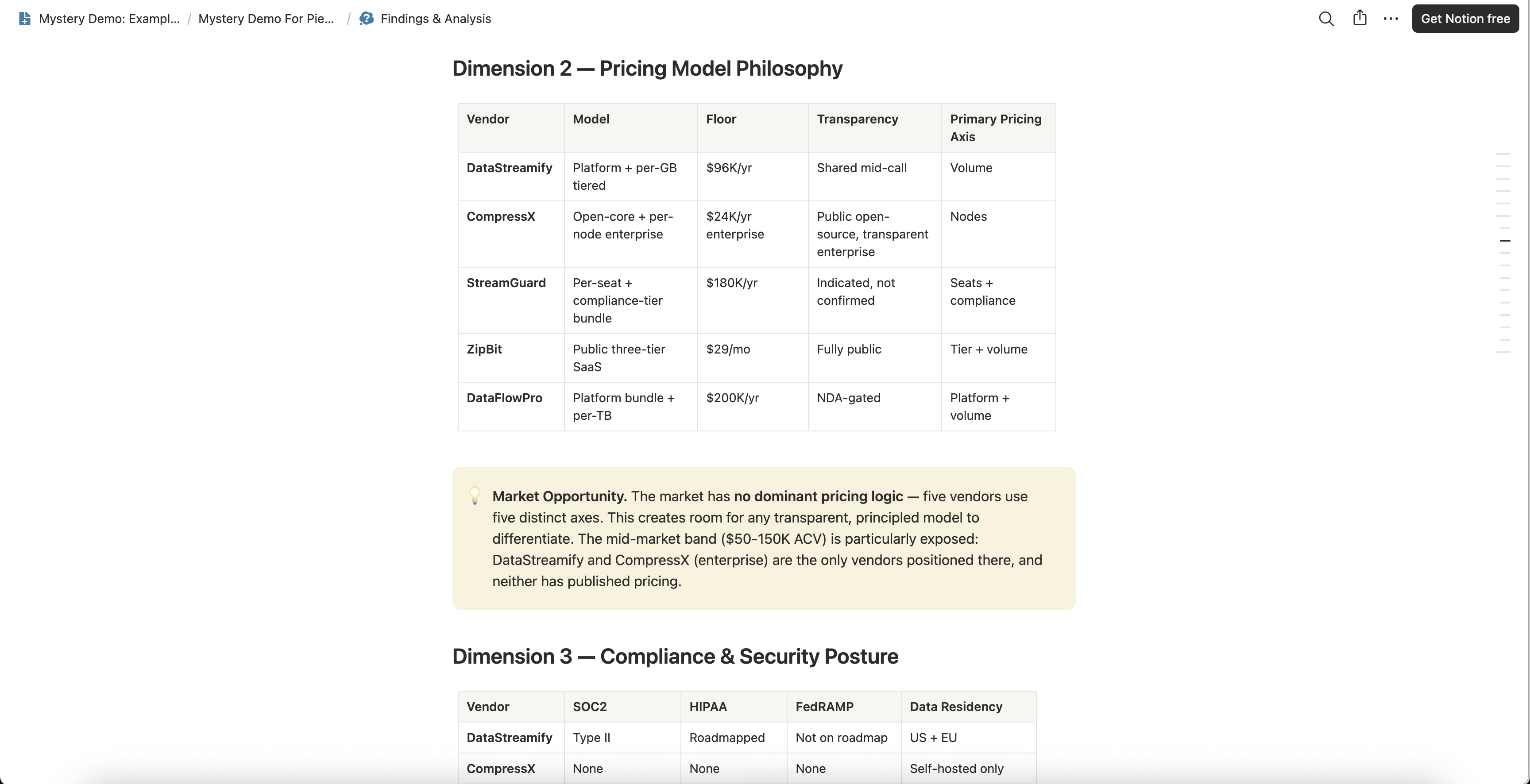
On the invented board above, each row is one rival, and its transparency column shows how openly that rival stated its price. From the matrix, sales enablement can build the sheet an approver reads. The invented one below sets each rival’s quote for one buyer like yours beside its published price, with when the quote expires and whether it can be compared yet.
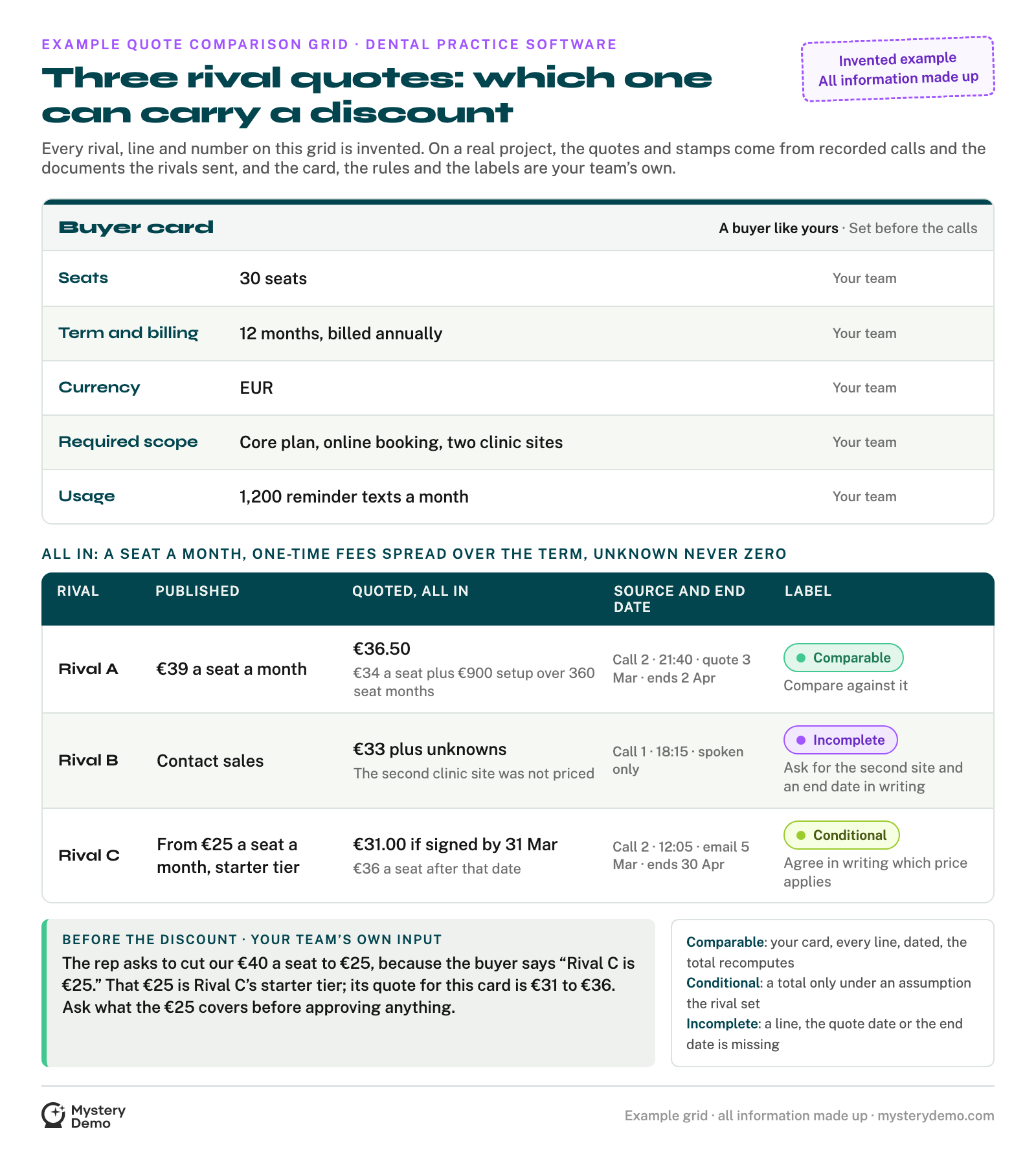
Read the labels before the prices. A quote with every line priced and dated goes into the comparison, and one with a gap or a condition waits until the gap is closed in writing. The note at the bottom shows the check at work: the buyer’s figure turns out to be the rival’s starter tier, well under what that rival quoted for the same buyer.
A researched quote is still one rep’s price for one buyer scenario on one date. It is never this buyer’s offer, and several things can move this buyer’s number away from it:
Use the researched quote to judge the buyer’s claim, never as this buyer’s price. It is comparable when the plan, the term and the seat range match, and otherwise it only marks the range. If the buyer’s figure sits far below a comparable quote, the first question is what it leaves out.
A rival’s rep prices the buyer in front of it, and your own team cannot be that buyer: the rep reads the email domain before the first call. Mystery Demo brings a believable buyer adapted to each rival. Its team has sold software, so it knows which follow-up gets a rep to say what a price includes.
Every number on the board comes with the recording and the timestamp it came from. One competitor costs a flat €499, everything included, and takes one to two weeks. Name the rival your buyers most often call cheaper, and we will get its quote as a buyer like yours before your next deal against it.
Approve the Discount Against What Is Documented
With a documented quote on file, the approval step can ask for it. Sales enablement keeps each rival’s quote with its scope and date, the rep brings what the buyer has shown, and the pricing owner or sales leader approves against both.
Approval is the right place for the check, because discounts are already decided there. In a 2025 survey by Price Intelligently by SBI, a pricing advisory firm, 48% of SaaS companies with a strict approval process kept discounts under 10% off list, against 22% of those with flexible guidelines. The survey counted 262 companies for that comparison, and it shows the two go together, not that the process caused the smaller discounts.
So before any competitive discount, the approver asks one question:
If nothing is documented, the check has not started. The discount then waits, or goes through as a named exception that does not claim to match the rival.
A competitive discount is a decision about evidence. Make it against a number someone has checked for scope, date and terms, or call it an exception and own it. A discount given against a number nobody checked answers a price the rival may never have offered.
Start with the rival your buyers name most when they ask for a discount, and put its quote for a buyer like yours on file. We can bring that quote back, with the recording behind every number, before the next “they’re cheaper” reaches your approval queue.


