
If you want to know how a competitor sells against you, a mystery demo will tell you more than an analyst report. The report ranks your rival in its market, largely from material the vendor prepared for the analysts. The deals you lose to that rival are fought on its sales calls, in what its rep tells your buyer, and no analyst is on those calls.
Mystery Demo puts a buyer on them. It books your competitor’s demo as a credible buyer, goes to every meeting, records each one, and hands you what the rep said, showed and quoted, all on one board.
Here is the quick comparison:
| Analyst report | Mystery Demo | |
|---|---|---|
| What it is built from | A questionnaire the vendor fills in, a demo the vendor prepares for the analyst, and reference customers the vendor picks | Your competitor’s real sales calls, sat by a buyer its rep has never met |
| Who the vendor thinks is watching | An analyst who will score it | A prospect with a real evaluation to run |
| What it tells you | How viable the vendor is, its market share, and where its strategy is heading | What the rival quotes, shows and promises, and what its rep says about you |
| What it can’t see | Any sales call with an ordinary buyer | Revenue, retention, and anything the rival never says on a call |
| How current it is | Refreshed about once a year at one large firm, and frozen at its research cutoff | Recorded in the past few weeks |
| What you hold at the end | A score for each vendor, relative to the others evaluated | Recordings, transcripts, emails and analysis on one board |
| What it costs | Priced by quote; one large firm sells a single published 29-page vendor assessment for $20,000 | A flat €499 per competitor you choose, everything included |
| How long it takes | Whenever the analyst publishes; one large firm’s evaluations run about 18 weeks from kickoff | One to two weeks for one competitor |
Why the Sales Call Is the More Useful Evidence
Analyst firms publish how they evaluate vendors, and their own methods explain the gaps in that table.
1. The analyst sees the version a vendor prepares. The vendor fills in a questionnaire, presents a strategy and product demo built around the analyst’s criteria, and supplies its own reference customers. Its briefings are presentations, and vendors are advised to arrive with a concise story, including where they fit against their top competitors.
That is a fair way to compare vendors side by side, and a poor way to learn how one of them sells. The vendor knows it is being scored, and at one large firm it even reviews its own write-up before publication.
A buyer the rep has never heard of gets the everyday call instead: the qualifying questions, the price that follows them, and the answer when your name comes up.
2. Analysts judge a market, and you are trying to win a deal. An analyst scores each vendor against the others in the evaluation, on things like viability, strategy and market share. One large firm says its criteria reflect what should matter most to enterprise buyers.
If your buyers are mid-sized companies, that scoring was not built for them. Your own question is narrower: what does this rival quote a buyer the size of yours, and what does its rep say about you?
An analyst’s questionnaire is not built to ask that. A sales call answers it every day.
3. A report is a snapshot, and your rival’s pitch keeps moving. One large firm’s flagship report is typically refreshed about once a year, and nothing after its research cutoff makes it in. A Mystery Demo board shows the pitch as it stands now, and one competitor takes one to two weeks.
Analysts do win on market-wide questions. If you need to know whether a rival is financially sound, how big it is, or where its category is heading, an analyst holds more of that evidence than any one buyer could.
Those answers matter, sometimes to your own buyers too. They rarely explain why one deal went to your rival. What its rep said to the buyer usually does, and Mystery Demo becomes that buyer, in six steps.
How Mystery Demo Works, Step by Step
1. You Name the Competitors, and We Agree the Questions
Every project starts at kickoff. You choose the competitors that matter, typically three to nine, and we agree what you need to learn from each one. You also walk us through your own product, so every question we ask sounds like a buyer who has done the homework.
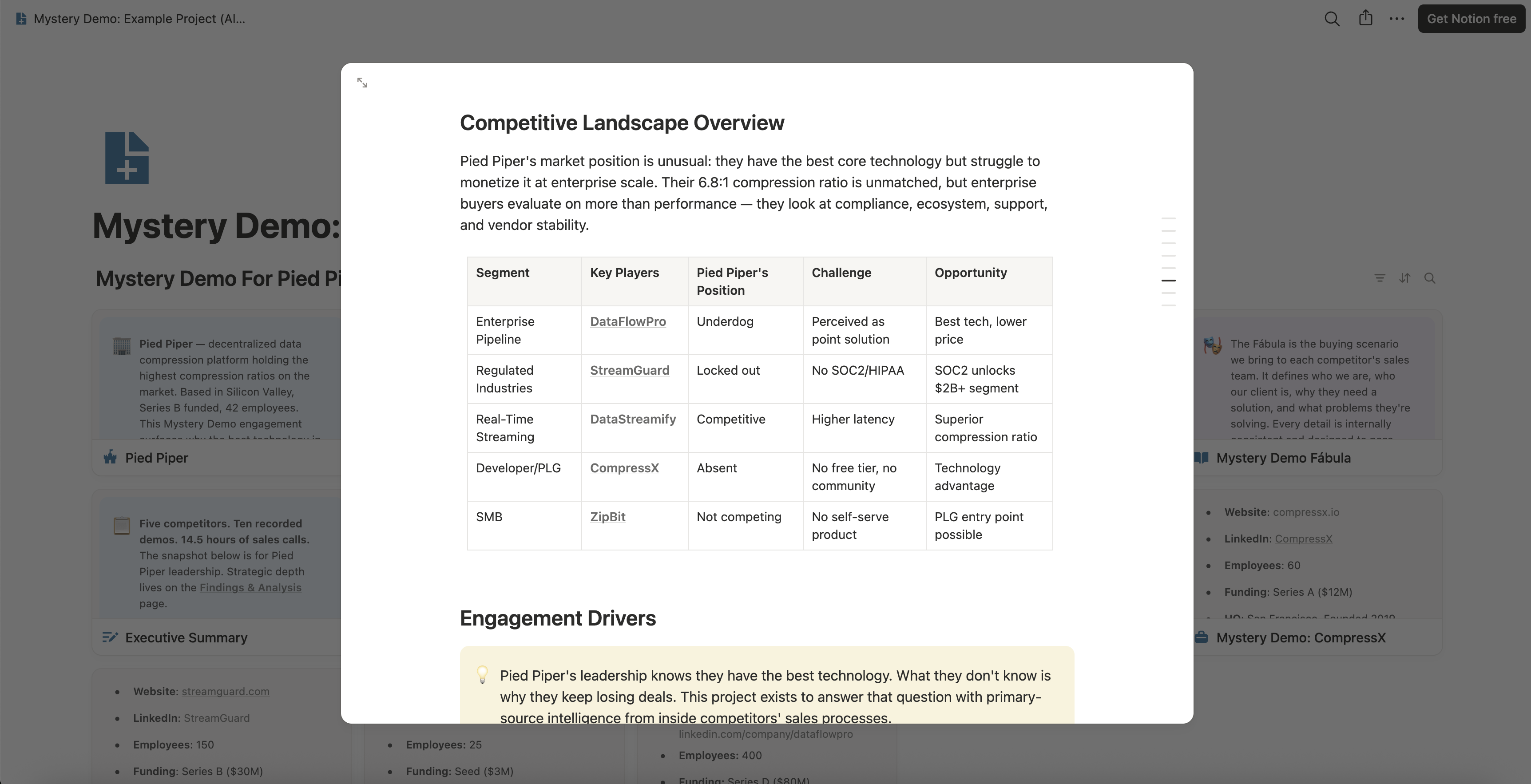
Every board starts from your own market. Below is the client page of our public example board, where the company and every competitor are invented. A real board is built from the calls we sit with that client’s own competitors.
The landscape table shows, for each market segment, which rival leads it and where the client stands. It is how a project decides whose sales calls matter most.
2. A Buyer Is Built for Each Competitor
The buying scenario is called the fábula. It describes a believable company, with its industry, headquarters, team size, funding stage, current tools, and how soon it has to decide. Each element is fitted to the kind of customer that competitor sells to, so its rep runs the call they run every week.
The buyer’s company is the only invented part. The questions, the requirements and the evaluation are real, and they come from your market. No real person is impersonated, and the competitor never learns who asked us to look.
3. The Demo Is Booked Through the Front Door
We approach each competitor the way any buyer does, through its own demo request, with an opening that fits what it leads with. To the rep, it is one more qualified prospect in the pipeline.
4. Every Call Is Sat and Recorded
Operators who have sold B2B software themselves sit every meeting: discovery, the demo, the technical deep dive, the pricing conversation and the follow-up. Every call is recorded, and every email and piece of collateral is kept.
Those operators know which questions pull a rep off the script. A buyer who asks for the price at a real seat count, or names a rival and waits, hears answers no analyst briefing contains.
.png)

5. Every Claim Is Checked, Then Written Up
After the calls, the transcripts are cleaned and every claim a rep made is checked against the competitor’s own website, LinkedIn and public news. Only then is the analysis written.
One call shows what one rep told one buyer on one day. When a different rep says the same thing on a later call, it is worth treating as the company’s line.
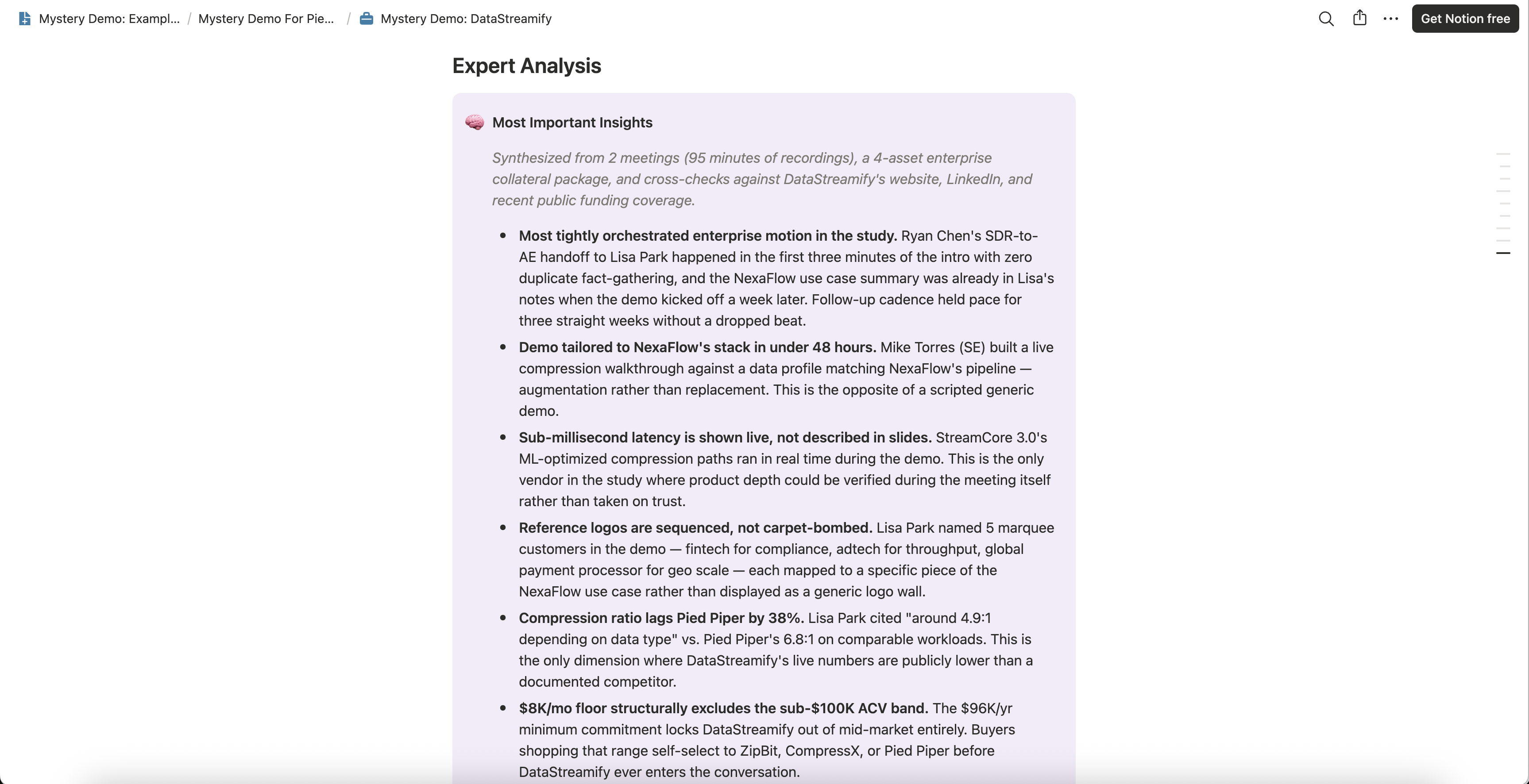
Each competitor gets its own page. Its expert analysis opens by saying how many meetings and minutes of recording it was built from, and what it was checked against.
6. The Board Comes Back to You
Everything lands on one shared Notion board. It holds your profile and objectives, the competitors and why each was chosen, the buyer scenario, a page per competitor, every recording in one database, the findings, and an executive summary.
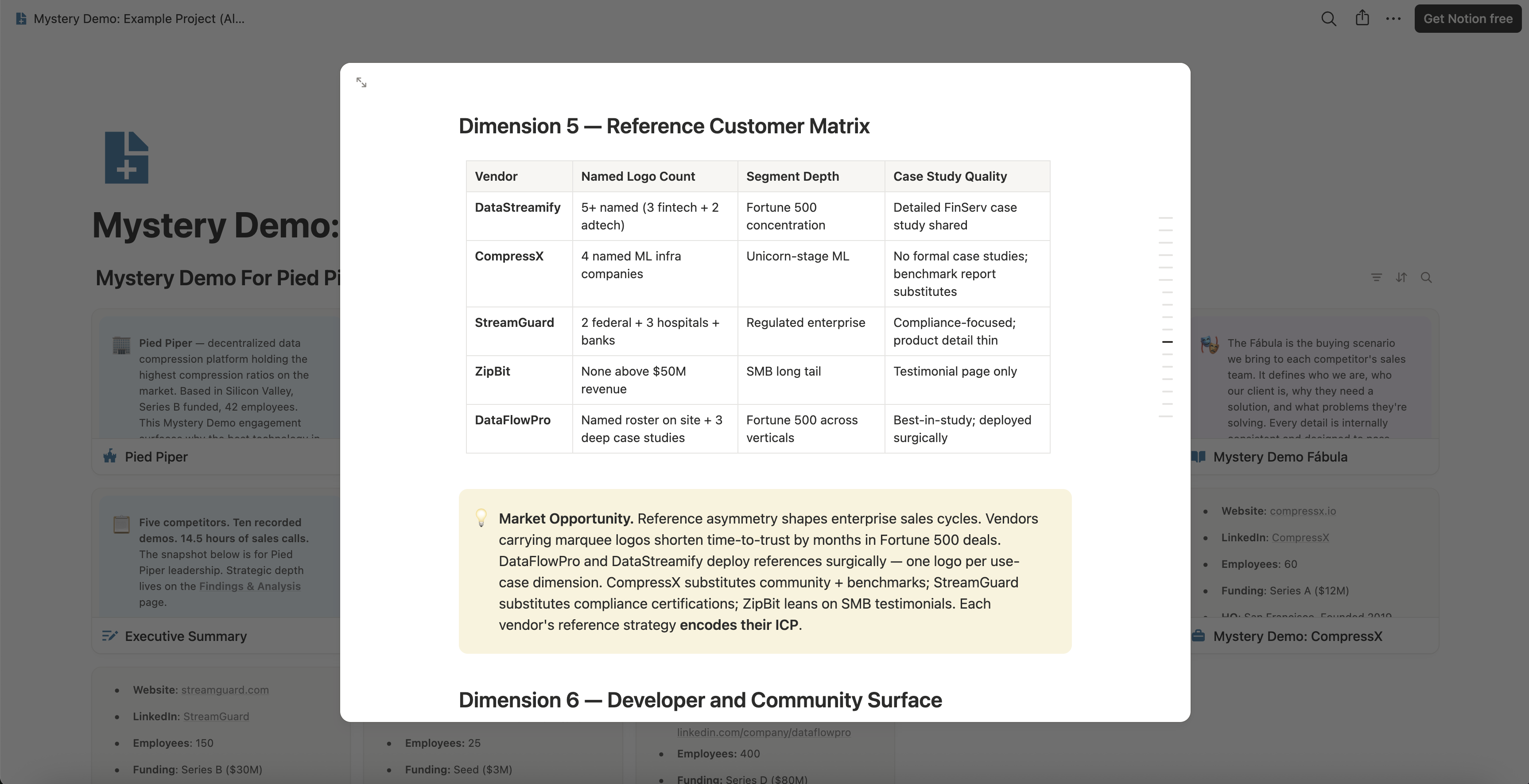
The findings compare the rivals one dimension at a time, and reference customers show why that matters.
An analyst calls the customers a vendor puts forward and asks how the product works for them. The board records which customers each rival puts in front of a buyer like yours, because those are the names your own buyer will hear.
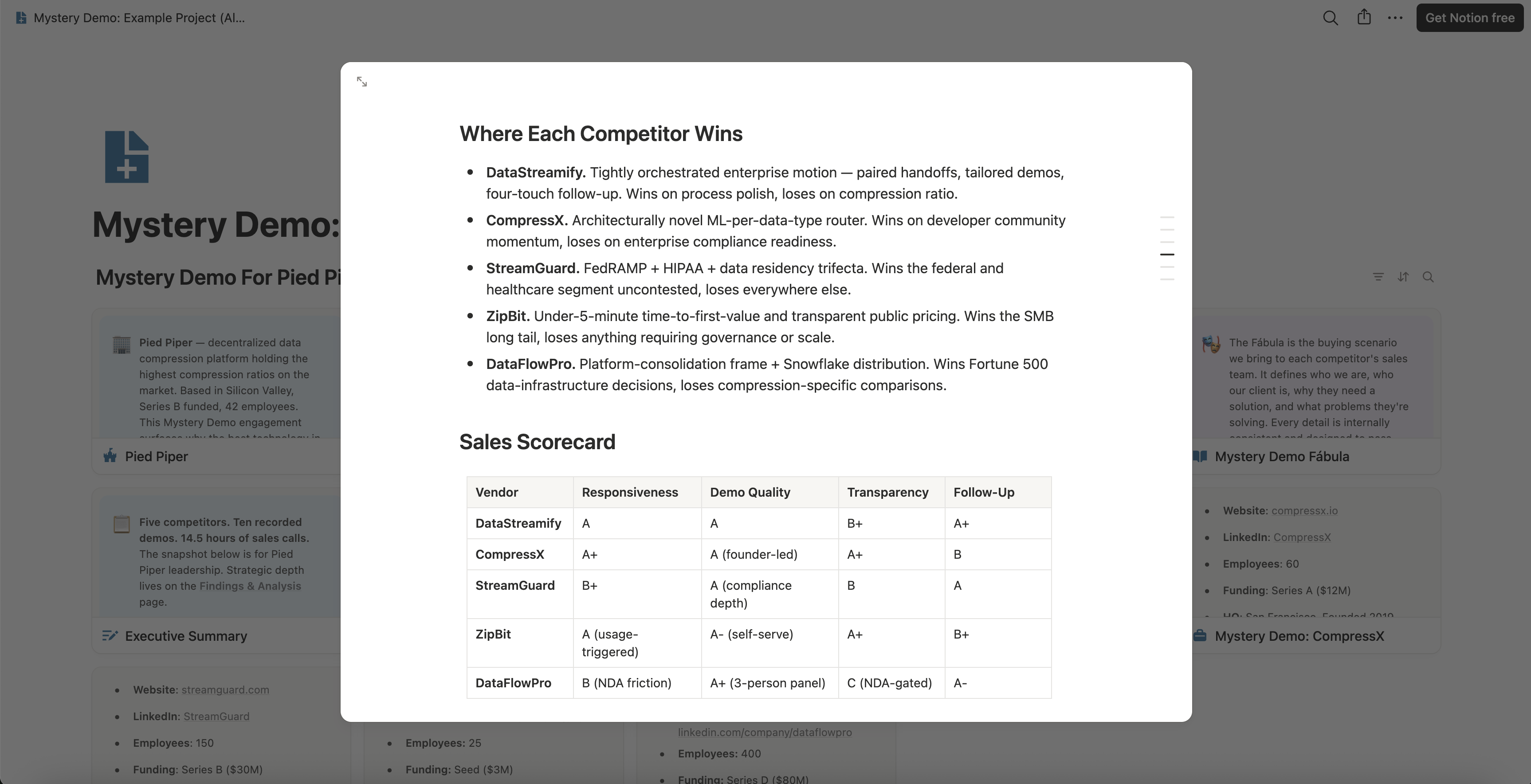
The executive summary is the page a leadership team reads first. On a market project, it says where each competitor wins and where it loses, with a sales scorecard underneath, and every line traces back to a recorded call.
One competitor costs a flat €499 with everything included, and takes one to two weeks. For a whole market of six to fifteen rivals, the calls run in parallel, so our SaaS market entry research takes four to eight weeks. If one rival keeps turning up in your lost deals, tell us which one, and we will sit its sales call for you.
The Analyst View You Can Collect Yourself
Analysts win on market-wide questions, and most of the answers about a single rival are public. Even if you keep an analyst subscription, here is what you can collect yourself to sit beside the Mystery Demo data, and where each source stops.
Put together, that is the rival’s public record. It tells you what the rival is and where it is heading. It also keeps changing, which is why the collecting is better left to tools.
What Firecrawl and Other Tools Do for You
Firecrawl, a web data tool built for AI, does most of that collecting for you, and you can try it without an account. Here is what it does with a rival’s website.
The Wayback Machine fills in the history. It keeps saved copies of web pages going back years, so you can see what a rival’s homepage or pricing page said last spring. Any AI assistant can then read everything you collect and tell you what changed this month.
Every one of these tools reads what a rival publishes. None of them can sit its sales call.
Your own team can try, but a rep who spots your company’s email domain gives you the generic tour, or no tour at all. Mystery Demo takes that seat for you.
Put Your First Research Money Where Deals Are Decided
An analyst report will tell you whether your rival is big and solid. Your desk tools will tell you what it publishes and when that changes. Neither will tell you what its rep says to your buyers, and that is where your deals against it are fought.
Name the rival you lose to most often, and we will sit its next sales call as the buyer. You get back the recording, the analysis, and what its rep said about you.
.png)


