
Ask an enterprise SaaS company what it charges and you will get a meeting, not a number.
Enterprise pricing is the most hidden price in software. The public Enterprise tier is a placeholder where a figure should be, and the real number only appears once a buyer is far enough into the funnel to be quoted.
That funnel is where we work: we take the enterprise sales call as a real buyer and bring back the custom quote, the seat math, and the gap between the tier on the site and the SKU on the order form.
We collected the most relevant, independently verified SaaS enterprise pricing statistics we could source on how often the Enterprise tier hides its price, what enterprise deals cost, how long the contracts run, and why those prices hold. Every figure below is footnoted to its original source.
If you only keep a handful of these enterprise SaaS pricing benchmarks, keep these:
Transparency Falls as Deal Size Rises
Transparency in SaaS slides with deal size, and the slide is steep. The bigger the contract, the less likely a number appears at all.
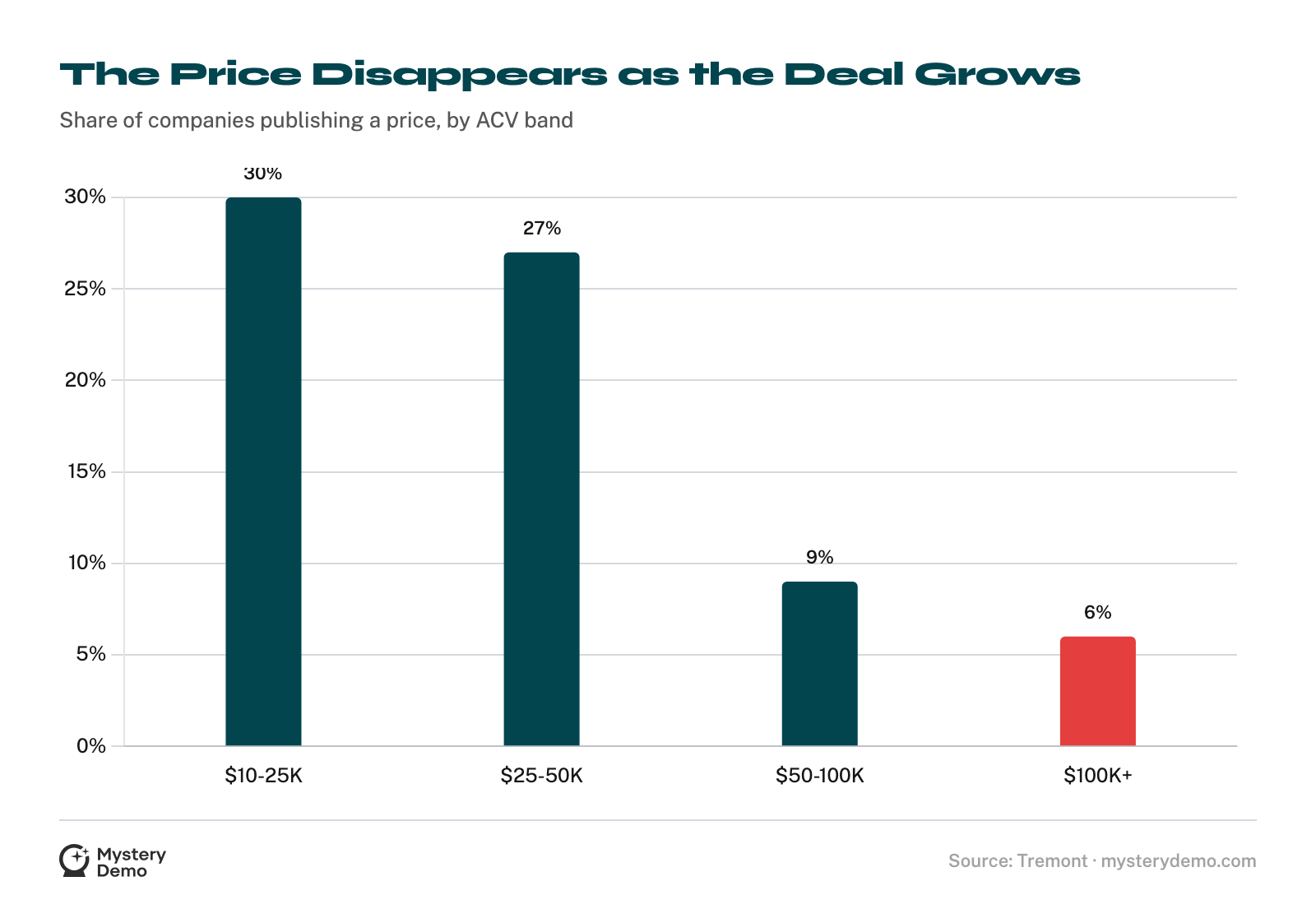
The same instinct toward hiding price runs across the whole market and intensifies with deal size: a majority of deals already show no number by the $25,000 mark.
For anyone benchmarking an enterprise competitor off their website, the data says the website will not have the answer.
The Contact-Us Button Is Doing Real Work
Structure, not coyness, keeps the enterprise price hidden. Once only 6% of companies above $100,000 ACV will show a number, the “contact us” button keeps the price fluid enough to be set per buyer, per seat count, per quarter.

This is the gap that defines enterprise pricing intelligence, and it is the one number no public dataset can give you: the spread between the tier a competitor advertises and the custom SKU they really quote.
A generalizable enterprise per-seat benchmark does not exist, because enterprise per-seat pricing is bespoke by design. It has to be observed rather than looked up.
.png)

What the Enterprise Tier Costs
When the numbers do surface, in private datasets rather than on websites, the enterprise-to-SMB spread is wide and the climb up-market is steep.
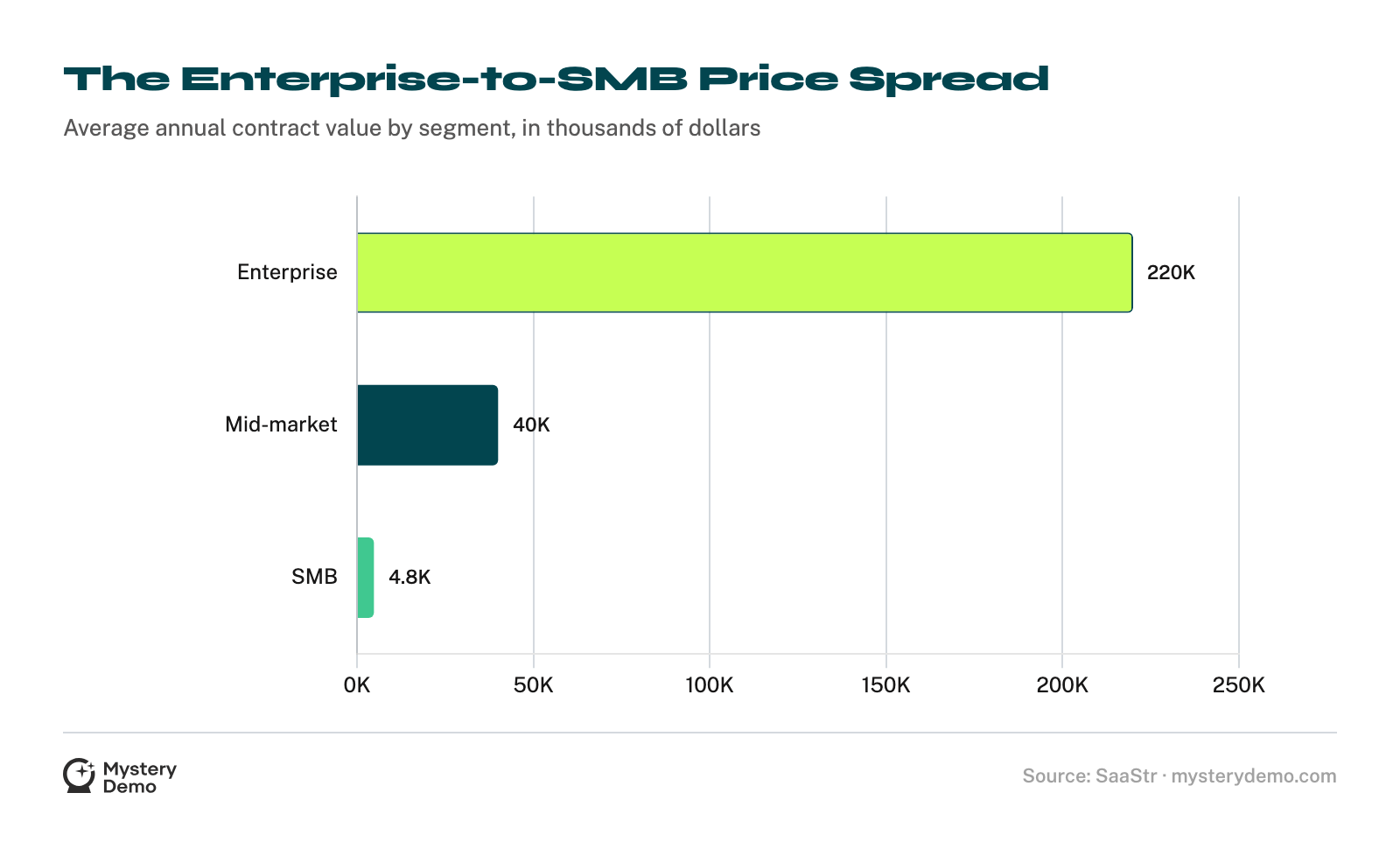
The spread alone is reason enough to price the enterprise deal privately. The more telling reading is the direction of travel: deal size climbs roughly 2.5 times as a company matures, which makes the enterprise price a destination a vendor climbs toward, not a fixed tier.
A vendor moving up-market is repricing its whole book upward, and the Enterprise SKU is where that ambition lands.
Enterprise Contracts Run Long
The enterprise price is attached to a term, and the term has been stretching. Vendors are pulling buyers off short commitments and into one-to-two-year locks.
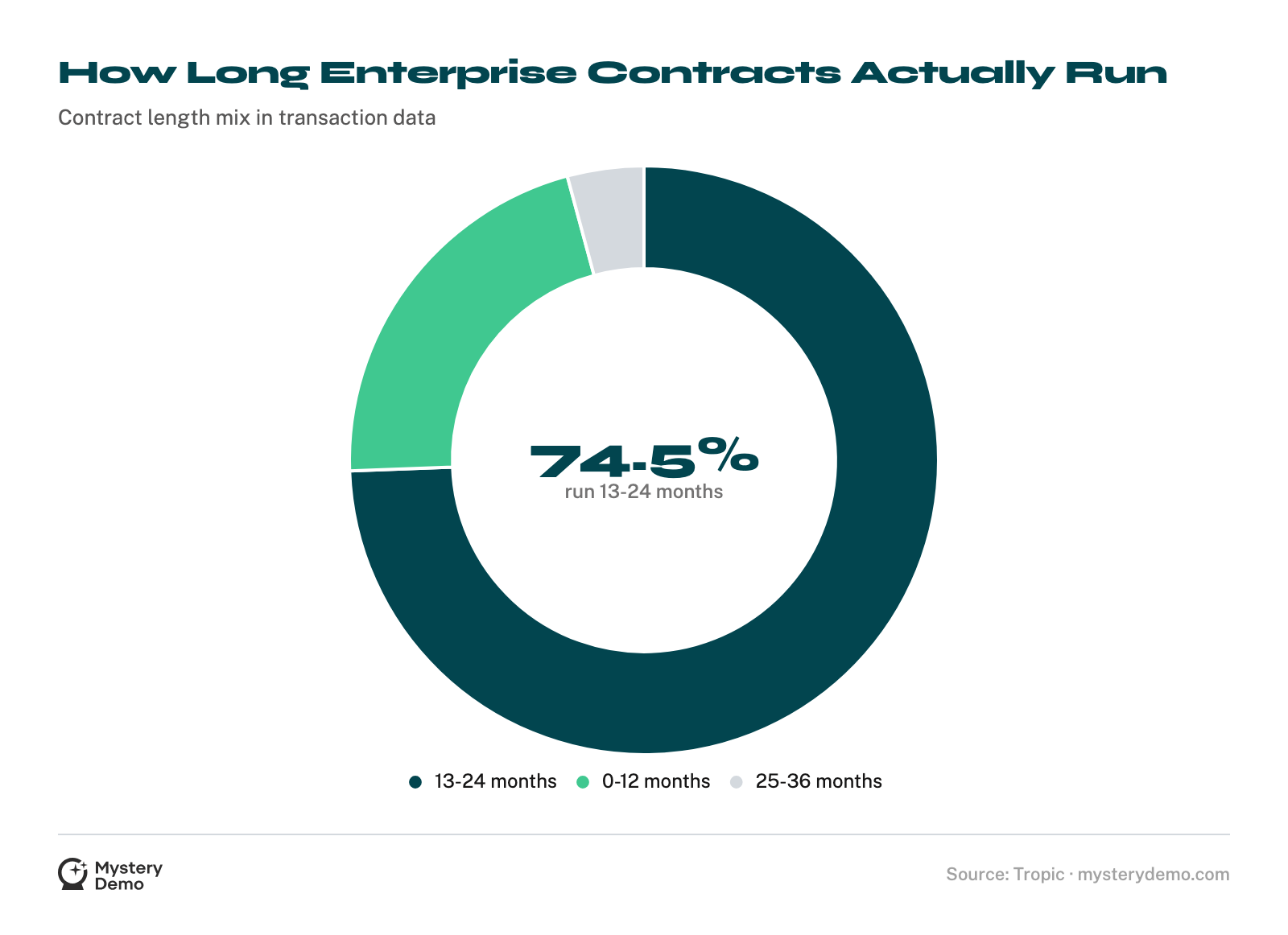
The term data clears up a common assumption: the three-year enterprise lock-in is rare in practice. True multi-year deals sit at just 4.2%, and the market has converged on shorter commitments instead.
The enterprise standard is settling at a year and a half to two years, long enough to lock the account through a full renewal cycle.
AI-native vendors push the longest terms, locking in revenue before buyers can benchmark a category that reprices every quarter.
Why the Enterprise Price Holds
The last question is why enterprise vendors can keep the price private and still keep the customer. The retention data answers it.
The same scoping, implementation, and dedicated team that justify hiding the price are what make the contract sticky once signed.
A high-ACV enterprise deal is expensive to win and even harder to unwind, which gives the vendor room to keep the number private and set the terms at renewal.
Once an enterprise has wired the product into billing, security review, and daily workflows, switching costs more than the renewal does.
What none of these benchmarks can give you is the one number that matters most: what a specific competitor quotes behind their own “contact sales” button, and how that quote bends with seat count, segment, and timing. That only exists on a real enterprise call.
That is the number we go get. For the structured version, our SaaS competitor pricing research turns a competitor’s custom quotes into a benchmark you can plan against.
Behind every Contact Sales button is a real number, quoted to a real buyer, with a real discount attached by the end of the call. Ask us to go get it: the quote, the tiering logic, and what moves when procurement pushes back.
Frequently Asked Questions
How often do enterprise SaaS companies hide their pricing?
Almost always. Above $100,000 in ACV, only 6% of companies publish a price and 68% show none at all1.
Does pricing transparency depend on deal size?
Strongly. The share publishing a price falls from 30% at $10,000 to $25,000 ACV to just 6% above $100,000, a steady gradient1.
What share of SaaS vendors publish pricing for large deals?
A small minority. 17% publish pricing for deals over $25,000, compared with 84% for deals under $1,0002.
Why do enterprise SaaS companies use a contact-us tier?
To keep the price fluid. With only 6% of high-ACV companies showing a number, the contact-us tier lets vendors price per buyer, per seat count, and per quarter1.
What is the average enterprise SaaS ACV?
It varies by segment. SaaStr’s analysis puts enterprise around $220,000 ACV against $40,000 for mid-market and $4,800 for SMB3.
What is the median ACV for a private SaaS company?
$26,265, rising to $56,101 for companies at the $10M to $20M ARR stage4.
Does funding affect enterprise SaaS pricing?
Yes. Equity-backed companies run a median ACV of $35,761 versus $23,391 for bootstrapped ones4.
How much does deal size grow as a SaaS company matures?
Roughly 2.5 times. Average deal size climbs about 50% from seed to expansion, another 40% into growth, and another 18% past $100M ARR2.
Is there a benchmark for enterprise per-seat pricing?
No reliable one. Enterprise per-seat pricing is custom by design, set per account on the call, which is why it has to be observed in a live quote rather than looked up1.
How long are enterprise SaaS contracts?
About one and a half to two years. The average term is 18.7 months for SaaS tools and 22.4 months for AI-native ones6, with the average contract near two years5.
Are most enterprise SaaS contracts multi-year?
Mostly one to two years. 74.5% run 13 to 24 months, while only 4.2% extend to 25 to 36 months, so genuine three-year deals are rare6.
How much SaaS revenue comes through the channel at scale?
A meaningful share. Around 20% of revenue comes through partners, rising to about 30% past $250M ARR5.
Is enterprise SaaS pricing usage-based or subscription?
Increasingly both. Among hybrid-pricing companies, revenue splits roughly 50/50 between usage and subscription as those models take hold5.
Do higher-priced SaaS contracts retain better?
Yes. At $25,000 to $50,000 ACV, median net revenue retention is 102%, and the highest-ACV companies post the best gross retention of all7.
Why do high-ACV enterprise contracts retain so well?
Because the deals are sticky. Deep scoping, implementation, and dedicated account management make a high-ACV contract expensive to leave, which is why the highest-ACV companies post the best gross retention7.
How do you find a competitor’s real enterprise price?
By being quoted it. The custom SKU and per-seat rate behind a contact-us tier only surface on a live enterprise call, which is what we capture for you, quote by quote.
References
- Tremont with Growth Unhinged: The 2025 State of B2B Monetization (2025)
- OpenView: Pricing Insights From 2,200 SaaS Companies (2021)
- SaaStr: What Is the Average Deal Size for SaaS Companies (2023)
- SaaS Capital: What Is the Average Deal Size for Private SaaS Companies (2025)
- ICONIQ Growth: The State of GTM in 2025 (2025)
- Tropic: 2026 Software and AI Pricing Trends (2025)
- SaaS Capital: What Is a Good Retention Rate for a Private SaaS Company in 2025 (2025)
.png)


