
Almost every B2B SaaS deal is now a knife fight between two or three finalists, and it usually closes for whoever put the most people in the room, held price the longest, and kept the deal from stalling, whatever the scorecard said about the product.
The product is the ticket in. The sales motion decides who walks out with the signature.
On your behalf, we go through competitors’ funnels as a real buyer and sit through their head-to-head pitches, watching the exact moments where a competitive deal tips: who they multi-thread to, when they reach for a discount, and how they handle the objection that decides it.
We collected the most useful, independently verified SaaS competitive deal statistics we could source on how often deals go competitive, what really moves the win rate, and where deals quietly die. Each figure below links to the study it came from.
If you only keep a handful of these, keep these:
Every Deal Is Now a Two- or Three-Way Race
The first thing to accept is that you are almost never selling alone. The buyer lined up rivals before you knew the deal existed, and the finalist list is short and brutal.
Put those two numbers together and the shape of the modern deal is clear: buyers cast a slightly wider net early, then cut hard to a final two or three. By the time you are on a real call, you are in a head-to-head, and the buyer has a ranked opinion you cannot see.
The competitive set is set before the selling starts. What you rarely know is how that competition really sells.
Competitive Deals Are Won by Multi-Threading
The single most consistent predictor of a competitive win is how many people on the buyer’s side the seller is talking to, well beyond the demo or the deck.
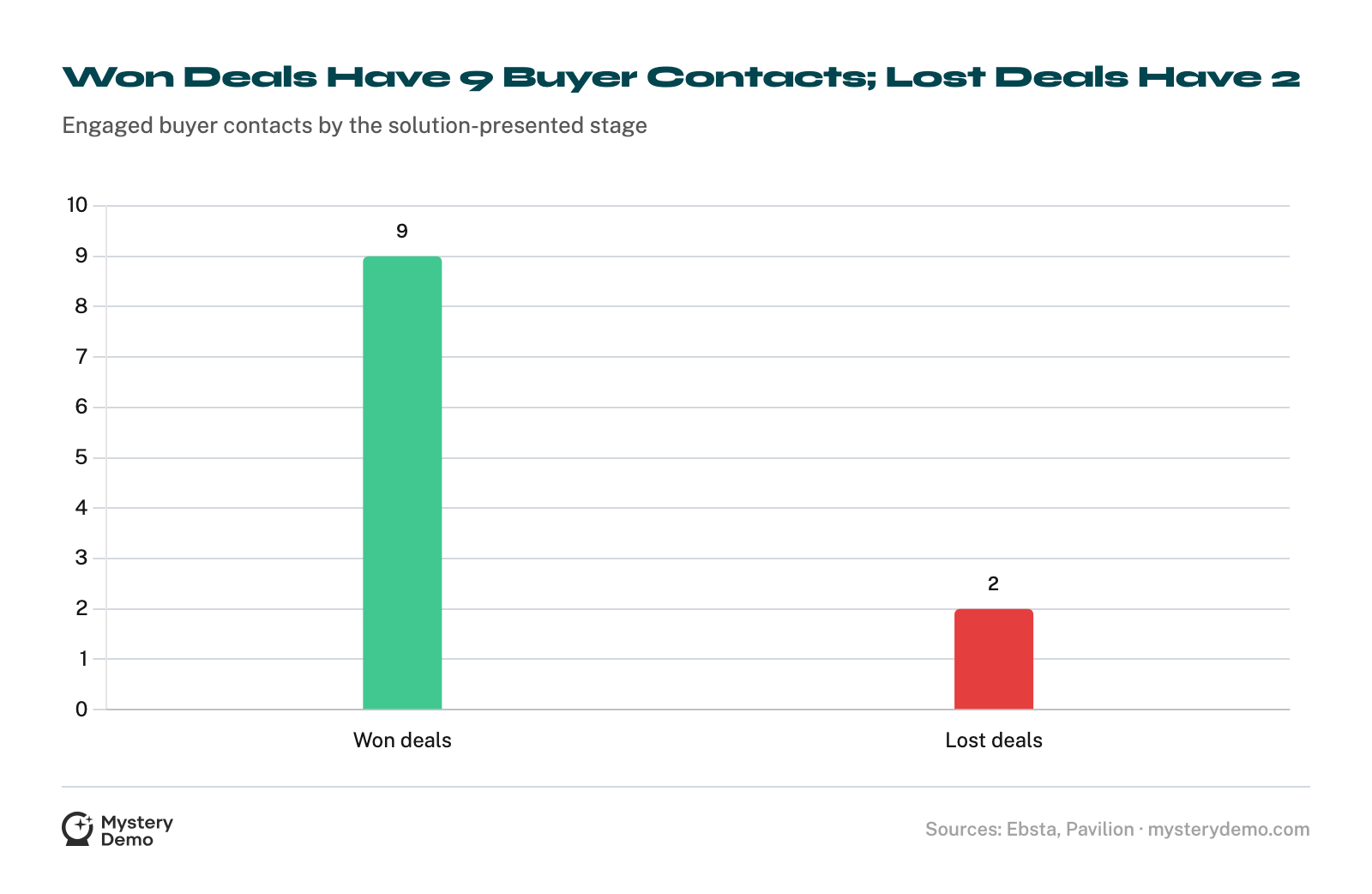
Two datasets from different vendors land on the same conclusion: the Ebsta and Pavilion 9-to-2 split and Gong’s multi-threading lift are measuring the same behavior from two angles.
The losing rep is the one talking to a single champion who cannot carry the deal through their own committee.
So when you study a competitor, the revealing number is how many threads they pull, and which roles they pull them to.
.png)

The Deadliest Opponent Is Buyer Indecision
In a head-to-head, the buyer’s own paralysis usually does more damage to your odds than the other vendor does.
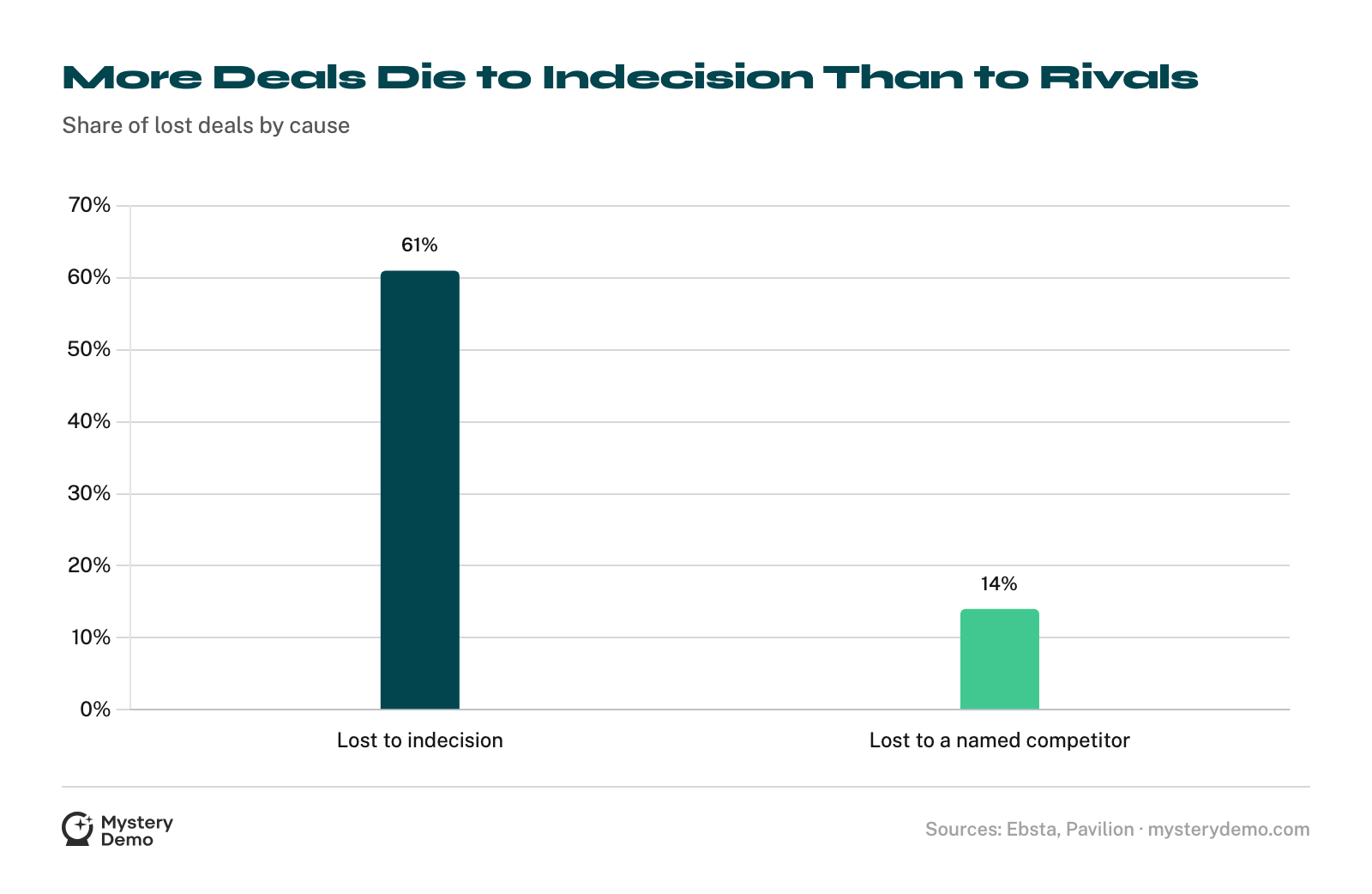
The 14% is the one to anchor on: among average performers, a real competitor is the named culprit in only about one in seven losses, while indecision is the bigger killer, cited in 61% of lost deals.
That reframes the competitive deal: you are mainly fighting the buyer’s urge to do nothing, more than the other logo on the shortlist.
There is a second dynamic, though. Once a buyer is genuinely deciding between vendors and ready to move, price becomes the lever, jumping to over half of switch reasons.
So the competitor beats you in two distinct ways, and they require two distinct defenses: keeping the deal alive at all, and then holding it on value once it is live.
The Discount Is a Tell
Watch when a competitor reaches for a discount and you learn exactly how confident they are in the deal.
Only 24% of deals carry a discount at all, and when one is discussed or applied before the negotiation stage, win rates drop by 39%3.
The discount reveals the win rate rather than lowering it. A rep who drops price before negotiation is a rep who already senses they are losing, and the data simply records the outcome they were trying to rescue.
For a competitor watcher, an early discount in the funnel means that vendor is on the back foot in this deal and buying time with margin.

Competitive Deals Don’t Die, They Stall
Losses in competitive deals mostly show up as a slip: a reschedule, a quarter that turns into next quarter, until the deal quietly stops being a deal.
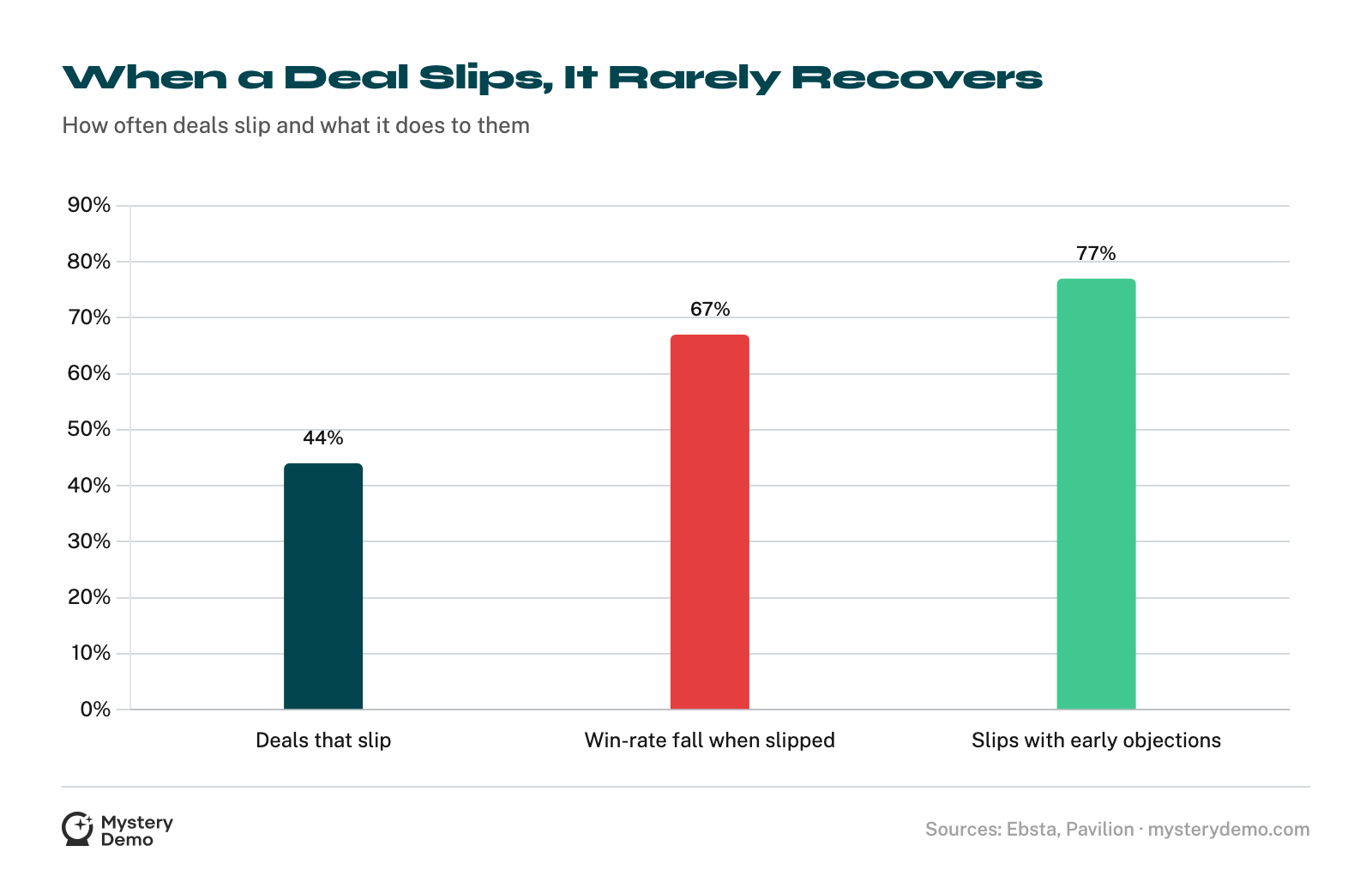
The throughline is that the loss is usually visible long before it happens. A deal that drags in qualification, or carries an objection nobody handled, is already slipping; the no just arrives later.
That is the real value of watching a competitor’s full sales process rather than a single demo: you see which deals they are quietly losing on the clock, and where the objection they never answered is sitting.
Finding that unhandled objection first is often what pulls a stalling deal away from a competitor already losing ground on it.
Your competitor’s pipeline reviews are closed to you. Their competitive sales process is not, and you can walk it exactly the way a real buyer does, watching every one of these moments happen.
On your behalf, we run that same head-to-head as a real buyer, funnel by funnel, and hand you the battlecard: who they put in the room, when they discount, which objection stalls them, and where the deal leaks.
For the deeper teardown, our competitor battlecard research turns one head-to-head into a working playbook.
Name the competitor you keep meeting in the final two. We will take their deal all the way to the end and bring back the pitch they save for the shortlist, plus the moment they start closing.
Frequently Asked Questions
How many vendors does a B2B SaaS buyer evaluate?
On average 5.1 vendors, up from 4.5 the year before4, though a typical shortlist narrows to just 2 to 3 finalists5.
How many products make a typical SaaS shortlist?
Just 2 to 3. 49% of buyers shortlist only 1 to 3 products (up from 33%), while those carrying 4 to 7 fell to 31%5.
Does multi-threading improve win rates?
Substantially. Multi-threading lifts win rates by 130% on deals over $50K, and 77% of deals are multi-threaded1.
How many buyer contacts do won deals have versus lost?
Won deals reach the solution-presented stage with 9 engaged contacts; lost deals carry only 23, and closed-won deals usually involve at least three active buyer-side stakeholders versus one for losses2.
Does involving a sales engineer help win competitive deals?
Yes. Bringing a sales engineer into the demo lifts win rates by as much as 30%, and closed-won selling teams run 67% larger than lost ones1.
Why are most competitive SaaS deals lost?
To indecision, not to a rival. 61% of lost deals are lost to indecision; a named competitor accounts for just 14% of losses among average performers, behind lack of budget (22%) and not a priority (20%)3.
What makes a buyer switch away from their preferred vendor?
Technical fit (29%) and price (28%) are the top triggers, but among buyers very likely to switch, price dominates at 53.5% versus 22.9% for fit4.
How often do SaaS deals involve a discount?
24% of deals carry a discount3. The timing matters more than the existence of one.
Does discounting early hurt win rates?
Sharply. When a discount is discussed or applied before the negotiation stage, win rates drop by 39%, because reaching for price early signals a losing position3.
How often do SaaS deals slip?
44% of deals slip, and when one does, its win rate falls by 67%3.
Can you predict a deal slip early?
Often. If the qualification stage runs 50% longer than average, the deal is 120% more likely to slip, and 77% of slipped opportunities had objections raised early in the process3.
What share of deals do you lose to a competitor?
About one in seven. A named competitor accounts for 14% of losses among average performers; the rest go to no-decision, budget, and priorities3.
Is the product or the sales motion more decisive in a competitive deal?
The motion. With shortlists down to 2 to 3 comparable products, win rates track multi-threading, discount discipline, and deal momentum far more than feature lists13.
What is an early warning that you are losing a competitive deal?
A single-threaded deal, an early discount, or a long qualification stage. Each correlates with a sharp win-rate drop and tends to show up before the loss does13.
How do you research how a competitor wins deals?
Walk their full competitive sales process as a real buyer: see who they multi-thread to, when they discount, and which objection stalls them. That primary-source teardown is exactly what we deliver, one competitor evaluation at a time.
.png)


